China Drives Rural Tourism Revitalisation: How Shibadong and Simola Wa Village Transform Local Economies Through Cultural Heritage and Cooperatives

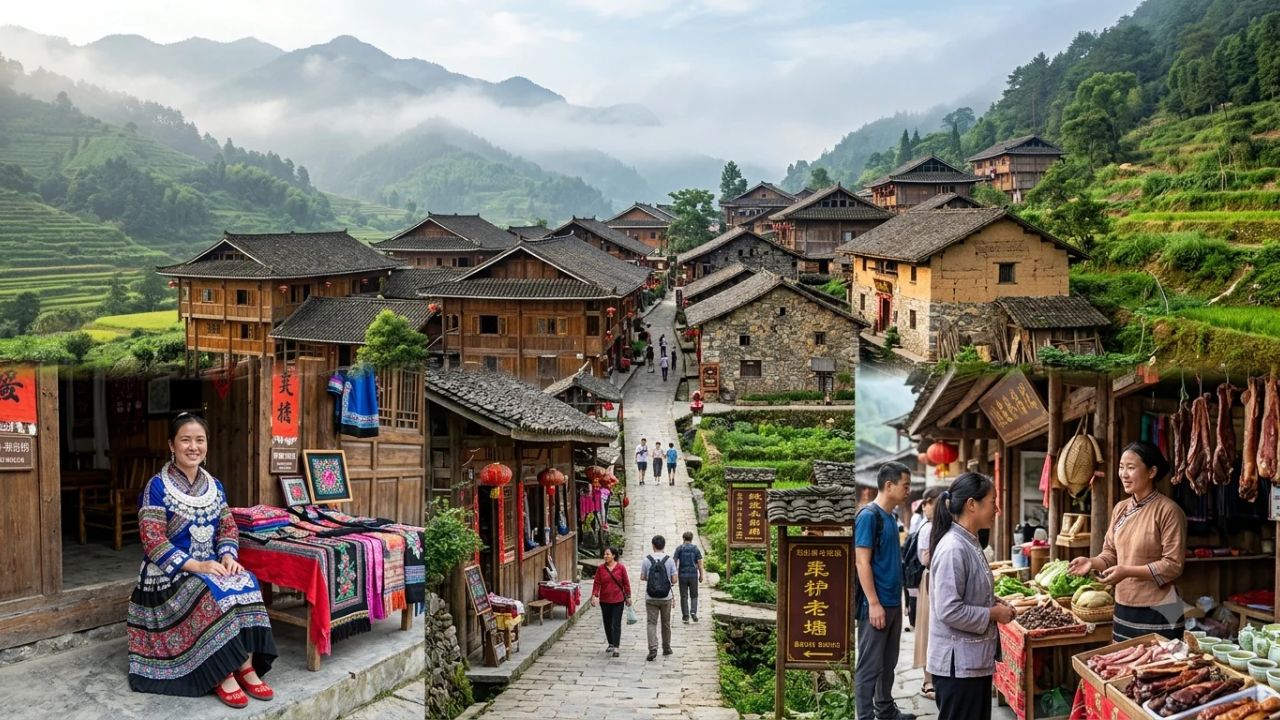
China is accelerating its national rural revitalisation agenda through community-anchored cultural tourism, deploying targeted public infrastructure, intangible heritage preservation, and collective cooperative equity models across remote mountain settlements to generate sustainable employment and reverse historic urban-rural income disparities.
The strategic evolution from emergency poverty eradication toward long-term rural revitalization is vividly demonstrated in the contrasting experiences of Shibadong Village in Hunan Province and Simola Wa Village in Yunnan Province. Once characterized by severe geographic isolation and subsistence agricultural yields, these ethnic minority communities have transformed their distinct cultural heritage—encompassing ancient Miao embroidery and indigenous Wa wooden drum traditions—into commercial tourism assets. By ensuring that local households retain equity ownership in tourism enterprises rather than ceding control to outside corporate conglomerates, both villages have achieved extraordinary increases in median household income while preserving fragile architectural and environmental environments.
This community-centric development paradigm provides important operational insights for developing economies worldwide. As international travelers increasingly seek authentic cultural engagement and eco-conscious rural escapes, China’s integration of high-speed transport access, cooperative dividend distribution, and traditional artisan workshops establishes a structured blueprint for balancing economic modernization with cultural conservation.
National Policy Framework: From Targeted Poverty Alleviation to Rural Revitalisation
To comprehend the transformation of China’s rural interior, it is necessary to examine the evolution of its national agrarian development policy over the past decade. In late 2013, the concept of "targeted poverty alleviation" (Jingzhun Fupin) was formally articulated as a methodology to identify specific impoverished households, diagnose the underlying causes of their poverty, and implement tailored, localized solutions rather than relying on indiscriminate state subsidies.
Following the nationwide elimination of extreme absolute poverty in late 2020, Chinese economic planners shifted focus toward "rural revitalisation" (Xiangcun Zhenxing). This broader mandate seeks to prevent rural re-impoverishment, elevate rural living standards to parity with urban centres, and stem the draining of young working-age labor to coastal mega-cities.
========================================================================================
CHINA RURAL DEVELOPMENT POLICY: CHRONOLOGY & METHODOLOGICAL SHIFTS
========================================================================================
Policy Phase         Active Period     Core Objective                  Key Implementation Tools
----------------------------------------------------------------------------------------
Targeted Poverty     2013–2020         Eliminating absolute poverty    - Precise household registry
Alleviation                            in remote rural regions         - Dedicated village taskforces
                                                                       - Basic infrastructure building
----------------------------------------------------------------------------------------
Comprehensive Rural  2021–Present      Long-term economic resilience,  - Cultural heritage tourism
Revitalisation                         industrial modernization, &     - Cooperative shareholder models
                                       preventing population drain     - Eco-agriculture & digital commerce
========================================================================================
Strategic Outcome: Transitioning remote agrarian hamlets from dependent welfare recipients into
self-sustaining cultural enterprises that generate sustainable local revenue and employment.
========================================================================================
Within this framework, cultural and rural tourism emerged as a premier catalyst. Unlike heavy industrial manufacturing or extractive mining, tourism leverages existing territorial assets—such as clean mountain air, terraced landscapes, folk architecture, and traditional crafts—without degrading the local ecosystem. By pairing state-funded infrastructure investments (paved highways, fiber-optic 5G telecommunications, sanitary plumbing, and electrical grid upgrades) with community-managed hospitality services, rural settlements have unlocked substantial consumer spending from China’s expanding urban middle class.
Shibadong Village: The Epicenter of Targeted Economic Transformation
Located within the rugged folds of the Wuling Mountains in Xiangxi Tujia and Miao Autonomous Prefecture, Hunan Province, Shibadong Village occupies a storied position in modern Chinese economic history. It was here, in November 2013, that the national targeted poverty alleviation policy was first introduced.
At that time, Shibadong was an impoverished, inaccessible mountain settlement composed of traditional wooden houses clinging to limestone cliffs. The village lacked paved roadways, telecommunications, and reliable drinking water systems. In 2013, the average annual net income per resident stood at a modest 1,668 yuan (approximately $230 USD), leaving the majority of households subsisting well below the national poverty line.
========================================================================================
SHIBADONG VILLAGE (HUNAN) ECONOMIC METRICS: 2013 BENCHMARK VS 2025 OUTCOME
========================================================================================
Socio-Economic Indicator             2013 Baseline Metric              2025 Achieved Outcome
----------------------------------------------------------------------------------------
Average Annual Income Per Resident   1,668 Yuan (~$230 USD)            30,755 Yuan (~$4,250 USD)
Net Income Expansion Ratio           Baseline Index (1.0x)             18.4x Increase Over 2013
Annual Total Visitor Inflow          Negligible / Unrecorded           Over 620,000 Visitors
Annual Tourism Gross Revenue         Negligible                        14.95 Million Yuan (~$2.07M USD)
Village Collective Economic Income   Near Zero                         7.03 Million Yuan (~$970K USD)
Direct Local Tourism Employment      Under 10 Residents                Over 300 Local Residents
Traditional Residences Restored      0 Homes                           225 Miao Architectural Houses
Original Architectural Integrity     Severely Dilapidated              Over 90% Features Preserved
Global Institutional Recognition     None                              UN Tourism Best Tourism Village (2024)
========================================================================================
Rather than relocating the entire population to urban apartment complexes—a strategy deployed in certain ecologically fragile zones—authorities collaborated with local Miao residents to devise a development strategy rooted in cultural tourism, specialized agro-forestry, and traditional artisan manufacturing.
By 2025, the economic results of this multi-faceted initiative proved transformative:
- Per Capita Income Expansion: Average annual net income per resident surged to 30,755 yuan (approximately $4,250 USD)—representing an extraordinary 18.4-fold increase compared to 2013 levels.
- Tourism Volume and Revenue: The village welcomed over 620,000 domestic and international visitors in 2025, generating 14.95 million yuan ($2.07 million USD) in direct visitor spending across ticketing, dining, accommodation, and guiding services.
- Village Collective Wealth: Shibadong's village collective economic income reached 7.03 million yuan ($970,000 USD), providing municipal funds that finance free medical insurance subsidies, student education grants, and senior-care pensions for elderly villagers.
- Local Job Creation: More than 300 village residents—primarily women and returning migrant youths who previously worked in distant industrial factories—secured stable, year-round employment within the local tourism ecosystem.
Traditional Miao Embroidery: Transforming Intangible Heritage into Global Commerce
A central driver of Shibadong’s economic autonomy is the revitalization of traditional Miao embroidery, an ancient needlework craft recognized as a National Intangible Cultural Heritage in China. Characterized by intricate geometric motifs, vivid silk color contrasts, and symbolic representations of dragons, birds, and water flora, Miao embroidery has been passed down matriarchally across generations for centuries.
Historically, this intricate craft was practiced exclusively for domestic use, with women spending months hand-stitching ceremonial garments for weddings and village festivals. To convert this cultural asset into a viable commercial engine, Shibadong established specialized embroidery cooperatives and training workshops within the village:
- Skills Standardization and Design Innovation: Master embroiderers provided structured training workshops to more than 200 local women, combining traditional needlework techniques with contemporary lifestyle product designs, including fashion accessories, wall hangings, silk scarves, and electronic device sleeves.
- Flexible Home-Based Production: The cooperative model allows women to complete embroidery work in their homes while tending to agricultural plots and caring for family members, paying seamstresses piece-rate wages that provide financial independence.
- Global Market Integration: Through strategic corporate partnerships and e-commerce platforms, Shibadong’s embroidery products entered international supply chains, securing retail distribution and private custom orders from luxury buyers in Germany and Austria.
According to official data released by the Hunan Provincial People's Government, the broader embroidery and textile industry cluster anchored by Shibadong achieved an annual industrial output value exceeding 20 million yuan ($2.77 million USD). The craft demonstrates how preserving indigenous cultural traditions can generate high-margin commercial value while reinforcing cultural pride among minority youth.
Architectural Stewardship and Global UN Tourism Recognition
A defining attribute of Shibadong’s tourism strategy is its disciplined commitment to architectural preservation and environmental conservation. Across China, early rural tourism projects frequently made the mistake of demolishing authentic wooden farmsteads to erect modern concrete hotels, destroying the historic atmosphere that attracted visitors.
Shibadong adopted a strict conservation-first mandate:
- Preservation of Miao Vernacular Architecture: Rather than replacing historic buildings, engineers and local carpenters restored 225 traditional residential houses, retaining more than 90 percent of their original Miao architectural characteristics—including wooden mortise-and-tenon framing, hanging stilt foundations (Diaojiaolou), gray slate roof tiling, and hand-carved window lattices.
- Adaptive Reuse of Historic Spaces: Traditional barns and storage lofts were thoughtfully retrofitted into cultural tea houses, artisan workshops, and boutique guesthouses, maintaining their historic exterior aesthetic while integrating modern interior amenities like clean ensuite bathrooms, insulation, and high-speed Wi-Fi.
- Infrastructure Concealment: Electrical wiring, telecommunications cables, and sewage conduits were buried underground beneath restored stone-flagged village lanes, ensuring that modern utilities did not disrupt the visual integrity of the historic mountain streetscapes.
In recognition of its outstanding harmony between cultural conservation, community equity, and environmental sustainability, Shibadong Village was officially selected by UN Tourism (formerly the World Tourism Organization - UNWTO) as one of the Best Tourism Villages in 2024. The prestigious global award placed Shibadong on the international stage as a prime example of regenerative rural tourism.
Simola Wa Village: 500 Years of Indigenous Heritage in Yunnan
While Shibadong illustrates the success of craft-led transformation in the central highlands, Simola Wa Village in Yunnan Province showcases the power of community-owned cooperative structures along China's southwestern frontier.
Situated in Tengchong City within Baoshan Prefecture, near the border with Myanmar, Simola Wa Village has a documented history spanning more than 500 years. The settlement is home to the Wa people, one of China's 55 officially recognized ethnic minority groups, known for their deep spiritual reverence for nature, ancient banyan groves, and energetic musical traditions. In the indigenous Wa language, "Simola" translates to "a place where happiness comes."
========================================================================================
SIMOLA WA VILLAGE (YUNNAN) COMMUNITY TOURISM PROFILE
========================================================================================
Operational Indicator                Community Metric                  Strategic Significance
----------------------------------------------------------------------------------------
Village Historical Heritage          Over 500 Years of Wa History      Indigenous ethnic culture
Total Resident Population            73 Registered Households          Close-knit tribal community
Cooperative Equity Participation     100% (All 73 Households Share)    Direct community ownership
Family-Operated Restaurants          10 Traditional Dining Venues      Authentic Wa culinary offerings
Boutique Village Guesthouses         5 Renovated Accommodations        Immersive overnight village stays
Agricultural Retail Stalls           40 Locally Managed Outlets        Direct farm-to-table sales
Stable Local Employment              77 Resident Jobs Created          Retention of working-age labor
Annual Visitor Inflow (2025)         Approximately 630,000 Visitors    High cultural leisure demand
Annual Tourism Revenue (2025)        8.60 Million Yuan (~$1.19M USD)   Direct injected community capital
========================================================================================
Core Structural Feature: 100% community-owned cooperative eliminating predatory middleman leasing.
========================================================================================
For centuries, the villagers of Simola relied on small-scale subsistence farming of rice, corn, and tea on steep terraced hillsides. However, the village possessed unique cultural assets:
- The Sacred Wooden Drum Dance (Mugu): The wooden drum represents the highest spiritual totem of the Wa people, traditionally beaten to communicate with ancestral spirits, pray for bountiful harvests, and celebrate seasonal festivals.
- Living Architectural Heritage: Rammed-earth courtyards, thatched roofs, carved wooden totem pillars, and century-old banyan trees provided a preserved historic environment.
- Gastronomic Traditions: Unique culinary customs, including Wa roasted tea, sticky rice cakes pounded in wooden mortars, and traditional smoked meats.
The 100 Percent Household Cooperative Model in Simola
The breakthrough in Simola’s economic trajectory occurred in 2020 with the formal establishment of a village tourism development cooperative. Rather than leasing village land and operating rights to an outside commercial developer—a model that frequently leaves local villagers with only low-wage service jobs—Simola established an equity-sharing cooperative structure in which all 73 households in the village became direct shareholders.
Under the cooperative’s charter, households contribute assets in various forms:
- Property and Land Contributions: Families lease portions of their traditional courtyards, disused barns, or agricultural plots to the cooperative for use as tea rooms, craft workshops, or tourist walkways, receiving guaranteed annual rental yields.
- Capital Equity: Families invest personal savings into the cooperative to fund shared visitor infrastructure, receiving proportionate dividend payouts from annual net tourism profits.
- Labor and Entrepreneurship: Cooperative members receive operational training and priority licensing to operate family-run dining establishments, guesthouses, and souvenir stalls.
========================================================================================
SIMOLA WA COOPERATIVE VALUE-DISTRIBUTION STRUCTURE
========================================================================================
Revenue Stream       Distribution Mechanism                    Recipient & Impact
----------------------------------------------------------------------------------------
Annual Net Profits   Dividend payouts based on household       All 73 village shareholder
                     share equity and land contributions       families; direct household income.
----------------------------------------------------------------------------------------
Operational Wages    Salaries for tour guides, performers,     77 local resident employees;
                     sanitation staff, and managers            stable monthly earnings.
----------------------------------------------------------------------------------------
Retail Commercial    Direct cash sales from dining, tea rooms, Individual family operators
Earnings             guesthouses, and 40 retail stalls         and agricultural producers.
----------------------------------------------------------------------------------------
Village Common Fund  Reinvestment into infrastructure, health  The entire community; ensures
                     subsidies, and ecological conservation    long-term public resilience.
========================================================================================
By 2025, Simola’s community-owned model had yielded substantial commercial results. The village established ten family-operated restaurants serving authentic Wa cuisine, five boutique guesthouses, and 40 retail stalls selling local tea, fruits, and handcrafted souvenirs. The cooperative provided stable direct employment for 77 residents, welcomed approximately 630,000 visitors, and generated 8.6 million yuan ($1.19 million USD) in total tourism revenue.
Because every household owns a stake in the enterprise, the entire village is personally invested in maintaining high service standards, preventing tourist scams, keeping public spaces pristine, and preserving cultural authenticity.
Agro-Tourism Integration and Digital Rural Commerce
A vital component bolstering the financial stability of both Shibadong and Simola Wa Village is the integration of traditional agriculture with experiential tourism and live-streaming digital commerce. Rather than treating farming and tourism as separate economic sectors, village cooperatives have fused them into unified agro-tourism ecosystems.
========================================================================================
AGRO-TOURISM & DIGITAL COMMERCE INTEGRATION IN RURAL VILLAGES
========================================================================================
Village / Region     Agricultural Specialty            Tourism & Digital Integration
----------------------------------------------------------------------------------------
Shibadong Village    Wild mountain honey, alpine tea,  - Tourist fruit-picking excursions;
(Hunan)              and organic red kiwifruit         - Cooperative-branded packaging;
                                                       - Live-streamed harvest broadcasts.
----------------------------------------------------------------------------------------
Simola Wa Village    Ancient banyan roasted tea,       - Interactive tea-roasting workshops;
(Yunnan)             organic mountain rice, and herbs  - Village e-commerce dispatch hub;
                                                       - Direct sales to guesthouse diners.
========================================================================================
Commercial Outcome: Eliminates third-party wholesale markups; farmers capture 100% of retail value.
========================================================================================
In Shibadong, the village collective planted over 1,000 mu (approximately 67 hectares) of high-yield red kiwifruit on terraced mountain slopes, alongside apiaries producing raw mountain honey. During harvest seasons, urban tourists pay premium admission to participate in fruit-picking activities, purchase freshly bottled honey, and dine in local farmhouses.
Concurrently, trained village youths utilize 5G broadband infrastructure to host daily live-streaming broadcasts across Chinese social media platforms like Douyin and Kuaishou, selling packaged agricultural goods directly to consumers in Beijing, Shanghai, and Guangzhou. This digital direct-to-consumer pipeline bypasses traditional wholesale intermediaries, ensuring that maximum profit margins remain directly within the village cooperative treasury.
Ecological Conservation and Cultural Integrity in Ethnic Tourism
A recurring hazard in global ethnic tourism is the commercial trivialization and commodification of cultural traditions—a phenomenon often termed "cultural disneyfication"—wherein sacred spiritual rituals are reduced to superficial stage shows performed for hurried tour buses.
Both Shibadong and Simola Wa have implemented strict institutional protocols to protect the cultural integrity of their communities:
========================================================================================
SAFEGUARDING PROTOCOLS: CULTURAL INTEGRITY & ENVIRONMENTAL PROTECTION
========================================================================================
Conservation Dimension               Implemented Safeguard             Operational Impact
----------------------------------------------------------------------------------------
Ritual Authenticity                  Sacred ceremonies performed       Maintains spiritual significance;
                                     according to lunar calendar       prevents staged trivialization.
----------------------------------------------------------------------------------------
Visitor Capacity Management          Daily tourist ceiling caps        Mitigates overcrowding; protects
                                     during peak national holidays     village trail infrastructure.
----------------------------------------------------------------------------------------
Ecological Watershed Protection      Strict organic farming & banned   Preserves river water purity
                                     chemical discharges in catchment  and forested hill terrain.
----------------------------------------------------------------------------------------
Commercial Licensing Control         Exclusion of unauthorized         Ensures 100% of commercial revenue
                                     outside chain stores & franchises remains with local families.
========================================================================================
In Simola Wa Village, cultural performances—such as the beating of the sacred wooden drum and traditional circle dances—are led by village elders and cultural inheritors who explain the historical meaning and cosmological symbolism of each ritual to visiting travelers. Performances are integrated into broader educational workshops where visitors learn to weave traditional textiles, brew roasted tea, and cook local specialties alongside resident families.
Environmentally, both villages enforce strict carrying capacity controls. During peak national holiday cycles (such as the Golden Week holidays in May and October), digital reservation systems cap daily visitor entries to prevent overcrowding, protect fragile mountain footpaths, and ensure that visitor noise does not disturb the everyday life of village residents.
Strategic Lessons for Global Rural Tourism Development
The parallel success of Shibadong in Hunan and Simola Wa in Yunnan delivers valuable strategic lessons for governments, development organizations, and tourism planners worldwide:
- State Infrastructure as the Foundation: Private tourism investment cannot succeed in isolation. The Chinese government’s foundational investments in paved road networks, high-speed rail feeder links, reliable electricity, clean water, and digital telecommunications were the indispensable prerequisites that made these remote villages accessible to modern travelers.
- Community Ownership Over Corporate Concessions: When external mega-corporations control tourism developments, profits are siphoned away to corporate headquarters, leaving local residents with low-wage menial jobs and rising living costs. The cooperative shareholder model deployed in Simola proves that retaining equity at the household level generates higher local satisfaction, equitable wealth distribution, and organic community stewardship.
- Heritage as an Economic Asset: Intangible cultural heritage—whether Miao embroidery or Wa folk music—should not be preserved merely as museum artifacts. When combined with modern design standards, quality craftsmanship, and digital marketing, traditional crafts become high-yielding economic engines that provide dignified livelihoods.
- Architectural Restraint: Preserving authentic vernacular architecture generates far greater long-term tourism value than building generic modern concrete hotels. Restoring original wooden and stone structures maintains a destination’s visual identity and emotional appeal.
========================================================================================
BLUEPRINT FOR SUSTAINABLE COMMUNITY RURAL TOURISM
========================================================================================
Pillar 1: Infrastructure        Pillar 2: Equity               Pillar 3: Heritage
----------------------------------------------------------------------------------------
Government-funded transport,    100% household cooperative     Intangible crafts and rituals
sanitation, & 5G connectivity   shareholding ensuring direct   commercialized without losing
enabling reliable visitor flow. dividend & wage distribution.  their historical authenticity.
========================================================================================
Strategic Outlook: Sustainable Prosperity on the Rural Frontier
China’s rural tourism revitalisation initiative demonstrates that the economic gap between urban metropolises and agrarian mountain villages can be bridged without sacrificing environmental balance or cultural identity.
Through disciplined architectural conservation, targeted infrastructure development, and cooperative shareholder frameworks, Shibadong Village and Simola Wa Village have transitioned from isolated subsistence hamlets into self-reliant, prosperous cultural destinations. By generating millions of yuan in collective revenue, creating hundreds of local jobs, and providing dignified employment for women and returning youth, these communities prove that cultural tourism can serve as a powerful engine for poverty eradication and rural revitalization.
As global tourism continues its post-pandemic search for authenticity, sustainability, and community-led travel, the lessons forged in the Wuling Mountains of Hunan and the volcanic ridges of Yunnan offer a compelling roadmap for the future of rural development across the developing world.
Related Travel Guides
- Albania and Southern Europe Face Tourism Strains as Inflation Pressures and Anti-Overtourism Protests Reshape Travel Economics
- UAE Travel Advisories Diverge as US Retains Level 3 Warning While Australia, UK, and Canada Assess Airspace Debris Risks
- Nepal Invests Rs 4.5 Billion in Rupa Lake Tourism Expansion: Dam Construction, Island Temple, and Eco-Recreation Corridor in Pokhara
- Italy and European Destinations Expand Summer 2027 Travel: New Ryanair Shannon–Milan Flights, Mediterranean Cruises, and Top Hotel Rankings
This article is for informational purposes. Flight routes, passenger regulations, visa rules, and transit advisories are subject to change by airlines and aviation authorities. Readers are advised to verify schedules and travel documentation with relevant carriers and border agencies before departure.
Related Stories

Saudi Arabia, UAE, Qatar, and Egypt Defy Tourism Crisis Claims: Official UN Tourism and Ministry Data Reveal Resilient Travel Growth in 2026

Nepal Invests Rs 4.5 Billion in Rupa Lake Tourism Expansion: Dam Construction, Island Temple, and Eco-Recreation Corridor in Pokhara