
Massive Travel Chaos Paralyzes China: Air China and China Eastern Trigger 138 Flight Cancellations Amid 4,551 Nationwide Airport Disruptions: Latest Airline News
As severe operational friction triggers massive travel chaos, the Chinese aviation network collapses, recording 138 flight cancellations and an astonishing 4,551 airport disruptions.

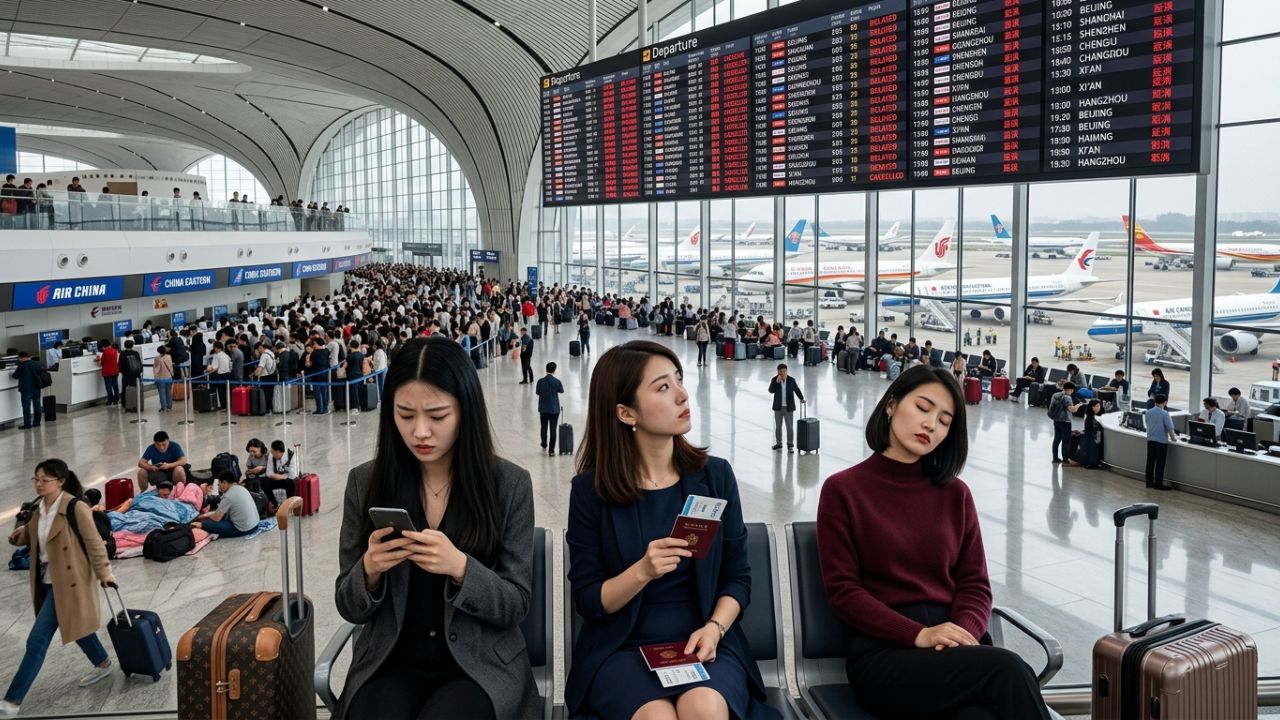
Image generated by AI
A catastrophic, highly destructive wave of systemic travel chaos has violently paralyzed the vast Chinese aviation network, severely crippling operations across every major domestic and international gateway. Reported on June 19, 2026, terminal departure boards from Beijing to Shenzhen reflect massive operational devastation, displaying an agonizing 138 outright flight cancellations alongside an absolutely astonishing 4,551 severe airport disruptions and cascading delays recorded over a brutal 24-hour period. This nationwide gridlock has completely overwhelmed the country's primary legacy and low-cost operators, heavily impacting China Eastern, China Southern, Air China, and Spring Airlines. With major interconnected metropolitan zones spanning from Shanghai to Chengdu caught in the crossfire, the disruption has effectively severed the nation’s highly prized corporate and leisure travel connectivity. As desperately overwhelmed airline ground crews attempt to clear the massive backlog of stranded aircraft at highly congested mega-hubs like Guangzhou and Hangzhou, this historic network collapse is driving today's most crucial headline in breaking airline news and essential global aviation updates.
By introducing direct passenger coordination and dynamic scheduling backups, the regional aviation hubs target growing passenger demand across vital commerce sectors. The choice to coordinate flight departures in phases helps to manage gate capacity, supporting the country's broader regional transportation network.
Context: The Reality of a Nationwide Network Collapse
For the global tourism and aviation industry, the sudden, devastating travel chaos currently gripping China perfectly illustrates the extreme fragility of massive international transit networks that rely entirely on tight aircraft rotation and consistent feeder scheduling across multiple mega-hubs.
As one of the world's largest aviation markets, China depends entirely on consistent scheduling performance for its complex domestic and international connections. Today, however, that efficiency has completely collapsed. While a total of 138 canceled flights represents a severe disruption, the true devastation lies in the staggering volume of 4,551 delayed flights bleeding out into the broader network. Because major carriers like Air China and China Southern rely on rapid turnarounds utilizing a highly interconnected web of metropolitan gateways, a localized delay at Shanghai Pudong instantly snowballs into massive downstream travel chaos. Passengers attempting to cross the vast country or reach major international gateways in Europe and Asia are currently facing agonizing waiting times, mathematically guaranteed missed connections, and hastily revised domestic itineraries as the entire national system struggles to absorb the imbalance.
To view live flight schedules, verify the active delay status of your specific trans-Pacific itinerary, or to track active regional airspace restrictions, travelers must consult official aviation directories. For direct updates regarding how this localized travel chaos affects specific route abandonments and current flight cancellations out of major Chinese hubs, travelers should aggressively utilize the official portals of China Eastern and Air China. To explore live flight tracking and monitor the exact severity of the cascading bottlenecks at major competitor hubs, passengers can consult the official FlightAware tracking service.
Section-Wise Breakdown: The Epicenters of Gridlock
The Shenzhen and Guangzhou Devastation
The absolute highest levels of disruption across the network were experienced in the southern economic powerhouses. Shenzhen Bao’an Int’l recorded a devastating 30 cancellations and an immense 1,044 delays. Just to the north, severe logistical difficulties were observed at Guangzhou Baiyun Int’l, which registered 10 cancellations and an astonishing 1,026 delays, completely paralyzing the Pearl River Delta corridor.
The Shanghai and Beijing Arteries
The primary international and financial gateways were also heavily saturated. Shanghai Pudong Int’l executed 7 cancellations alongside 390 delays, while the secondary Shanghai Hongqiao Int’l recorded 18 cancellations and 263 delays. In the capital, Beijing Daxing International Airport suffered 9 cancellations and 211 delays, compounded by Beijing Capital Int’l, which posted 5 cancellations and 200 delays.
The Regional Hub Collapse
Simultaneously, the vital regional network collapsed across the interior. Hangzhou Xiaoshan Int’l recorded 6 cancellations and 384 delays. In the vital transit hub of Chengdu Tianfu Int’l, 8 cancellations and 219 delays were verified. Furthermore, Chongqing Jiangbei Int’l (6 cancellations, 260 delays), Haikou Meilan Int’l (8 cancellations, 197 delays), Kunming Changshui Int’l (12 cancellations, 163 delays), Guiyang Longdongbao (6 cancellations, 113 delays), and Hefei Xinqiao Airport (13 cancellations, 81 delays) all suffered heavy operational friction.
Technical Roster: Nationwide Aviation Disruption Data
To ensure absolute factual accuracy regarding the exact parameters of this systemic friction and the specific airports driving the flight cancellations across China, the following matrix details the verified operational data impacting the network:
Chinese Airport Disruption Matrix
| Major Airport Hub | Cancelled Flights | Delayed Flights |
|---|---|---|
| Shenzhen Bao’an Int’l | 30 | 1,044 |
| Shanghai Hongqiao Int’l | 18 | 263 |
| Hefei Xinqiao Airport | 13 | 81 |
| Kunming Changshui Int’l | 12 | 163 |
| Guangzhou Baiyun Int’l | 10 | 1,026 |
| Beijing Daxing Int’l | 9 | 211 |
| Chengdu Tianfu Int’l | 8 | 219 |
| Haikou Meilan Int’l | 8 | 197 |
| Shanghai Pudong Int’l | 7 | 390 |
| Chongqing Jiangbei Int’l | 6 | 260 |
| Hangzhou Xiaoshan Int’l | 6 | 384 |
| Guiyang Longdongbao | 6 | 113 |
| Beijing Capital Int’l | 5 | 200 |
Data accurately reflects the severe operational breakdown across the Chinese aviation grid, highlighting that while Shenzhen absorbed the highest number of outright cancellations, the delay volumes at Shenzhen and Guangzhou entirely devastated regional capacity.
Passenger Impact: A Nightmare for Domestic and Global Travel
For the thousands of passengers trapped across Chinese terminals today, the sudden volume of 4,551 delays guarantees a highly stressful, heavily compromised journey.
The immediate passenger impact of this nationwide travel chaos is the complete eradication of carefully planned mainland connections. Travelers booked on routes operated by China Eastern and China Southern have been the most directly devastated, requiring them to wait for extensive rebooking onto much later flights. A delayed feeder flight from Hefei into Shanghai mathematically guarantees a highly restrictive transfer window onto an Air China flight to Europe or North America is missed, stranding passengers overnight. This friction creates massive additional pressure on airport hotels, customer service desks, and local ground transport. Because multi-destination itineraries are heavily interconnected, a single delay causes a devastating domino effect on subsequent hotel bookings, local tours, and pre-booked excursions, severely eroding consumer confidence in the domestic network.
Industry Analysis: The Fragility of Mega-Hub Dependency
Aviation industry analysts view the systemic breakdown across China as a critical, glaring reminder of the structural dependency of the aviation system on its massive mega-hubs.
Analysts note that flight cancellations and delays of this magnitude—affecting China Eastern, China Southern, Air China, and Spring Airlines simultaneously—suggest a massive systemic scheduling imbalance driven by widespread logistical limitations, likely triggered by severe regional weather patterns or compounding air traffic management restrictions. When massive transport nodes like Shenzhen (1,044 delays) and Guangzhou (1,026 delays) clog with delayed aircraft, the entire nation suffers. The ripple effects will be analyzed by tourism boards for months, as flight punctuality plays a critical role in destination selection. When structural disruptions are observed on this scale, the overall attractiveness of regional tour packages is severely tested, and future travel choices are likely to be dictated by perceived operational stability, with many holidaymakers potentially opting for China's extensive high-speed rail networks instead.
Actionable Advice for Navigating the Nationwide Gridlock
While standard passengers cannot control runway sequencing bottlenecks or airline crew shortages, you can execute this strategic survival checklist to actively manage the travel chaos currently affecting China:
- Leverage Digital Rebooking Immediately: If your Air China or China Southern flight is canceled, do not join the massive physical line at the PVG or PEK service desks. Ground staff will be instantly overwhelmed. Immediately use the airline’s official mobile application (or WeChat mini-programs) to secure priority rebooking onto a partner airline before the highly limited remaining seats are sold out.
- Pivot to High-Speed Rail: If your domestic flight between major hubs like Beijing and Shanghai, or Shenzhen and Guangzhou is heavily delayed, immediately audit the high-speed rail network. In many instances, pivoting to a bullet train will bypass the airport disruptions entirely and guarantee your arrival while the aviation grid remains locked down.
- Audit Your Consumer Rights: When cancellations are recorded at massive hubs like Chengdu or Hangzhou, ground staff should be consulted regarding duty-of-care provisions. Complimentary meals or refreshments are frequently distributed during prolonged waiting periods. Furthermore, if you hold comprehensive travel insurance, ensure you retain all receipts for alternative accommodation and food to submit a claim for unexpected cancellations.
FAQ: Chinese Nationwide Airport Disruptions
Why are Chinese airports experiencing massive travel chaos?
The entire national aviation grid is suffering from severe interconnected operational friction, resulting in 138 flight cancellations and a staggering 4,551 cascading delays across major hubs.
Which airlines are responsible for the highest number of cancellations?
The massive logistical adjustments heavily impacted major aviation brands including China Eastern, China Southern, Air China, and Spring Airlines.
Which Chinese airports were most impacted by this regional gridlock?
Shenzhen Bao'an and Guangzhou Baiyun recorded the heaviest volume of disruptions (each exceeding 1,000 delays), while massive hubs in Shanghai, Beijing, Chengdu, and Hangzhou also suffered extensive friction.
The Reality of Combating Nationwide Hub Saturation
The severe operational friction currently impacting the entire Chinese aviation network proves definitively that even a highly modernized national transit grid remains entirely susceptible to catastrophic, highly disruptive travel chaos. By absorbing 138 flight cancellations and 4,551 massive delays across the networks of China Eastern, Air China, and China Southern, the region demonstrates the extreme volatility of highly interconnected transcontinental scheduling. As airlines desperately attempt to shuffle limited aircraft to recover their destroyed itineraries—frequently stranding passengers who miss their crucial global connections—travelers must accept a critical new reality: surviving the Asian skies requires aggressive digital rebooking tactics, a thorough understanding of comprehensive travel insurance, and a ruthless willingness to adapt to sudden airport disruptions the moment the departure board flashes red.
Key Takeaways
- Nationwide Gridlock: The entire Chinese aviation network is currently paralyzed, reporting 138 flight cancellations and an unprecedented 4,551 operational delays.
- Shenzhen and Guangzhou Devastated: Southern mega-hubs suffered the heaviest delay volumes, each registering over 1,000 delayed flights and completely choking regional capacity.
- Legacy Carriers Crippled: National heavyweights including China Eastern, China Southern, Air China, and Spring Airlines were severely disrupted.
- Shanghai and Beijing Saturated: Primary international gateways in Shanghai (Pudong and Hongqiao) and Beijing (Daxing and Capital) absorbed heavy cancellations.
- Tourism Friction: The volume of grounded aircraft guarantees missed onward connections, heavily disrupting time-sensitive domestic multi-stop tours and long-haul international travel flows.
Related Travel Guides
Massive Travel Chaos Paralyzes Chicago O'Hare with 1,425 Disruptions
Disclaimer
This article is for informational and educational purposes only. It does not constitute legal, financial, or professional advice. While we strive to provide accurate and up-to-date information, travel policies, regulations, and conditions change rapidly. Always verify information with official sources before making travel decisions. Nomad Lawyer makes no representations about the accuracy, reliability, completeness, or suitability of the information provided. Readers should consult qualified professionals for advice specific to their circumstances. The views expressed in this article are those of the author and do not necessarily reflect the views of Nomad Lawyer.
Kunal K Choudhary
Co-Founder & Contributor
A passionate traveller and tech enthusiast. Kunal contributes to the vision and growth of Nomad Lawyer, bringing fresh perspectives and driving the community forward.
Learn more about our team →