
China Airport Selection Guide 2026: Avoiding Hidden Costs in Dual-Hub Cities
Navigating China's 270 airports requires more than flight shopping. Learn how choosing the wrong gateway in Beijing, Shanghai, and Chengdu can lead to expensive transfers and lost time.

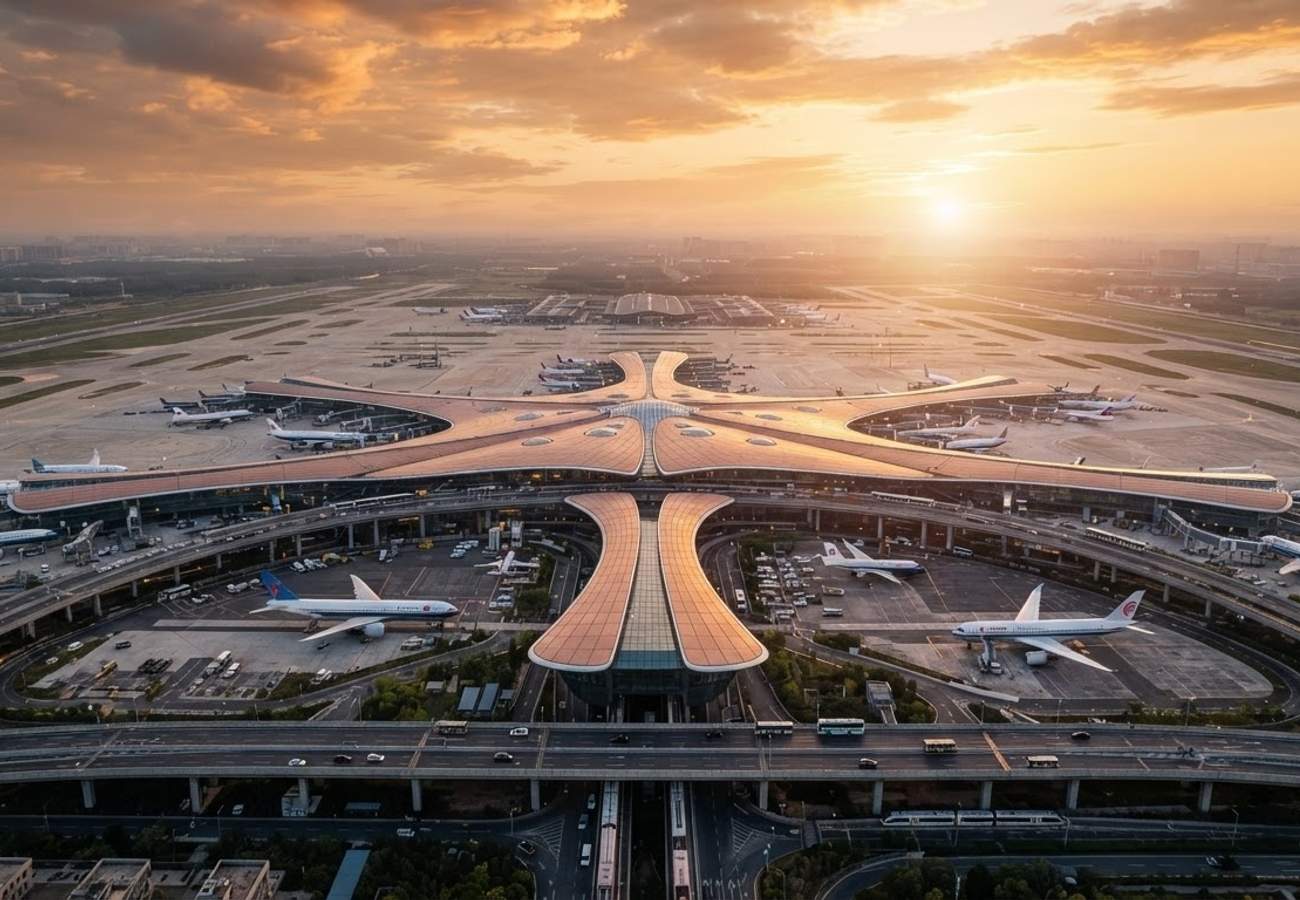
Image generated by AI
Choosing the wrong gateway in China can turn a cheap airfare into a costly logistical failure. With 270 airports nationwide, the rise of dual-hub systems in major cities means your arrival point now dictates your total travel spend and transit time.
The High Cost of "Cheap" Flight Selection
China's aviation infrastructure has scaled rapidly, with the Civil Aviation Administration of China (CAAC) reporting national passenger traffic reached 1.529 billion trips in 2021, a 4.8% increase. By 2025, the system evolved further, with 41 airports serving over 10 million passengers each and international-route throughput hitting 117.8 million—an 18.7% year-on-year increase.
For the modern traveler, the challenge is no longer finding a flight, but selecting the correct entry point. Major metropolitan areas now distribute traffic across multiple gateways. A lower ticket price often masks the "hidden cost" of longer transfers, expensive taxi fares, or the need for additional intercity rail journeys. In 2025, China operated 5,488 scheduled routes across 65 commercial airlines, making the variety of entry points vast but potentially confusing.
Gateway Selection Matrix for International Travelers
| Traveler Priority | Primary Checkpoint | Key Logistical Consideration |
|---|---|---|
| International Arrival | Terminal Facilities | Immigration efficiency and onward connection sync |
| City Sightseeing | Hotel Proximity | Distance to central transport hubs |
| Business Travel | District Access | Proximity to CBD or exhibition venues |
| Domestic Connection | Transfer Type | Same-airport vs. cross-city transfer |
| Rail Integration | HSR Access | Direct links to High-Speed Railway (HSR) stations |
| Late Arrivals | Transit Availability | 24-hour bus, rail, and ride-hailing options |
| Budget Optimization | Total Journey Cost | Flight fare + ground transfer expenditure |
Analyzing the Dual-Hub Systems
Beijing: PEK vs. PKX
Beijing’s aviation strategy splits traffic between Beijing Capital International Airport (PEK) and Beijing Daxing International Airport (PKX). Together, they handled 124 million passengers in 2025, marking a 6.5% annual increase.
PEK remains the established Asia-Pacific hub with superior connectivity to northern and central Beijing. Conversely, PKX is the modern integrated hub for the Beijing-Tianjin-Hebei region. Located 46 kilometers from Tianan neighborhood, PKX had an initial 2025 target of 72 million passengers, with long-term capacity reaching 100 million. As of July 2026, both airports have expanded early-morning and late-night bus services to mitigate transit gaps.
Shanghai: PVG vs. SHA
Shanghai provides the most stark contrast in airport utility. Pudong International Airport (PVG) is the long-haul gateway located 30 kilometers from downtown. Hongqiao International Airport (SHA) is located just 13 kilometers from the center and primarily serves domestic and regional traffic.
The logistics shift occurred in December 2024 with the launch of the 68.6-kilometer Airport Link Line, connecting SHA and PVG in approximately 40 minutes. In 2025, combined traffic exceeded 135 million trips, with SHA crossing the 50 million mark for the first time.
Chengdu: TFU vs. CTU
Chengdu ranks third nationally among aviation cities, handling 90 million passengers in 2025. The city splits traffic between Tianfu International Airport (TFU) and Shuangliu International Airport (CTU). TFU has become the primary international gateway, ranking fifth among all individual Chinese airports by volume. CTU remains the preferred choice for premium domestic business connectivity.
Regional Powerhouses: Shenzhen and Guangzhou
In Southern China, the Guangdong-Hong Kong-Macao Greater Bay Area offers complex choices. Shenzhen Bao’an International Airport (SZX) handled 66.48 million passengers in 2025, with international traffic rising over 20% year-on-year to exceed 6.3 million. Travelers often weigh SZX against Hong Kong International Airport, where the decision rests on border formalities versus flight availability.
Meanwhile, Guangzhou Baiyun International Airport (CAN) has scaled to over 80 million annual passengers, with international traffic exceeding 16.6 million in 2025. It stands as one of the four largest airports in China (above 60 million passengers), serving as the primary engine for the Pearl River Delta.
Traveler Logistics Guide: Navigating the Gateways
From a ground-level perspective, the best way to navigate China's dual-hub system is to map your hotel location before booking your flight.
1. The "Center-Out" Booking Strategy Do not book based on the airline's prestige or the ticket price alone. If staying in southern Beijing, PKX is significantly more efficient than PEK. In Shanghai, if your itinerary involves heavy domestic hopping, SHA is the superior choice due to its integrated High-Speed Rail complex.
2. Managing Cross-Airport Transfers In Shanghai, utilize the Airport Link Line for transfers between PVG and SHA to avoid the volatility of city traffic. In Beijing, utilize the expanded 24-hour bus network if arriving during off-peak hours.
3. Digital Transit Integration Ensure your payment apps (Alipay/WeChat Pay) are linked to an international card. Most airport express trains and ride-hailing services in these hubs have moved almost entirely to digital payment, and traditional cash is increasingly inefficient for rapid transit.
4. Border and Customs Efficiency When choosing between Shenzhen (SZX) and Hong Kong, factor in the "border tax" of time. While SZX may offer cheaper flights, the customs process for entering mainland China is streamlined. Conversely, entering via Hong Kong requires an additional immigration step to reach the mainland.
The most expensive flight is often the cheapest ticket plus a three-hour taxi ride.
Related Travel Guides
Disclaimer
This article is for informational and educational purposes only. It does not constitute legal, financial, or professional advice. While we strive to provide accurate and up-to-date information, travel policies, regulations, and conditions change rapidly. Always verify information with official sources before making travel decisions. Nomad Lawyer makes no representations about the accuracy, reliability, completeness, or suitability of the information provided. Readers should consult qualified professionals for advice specific to their circumstances. The views expressed in this article are those of the author and do not necessarily reflect the views of Nomad Lawyer.
Raushan Kumar
Founder & Lead Developer
Full-stack developer with 11+ years of experience and a passionate traveller. Raushan built Nomad Lawyer from the ground up with a vision to create the best travel and law experience on the web.
Learn more about our team →