
Beyond Barriers on the Mediterranean: How Valencia, Alicante, and Castellón Are Redefining Accessible Cultural Travel
Backed by nearly 500 verified assessments from TUR4all, Spain's Comunitat Valenciana courts high-spending US travelers with adapted Costa Blanca beaches, urban greenways, and barrier-free heritage.

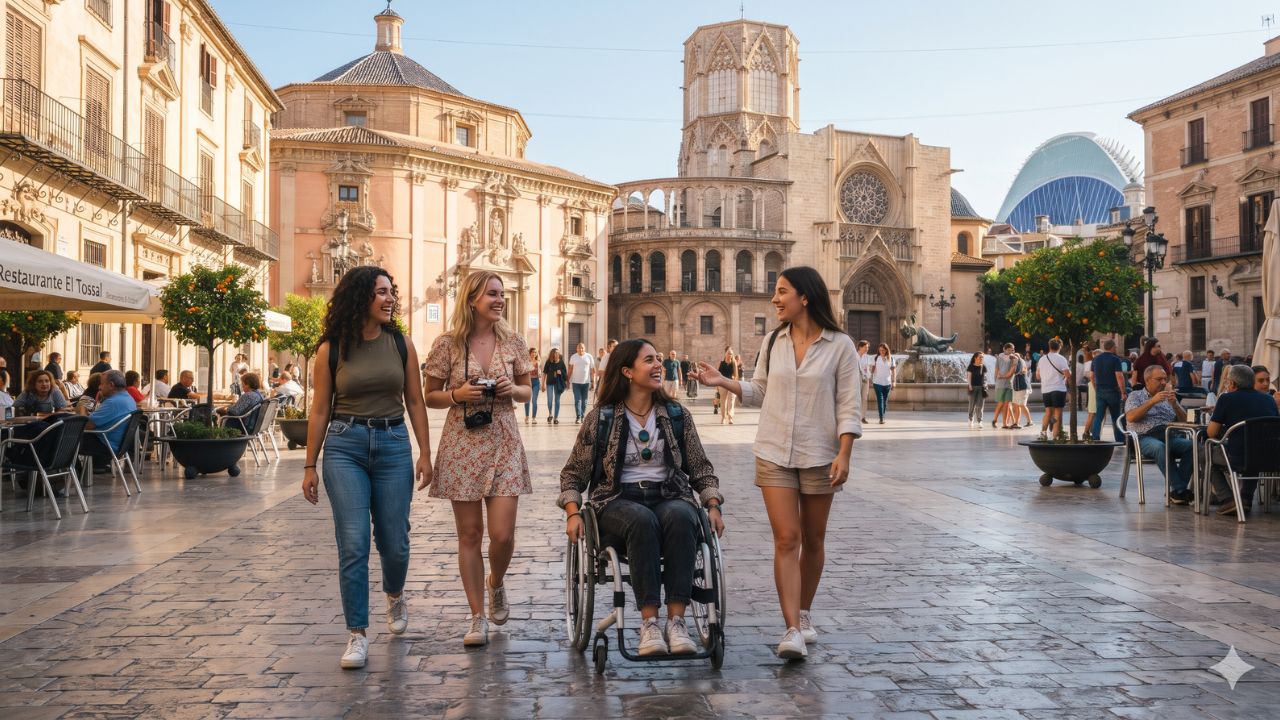
Contrary to the outdated assumption that travelers with disabilities or limited mobility seek only passive resort pools, cultural exploration accounts for an overwhelming 45% to 50% of demand in Spain's international accessible tourism market. To capture this sophisticated demographic, Spain's Comunitat Valenciana—encompassing the three diverse provinces of Valencia, Alicante, and Castellón—is launching an ambitious commercial roadshow targeting North American travel advisors. Backed by national tourism board Turespaña and accessibility benchmark IMPULSA IGUALDAD–TUR4all under the "Spain, a country for everyone" campaign, the initiative features dedicated trade forums in New York City on 27 October 2026 and Chicago on 1 December 2026.
The timing is strategic. According to TUR4all Travel's 2026 market report, American travelers generate 10% to 12% of total international accessible travel demand to Spain, recording the highest average daily expenditure of any source nationality. Concurrently, travelers over the age of 60 command roughly 35% of the market. Rather than relying on vague assurances, the Valencian region presents verified empirical data: nearly 500 hotels, cultural monuments, nature trails, and transportation providers have undergone rigorous on-site accessibility audits, giving independent explorers the confidence to experience Spain on their own terms.
The Data Behind Spain's Inclusive Travel Shift
Accessible travel has evolved from an ad-hoc accommodation service into a major commercial sector. For travelers navigating mobility, visual, auditory, or neurodiverse requirements, verified technical information—such as doorway clearances, step-free access, tactile guides, and acoustic zoning—is non-negotiable.
| Category / Market Dimension | Recorded Statistic / Metric | Travel & Operational Impact |
|---|---|---|
| Verified Regional Establishments | Nearly 500 assessed facilities | Audited across Valencia, Alicante, and Castellón via TUR4all |
| Cultural & Heritage Interest Share | 45% to 50% of accessible demand | Dominant preference over purely passive beach vacations |
| Accessible Coastal Holiday Share | 20% to 23% of market preferences | Demand for adapted boardwalks, ramps, and water-access assists |
| Nature & Outdoor Experiences Share | 12% to 15% of market preferences | Vías Verdes (greenways), nature reserves, and boat tours |
| US Market Share in Spain | 10% to 12% of international demand | Represents highest daily per-traveler spending of any market |
| Senior Demographic (Aged 60+) | ~35% of accessible travel market | Fueling demand for step-free heritage and multi-generational stays |
| New York B2B Presentation Date | 27 October 2026 | Focus on cultural city breaks, leisure, and tailor-made packages |
| Chicago B2B Presentation Date | 1 December 2026 | Focus on inclusive corporate meetings, conferences, and MICE travel |
| Adapted Costa Blanca Beaches | Approximately 50 certified beaches | Equipped with amphibious chairs, shaded tents, and lifeguard aids |
| Accessible Alicante Greenways | 4 Vías Verdes (Alcoy, Maigmó, Torrevieja, Xixarra 2) | Former railway lines converted into flat, scenic nature routes |
Official coordination via Spain.info and the regional portal Comunitat Valenciana Tourism highlights how universal design across urban transit, hotel bathrooms, and museum entrances allows travelers to discover Mediterranean life without physical barriers.
Three Provinces: Tailoring Inclusive Travel Experiences
Comunitat Valenciana's strength lies in the geographical variety of its three provinces, which allow travelers to combine urban architecture, mountain greenways, and tranquil coastal lagoons into a single accessible journey.
Valencia: Avant-Garde Design, Green Riverbeds, and Silk Heritage
The city of Valencia balances ancient history with futuristic architecture. In the historic quarter, the 15th-century Silk Exchange (La Lonja de la Seda), designated by the UNESCO World Heritage Centre, features ramped entrances allowing visitors to roll beneath dramatic gothic twisting columns. Nearby, the Central Market offers level access through its stained-glass portals to sample fresh Iberian cured ham and regional citrus.
Dividing the city is the Jardín del Turia, a nine-kilometer sunken park created in the former riverbed. Completely flat, car-free, and paved with smooth paths, it offers continuous outdoor exploration connecting central neighborhoods directly to the iconic City of Arts and Sciences. Designed by Santiago Calatrava, this futuristic cultural complex features step-free boardwalks, wide elevators, and sensory-friendly acoustic spaces throughout the Hemisfèric and Oceanogràfic aquarium. Just south of the city, the Albufera Natural Park provides adapted wooden docks and certified flat-bottom boat excursions gliding past rice paddies where authentic Valencian paella originated.
Alicante: Adapted Shorelines and Mountain Vías Verdes
Further south, the province of Alicante transforms the traditional beach holiday into an inclusive experience. Along the sunlit Costa Blanca, regional municipalities maintain approximately 50 adapted beaches. These coastal facilities feature wooden ramps extending directly to the water's edge, shaded platforms, accessible changing rooms, and amphibious floating chairs (sillas anfibias) operated by trained Red Cross rescue staff.
Inland, Alicante repurposes historical infrastructure for outdoor recreation. Four dedicated greenways (Vías Verdes)—including the Alcoy, Maigmó, Torrevieja, and Xixarra 2 routes—convert disused railway lines into flat, hard-packed trails. The Maigmó greenway, running through pine-covered slopes and across historic viaducts, provides handcyclists and wheelchair users with unobstructed mountain views that would otherwise be inaccessible.
Castellón: Subterranean Wonders and Peaceful Coastal Fortresses
In the northern province of Castellón, tourism moves at a gentle, unhurried pace. The provincial capital features the Castellón Planetarium, equipped with step-free seating, tactile astronomical models, and adapted access.
Along the coast, the medieval fortified town of Peñíscola rises above the sea, offering designated accessible routes through lower plazas and coastal viewpoints. A standout natural adventure lies in the San José Caves (Coves de Sant Josep) near La Vall d'Uixó, home to Europe's longest navigable underground river. Specialized mechanical hoists and modified electric boats allow wheelchair users to navigate into illuminated subterranean caverns safely.
Accessible Business and MICE Travel in Chicago Spotlight
The upcoming Chicago presentation on 1 December 2026 directly targets the global meetings, incentives, conferences, and exhibitions (MICE) sector. Successful inclusive corporate travel requires synchronized logistical planning:
- Integrated Convention Centers: Facilities like the Valencia Conference Centre (designed by Norman Foster), Feria Valencia, and the Marina de Valencia offer step-free stages, adjustable podiums, wide circulation aisles, and hearing loop technology.
- Accessible Accommodations: Business hotels across Valencia, Alicante, and Castellón provide roll-in showers, visual alarm systems, lowered reception desks, and braille signage.
- Barrier-Free Group Excursions: Corporate organizers can schedule inclusive group activities, from private adapted boat tours across the Albufera lagoon to olive oil and wine tastings in accessible historic bodegas.
Visitor Insider Tips
Experiencing the Valencian coast with accessibility requirements runs smoother when utilizing local operational hacks:
- Reserve Assisted Bathing on Costa Blanca Beaches in Advance: While Alicante's 50 adapted beaches offer walk-up services during high summer, utilizing the amphibious chairs during shoulder season (May, June, September, and October) often requires calling the local municipal Red Cross post 24 hours prior to ensure lifeguard assistance is pre-positioned.
- Book Accessible Albufera Boat Tours from El Saler or Catarroja: While many casual tourist boats in El Palmar require stepping down into wooden vessels, certified adapted pontoons equipped with boarding ramps operate primarily from the piers in El Saler and the Port of Catarroja. Combine the cruise with a wood-fired lunch of traditional arroz del senyoret (where all shellfish is pre-peeled).
- Utilize the Metrovalencia Accessible Network: Valencia's modern subway and tram network is virtually 100% accessible, featuring level-entry train cars, tactile platform strips, and reliable street-level elevators at all central stations, including Xàtiva and Colón.
- Download the TUR4all Mobile Application: Rather than relying on generic review sites, consult the free TUR4all app before dining or sightseeing. Each listing details exact door measurements, bathroom turn radiuses, gradient angles of ramps, and noise levels reviewed by professional occupational therapists.
- Secure Timed Slots for Coves de Sant Josep: Castellón's underground river boats have limited capacity for adapted seating. Reserve your tour at least two weeks in advance via their official booking portal, specifying the requirement for the boarding crane and adapted vessel.
Cultural and Environmental Context
Developing accessible tourism in Spain is not merely an engineering achievement; it reflects a deep cultural commitment to social integration (convivencia). Across Mediterranean towns, public life centers on evening strolls (el paseo), multi-generational family gatherings in public plazas, and neighborhood dining. Ensuring that historic cobblestone quarters like Valencia's Carmen district incorporate smooth stone pathways allows older generations—who represent 35% of the accessible market—to remain active participants in community life alongside grandchildren and international visitors.
Simultaneously, accessibility aligns with environmental protection. Converting abandoned railway corridors into Vías Verdes safeguards rural habitats from commercial overdevelopment while providing car-free transit corridors. By promoting low-impact train travel and decentralized cultural exploration in inland villages, inclusive tourism distributes economic prosperity into rural valleys while preserving the authentic traditions of Mediterranean Spain.
FAQ: Accessible Travel in Valencia, Alicante, and Castellón 2026
How reliable is accessibility data across Comunitat Valenciana?
Data is independently audited through TUR4all and IMPULSA IGUALDAD, providing verified physical measurements, bathroom layouts, and sensory accommodations for nearly 500 tourism assets.
Are public transport networks wheelchair-accessible in Valencia?
Yes. All city buses in Valencia feature automated kneeling mechanisms and deployable boarding ramps, while Metrovalencia stations provide street-to-platform elevators and level-boarding train cars.
How do assisted bathing services work on Alicante's beaches?
Approximately 50 Costa Blanca beaches provide wooden ramps down to the water, shaded waiting pergolas, and amphibious floating chairs staffed by trained municipal lifeguards during operational hours.
Can travelers with disabilities visit the San José underground caves?
Yes. Coves de Sant Josep in Castellón provides accessible paths to the cave mouth, hydraulic boarding lifts, and specially modified boats to tour the subterranean river.
On the warm shores of the Valencian Mediterranean, true travel freedom is not having to ask if you belong, but knowing the way has already been opened.
Related Travel Guides
- Beyond the Summer Beach: Wizz Air Unlocks Málaga, Granada, and Asturias with £26.99 Winter Flights from London
- Spain's Wilderness Frontier: How Garajonay, Doñana, and Teide Are Pioneering High-Value Nature Escapes
- Spain's Walking Tourism Revolution: How 60,000 Kilometers of Trails Are Rescuing Historic Towns
Disclaimer
This article is for informational and educational purposes only. It does not constitute legal, financial, or professional advice. While we strive to provide accurate and up-to-date information, travel policies, regulations, and conditions change rapidly. Always verify information with official sources before making travel decisions. Nomad Lawyer makes no representations about the accuracy, reliability, completeness, or suitability of the information provided. Readers should consult qualified professionals for advice specific to their circumstances. The views expressed in this article are those of the author and do not necessarily reflect the views of Nomad Lawyer.
Preeti Gunjan
Contributor & Community Manager
A passionate traveller and community builder. Preeti helps grow the Nomad Lawyer community, fostering engagement and bringing the reader experience to life.
Learn more about our team →