
The Bush Capital Unveiled: Why Canberra Is Australia’s Ultimate Wildlife and Architecture Secret in 2026

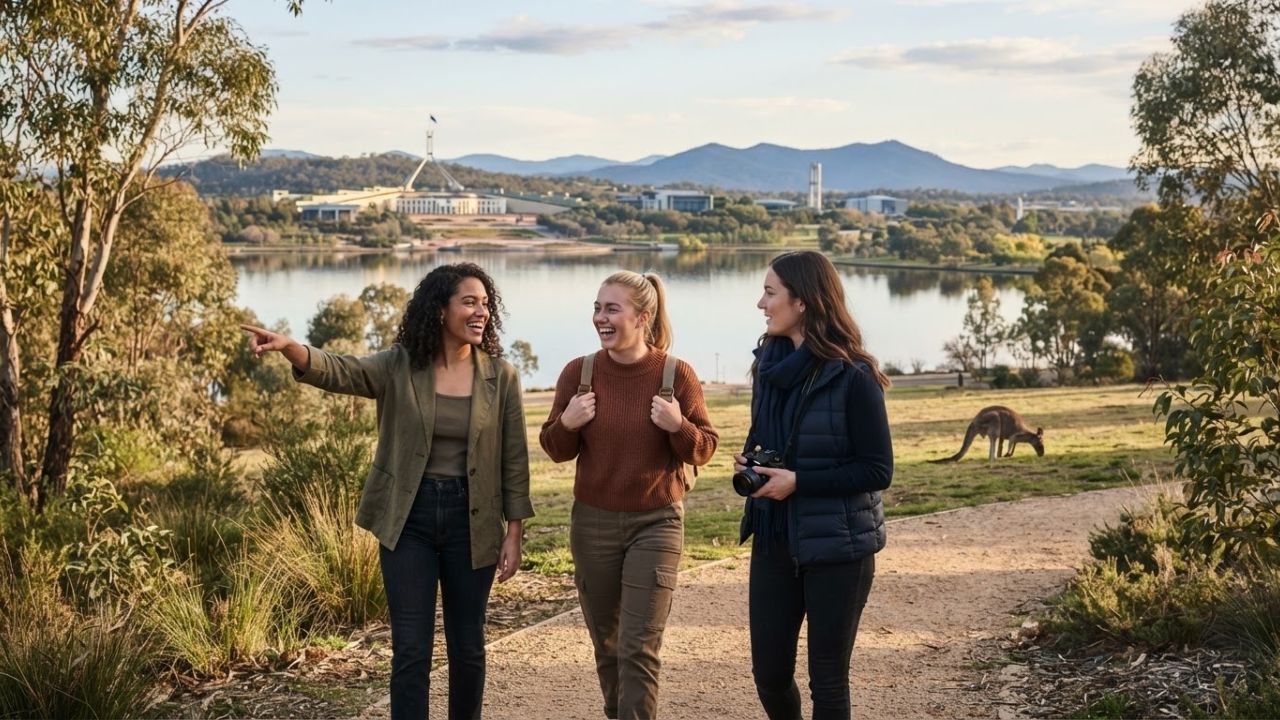
While international travelers often assume Australia's national capital is a sterile grid of concrete ministries, Canberra is the only planned capital on Earth where wild eastern grey kangaroos graze on parliament lawns and native eucalyptus forests wrap directly around diplomatic embassies. Selected in 1908 to settle an intense political rivalry between Sydney and Melbourne, the "Bush Capital" was shaped by the visionary, long-overlooked architectural artistry of Marion Mahony Griffin—creating a world capital where native wilderness dictates urban form, rather than being erased by it.
Standing atop the granite summit of Mount Ainslie at first light reveals the quiet genius of the city. Below, morning mist slowly lifts off the glassy expanse of Lake Burley Griffin, unveiling an extraordinary geometric axis that aligns the red gravel of Anzac Parade directly with Capital Hill. Unlike coastal metropolises defined by dense skyscrapers and crowded traffic arteries, Canberra breathes with open space, mountain ridges, and birdsong. For travelers seeking authentic Indigenous history, world-class art collections, and wild ecological encounters, Australia’s purpose-built capital offers one of the most rewarding cultural journeys in the Southern Hemisphere.
Beyond the Political Bubble: The Reinvention of Australia’s Bush Capital
Long before colonial surveyors marked lines across the Molonglo Valley, this fertile highland basin was the ancestral home of the Ngunnawal people, whose spiritual connection and custodianship extend back more than 20,000 years. The name "Canberra" itself derives from an ancient Indigenous term widely understood to mean "meeting place," honoring the seasonal gatherings where diverse First Nations clans assembled to harvest nutritious bogong moths, conduct trade, and perform sacred ceremonies.
Following the Federation of Australia in 1901, the fierce contest between Sydney and Melbourne for federal supremacy led parliament to designate a neutral federal territory in 1908. In 1912, the international design competition to sculpt this empty canvas was awarded to American architect Walter Burley Griffin and his extraordinary creative partner and wife, Marion Mahony Griffin.
For decades, official histories reduced Marion Mahony Griffin to a footnote. In reality, she was one of the first licensed female architects in the United States, the foundational employee hired by legendary master Frank Lloyd Wright, and a consummate artist whose breathtaking rendering drawings—inked with gold wash on Japanese silk—convinced the international jury to choose their design. Today, Canberra's cultural institutions actively restore her legacy, celebrating her as the primary co-creator whose holistic philosophy subordinated human buildings to the natural topography of the valley.
Their masterplan avoided imposing rigid European city grids. Instead, the Griffins established grand ceremonial avenues, curving residential parkways, and artificial water basins nestled between protected ridges. Government buildings were deliberately restricted in height, ensuring that from every street corner, the forested hills of the Brindabella Ranges remain the dominant visual vista.
What Makes Canberra’s Wildlife and Cultural Precincts Unique
Canberra's identity as the Bush Capital is not an idle marketing slogan; it is an everyday ecological reality. Within a 40-minute drive from the city center lies Tidbinbilla Nature Reserve, a pristine 54-square-kilometer sanctuary that showcases Australia's most remarkable wildlife species:
- Mobs of wild eastern grey kangaroos roaming open sub-alpine grasslands;
- Koalas thriving in protected eucalyptus canopies;
- Wild platypuses foraging in quiet, fern-fringed freshwater pools;
- Crimson rosellas, gang-gang cockatoos, and wedge-tailed eagles inhabiting mountain forests.
Beyond serving as a nature sanctuary, Tidbinbilla plays a vital frontline role in endangered species recovery. The reserve is the operational heart of the breeding program for the southern brush-tailed rock-wallaby, the official mammal emblem of the Australian Capital Territory (ACT). Locally extinct in the ACT wild since the mid-20th century, this distinct southern genetic lineage has dwindled to fewer than 40 surviving individuals in fragmented pockets of neighboring Victoria. At Tidbinbilla, specialized veterinary enclosures and habitat monitoring work continuously to rebuild the lineage for future reintroduction.
Complementing this wild biodiversity is an unmatched concentration of national cultural treasures centered within the lakeside National Triangle. Unlike many global capitals that charge steep museum admissions, Canberra provides free general entry to the permanent collections of its flagship institutions:
- The National Gallery of Australia (NGA), which houses Jackson Pollock’s iconic 1952 masterpiece Blue Poles alongside the world’s finest public collection of Aboriginal and Torres Strait Islander art;
- The National Museum of Australia, celebrating social history through innovative interactive pavilions;
- The National Portrait Gallery, exploring identity through striking contemporary portraits;
- The National Library of Australia, preserving historic Pacific voyaging journals and rare manuscripts.
Nearby on Capital Hill, Australian Parliament House—opened in 1988 and designed by Italian-born architect Romaldo Giurgola—stands as a triumph of contextual architecture. Embedded directly into the earth with two massive curved granite walls, the building features grass-covered roof ramps originally created to symbolize that citizens walk above their elected politicians. While modern security updates now channel visitors to designated elevated viewing plazas rather than the open grass slopes, the structure remains a brilliant testament to civic design embedded into nature.
Beyond statecraft, curious explorers uncover forgotten wartime and scientific sanctuaries. Established in 1928, Mount Stromlo Observatory offers celestial stargazing across unpolluted night skies, while the hidden subterranean West Block Dugout commemorates the "Cable Girls"—a courageous group of young civilian women who decoded sensitive Allied wartime transmissions during the Second World War.
Visitor Insider Tips
Experiencing Canberra like an insider requires stepping away from parliamentary coach routes and embracing the city's distinct neighborhood rhythms.
First, align your visit with Canberra's four distinct seasons. Visit in spring (September to October) to witness Floriade, the Southern Hemisphere's largest flower festival, when more than one million blooms carpet Commonwealth Park. In autumn (March to May), the city explodes in rich crimson, gold, and amber foliage, creating perfect conditions for morning cycling. Winter (June to August) brings crisp, cloudless blue skies and views of snow-dusted alpine peaks, while summer (December to February) offers long twilight picnics along the lake.
Second, skip corporate government hotels and base yourself in Braddon or Kingston. Braddon's Lonsdale Street is the city’s creative epicenter, filled with independent fashion boutiques, artisan bakeries, and craft brewpubs. On the south shore, the Kingston Foreshore provides waterfront dining and easy walking access to the historic Old Bus Depot Markets on Sundays.
Third, explore on two wheels using public transport links. Canberra is Australia's cycling capital, crisscrossed by dedicated paved pathways. Rent an e-bike or e-scooter to navigate the 28-kilometer Lake Burley Griffin circuit, or use Transport Canberra light rail to travel effortlessly between the city center and the northern precincts.
Fourth, experience the world-class culinary and coffee culture. Canberra is home to world champion baristas; visit ONA Coffee in Fyshwick or Cupping Room in the city center for extraordinary single-origin filter roasts. For dinner, drive 35 minutes into the surrounding Canberra District wine region around Murrumbateman, where boutique cool-climate vineyards produce award-winning peppery Shiraz and crisp, mineral-driven Rieslings.
Cultural and Environmental Context
Canberra’s urban evolution demonstrates a profound respect for Indigenous heritage and environmental balance. In collaboration with the Ngunnawal Traditional Custodians, the ACT government integrates traditional fire-stick land management, cultural walking trails, and native botanical restoration across the territory.
Promoted internationally by Tourism Australia, the Bush Capital represents a sustainable model of low-density urban planning. Rather than allowing urban sprawl to engulf natural habitats, the city preserves 70% of the Australian Capital Territory as protected open space, nature parks, and nature reserves. Green ridgelines act as permanent wildlife corridors, allowing native birds, marsupials, and reptiles to move freely across the Molonglo Valley.
Canberra also provides a natural staging ground for overland cultural journeys toward legendary Australian sites recognized by UNESCO World Heritage, including the Greater Blue Mountains wilderness and the Sydney Opera House. By preserving its forested mountains and celebrating First Nations custodianship alongside cutting-edge democratic architecture, Canberra proves that a nation's capital can honor political power while maintaining deep humility before the ancient earth.
FAQ: Visiting Canberra 2026
What makes Canberra different from Sydney and Melbourne? Canberra is a purpose-built capital surrounded by nature reserves. It offers world-class free national museums, minimal traffic, wild kangaroos grazing close to the city center, and four distinct seasons without coastal crowds.
Are the major national museums in Canberra free to visit? Yes. General admission to the permanent galleries of the National Gallery of Australia, National Museum, National Library, and National Portrait Gallery is completely free, though special temporary international exhibitions require paid tickets.
Where can visitors see native Australian wildlife in Canberra? Tidbinbilla Nature Reserve, located 40 minutes from downtown, offers wild kangaroos, koalas, platypuses, and endangered rock-wallabies. Wild kangaroos can also be observed grazing at sunrise across Mount Ainslie and Weston Park.
What is the best way to get around Canberra? Canberra is best explored by cycling its extensive paved pathways around Lake Burley Griffin, utilizing the electric light rail between Gungahlin and the city center, or hiring a rental car for regional nature reserves.
In a world that builds upward toward the sky, Canberra endures by bowing downward to the mountain, the forest, and the ancient song of the earth.
Related Travel Guides
Disclaimer
This article is for informational and educational purposes only. It does not constitute legal, financial, or professional advice. While we strive to provide accurate and up-to-date information, travel policies, regulations, and conditions change rapidly. Always verify information with official sources before making travel decisions. Nomad Lawyer makes no representations about the accuracy, reliability, completeness, or suitability of the information provided. Readers should consult qualified professionals for advice specific to their circumstances. The views expressed in this article are those of the author and do not necessarily reflect the views of Nomad Lawyer.
Raushan Kumar
Founder & Lead Developer
Full-stack developer with 11+ years of experience and a passionate traveller. Raushan built Nomad Lawyer from the ground up with a vision to create the best travel and law experience on the web.
Learn more about our team →