Canada-US Cross-Border Travel Surges: Vancouver-Seattle and Regional Corridors Guide 2026

American leisure visits across the northern boundary climbed 8.1% to approximately 1.54 million trips in October 2026, marking the ninth consecutive month of sustained expansion for inbound Canadian tourism. At the same time, Canadian-resident return trips from the United States reached 1.88 million across road and aviation checkpoints—a 3.0% annual increase representing seven straight months of positive momentum. While Canadian southbound departures remain slightly below 2024 baselines, the cross-border circuit connecting the Pacific Northwest, Great Lakes, and maritime frontiers is experiencing its most stable bilateral flow in three years.
From the coastal rainforests linking Vancouver and Seattle to the shared waters of the Detroit River and the thundering precipice of Niagara Falls, dual-nation itineraries are redefining regional exploration across North America.
Dissecting the Bilateral Travel Rebound
Data released by Statistics Canada demonstrates how highway crossings and regional flights are driving regional economic recovery. American travelers crossing into Canada by automobile expanded 8.7% during October 2026, while American air arrivals grew 6.5%. Conversely, Canadian return travel via air jumped 5.6%, outpacing a modest 2.2% rise in automobile border entries.
This multi-modal surge reflects evolving currency values and lower regional fuel costs, encouraging travelers on both sides of the 49th parallel to combine neighboring metropolitan centers into single vacation routes:
| Cross-Border Mobility Indicator | October 2026 Volume | Annual Percentage Change | Consecutive Growth Period |
|---|---|---|---|
| US Resident Arrivals into Canada | ~1.54 million trips | +8.1% | 9 consecutive months |
| US Resident Arrivals by Automobile | Majority of road entries | +8.7% | 9 consecutive months |
| US Resident Arrivals by Air | Commercial flight volume | +6.5% | 8 consecutive months |
| Canadian Return Trips from US | ~1.88 million trips | +3.0% | 7 consecutive months |
| Canadian Return Trips by Air | Transborder airline routes | +5.6% | 7 consecutive months |
| Canadian Return Trips by Automobile | Land border crossings | +2.2% | 6 consecutive months |
Premier Cross-Border Corridor Pairings
Rather than treating the international boundary as a barrier, savvy travelers are building interconnected multi-city road trips that highlight contrasting civic cultures:
| Canadian Hub | American Partner City | Signature Regional Experience | Primary Transit Mode |
|---|---|---|---|
| Vancouver, BC | Seattle, Washington | Pacific Northwest waterfronts & culinary trails | Interstate 5 / Amtrak Cascades |
| Victoria, BC | Port Angeles, Washington | Maritime heritage & temperate rainforest trails | Black Ball Ferry Line |
| Niagara Falls, ON | Niagara Falls, New York | Shared cataract views & estate winery cycling | Rainbow Bridge / Whirlpool Bridge |
| Toronto, ON | Buffalo, New York | Architectural history, theater & sporting events | Queen Elizabeth Way / Peace Bridge |
| Windsor, ON | Detroit, Michigan | Fluvial riverfronts & automotive design history | Ambassador Bridge / Gordie Howe Bridge |
| Montreal, QC | Burlington, Vermont | French-Canadian bistro culture & farm cuisine | Autoroute 15 to Interstate 89 |
| Quebec City, QC | Portland, Maine | Fortified historic ramparts & Atlantic coastlines | Route 201 mountain passes |
| Waterton Lakes, AB | Glacier National Park, MT | Glacial valleys, alpine hikes & wildlife corridors | Chief Mountain Highway |
| St. Andrews, NB | Bar Harbor, Maine | Fundy tides, lobster wharves & Acadian history | Coastal Route 1 crossings |
| Winnipeg, MB | Grand Forks, North Dakota | Prairie cultural venues & cross-border shopping | Highway 75 to Interstate 29 |
What Sets the Northern Cross-Border Experience Apart
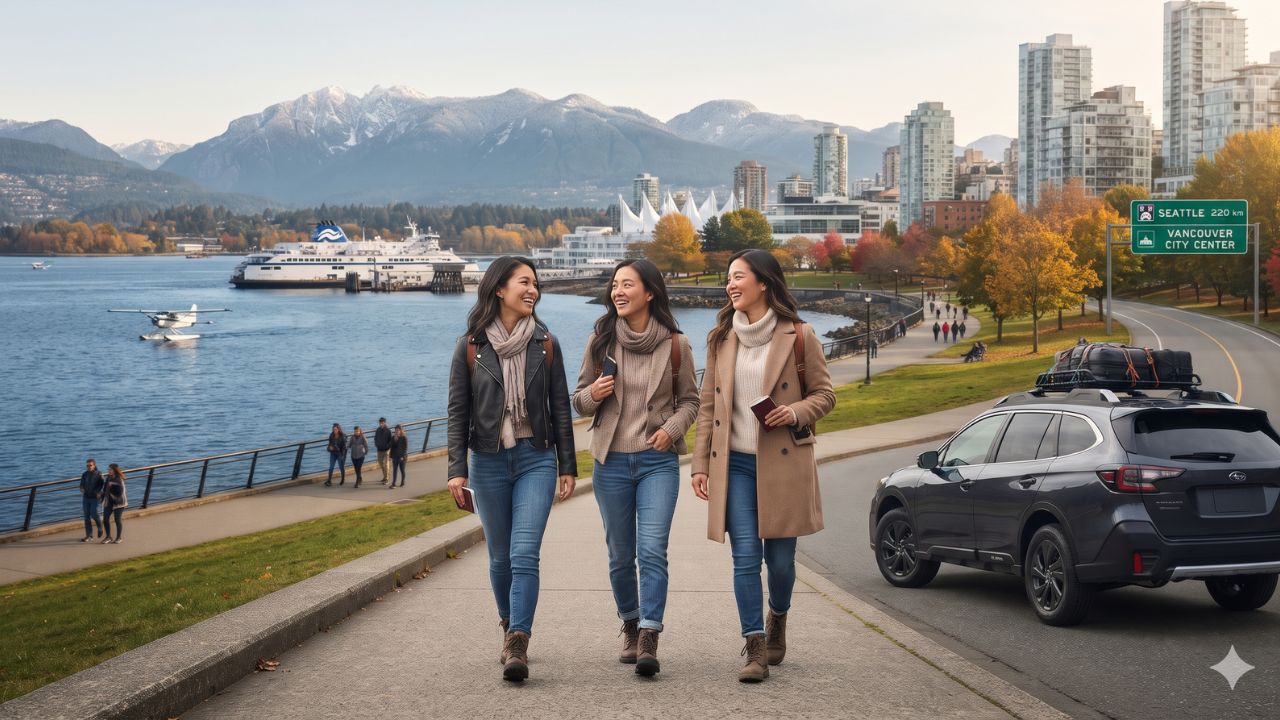
The geographical intimacy between major border cities allows travelers to transition between distinct national cultures within a few hours of driving. In the Pacific Northwest corridor, departing Vancouver leads past the coastal seawall of Stanley Park, the public market stalls of Granville Island, and historic Gastown before tracing Interstate 5 south. Travelers cross the Peace Arch border into Washington, stopping in coastal Bellingham before reaching Seattle’s Space Needle and Pike Place Market.
Farther west, combining Victoria on Vancouver Island with Port Angeles via international vehicle ferries pairs British Columbia’s Royal BC Museum and Parliament buildings with the old-growth wilderness of Olympic National Park.
In the Great Lakes basin, the opening of the Gordie Howe International Bridge in July 2026 established an architectural landmark between Windsor and Detroit. This modern conduit adds vital capacity across the Detroit River, connecting Windsor’s manicured sculpture gardens with Detroit’s Motown heritage, world-class museum district, and revived downtown waterfront.
Visitor Insider Tips: Navigating Land Crossings
- Avoid Weekend Peak Border Hours: Land ports of entry encounter heavy queues on Friday afternoons and Sunday evenings between 15:00 and 19:00. Aim to cross before 08:30 in the morning or after 20:00 at night.
- Utilize Secondary Crossings: When driving between Vancouver and Seattle, bypass the primary Peace Arch crossing on Interstate 5 by diverting eastward to the Pacific Highway (Truck Crossing), Aldergrove, or Sumas checkpoints.
- Inspect Vehicle and Medical Coverage: Ensure your personal auto insurance policy explicitly covers travel across the international border. Canadian and American healthcare systems do not reciprocate, making private travel health insurance mandatory.
- Carry Compliant Documentation: American passport holders do not require an Electronic Travel Authorization (eTA) or visitor visa to enter Canada, while Canadian citizens generally do not need visitor visas for typical tourism visits south. However, all third-country passport holders must verify specific entry clearances beforehand.
- Declare Cross-Border Purchases Accurately: Both Canada Border Services Agency (CBSA) and US Customs and Border Protection (CBP) enforce strict personal duty exemptions tied directly to the length of your stay away from home.
Cultural Context and Environmental Preservation
Cross-border tourism in North America is anchored in shared environmental stewardship. Nowhere is this relationship more evident than the Waterton-Glacier International Peace Park, established in 1932 as the world’s first peace park and inscribed on the UNESCO World Heritage Centre register. Spanning the international boundary between Alberta and Montana, this reserve protects grizzly bear corridors, bighorn sheep habitats, and fragile alpine tundra.
Similarly, cooperative watershed management along the Niagara River and Detroit River demonstrates how binational conservation protects freshwater ecosystems while welcoming millions of annual holidaymakers. By adhering to regional trail etiquette, respecting wildlife distances, and supporting locally owned farmstands and outfitters in border towns, travelers directly sustain these shared ecological frontiers.
Detailed regional itineraries and national travel standards are curated by Destination Canada.
FAQ: Canada-US Cross-Border Travel 2026
What drove the increase in October 2026 cross-border travel?
US resident visits to Canada rose 8.1% to 1.54 million, while Canadian return journeys grew 3.0% to 1.88 million, spurred by lower regional fuel costs and multi-destination road trip demand.
Do US citizens need a visa to drive into Canada?
No. American citizens presenting a valid US passport or passport card do not require a Canadian visitor visa or electronic travel authorization for leisure visits.
What is the fastest way to travel between Vancouver and Seattle?
Driving via Interstate 5 takes approximately 2.5 to 3.5 hours depending on border wait times. Alternatively, the Amtrak Cascades rail service offers scenic daily downtown-to-downtown connections.
Are both sides of Niagara Falls accessible on a single trip?
Yes. Travelers with valid travel documents can easily walk or drive across the Rainbow Bridge between Niagara Falls, Ontario, and Niagara Falls, New York.
Crossing North America's peaceful northern boundary reveals how complementary cultures and shared natural wonders enrich a single journey.
Related Travel Guides
This article is for informational purposes. Flight routes, passenger regulations, visa rules, and transit advisories are subject to change by airlines and aviation authorities. Readers are advised to verify schedules and travel documentation with relevant carriers and border agencies before departure.
Related Stories

Edmonton Winter Festivals and Indigenous Heritage Tours Guide 2026–2027
Puebla and Los Cabos Travel Guide 2027: Mexico's Dual Faces of Culture and Coast