
Aviation Updates: Massive Canadian Travel Chaos Triggers 114 Flight Cancellations and 702 Delays as Severe Weather Paralyzes Air Canada and WestJet
As incredibly severe weather and operational failures completely suffocate Canadian airspace, thousands of passengers are plunged into terrifying travel chaos following 114 flight cancellations.

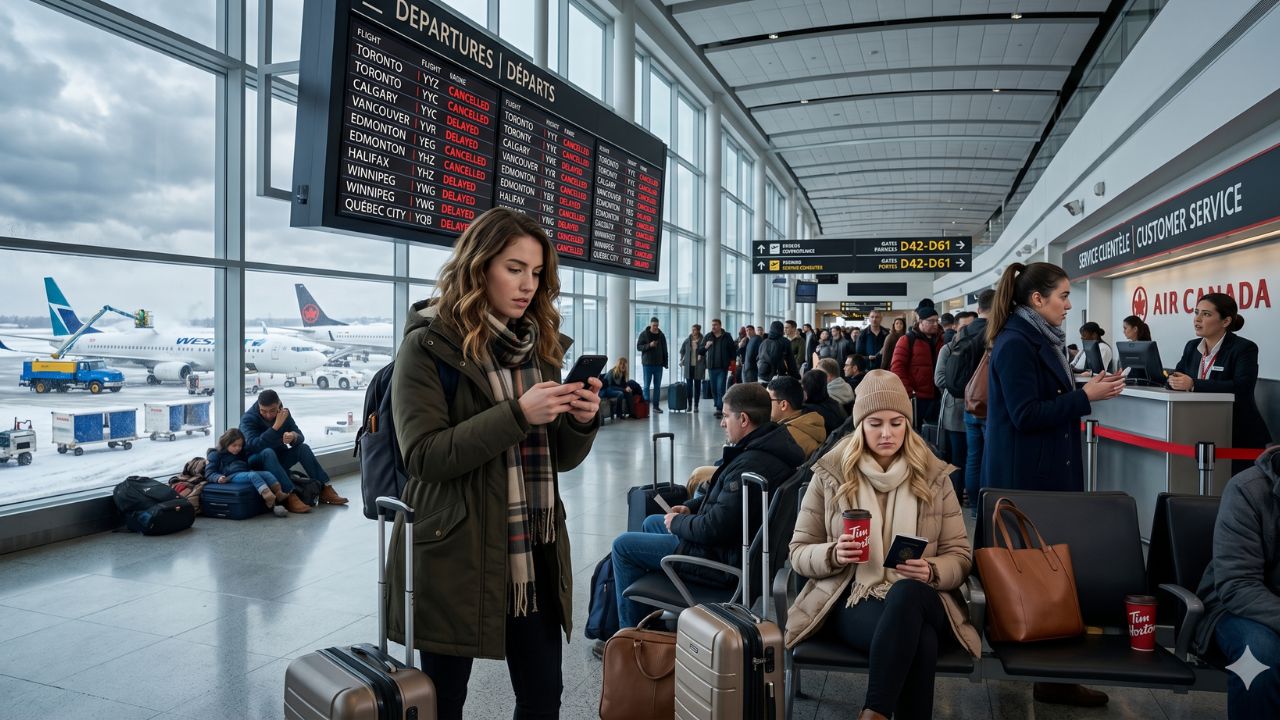
Image generated by AI
Aviation Updates: Massive Canadian Travel Chaos Triggers 114 Flight Cancellations and 702 Delays as Severe Weather Paralyzes Air Canada and WestJet
As incredibly severe terminal gridlock and massive regional operational failures completely suffocate the primary aviation gateways of Canada, thousands of deeply exhausted passengers are actively battling terrifying travel chaos following a catastrophic, nationwide meltdown that triggered 114 flight cancellations and 702 cascading delays.
While incredibly exhausted domestic and international passengers desperately navigate an incredibly brutal peak travel season defined by rolling flight cancellations and severe, localized airport disruptions, a massive, highly destructive operational collapse is actively paralyzing the absolute highest levels of the Canadian commercial aviation network. According to the absolute latest breaking airline news and official operational metrics sourced directly from FlightAware for June 23, an absolute tidal wave of high-density airspace pressure has completely shattered operations across the country. Desperate to ensure that severe weather systems and acute infrastructure limitations did not completely destroy the safety parameters of heavily congested airspace corridors, major carriers—including Air Canada, WestJet, and Jazz—were forced into massive, unannounced schedule suspensions. At the time of reporting, real-time aviation trackers confirm that this massive disruption event has effectively stranded thousands of travelers, creating widespread travel challenges that are actively crippling Toronto, Calgary, Edmonton, Ottawa, Montreal, Vancouver, and Quebec City.
This highly critical capacity collapse explicitly exposes the Canadian aviation network not just as a vital transit feed, but as a heavily congested, deeply fragile capacity zone prone to sudden, catastrophic failure. By violently overwhelming ground handling crews, customer service desks, and massive regional aircraft rotation schedules, this systemic demand is directly driving massive travel chaos. Because traditional massive transit nodes like Toronto Pearson frequently suffer from severe tarmac congestion leading to massive, unannounced communication breakdowns, this current meltdown serves as an absolute warning. It completely bypasses the terrifying logistical nightmares of standard seasonal delays, representing a highly structural failure that forces regional and legacy carriers into a brutal, high-stakes battle of immediate rebooking. The resulting gridlock strands families and corporate commuters in overcrowded terminals, explicitly demonstrating how rapidly local hub issues can completely destroy the national flight matrix.
Aviation Updates: The Systemic Collapse of the Canadian Network
This massive, highly structural shift in regional network stability perfectly illustrates the intense, incredibly fragile nature of modern domestic mobility.
According to highly detailed, official aviation updates, this strategic ground management failure is explicitly triggered by severe, overlapping operational disruptions across the country's core operators. The flight cancellation data reveals that Canada's busiest airports experienced the most significant disruption, accounting for an overwhelming 114 cancelled flights alongside an absolutely staggering 702 severe delays. The disruption spread well beyond the immediate metropolis of Toronto, violently impacting major connecting routes from coast to coast. Passengers encountered agonizingly long waits, massively missed connections, and rolling schedule changes throughout the entire day. Severe weather patterns—specifically residual, highly destructive winter-like anomalies—remain a primary trigger, heavily compounded by brutal operational challenges including aircraft rotations, crew availability issues, air traffic constraints, and massive maintenance requirements. This massive consistency in airport disruptions prevents any unified transit recovery, instead generating a highly volatile, highly delayed environment across the entire Canadian airspace.
Section-Wise Breakdown: Navigating the Paralyzed Hubs
The sudden, massive evolution of these critical transit failures actively impacts several incredibly distinct, highly sensitive operational dynamics spanning multiple major aviation sectors.
The Toronto Pearson Epicenter
At the absolute core of this massive operational pivot is the severe congestion strangling Canada's busiest airport. Toronto Pearson International Airport experienced the largest number of disruptions, registering a catastrophic 207 delays and 40 cancellations. Air Canada, Jazz (ACA), Porter Airlines, and WestJet were among the airlines most violently affected. Simultaneously, the downtown transit node, Toronto City Centre Airport, recorded 40 delays and six cancellations, effectively sealing off the city from stable air travel and plunging local commuters into severe travel chaos.
The Montreal and Ottawa Corridor Collapse
While Toronto absorbed the initial shockwaves, the eastern corridor completely failed to maintain network integrity. Montreal-Trudeau Airport reported a massive 156 delays and 38 cancellations. Operations involving Air Canada, Jazz (ACA), PAL Airlines, and Air Canada Rouge faced significant, deeply paralyzing disruptions. Further west, Ottawa Macdonald-Cartier International Airport reported 38 delays and 14 cancellations, with Porter Airlines and Air Canada Rouge desperately attempting to maintain their severely compromised schedules.
The Western Hub Spillage
The operational collapse refused to remain localized in the east, rippling violently into the western provinces. Vancouver International Airport recorded a staggering 114 delayed flights and four cancellations, heavily impacting Pacific Coastal Airlines alongside the major legacy carriers. Calgary International Airport registered 80 delays and three cancellations, severely crippling WestJet and WestJet Encore operations. Edmonton International Airport and Quebec/Jean Lesage International Airport also suffered rolling airport disruptions, confirming that the entire national network is operating in a state of fragile, highly volatile recovery.
Flight Details and Verified Disruption Impact Matrices
To fully understand the exact structural parameters of this massive performance collapse and how airlines are desperately attempting to navigate complex airspace constraints, the following matrices explicitly detail the massive failures directly recorded by FlightAware.
Confirmed Canadian Airport Disruption Matrix
| Airport Hub | Total Cancellations | Total Delays |
|---|---|---|
| Toronto Pearson | 40 | 207 |
| Montreal-Trudeau | 38 | 156 |
| Ottawa Macdonald-Cartier | 14 | 38 |
| Toronto City Centre | 6 | 40 |
| Vancouver International | 4 | 114 |
| Calgary International | 3 | 80 |
Confirmed Canadian Airline Disruption Matrix
| Airline Carrier | Total Cancellations | Total Delays |
|---|---|---|
| Jazz (ACA) | 39 | 140 |
| Air Canada | 25 | 158 |
| PAL Airlines | 16 | 10 |
| Air Canada Rouge | 9 | 28 |
| Porter Airlines | 6 | 71 |
| WestJet Encore | 3 | 27 |
| WestJet | 0 | 56 |
Data explicitly reflects the massive, highly structural operational disruption currently paralyzing the Canadian aviation network, with additional spillover affecting US carriers like American Airlines and United Airlines.
Passenger Impact: The Financial and Emotional Toll
For the highly demanding passengers actively engaged in this massive domestic mobility crisis, traditional, highly anticipated peak travel is currently viewed as a completely terrifying trap.
The immediate consequence of this massive operational event is measured in the thousands of passengers violently displaced inside the crowded terminals of Toronto, Montreal, and Vancouver. Passengers facing these massive airport disruptions are suffering intense anxiety as they endure rolling delays and the terrifying reality of overnight terminal stays. Families are losing massive amounts of non-refundable hotel deposits, while business travelers are completely severed from critical meetings across the provinces. As soon as a flight is canceled, travelers must frantically attempt to contact airline customer service, only to find massive, hour-long physical queues at the service desks. The sheer volume of this travel chaos forces desperate passengers to consider abandoning aviation entirely, seeking out highly expensive last-minute rail or rental car options just to escape the paralyzed airport gridlock.
Industry Analysis: The Economics of Systemic Network Fragility
Aviation structural analysts strictly point out that this massive, multi-national operational failure perfectly illustrates the extreme, highly vital importance of heavily optimized, resilient regional feeder networks.
Aviation data explicitly indicates that massive carrier networks are absolutely desperate to secure rapid schedule recoveries. The scale of disruption across Canada underscores the critical, highly sensitive role that regional feeder airlines play in the North American aviation network. Jazz (ACA) recorded the absolute highest number of cancellations (39), explicitly proving that when regional operators collapse under severe weather or crew availability pressure, the primary legacy carriers lose their entire short-haul distribution matrix. This systemic vulnerability guarantees that a localized disruption in Toronto will immediately trigger massive flight cancellations across the entire continent.
Conclusion: A Highly Fragile Recovery Outlook
The massively evolving infrastructure dynamics directly defining the integration of regional volume into the Canadian aviation network violently reflect a much broader, highly critical structural transformation currently dominating how North American commercial aviation is physically managed in 2026.
Rather than violently forcing massive domestic traffic through deeply congested, delay-prone legacy terminals during operational meltdowns, airlines are actively forced to suspend flights to maintain baseline safety. As airlines aggressively attempt to rebook affected customers through the weekend, travelers actively navigating the incredibly busy sector must absolutely remain highly vigilant. To actively survive potential travel chaos this week, passengers must aggressively monitor all breaking aviation updates, check their flight status constantly before heading to Toronto Pearson or Montreal-Trudeau, keep essential travel documents readily accessible, and perfectly understand that escaping modern airport disruptions fundamentally requires massive logistical flexibility.
Key Takeaways
- Massive National Meltdown: Canadian airspace suffered a catastrophic operational failure on June 23, resulting in 114 cancellations and 702 delays.
- Airlines Paralyzed: Jazz (ACA) absorbed 39 cancellations, while Air Canada suffered a massive 158 delays across the network.
- Toronto Pearson Epicenter: Canada's busiest airport was decimated by 40 cancellations and 207 severe delays.
- Systemic Failures: Severe weather, aircraft rotations, and crew availability issues triggered the massive nationwide collapse.
- Passenger Survival Strategy: Travelers are aggressively urged to constantly monitor real-time aviation updates, allow massive additional airport processing time, and prepare for severe, cascading travel chaos if connecting through major Canadian hubs.
Related Travel Guides
Massive UAE Visa Bombshell: Strict New 30-Day Escape Window Announced
Travel Chaos Cripples Spain as Iberia and Ryanair Suffer 1,079 Delays
Disclaimer
This article is for informational and educational purposes only. It does not constitute legal, financial, or professional advice. While we strive to provide accurate and up-to-date information, travel policies, regulations, and conditions change rapidly. Always verify information with official sources before making travel decisions. Nomad Lawyer makes no representations about the accuracy, reliability, completeness, or suitability of the information provided. Readers should consult qualified professionals for advice specific to their circumstances. The views expressed in this article are those of the author and do not necessarily reflect the views of Nomad Lawyer.
Preeti Gunjan
Contributor & Community Manager
A passionate traveller and community builder. Preeti helps grow the Nomad Lawyer community, fostering engagement and bringing the reader experience to life.
Learn more about our team →