
Calgary International Airport Transforms Domestic Travel with Nine Security Lanes and Advanced CATSA CT Technology

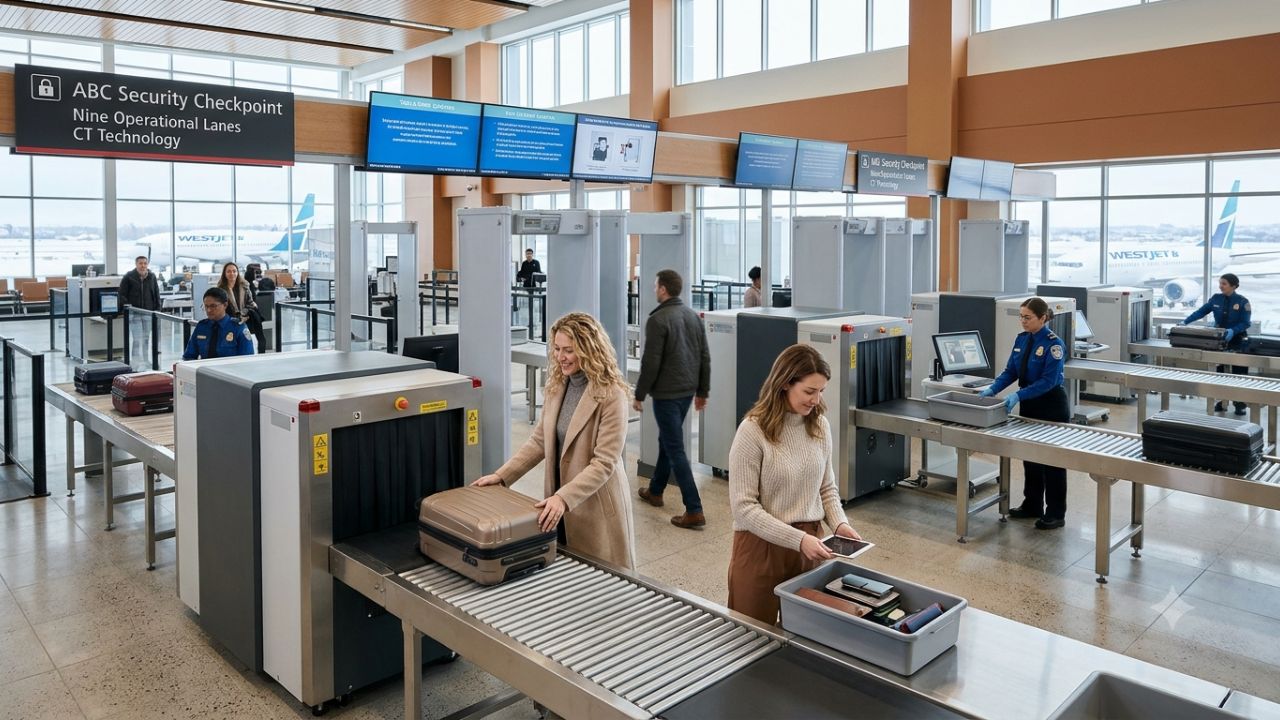
CALGARY — Domestic air travel through Western Canada has entered a new era of operational efficiency as YYC Calgary International Airport officially brought all nine security screening lanes into active service at its centralized ABC Security checkpoint. The infrastructure milestone, confirmed by The Calgary Airport Authority on November 5, 2026, marks the full operational realization of a multi-phase passenger terminal transformation. By integrating cutting-edge computed tomography (CT) X-ray scanning technology across all nine lanes, the facility elevates domestic passenger screening capacity to nearly 2,000 travelers per hour, representing an extraordinary 70 percent increase in throughput over the airport's legacy domestic checkpoint configuration.
The opening of the final two screening lanes concludes a modernization initiative initiated in December 2025, when the airport first amalgamated three aging, separate concourse checkpoints into a singular architectural gateway on the departures level between terminal doors 4 and 7. Since that initial launch, more than 3.7 million domestic passengers have transited the centralized checkpoint. Now operating at maximum design capacity, the expanded facility eliminates persistent terminal bottlenecks, allows travelers to leave laptops, tablets, and compliant liquids inside carry-on luggage, and equips Calgary to accommodate a projected 40 percent surge in passenger traffic across the coming decade.
       YYC CALGARY AIRPORT DOMESTIC PASSENGER SCREENING TRANSFORMATION
       ===============================================================

       [ LEGACY DOMESTIC CONFIGURATION (PRE-DECEMBER 2025) ]
       * 3 Separate Fragmented Checkpoints (Concourses A, B, and C)
       * Legacy 2D dual-energy X-ray machines
       * Mandatory unpacking of laptops, electronics & liquids
       * Uneven queue distribution & severe peak-hour bottlenecks
                                      |
                                      v
       [ PHASE 1 CONSOLIDATION (DECEMBER 2025) ]
       * Unified ABC Security Checkpoint unveiled between Doors 4 & 7
       * 7 initial operational lanes deployed with CATSA CT technology
       * Over 3.7 million domestic travelers processed in first operational year
                                      |
                                      v
       [ FULL OPERATIONAL COMPLETION (NOVEMBER 2026) ]
       * All 9 Security Lanes fully activated with high-speed CT 3D scanners
       * Peak Screening Capacity: 1,800 to 1,980 passengers per hour (+70% YoY)
       * Laptops, tablets & compliant liquids remain untouched inside bags
       * Universal accessibility layout with dedicated special assistance lanes
The Architecture of Centralization: From Fragmented Checkpoints to ABC Security
Prior to the introduction of the ABC Security checkpoint, domestic departures at YYC Calgary International Airport were characterized by a fragmented, multi-checkpoint architecture that had evolved incrementally over several decades. Passengers departing on domestic flights were channeled into three separate, geographically isolated security areas serving Concourses A, B, and C.
This legacy layout suffered from severe operational imbalances. A sudden surge in WestJet departures from Concourse A would generate sprawling queues extending back into the terminal check-in halls, while screening lanes at Concourse C remained underutilized. Conversely, passengers arriving on connecting flights faced confusing wayfinding and convoluted security re-checks when transferring between distinct terminal piers. Gate agents and airline ground crews frequently dealt with delayed departures caused by passengers trapped in security queues at one concourse while screening staff stood idle at another.
YYC DOMESTIC SCREENING: LEGACY VS. CENTRALIZED MATRIX
| Entity / Facility | Delays | Cancellations | Details |
|---|---|---|---|
| Operational Feature | Legacy Fragmented | Consolidated ABC | Performance & Passenger |
| & Performance Metric | Concourse Screening | Security (9 Lanes) | Efficiency Dividend |
| Checkpoint Locations | 3 separate areas | 1 centralized hub | Eliminates confusing |
| & Wayfinding Flow | across Concourses | between terminal | terminal wayfinding; |
| A, B, and C | doors 4 and 7 | unified entry point | |
| Operational Screening | Approximately | 1,800 to 1,980 | +70% hourly passenger |
| Throughput Capacity | 1,100 passengers | passengers per | processing volume; |
| per hour combined | hour at peak | absorbs flight banks | |
| Screening Technology | Legacy 2D planar | Advanced 3D | 360-degree volumetric |
| & Baggage Imaging | transmission X-ray | Computed Tomography | inspection; automated |
| scanners | (CT) technology | threat detection | |
| Passenger Luggage | Mandatory removal | Laptops, tablets & | Drastically reduces bin |
| Preparation Burden | of all laptops, | permitted liquids | usage; speeds up tray |
| tablets & liquids | remain inside bags | loading to <15 seconds |
The construction of the centralized ABC Security facility resolved these structural friction points by consolidating all domestic screening into a single wide-span concourse. When Phase 1 opened in December 2025 with seven initial lanes, it immediately proved the efficacy of centralization, processing over 3.7 million domestic travelers across its first eleven months of operation.
With the activation of lanes eight and nine in November 2026, the facility reaches its maximum architectural capability. Airport operations managers can now dynamically adjust lane openings based on real-time flight departures, distributing passenger flows evenly across the nine lanes and eliminating the erratic bottlenecks that previously plagued peak morning and late-afternoon travel banks.
The Physics and Efficiency of Computed Tomography (CT) 3D Scanning
The true technological engine powering Calgary’s domestic security transformation is the deployment of advanced computed tomography (CT) X-ray scanners across every single lane. Deployed in close partnership with the Canadian Air Transport Security Authority (CATSA)—the federal Crown corporation responsible for passenger and baggage screening across 89 designated Canadian airports—the equipment represents the most significant advancement in checkpoint aviation security in a generation.
Legacy airport security checkpoints have long relied on two-dimensional dual-energy X-ray machines. While effective, standard 2D machines produce flat, shadow-like projection images. When complex electronic devices such as laptops, portable hard drives, camera bodies, and liquid bottles are packed closely together inside a carry-on bag, their internal circuitry, battery cells, and containers overlap on the screen, creating opaque visual masses that security screeners cannot decipher. Consequently, passengers were historically required to execute the cumbersome "bin shuffle": unzipping luggage, extracting laptops and tablets, placing liquid containers in clear plastic bags, and spreading items across three or four separate plastic trays.
       COMPUTED TOMOGRAPHY (CT) VS. 2D X-RAY SCREENING MECHANICS
       =========================================================

       [ LEGACY 2D DUAL-ENERGY X-RAY ]
       * Produces static, flat silhouette images
       * Overlapping circuitry creates visual blind spots
       * High manual bag search rate (10% to 15% of all bags flagged)
       * Average tray preparation time per passenger: 45 to 60 seconds
                                      |
                                      v
       [ ADVANCED COMPUTED TOMOGRAPHY (CT) 3D SCANNERS ]
       * High-speed rotating gantry captures hundreds of cross-sectional views
       * Algorithmic 3D volumetric reconstruction of entire bag interior
       * Screeners rotate, slice, and isolate individual objects digitally
       * Automated explosive detection algorithms calculate material density
       * Average tray preparation time per passenger: Under 15 seconds
Computed tomography operates on entirely different physical principles, derived from medical diagnostic scanning technology. As a carry-on suitcase enters the CT scanner tunnel, an X-ray source and detector array rotate rapidly around the bag, taking hundreds of precise cross-sectional photographic exposures per second. Sophisticated computer algorithms instantly synthesize these individual cross-sections into a high-resolution, three-dimensional volumetric image of the bag’s entire interior.
Security screening officers can manipulate this 3D image on high-resolution touchscreens—rotating the virtual suitcase 360 degrees on any axis, digitally peeling back layers of clothing, and isolating individual electronic components. In parallel, the CT system incorporates automated threat recognition software that calculates the precise atomic density and mass of organic substances, automatically flagging potential liquid or solid explosives with colored visual overlays.
Because the system visualizes the bag's contents with volumetric clarity, passengers no longer need to unpack their belongings. Laptops, iPads, digital cameras, CPAP machines, and permitted toiletry bottles remain securely zipped inside carry-on luggage. By eliminating the necessity of unpacking and repacking bags at the conveyor belt, average tray loading times have dropped from nearly a minute per passenger to under 15 seconds, dramatically accelerating the physical speed of the screening line.
Debunking the Liquid Rule: What the CT Upgrade Changes and What It Does Not
The introduction of advanced CT technology has generated widespread public discussion regarding international aviation liquid allowances. Travelers must understand the precise regulatory distinction between screening capability and statutory liquid volume limits:
CATSA LIQUID REGULATIONS AT YYC CALGARY AIRPORT
| Regulatory Dimension | Legacy Rule Status | New CT Lane Status | Traveler Action |
|---|---|---|---|
| & Security Standard | (Pre-Upgrade) | (Active Standard) | & Compliance Rule |
| 100 mL Container | Strictly capped | Strictly capped | Every container must |
| Capacity Limit | at 100 mL / | at 100 mL / | be 100 mL (3.4 oz) or |
| 3.4 oz per bottle | 3.4 oz per bottle | smaller; no changes | |
| Total Liquid Bag | Must fit inside | Must fit inside | 1-liter clear plastic |
| Volume Limit | one clear 1-liter | one clear 1-liter | bag allowance remains |
| resealable bag | resealable bag | the statutory ceiling | |
| Physical Removal | Mandatory removal | Permitted to | Keep liquids zipped |
| from Carry-On Luggage | of liquid bag onto | remain inside bag; | inside luggage during |
| screening tray | no removal needed | checkpoint transit | |
| Exceptions for Baby | Permitted in | Permitted in | Must be declared to |
| Formula & Medication | reasonable amounts | reasonable amounts | screening officers |
| exceeding 100 mL | exceeding 100 mL | for separate test |
Calgary Airports and CATSA have emphasized that the rollout of CT scanners does not signal an abolition of the long-standing 100-milliliter (3.4-ounce) liquid restriction. Full-sized shampoo bottles, aerosol cans, large beverage containers, and travel coffee mugs exceeding 100 mL remain strictly prohibited in carry-on baggage under Transport Canada civil aviation security regulations.
What has changed is purely procedural: passengers carrying compliant 100 mL containers within their one-liter clear toiletry bags are no longer required to remove that bag from their suitcase. The CT scanner’s density-measuring algorithms verify the chemical profile of permitted liquids while they remain nestled between clothing items. Any oversized liquid container detected by the CT system will still trigger an automated bag rejection, requiring a manual search by a CATSA screening officer.
Accessibility, Human-Centric Design, and Terminal Ambiance
Beyond raw engineering metrics, the centralized ABC Security facility represents a philosophical shift toward human-centric airport architecture. Airport security checkpoints are universally recognized as the single most stressful juncture in modern commercial aviation, where time pressure, noise, sensory overload, and physical scrutiny combine to heighten passenger anxiety.
Positioned on the departures level between terminal doors 4 and 7, the ABC facility was specifically engineered to alleviate psychological and physical strain. The spatial layout incorporates expansive architectural sightlines that allow travelers entering from the public concourse to immediately view the entire screening floor, assess queue progression, and navigate without spatial disorientation.
       ABC SECURITY ACCESSIBILITY & PASSENGER COMFORT FRAMEWORK
       ========================================================

       [ EXPANSIVE SPATIAL ARCHITECTURE ]
       * High vaulted ceilings with integrated acoustic dampening panels
       * Soft, indirect natural daylight filtering through glass facades
       * Wide circulation channels accommodating oversized mountain sports gear
                                     |
                                     v
       [ DEDICATED SPECIAL ASSISTANCE INFRASTRUCTURE ]
       * Specialized low-barrier lanes for wheelchair and mobility scooter access
       * Dedicated family processing zones with extended staging benches
       * Tactile floor wayfinding and high-contrast visual signage
                                     |
                                     v
       [ RECONFIGURED REVESTING & EXIT PRECINCTS ]
       * Spacious post-screening repack zones equipped with ergonomic seating
       * Dedicated counters for organizing belongings away from conveyor exits
       * Direct visual connection into domestic retail and dining concourses
Acoustic management was a primary design consideration. High-vaulted ceilings lined with sound-dampening acoustic baffles absorb the ambient clatter of plastic conveyor trays, automated rollers, and public address announcements. High-output, non-glare LED illumination mimics natural daylight, while broad circulation lanes comfortably accommodate families with strollers, elderly passengers, and travelers carrying bulky outdoor sporting gear such as ski bags, hiking packs, and golf cases.
Importantly, the checkpoint features dedicated Special Assistance and Family lanes. These lanes are outfitted with lowered conveyor belts, wider physical turnstiles that easily accommodate motorized wheelchairs and electric mobility scooters, and specialized private screening rooms for travelers requiring confidential physical examinations. CATSA personnel assigned to these lanes receive specialized training in assisting neurodivergent passengers, travelers with hidden disabilities, and individuals transiting with service animals.
Following the screening process, the facility opens into an expanded "revesting" area. Rather than being forced to balance on one foot while tying shoes in a crowded conveyor exit, travelers have access to long wooden benches, clean shelving units, and full-length mirrors to repack their belongings at an unhurried pace before proceeding into the airside departure concourses.
The Gateway to the Canadian Rockies: Accommodating a 40% Growth Horizon
The full commissioning of the nine-lane ABC Security checkpoint is directly linked to the broader macroeconomic trajectory of Alberta and the Calgary Airport Authority’s long-term master development plan. Operating under the provincial Regional Airports Authorities Act, The Calgary Airport Authority manages both YYC Calgary International Airport and YBW Springbank Airport as self-sustaining, non-share-capital regional economic engines.
YYC currently supports over 50,000 direct and indirect regional jobs and generates billions of dollars in annual provincial gross domestic product (GDP). Recognized as one of Alberta's Top Employers for 2026, the authority has published long-range traffic forecasts projecting that passenger throughput at YYC will surge by 40 percent over the next ten years.
CALGARY REGIONAL TOURISM & AVIATION EXPANSION VECTORS
| Economic & Tourism | Strategic Driver | Target Passenger | Airport Operational |
|---|---|---|---|
| Growth Vector | & Regional Scale | Demographics | Infrastructure Role |
| Canadian Rockies | Year-round tourism | Millions of inbound | High-capacity domestic |
| International Gateway | to Banff, Jasper, | leisure travelers | arrival-to-departure |
| Lake Louise & Kananaskis | from US, Europe & Asia | transfer screening | |
| Alberta Commercial | Booming energy, | Corporate business | Rapid <10 minute |
| & Corporate Engine | agriculture, tech | commuters flying | throughput for high- |
| & logistics sector | transcontinental | frequency flyers | |
| WestJet Global | Consolidation of | Connecting transfer | Optimized Minimum |
| Hub Network Hub | Boeing 737 MAX & | traffic linking | Connection Times (MCT) |
| 787 Dreamliner fleet | domestic to world | between flight banks |
Calgary’s aviation growth is fueled by two distinct passenger currents. Domestically, Alberta has experienced sustained population in-migration, attracting tens of thousands of skilled professionals and families relocating from British Columbia and Ontario. This demographic influx has stimulated intense year-round commercial travel across the Calgary–Edmonton corridor and high-frequency transcontinental business shuttles connecting Calgary with Toronto, Vancouver, and Montreal.
Simultaneously, Calgary functions as the undisputed international aviation gateway to the Canadian Rocky Mountains. Positioned just 90 minutes east of Banff National Park—a UNESCO World Heritage site that welcomes over four million visitors annually—YYC funnels millions of global eco-tourists, alpine skiers, mountaineers, and road-trippers arriving from the United States, Europe, and Asia. Inbound international tourists landing in Calgary frequently take domestic connecting flights to explore northern Alberta, British Columbia's interior, or the Northwest Territories.
Expanding domestic security screening to an hourly capacity of nearly 2,000 passengers ensures that during the intense summer tourist rush and winter ski seasons, the airport can process waves of outdoor adventurers with oversized gear without compromising safety or schedule reliability.
WestJet’s Mega-Hub: Protecting Minimum Connection Times and Flight Banks
The strategic value of the nine-lane ABC Security checkpoint is nowhere more evident than in its integration with the corporate operations of WestJet. Headquartered on the grounds of YYC, WestJet is Canada’s second-largest airline and has established Calgary as its primary global mega-hub.
Under WestJet’s post-pandemic network strategy, the carrier concentrated its intercontinental widebody Boeing 787-9 Dreamliner operations exclusively in Calgary, operating direct intercontinental flagship routes to London Heathrow, Paris Charles de Gaulle, Tokyo Narita, Rome Fiumicino, and Dublin. To fill these massive widebody aircraft, WestJet relies on a sophisticated "hub-and-spoke" wave structure, funneling dozens of narrowbody Boeing 737 MAX and regional feeder flights from cities across Western and Northern Canada into Calgary every morning and afternoon.
       WESTJET CONNECTING BANK ARCHITECTURE AT YYC CALGARY
       ====================================================

       [ INBOUND DOMESTIC MORNING WAVE (07:30–09:00) ]
       * Feeder flights arrive from Edmonton, Vancouver, Victoria, Kelowna, Regina
       * Hundreds of domestic transfer passengers disembark into central terminal
                                      |
                                      v
       [ THE ABC SECURITY TRANSIT JUNCTION ]
       * High-throughput 1,980 passengers/hour capacity
       * Decongested central screening prevents transfer passenger logjams
       * Fast-track lanes for verified travelers and tight connections
                                      |
                                      v
       [ OUTBOUND INTERCONTINENTAL & TRANSCONTINENTAL BANK (10:00–11:30) ]
       * Boeing 787 Dreamliners depart for London, Paris, Tokyo, Rome
       * Narrowbody Boeing 737 MAX flights depart for Toronto, Montreal, Ottawa
       * Result: Zero aircraft dispatch delays attributable to security queues
In a tightly coordinated hub operation, security screening efficiency directly governs Minimum Connection Times (MCT). If transfer passengers arriving on regional domestic flights must clear security before accessing international departure gates or connecting domestic concourses, any checkpoint delay risks triggering missed flight connections, stranded luggage, and costly flight delays.
By boosting domestic screening throughput by more than 70 percent, the ABC checkpoint acts as a high-capacity flow regulator. Hundreds of connecting passengers disembarking from a delayed regional flight can clear the nine-lane checkpoint in a fraction of the time previously required, ensuring that WestJet’s multi-million-dollar widebody departures push back from the gate on schedule.
National Leadership: Comparing Calgary with Toronto, Vancouver, and Montreal
The completion of Calgary’s nine-lane CT screening facility places YYC at the leading edge of a broader, multi-year technological transformation unfolding across Canadian civil aviation. CATSA’s national modernization mandate, officially launched in 2024, aims to replace legacy 2D X-ray systems across all major Tier 1 Canadian airports over a multi-year capital deployment cycle.
While pilot testing of CT scanners has occurred at Toronto Pearson International Airport (YYZ), Vancouver International Airport (YVR), and Montreal-Trudeau International Airport (YUL), Calgary is among the very first major Canadian aviation hubs to execute a total, wall-to-wall deployment across an entire centralized domestic screening complex.
NORTH AMERICAN AIRPORT CT SECURITY DEPLOYMENT BENCHMARK
| Airport & National | Deployment Scale | Passenger Policy | Domestic Passenger |
|---|---|---|---|
| Security Authority | & Operating Status | & Carry-On Rules | Experience Impact |
| YYC Calgary Airport | Full 9-lane wall- | Laptops & liquids | Industry benchmark; |
| (CATSA / Canada) | to-wall deployment | stay inside bags; | 1,980 passengers/hour; |
| at ABC Checkpoint | 100 mL cap active | zero concourse split | |
| YYZ Toronto Pearson | Phased rollout | Laptops stay in | High-capacity terminals |
| (CATSA / Canada) | across Terminal 1 | bags on active CT | gradually transitioning |
| and Terminal 3 | designated lanes | from legacy 2D lanes | |
| US Tier 1 Hubs | Extensive rollout | Laptops stay in | PreCheck lanes enjoy |
| (TSA / United States) | across major hubs | bags; liquids cap | rapid transit; standard |
| (ATL, ORD, DFW) | strictly enforced | lanes still transitioning | |
| European Hubs | Mixed rollout; some | In select hubs, | Uneven implementation; |
| (ECAC / Europe) | hubs lifted 100 mL | 100 mL rule lifted | temporary reimposition |
| cap temporarily | then reinstated | of 100 mL caps in EU |
Calgary’s implementation stands in stark contrast to the uneven rollouts observed internationally. In the United States, the Transportation Security Administration (TSA) has deployed hundreds of CT checkpoint scanners, yet many high-volume domestic lanes still utilize legacy equipment, forcing travelers to navigate inconsistent packing rules from airport to airport. In Europe, several airports that attempted to eliminate the 100 mL liquid cap entirely following CT installation were recently forced by the European Commission to temporarily reinstate the restriction due to software calibration reviews.
By maintaining strict adherence to the 100 mL container limit while maximizing the convenience of keeping items inside bags across all nine lanes, Calgary has implemented a stable, predictable, and exceptionally rapid security operation that serves as a gold standard for airport authorities worldwide.
Traveler Action Plan: Mastering Domestic Departures at YYC in 2026/2027
For domestic passengers, corporate road warriors, and international tourists departing from Calgary International Airport, following these practical guidelines ensures a smooth, stress-free journey through the new ABC Security checkpoint:
        YYC DOMESTIC DEPARTURE TRANSIT WORKFLOW
        =======================================

        [ 1. TARGET TERMINAL ACCESS DOORS 4 THROUGH 7 ]
        * Departures level curb drop-off between Doors 4 and 7
        * Unified access point for all airlines (WestJet, Air Canada, Porter, Flair)
                               |
                               v
        [ 2. ORGANIZE CARRY-ON PACKING BEFORE ARRIVAL ]
        * Leave laptops, tablets & e-readers packed inside luggage
        * Ensure all liquid containers are 100 mL (3.4 oz) or smaller
        * Pack all liquids in one clear, resealable 1-liter plastic bag
                               |
                               v
        [ 3. SELECT OPTIMAL CHECKPOINT CONVEYOR LANE ]
        * Standard Travelers: Lanes 1 through 7 (High-speed automated flow)
        * Special Assistance & Families: Dedicated low-barrier lanes 8 and 9
        * CATSA Verified Travellers: Dedicated priority access lanes
                               |
                               v
        [ 4. EFFORTLESS TRAY LOADING & REVESTING ]
        * Place entire carry-on bag directly into scanner tray
        * Empty coat pockets, remove bulky outerwear & metal belts
        * Revest in spacious post-screening lounge with dedicated benches
- Enter via Departures Doors 4 to 7: Disregard old concourse-specific security habits. Whether flying on WestJet from Concourse A, Air Canada from Concourse C, or regional carriers from Concourse B, proceed directly to the central ABC Security entrance located on the upper departures level between terminal doors 4 and 7.
- Leave Electronics and Liquids Packed: Do not waste time unzipping your carry-on luggage in the queue. Your laptop, tablet, Kindle, mobile devices, and compliant liquid bag should remain safely packed inside your suitcase. Simply place your suitcase flat on the automated conveyor belt tray.
- Double-Check Container Volumes: Remember that the 100 mL limit remains strictly enforced. Even with advanced CT technology, an unemptied metal water bottle or a 150 mL lotion container will automatically flag your bag for manual physical inspection, wiping out the time saved by the high-speed scanner. Empty all reusable water bottles before entering the queue (water refill stations are located immediately post-security).
- Leverage CATSA Verified Traveller Lanes: Eligible passengers—including members of NEXUS, Global Entry, active military personnel, and aircrew—can utilize dedicated CATSA Verified Traveller access lines within the ABC checkpoint. These priority lanes further accelerate processing during morning departure rushes between 06:00 and 08:30.
The completed transformation of the ABC Security checkpoint at YYC Calgary International Airport proves that modern aviation security does not need to be an exercise in traveler frustration. By uniting unified architectural space, compassionate accessibility, and advanced 3D scanning physics, Calgary has created a domestic departure experience that sets a new national standard for Canadian travel.
Related Travel Guides
- USA Air Travel Costs Surge as JetBlue Increases Baggage Fees to Fifty Dollars
- Vietnam Airlines Implements Strict US Travel Rules and CDC Ebola Health Declarations
- Emirates Explores First Class Suites for Airbus A350-1000 Amid Widebody Fleet Modernization
- Virgin Australia Unveils Major Lounge Network Expansion with 100-Seat Brisbane Upgrade
- Air Canada Drops Toronto–Mumbai Flights from 2027 Network Amid Widebody Fleet Realignment
This article is for informational purposes. Flight routes, passenger regulations, visa rules, and transit advisories are subject to change by airlines and aviation authorities. Readers are advised to verify schedules and travel documentation with relevant carriers and border agencies before departure.
Related Stories
Auckland and Regional Aviation Hubs Advance New Zealand's Long-Haul Travel with Economy Skynest Sleep Cabins and Biometric Borders
Emirates Explores First Class Suites for Airbus A350-1000 Amid Widebody Fleet Modernization and A380 Succession Planning
