Emirates Explores First Class Suites for Airbus A350-1000 Amid Widebody Fleet Modernization and A380 Succession Planning

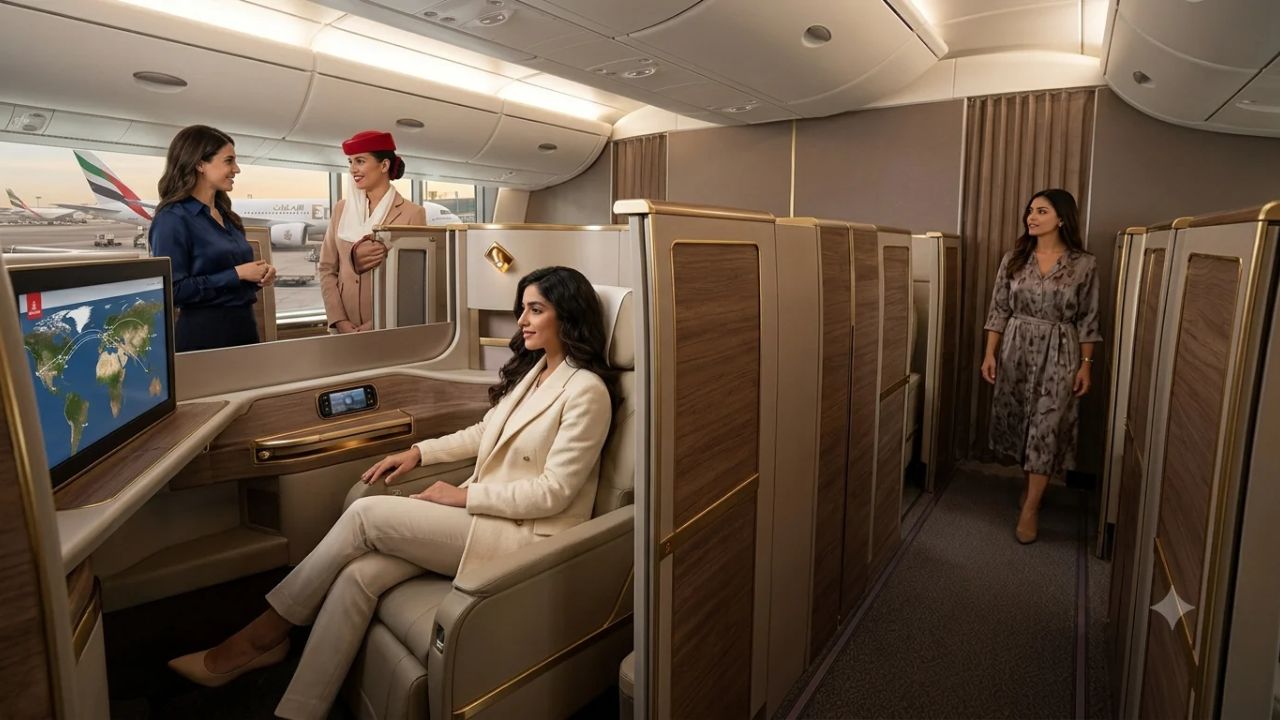
DUBAI — Gulf mega-carrier Emirates has engaged in collaborative cabin design studies with European planemaker Airbus to engineer a bespoke First Class suite product for the Airbus A350-1000, signaling a potential expansion of its signature luxury travel tier onto next-generation twin-engine widebodies. The disclosure, confirmed by Emirates President Sir Tim Clark in early November 2026, marks the first time the Dubai-based airline has formally developed top-tier luxury layouts for the A350 aircraft family—a platform that currently operates exclusively in a three-class configuration without first class across Emirates’ active fleet.
While Emirates has not yet executed a firm purchase contract or announced delivery dates for the stretched A350-1000, Clark affirmed the airline’s strategic intent: if Emirates proceeds with an order for the largest A350 variant, an ultra-exclusive First Class cabin will be central to its interior architecture. The design initiative emerges at an important inflection point in global long-haul aviation. As Emirates outlines the phased retirement of its iconic double-decker Airbus A380 fleet toward a 2041 horizon, and contends with multi-year delivery delays on its massive 270-aircraft Boeing 777X orderbook, the carrier is systematically preparing alternative widebody platforms to uphold its reputation as the preeminent benchmark of commercial aviation luxury.
       EMIRATES LONG-HAUL WIDEBODY FLEET EVOLUTION MATRIX (2026–2041)
       ==============================================================

       [ THE PAST & PRESENT BENCHMARK ]       [ CURRENT TWIN-ENGINE WORKHORSE ]
       Airbus A380-800 Superjumbo             Airbus A350-900 (73 on Order)
       * Double-decker spatial luxury          * In service since Jan 2025 (30+ destinations)
       * Shower Spas & Upper Deck Lounge      * Strictly 3-Class (32 Biz, 21 Prem, 259 Econ)
       * Planned fleet retirement by ~2041    * No First Class suites installed
                         \                                /
                          \                              /
                           v                            v
       +---------------------------------------------------------------+
       |           NEXT-GENERATION ULTRA-LUXURY TWIN-ENGINE FLEET      |
       |  * A350-1000 First Class Concept: Bespoke enclosed suites     |
       |  * Boeing 777-9 (270 on order): Safran Unity Business Suites  |
       |  * Mid-Cabin Social Lounge: Preserving A380 social ethos      |
       |  * Future Mega-Twin Explorations: A350-2000 & Boeing 777-10  |
       +---------------------------------------------------------------+
                                       |
       +-------------------------------+-------------------------------+
       |                               |                               |
       v                               v                               v
[ SPATIAL RECONFIGURATION ]    [ AERODYNAMIC EFFICIENCY ]     [ SCHEDULE RESILIENCE ]
* Enclosed suites on single-   * 25% lower fuel burn vs.      * Dual-source hedge against
  deck composite airframes       quad-engine superjumbos        ongoing Boeing 777X delays
The A380 Succession Dilemma: Reinventing Spatial Luxury on a Single Deck
For more than two decades, the Airbus A380 superjumbo has functioned as the defining architectural statement of the Emirates brand. With approximately 116 superjumbos forming the commercial backbone of its Dubai hub at its peak, Emirates constructed an unparalleled passenger experience around the double-decker aircraft’s vast interior volume. Amenities such as the First Class Shower Spas, private enclosed suites with sliding privacy doors, and the famous horseshoe-shaped Upper Deck Onboard Lounge transformed long-haul transit into a hospitality destination.
However, commercial aviation economics have permanently shifted away from four-engine very large aircraft (VLAs). Airbus officially concluded A380 production in 2021, and while Emirates has invested hundreds of millions of dollars in comprehensive cabin retrofit programs to extend the operating life of its superjumbos into the late 2030s, the airline is operating against an inescapable retirement timeline. Current fleet projections anticipate that the final Emirates A380 will be phased out of commercial service by approximately 2041.
EMIRATES WIDEBODY FLEET PLATFORM SPECIFICATION
| Entity / Facility | Delays | Cancellations | Details |
|---|---|---|---|
| Aircraft Platform | Structural Length | Maximum Seating | First Class Offering |
| & Program Status | & Wingspan Dimensions | & Cabin Width | & Luxury Configuration |
| Airbus A380-800 | Length: 72.72 m | 484 to 615 seats | 14 Enclosed Suites |
| (Active Mainstay) | Wingspan: 79.75 m | Double-deck: 6.54 m | with 2 Shower Spas |
| Airbus A350-900 | Length: 66.80 m | 312 seats | No First Class; |
| (In Active Service) | Wingspan: 64.75 m | Single-deck: 5.61 m | 3-Class Layout Only |
| Airbus A350-1000 | Length: 73.78 m | 375 to 400 seats | Bespoke Concept Under |
| (Design Evaluation) | Wingspan: 64.75 m | Single-deck: 5.61 m | Joint Airbus Study |
| Boeing 777-9 (777X) | Length: 76.72 m | ~380 to 420 seats | Game-Changer Suites & |
| (On Order: 270) | Wingspan: 71.75 m | Single-deck: 5.96 m | Safran Unity Business |
The fundamental dilemma confronting Sir Tim Clark and his network planners is spatial translation: how does an airline maintain the world’s most recognized luxury proposition when transitioning from a gargantuan double-decker aircraft to narrower, single-deck twin-engine airframes?
On an A380, the upper deck forward fuselage provided ample dead space for two full-sized shower suites and private restrooms without sacrificing lucrative business class seating rows. On modern twin-engine composite aircraft like the Airbus A350 and Boeing 777X, every square meter of floor space carries acute opportunity cost. Installing oversized private suites reduces the seat count in business class, premium economy, and economy, placing immense pressure on flight yields. The joint design study between Emirates and Airbus on the A350-1000 represents a concerted effort to test whether advanced industrial ergonomics can deliver an authentic first class sanctuary on a single-deck platform while preserving sustainable route profitability.
The Airbus A350-1000 as a Luxury Platform: Scale, Range, and Aerodynamics
The Airbus A350-1000 presents a compelling technical canvas for luxury long-haul engineering. Measuring 73.78 meters from nose to tail, the aircraft is seven meters longer than the A350-900, providing an expansive cabin floor area that comfortably accommodates between 375 and 400 passengers in a standard three-class layout, with certification limits extending up to 480 passengers.
Powered by advanced Rolls-Royce Trent XWB-97 turbofans, the A350-1000 boasts a published maximum operating range of up to 9,100 nautical miles in its latest performance iteration. This exceptional range allows the aircraft to connect Dubai nonstop with virtually any commercial aviation market across North America, South America, Australasia, and East Asia.
       A350-900 VS. A350-1000 CABIN FLOORSPACE DISTRIBUTION
       ====================================================

       [ CURRENT A350-900 THREE-CLASS CABIN (312 SEATS) ]
       +-----------------------------------------------------------------+
       |  32 Business Class   | 21 Prem Econ |      259 Economy Seats    |
       +-----------------------------------------------------------------+
       * Zero First Class Suites
       * Focus: High-efficiency mid-sized international spoke routes
                                      |
                                      v
       [ PROSPECTIVE A350-1000 FOUR-CLASS CONCEPT ]
       +-----------------------------------------------------------------+
       | 4-6 First |  44-50 Business  | 32 Prem Econ |  220-240 Economy  |
       |   Suites  |   (With Doors)   |              |       Seats       |
       +-----------------------------------------------------------------+
       * Dedicated First Class zone in forward cabin
       * Extended fuselage provides 7 extra meters of usable revenue deck
       * Balanced premium-to-economy floor allocation
The seven meters of additional fuselage length are decisive. On the smaller A350-900, dedicating space to four or six ultra-wide first class suites would have forced Emirates to drastically downsize its business class cabin or surrender valuable premium economy rows. Consequently, Emirates configured its initial order of 73 A350-900s without First Class, choosing a balanced three-class configuration comprising 32 Business Class seats, 21 Premium Economy seats, and 259 Economy seats (totaling 312 passenger accommodations).
On the A350-1000, however, the extended cabin deck allows Emirates to install a small, ultra-exclusive First Class cabin—likely configured with four to six fully enclosed private suites—while still retaining a business class cabin of 44 to 50 seats, a generous premium economy zone, and over 220 economy seats. This passenger mix generates the multi-tiered revenue density required to support intercontinental flagship routes connecting Dubai with high-yield financial hubs such as New York, London, Tokyo, and Sydney.
The Rolls-Royce Standoff: Engine Durability in Hostile Environments
While the aerodynamic and spatial merits of the A350-1000 are undisputed, Emirates’ reluctance to finalize a commercial order has historically centered around engine economics. At the Dubai Airshow in November 2023, Sir Tim Clark engaged in a widely publicized confrontation with British engine manufacturer Rolls-Royce regarding the durability of the Trent XWB-97 in harsh Middle Eastern operating environments.
Dubai’s geographic setting subjects commercial aircraft engines to extreme environmental stresses: scorching summer ambient temperatures frequently exceeding 45 degrees Celsius, combined with airborne quartz dust, desert sand, and industrial humidity. Under these abrasive thermal conditions, high-thrust turbofan engines experience elevated turbine blade erosion, thermal coating degradation, and premature maintenance cycles.
MIDDLE EAST ENGINE ENVIRONMENT STRESS FACTORS
| Operating Stressor | Physical & Thermal | Engineering Impact | Airline Commercial |
|---|---|---|---|
| & Regional Challenge | Manifestation | on Turbofan Core | Consequence |
| High Ambient Takeoff | Airfield surface | Reduced air density | Turbines operate at peak |
| Temperatures (45°C+) | heat spikes during | forces engines to | thermal redline, accelerating |
| midday departures | run hotter internal | component metal fatigue | |
| Airborne Quartz Sand | Fine particulate | Blasts compressor | Strips protective ceramic |
| & Desert Silica Dust | ingestion during | blades and clogs | coatings; causes glass-like |
| taxi, climb & descent | internal cooling air | deposits inside combustor | |
| Diminished Time On- | Frequent off-wing | Maintenance shop | Multiplies engine overhaul |
| Wing (TOW) Cycles | engine removal for | visits required at | expenses; grounds aircraft |
| major refurbishment | 2,000–3,000 hours | awaiting spare engines |
Clark had publicly stated that Emirates would not commit to purchasing the A350-1000 until Rolls-Royce demonstrated that the Trent XWB-97 could achieve satisfactory "time-on-wing" (TOW) intervals without requiring premature off-wing removals. Clark warned that if an engine had to be pulled off-wing every 2,000 to 2,500 flight hours for overhaul in desert conditions, the resulting maintenance expenses and aircraft downtime would destroy the operational profitability of the fleet.
The revelation in November 2026 that Emirates is actively designing First Class suites with Airbus indicates that technical and commercial negotiations with Rolls-Royce have advanced meaningfully. In response to Clark's unyielding public critiques, Rolls-Royce initiated a multi-million-pound engineering remediation program focused on its Trent family of powerplants. Metallurgists and propulsion engineers in Derby redesigned the high-pressure turbine blades, applying proprietary ceramic thermal barrier coatings capable of withstanding the micro-abrasive silica dust prevalent across Gulf desert routes.
In addition, Rolls-Royce introduced enhanced internal cooling geometry that reduces thermal stress across the combustor during high-power takeoff runs at ambient airfield temperatures exceeding 45 degrees Celsius. While Emirates has not signed a finalized power-by-the-hour maintenance concession, Clark’s willingness to advance cabin industrial design directly with Airbus demonstrates that the engine durability gap is closing toward mutually acceptable commercial guarantees. Should Rolls-Royce deliver binding time-on-wing performance benchmarks, the path will be clear for Emirates to cement a multi-billion-dollar A350-1000 order.
The Boeing 777X Bottleneck: Delays, Certification, and Cabin Write-Offs
Emirates’ consideration of the Airbus A350-1000 must also be evaluated within the context of Boeing’s protracted 777X development delays. Emirates represents the undisputed anchor customer of the Boeing 777X program, having committed to a staggering orderbook of 270 aircraft—comprising 205 Boeing 777-9s and 35 smaller 777-8s—solidified by a US$38 billion order expansion at the Dubai Airshow in November 2025.
However, the Boeing 777X certification timeline has suffered repeated multi-year postponements. Originally slated for commercial passenger delivery in 2020, the aircraft’s entry into service has been continuously delayed due to rigorous regulatory scrutiny following the 737 MAX groundings, software revisions, engine testing adjustments, and recent flight-test halts associated with engine-thrust-link structural inspections. Boeing's third-quarter 2026 financial guidance identified 2027 as the targeted first delivery milestone, representing an unprecedented seven-year delay from original contract projections.
       BOEING 777X CERTIFICATION TIMELINE DISRUPTION
       ==============================================

       2013: Program Launched; Emirates places landmark foundational orders
         |
       2020: Original Contracted Delivery Horizon (Unmet due to development delays)
         |
       2022: Certification timelines pushed out; global supply chain disruptions
         |
       2024: Test fleet engine-link inspections trigger temporary flight-test pause
         |
       2025: Emirates adds 65 additional 777-9s at Dubai Airshow (Total: 270 aircraft)
         |
       2026: Technology obsolescence forces complete €30M business class redesign
         |
       2027: Boeing's targeted first commercial delivery milestone
These persistent delays have imposed severe financial and operational costs on Emirates. Most dramatically, Clark disclosed that Emirates was forced to completely discard its original bespoke business class cabin design for the 777-9 because the rapid pace of passenger-facing consumer electronics had rendered the early concept obsolete before the aircraft was ever built.
Developing a premier long-haul cabin involves heavy industrial tooling, ergonomic certification, and crash-testing approvals with seat manufacturers. Abandoning the initial 777-9 seating concept incurred between €20 million and €30 million in direct cancellation and write-off costs paid to aerospace seat fabricators. Entertainment screens that were state-of-the-art in 2018 lacked 4K resolution and Bluetooth multi-pairing; wireless charging docks did not support contemporary Qi fast-charging protocols; and privacy sliding doors had evolved from luxury novelties into standard commercial expectations.
By simultaneously studying an A350-1000 First Class concept with Airbus, Emirates establishes vital strategic hedging. Engaging Airbus in direct design work signals to Boeing that while Emirates remains committed to the 777X, the Gulf carrier will not permit perpetual certification slips to paralyze its long-term premium fleet modernization.
The fleet stakes could hardly be higher. The Boeing 777-9, equipped with massive GE Aerospace GE9X powerplants and revolutionary folding carbon-fiber wingtips, is designed to serve as Emirates’ high-capacity flagship for the 2030s. The 71.75-meter wingspan folds upright to 64.8 meters upon landing, allowing the giant twin-jet to utilize standard Code E airport parking gates without requiring the specialized dual-jetbridge gate modifications that restricted the A380. However, until Boeing resolves its regulatory flight-testing hurdles and FAA certification sign-offs, Emirates cannot afford to let its long-term fleet renewal remain beholden to a single manufacturer. Developing an alternative first-class platform on the A350-1000 ensures that if 777-9 delivery dates slip into late 2027 or 2028, Emirates can pivot widebody acquisition toward Toulouse with ready-made cabin architecture.
The Next-Generation Interior: Safran Unity and the Mid-Cabin Social Lounge
As Emirates reconfigures its future widebody interiors, the airline is introducing advanced seating architectures that bridge the gap between individual privacy and collective social hospitality. For its upcoming Boeing 777-9 fleet, Emirates has selected a heavily customized iteration of Safran’s acclaimed Unity platform as the foundation for its next-generation business class.
The Safran Unity architecture provides fully enclosed passenger suites equipped with full-height sliding privacy doors, direct-aisle access for every passenger, personal refrigerated mini-bars, integrated wireless inductive charging stations, and ultra-high-definition 4K touchscreens. The layout utilizes a subtle staggered geometry: window suites alternate between positions flush against the fuselage wall (offering maximum privacy) and positions adjacent to the aisle, while central suite pairs can be converted into shared double suites for traveling companions or partitioned off for solitary travelers.
                  EMIRATES FUTURE WIDEBODY CABIN ARCHITECTURE
                  ===========================================

                        [ FORWARD CABIN: FIRST CLASS SANCTUARY ]
                        * 4 to 6 fully enclosed private suites
                        * Zero-gravity flat-bed positioning & virtual windows
                        * Dedicated personal wardrobe & dining table for two
                                            |
                                            v
                        [ MID-CABIN: NEXT-GEN BUSINESS SUITES ]
                        * Safran Unity customized seating platform
                        * Full sliding privacy doors & 4K entertainment
                        * Inductive device charging & personal chilled minibars
                                            |
                                            v
                        [ CENTRAL TRANSIT: THE SOCIAL LOUNGE ZONE ]
                        * Reimagined social space between business sections
                        * Dual-sided banquette seating with charging ports
                        * Self-service premium refreshments & barista drinks
                                            |
                                            v
                        [ REAR CABIN: PREMIUM ECONOMY & ECONOMY ]
                        * Dedicated 2-4-2 layout with calf rests and cradle recline
                        * High-density 3-4-3 modern economy seating with USB-C
In parallel, Emirates is also reimagining the social element that made the A380 famous. Because a full horseshoe bar and cocktail lounge consumes too much floor space on a single-deck twin-engine widebody, Emirates is engineering a sophisticated "Social Lounge" zone situated in the central architectural cross-aisle between business class cabins on the 777-9.
Rather than a stand-up bar staffed by dedicated flight attendants, the concept features elegant dual-sided banquette seating, ambient mood lighting, high-end acoustic dampening, and self-service artisan refreshment stations offering specialty coffees, fine wines, and gourmet hors d'oeuvres. This innovative spatial compromise preserves the vital community ethos of Emirates' premium long-haul flying while retaining valuable floor space for revenue-generating seats. While it remains unconfirmed whether a similar social area could be integrated into a future A350-1000 layout, the design philosophy demonstrates Emirates' determination to carry its hospitality hallmarks onto twin-engine airframes.
The "Mega-Twin" Ambition: Lobbying for the A350-2000 and Boeing 777-10
Sir Tim Clark’s strategic gaze extends even further into the aerospace horizon. In his discussions regarding future fleet requirements, Clark reiterated his long-standing call for airframe manufacturers to develop true "mega-twins"—stretched twin-engine aircraft capable of seating 450 or more passengers in comfortable multi-class arrangements.
Clark specifically referenced prospective studies for an Airbus A350-2000 (a further fuselage stretch beyond the A350-1000) alongside a potential Boeing 777-10, which would extend the 777-9 by several fuselage frames. Emirates’ November 2025 agreement with Boeing formally preserved contractual options and conversion rights that could be directed toward a 777-10 development program should Boeing proceed with launch.
THE "MEGA-TWIN" AIRFRAME PROSPECTIVE LANDSCAPE
| Entity / Facility | Delays | Cancellations | Details |
|---|---|---|---|
| Aircraft Concept | Structural Scope | Targeted Seating | Strategic Role in |
| & Development Status | & Technical Form | & Cabin Capacity | Hub Decongestion |
| Airbus A350-2000 | Prospective 78 m | 420 to 450 seats | Bridges capacity gap |
| (Conceptual Study) | fuselage stretch; | in standard 3/4- | on slot-restricted |
| Trent XWB upgrade | class layout | European & Asian hubs | |
| Boeing 777-10 | Conceptual 80 m | 450 to 480 seats; | Direct twin-engine |
| (Contract Options | extended composite | high-density long- | successor to the A380 |
| Held by Emirates) | wing and fuselage | haul trunk routes | superjumbo volume |
The underlying motivation behind Clark’s push for mega-twins is airport slot congestion. Major global aviation hubs—including London Heathrow, Frankfurt, Paris Charles de Gaulle, Tokyo Haneda, and Dubai International itself—operate at or near maximum runway and gate capacity. In an airport environment where airlines cannot simply add more flights to meet surging travel demand, the only viable commercial mechanism for growth is "gauge"—flying physically larger aircraft that carry more passengers per departure slot.
As the A380 approaches retirement, failure by manufacturers to provide large-capacity twin-engine replacements would force hub-and-spoke carriers like Emirates to either cap passenger throughput or flood congested airports with smaller aircraft. By pushing Airbus on the A350-1000 and prospective A350-2000, and Boeing on the 777-9 and 777-10, Emirates is actively shaping the future product roadmaps of global aerospace manufacturing.
Traveler Guide: Navigating Emirates' Current and Future Cabin Reality
For business travelers, frequent flyers, and luxury enthusiasts booking travel on Emirates in 2026 and 2027, understanding the practical distinctions between active aircraft types and future cabin concepts is essential:
        TRAVELER CABIN SELECTION & VERIFICATION WORKFLOW
        ================================================

        [ 1. IDENTIFY DESIRED CABIN CLASS ]
        * If First Class is required:
          -> Prioritize Airbus A380-800 or Boeing 777-300ER / 777-200LR
          -> Avoid Airbus A350-900 (Strictly 3-Class: No First Class)
                               |
                               v
        [ 2. VERIFY AIRCRAFT EQUIPMENT ON ROUTE ]
        * Review booking engine equipment codes:
          -> A380: Shower Spa, Private Suites, Upper Deck Lounge
          -> 777-300ER: Check for Game-Changer 1-1-1 enclosed suites
          -> A350-900: Brand-new Business Class (1-2-1) & Premium Economy (2-4-2)
                               |
                               v
        [ 3. TRACK A350-900 NETWORK EXPANSION ]
        * Now operating to 30+ destinations including Edinburgh, Gatwick,
          Montréal, Lyon, Bologna, Muscat, and Kuala Lumpur
        * 6 additional airframes arriving before end of 2026 (36 total cities)
                               |
                               v
        [ 4. MAINTAIN REALISTIC HORIZONS FOR FUTURE TYPES ]
        * Boeing 777-9 entry into service targeted for 2027
        * Airbus A350-1000 First Class remains an unconfirmed future concept
- Verify Equipment Codes Before Booking First Class: Because Emirates’ active A350-900 fleet does not offer First Class, travelers seeking the carrier’s highest service tier must ensure their selected flights are operated by the Airbus A380 or Boeing 777. The A350-900 offers an exceptional three-class experience featuring cutting-edge business class seats and dedicated premium economy cabins, but first class suites will remain unavailable on A350 flights until an A350-1000 model is formally acquired and delivered.
- Monitor the Rapid A350-900 Route Rollout: The A350-900 is expanding across Europe, the Americas, and Asia. Having made its commercial debut to Edinburgh in January 2025, the aircraft now operates to London Gatwick, Montréal, Lyon, Bologna, and Kuala Lumpur, with its destination network reaching 36 cities by December 2026. Passengers traveling on these routes enjoy Emirates’ newest in-flight entertainment interfaces, faster satellite Wi-Fi connectivity, and quieter cabin acoustics.
- Understand 777X and A350-1000 Timelines: Travelers planning long-term luxury itineraries should note that the next generation of cabins will arrive in stages. The Boeing 777-9 with its customized Safran Unity business suites and mid-cabin social spaces is not expected to enter commercial service before 2027. Any prospective A350-1000 First Class suites remain in conceptual engineering and would require a formal aircraft order, manufacturing timeline, and delivery sequence that extends well toward the end of the decade.
Emirates’ collaborative exploration of First Class suites for the Airbus A350-1000 demonstrates that the airline is proactively safeguarding its luxury heritage in a post-A380 era. By challenging planemakers to push the spatial and aerodynamic boundaries of twin-engine widebodies, Emirates continues to dictate the terms of high-end international air travel for decades to come.
Related Travel Guides
- Virgin Australia Unveils Major Lounge Network Expansion with 100-Seat Brisbane Upgrade and Perth Beyond Reopening
- Air Canada Drops Toronto–Mumbai Flights from 2027 Network Amid Widebody Fleet Realignment
- Koh Yao Noi and Historic Global Capitals Gain Wider Luxury Reach as Wyndham Expands Registry Collection
- Seoul Tourism Spending Shifts Beyond Myeong-dong as Foreign Visitors Fuel an 80 Percent Surge in Seongsu and Namdaemun
- Secondary Cities Outpace Traditional Hubs in 2026 as Anti-Overtourism Regulations Spread
This article is for informational purposes. Flight routes, passenger regulations, visa rules, and transit advisories are subject to change by airlines and aviation authorities. Readers are advised to verify schedules and travel documentation with relevant carriers and border agencies before departure.
Related Stories
Emirates A380 Flight EK31 Diverts to Frankfurt Due to In-Flight Passenger Medical Emergency
Armenia Partners with Corporación América Airports for Major Zvartnots Terminal Expansion to Expand International Tourism Connectivity