Auckland and Regional Aviation Hubs Advance New Zealand's Long-Haul Travel with Economy Skynest Sleep Cabins and Biometric Borders

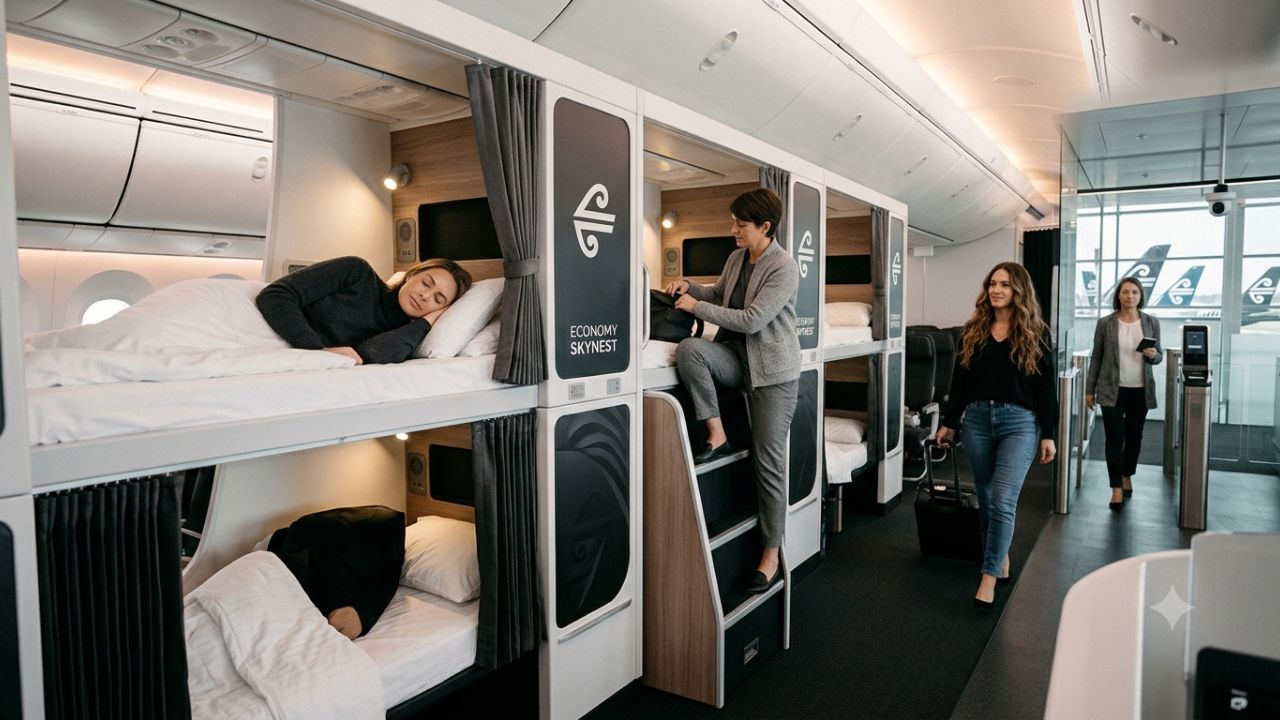
AUCKLAND — The profound geographic isolation of the South Pacific is driving an unprecedented systemic revolution across commercial aviation, as New Zealand carriers and border authorities deploy a synchronized ecosystem of physical cabin innovations, automated biometric processing, and algorithmic airline retailing. Unveiled across regional transport networks in November 2026, the initiatives address the acute physical and operational challenges of ultra-long-haul flight corridors connecting Auckland Airport (AKL) with North America and Europe. Leading this transformation is Air New Zealand’s commercial deployment of the Economy Skynest—the world's first certified lie-flat sleeping bunk installation engineered specifically for economy class passengers—paired with contactless "invisible border" clearance and modern dynamic retailing frameworks.
For decades, the physical separation of Oceania from global commercial capitals in London, New York, and Tokyo imposed severe economic and physiological penalties on international passengers and airline operations. Flagship services, such as the direct 17-hour transpacific route linking Auckland with New York’s John F. Kennedy International Airport (JFK), push twin-engine widebody aircraft to their aerodynamic and fuel-capacity boundaries while subjecting passengers confined in standard seating to severe circadian desynchronization and musculoskeletal exhaustion. By restructuring aircraft floor space around timeshared sleep economics, digitizing border control through privacy-preserving biometric tokens, and dismantling antiquated ticketing architectures, New Zealand is establishing an internationally recognized blueprint for sustainable, high-comfort long-haul mobility.
       NEW ZEALAND ULTRA-LONG-HAUL AVIATION TRANSFORMATION (2026–2027)
       ===============================================================

       [ THE OCEANIC DISTANCE CHALLENGE ]
       * Extreme Nonstop Sectors: Auckland (AKL) to New York (JFK) [17+ Hours]
       * Physical Toll: Musculoskeletal fatigue, circadian disruption, jet lag
       * Commercial Limits: Static seat density fails to maximize long-haul yields
                                      |
                                      v
       +---------------------------------------------------------------+
       |             THE TRI-PILLAR SYSTEMIC AVIATION SOLUTION         |
       +---------------------------------------------------------------+
            |                         |                         |
            v                         v                         v
[ 1. ECONOMY SKYNEST ]     [ 2. INVISIBLE BORDERS ]   [ 3. MODERN RETAILING ]
* 6-bunk lie-flat module   * Contactless eGates at    * IATA Offers & Orders
* 4-hour sleep sessions      AKL, WLG, CHC, and ZQN     replaces legacy PNRs
* Decouples physical rest  * Ephemeral cryptographic  * Dynamic attribute
  from ticket classes        biometric tokenization     bundling & wellness
* Full FAA/CAA clearance   * Privacy Code 2025 rules    curated sleep packages
                                      |
                                      v
       [ INTEGRATED ENTERPRISE RESILIENCE & PACIFIC SAFETY ]
       * Biomathematical Fatigue Risk Management Systems (FRMS) for flight crews
       * Real-time oceanic weather routing avoiding South Pacific convective storms
       * Seamless trans-Tasman processing synchronized with Australian SmartGates
The Tyranny of Distance: Operational Realities of 17-Hour Pacific Crossings
Commercial aviation in the South Pacific operates under what regional historians and transport economists define as the "tyranny of distance." Located in the southwestern Pacific Ocean, New Zealand is separated from mainland North America by more than 8,000 nautical miles of open water, while European hubs require circumnavigating half the globe.
Maintaining continuous, high-capacity commercial links across these trans-oceanic distances is an economic imperative for New Zealand's tourism economy, international education export sector, and high-value agricultural commerce. However, operating scheduled non-stop passenger flights on extreme sectors—such as Auckland to New York JFK or Auckland to Chicago O'Hare—presents immense technical and operational hurdles.
OCEANIC ULTRA-LONG-HAUL STAGE LENGTH DYNAMICS (AKL–JFK)
| Operational Factor | Baseline Metric | Flight Dispatch | Passenger Impact |
|---|---|---|---|
| & Flight Parameter | & Standard Value | Challenge | & Human Physiology |
| Scheduled Block Time | 16 hours 30 min to | Headwind variability | Musculoskeletal fatigue |
| & Flight Trajectory | 17 hours 45 min | over Pacific track | & prolonged immobility |
| Airframe Platform | Boeing 787-9 with | Heavy fuel burn vs. | High seat occupancy vs. |
| & Weight Thresholds | upgraded Maximum | commercial cargo | passenger physical |
| Takeoff Weight | payload trade-offs | comfort trade-offs | |
| Flight Crew Fatigue | Augmented 4-pilot | Strict regulatory | Cabin crew shift turns |
| & Rostering Limits | flight crew & dual | duty limits under | require certified |
| relief rotations | civil aviation law | dedicated rest bunks |
Twin-engine widebody aircraft, specifically higher-gross-weight variants of the Boeing 787-9 Dreamliner, are dispatched at their certified structural weight ceilings. Flight dispatchers must constantly calculate complex trade-offs between passenger loads, high-value freight cargo, seasonal jet-stream headwinds, and mandatory long-range fuel reserves required for emergency diversions to remote Pacific island runways like Honolulu, Tahiti, or Fiji.
Simultaneously, airline passenger surveys across post-pandemic travel cohorts revealed a stark reality: while travelers eagerly booked non-stop ultra-long-haul itineraries to avoid intermediate transit connections, the physiological toll of remaining seated upright in economy class for 17 continuous hours caused widespread physical discomfort, severe musculoskeletal stiffness, and prolonged jet-lag disruption that lingered for days after arrival. Traditional airline configurations that simply added an inch of legroom were no longer sufficient; addressing passenger well-being required an entirely new approach to physical rest architecture.
The Engineering of the Economy Skynest: Safety, Crashworthiness, and Pod Systems
Air New Zealand’s response to this challenge is the Economy Skynest—a world-first interior design that installs a six-bed, multi-level lie-flat sleeping compartment within the economy section of widebody passenger aircraft. Rather than reserving horizontal rest exclusively for premium business class cabins paying thousands of dollars per ticket, the Skynest introduces dedicated bunk beds for economy travelers.
Integrating a multi-tiered sleeping structure into a commercial airliner required years of intensive structural analysis, prototype testing, and joint airworthiness certification from the Civil Aviation Authority of New Zealand (CAA) and the United States Federal Aviation Administration (FAA).
                  AIR NEW ZEALAND ECONOMY SKYNEST POD ARCHITECTURE
                  ================================================

                           [ UPPER LEVEL: BUNK 1 & BUNK 2 ]
                           * Ergonomic full-length mattress (200 cm x 58 cm)
                           * Retractable acoustic privacy curtains
                           * Individual ventilation louvers & reading light
                                          |
                               [ ACCESS LADDER SYSTEM ]
                                          |
                           [ MIDDLE LEVEL: BUNK 3 & BUNK 4 ]
                           * Direct aisle access via central ladderway
                           * Personal storage pocket & device charging port
                           * Certified crash-rated lap restraint belt
                                          |
                                          v
                           [ LOWER LEVEL: BUNK 5 & BUNK 6 ]
                           * Low-entry floor-level bunk accessibility
                           * Independent continuous-flow oxygen module
                           * Automated thermal & smoke detection sensors
To meet rigorous global aviation safety criteria, the Skynest structure incorporates several advanced engineering systems:
- Structural Crashworthiness and Dynamic Load Absorption: Under international airworthiness regulations (FAR/JAR 25.562), passenger interior structures must withstand extreme dynamic deceleration forces of up to 16 times the force of gravity (16G) along the longitudinal flight axis. The Skynest bunk module is fabricated from high-tensile carbon-composite frames and aerospace-grade aluminum alloys, secured directly to the aircraft’s primary titanium floor seat tracks using energy-absorbing locking mechanisms designed to remain anchored during extreme impact.
- Emergency Evacuation and In-Flight Egress Clearance: International certification mandates that a fully loaded widebody cabin must be completely evacuated within 90 seconds through half the available exits in an emergency. Because the Skynest is certified solely for use during the cruise phase of flight, passengers are strictly prohibited from occupying the bunks during taxi, takeoff, and landing (TT&L). Every passenger using the Skynest retains their standard assigned forward-facing economy seat. In parallel, the pod entrance features a wide central corridor feeding directly into the aircraft's primary aisle, ensuring that resting passengers can evacuate instantly during clear-air turbulence or cabin depressurization events.
- Independent Environmental and Life-Support Systems: Each individual pod functions as a self-contained environmental chamber. Bunks are equipped with independent continuous-flow oxygen masks linked directly to the aircraft’s primary gaseous oxygen distribution network, ensuring instantaneous deployment if cabin altitude exceeds safe levels. In addition, each pod features sensitive optical smoke detectors, personal air-gasper louvers connected to the aircraft’s HEPA air filtration system, and certified lap seatbelts that passengers must keep fastened over their duvet while sleeping to protect against sudden turbulence.
The Sleep Economics Revolution: Timesharing Micro-Cabins and Yield Optimization
The introduction of the Economy Skynest fundamentally alters commercial airline revenue management. Historically, airlines monetized cabin floor space through a static, linear continuum: an economy passenger paid for a fixed seat footprint for 100 percent of the flight's duration, while business class travelers paid massive four- to six-fold fare markups to retain an exclusive lie-flat suite throughout the entire journey.
The Skynest commercializes "sleep economics" by decoupling physical rest from the baseline transport ticket. Instead of purchasing permanent horizontal space for the entire flight, economy and premium economy passengers can book discrete four-hour sleeping sessions in a Skynest pod as an optional ancillary purchase.
CABIN REVENUE & FLOOR-SPACE MONETIZATION COMPARISON
| Entity / Facility | Delays | Cancellations | Details |
|---|---|---|---|
| Interior Component | Baseline Economy | Economy Skynest | Business Premier |
| & Seating Class | Seating Row | 6-Bunk Module | Enclosed Suite |
| Floor Space Consumed | Approx. 9 standard | Space equivalent to | Approx. 4 to 5 times |
| by Cabin Module | economy seat units | roughly 9 economy | the floor footprint of |
| across cabin rows | seats in center | a basic economy seat | |
| Monetization Model | Single ticket fare | Timeshared access; | Dedicated premium fare; |
| & Revenue Frequency | per passenger for | multiple 4-hour | 1 passenger commands |
| entire flight leg | sessions sold | space for entire route | |
| Passenger Yield | Baseline economy | Decoupled premium; | Elite corporate yield; |
| Multiplication | unit margin per | monetizes rest on | highly sensitive to |
| available seat mile | high-volume flight | business travel cycles |
The four-hour session duration is rooted in clinical sleep medicine. Human sleep architecture is structured around 90-minute ultradian cycles that progress through light sleep (Stages N1 and N2), restorative deep slow-wave sleep (Stage N3), and rapid eye movement (REM) dreaming sleep. A four-hour booking provides ample duration for a traveler to complete two full, restorative 90-minute sleep cycles, with an integrated 30-minute operational buffer allowing for settling down, falling asleep, waking up, and dressing.
From a commercial yield perspective, the timesharing model dramatically outperforms static seating economics. The Skynest module occupies cabin floor space that would otherwise hold approximately nine standard economy seats. On a traditional flight, those nine seats could be sold only once per passenger leg. However, by rotating passengers through the six bunks in sequential four-hour shifts across a 17-hour flight, the airline can sell up to 18 or 24 individual sleeping sessions per transpacific crossing. This multiplies ancillary revenue density per square meter of cabin floor space while providing budget-conscious travelers with affordable access to restorative horizontal sleep.
In-Flight Turnaround Protocols: Circadian Lighting, Hygiene, and Acoustic Etiquette
Operating a shared sleeping facility at 38,000 feet requires disciplined operational protocols executed by trained cabin crew teams. Between each four-hour sleeping block, cabin crew observe a strict 30-minute turnaround window to maintain absolute hygiene and passenger security.
       SKYNEST OPERATIONAL SESSION WORKFLOW & IN-FLIGHT PROTOCOLS
       ==========================================================

       [ PHASE 1: PRE-SESSION NOTIFICATION ]
       * In-flight entertainment screen prompts passenger 15 minutes before session
       * Passenger transitions from assigned seat to Skynest staging area
                                      |
                                      v
       [ PHASE 2: 4-HOUR RESTFUL POD OCCUPANCY ]
       * Full-length horizontal sleep on certified ergonomic mattress
       * Lap seatbelt secured outside duvet for clear-air turbulence protection
       * Personal electronic devices restricted to wired/Bluetooth headphones
                                      |
                                      v
       [ PHASE 3: GENTLE CIRCADIAN AWAKENING ]
       * Ambient pod LED illumination shifts smoothly through sunrise spectrum
       * Soft chime sounds gently through in-pod acoustic speakers
                                      |
                                      v
       [ PHASE 4: 30-MINUTE CABIN CREW TURNOVER ]
       * Used bedding stripped and placed into hermetically sealed linen bags
       * All surfaces disinfected with hospital-grade antimicrobial agents
       * Fresh, hermetically sealed mattress protectors, sheets & duvets installed
Crew workflows are coordinated through automated cabin management software. Fifteen minutes before a booked session begins, the passenger’s seatback entertainment monitor displays a discrete notification alerting them to prepare for their rest window. When the passenger arrives at the Skynest, an attendant issues a specialized amenity kit containing noise-canceling earplugs, an ergonomic contoured eye mask, moisture-wicking compression socks, and natural botanical skin balms formulated to counteract dehydrating cabin humidity levels.
Strict behavioral guidelines preserve the acoustic and olfactory sanctuary inside the module. Consuming food and non-water beverages inside the bunks is strictly prohibited to eliminate accidental spills, crumbs, and lingering aromas; bottled water is the sole permitted beverage. Mobile phones and personal entertainment devices must be switched to silent mode and utilized exclusively with headphones.
During the final fifteen minutes of each rest block, the pod’s intelligent lighting system activates a gradual sunrise lighting sequence, shifting from soothing indigo to warm amber and natural daylight tones to awaken the traveler gently without jarring cortisol spikes. Once the passenger vacates the bunk, cabin attendants strip all linens, sanitize all touchpoints with medical-grade antimicrobial wipes, and install fresh, vacuum-sealed pillows, duvets, and sheets prior to admitting the next guest.
Invisible Borders: Contactless Biometric Processing Across Australasia
While physical rest architecture optimizes the experience inside the aircraft, technological advancements on the ground ensure that the benefits of restful flight are not erased by frustrating arrival terminal delays. New Zealand and Australia have led the deployment of automated, contactless border processing systems colloquially known as "invisible borders."
Operating across New Zealand’s primary international aviation gateways in Auckland (AKL), Wellington (WLG), Christchurch (CHC), and Queenstown (ZQN), the New Zealand Customs Service executes passenger entry verification under Section 296 of the Customs and Excise Act 2018. The system pairs automated biometric eGates with the digital New Zealand Traveller Declaration (NZTD)—an encrypted electronic submission that completely replaces legacy paper arrival cards.
       TRANSPACIFIC & TRANS-TASMAN INVISIBLE BORDER WORKFLOW
       =====================================================

       [ PRE-DEPARTURE: DIGITAL DECLARATION ]
       * Passenger completes digital New Zealand Traveller Declaration (NZTD)
       * Customs, biosecurity & immigration declarations encrypted online
                                      |
                                      v
       [ ARRIVAL AT AUCKLAND / WELLINGTON / CHRISTCHURCH ]
       * Passenger approaches automated contactless biometric eGate
       * Real-time high-speed optical cameras capture facial geometry
                                      |
                                      v
       [ CRYPTOGRAPHIC VERIFICATION ENCLAVE ]
       * Facial features matched against encrypted microchip in ePassport
       * Live mathematical hash verified against declaration database
       * Zero physical document handover required; processing time: <10 seconds
                                      |
                                      v
       [ MANDATORY REAL-TIME EPHEMERAL PURGE ]
       * Facial hash purged immediately from volatile system memory
       * Compliance with New Zealand Biometric Processing Privacy Code 2025
As an international traveler approaches a modern eGate, high-resolution optical cameras capture live facial geometry, performing an instant mathematical comparison against the cryptographic digital facial image stored inside the chip of their electronic biometric passport (ePassport). When cross-referenced with the pre-submitted NZTD database, the automated barrier opens in under ten seconds without requiring physical document inspection by a border officer.
This contactless architecture is mirrored across the Tasman Sea by the Australian Border Force’s next-generation SmartGate network in Sydney, Melbourne, Brisbane, and Perth. By automating passenger verification across both sides of the Tasman, international airports across Oceania can process massive arrival waves from twin-aisle widebodies—such as arriving Boeing 787s and Airbus A350s carrying 300 or more passengers—in a fraction of the time required by traditional border booths, preventing terminal hall crowding and preserving flight connection windows.
Cryptographic Privacy: The Biometric Processing Privacy Code 2025
The widespread deployment of biometric facial recognition across international borders inevitably introduces acute civil liberty, surveillance, and data security concerns. Because facial geometry is an immutable biological identifier—unlike a password or credit card number, a human face cannot be reissued if compromised in a data breach—privacy watchdogs have demanded strict statutory guardrails.
To govern this technology, New Zealand’s Office of the Privacy Commissioner enacted the Biometric Processing Privacy Code 2025 under the authority of the Privacy Act 2020. Central to this legislation is the formalization of Information Privacy Principle 3A, which imposes stringent legal obligations on all government agencies and private airport operators utilizing automated biometric scanning:
BIOMETRIC PROCESSING PRIVACY CODE 2025: CORE PRINCIPLES
| Entity / Facility | Delays | Cancellations | Details |
|---|---|---|---|
| Privacy Principle | Statutory Legal | Technical System | Individual Passenger |
| & Governance Pillar | Requirement | Architecture | Protection Guarantee |
| Proportionality & | Biometrics used | Agency must prove | Prevents automated |
| Necessity Test | only when security | traditional checks | facial scanning for |
| cannot be achieved | cannot achieve | trivial, non-security | |
| by other methods | identical security | commercial tracking | |
| Mandatory Manual | Travelers preserve | Alternative non- | Absolute right to opt |
| Opt-Out Pathways | right to decline | biometric physical | out of facial scanning |
| automated facial | lanes staffed by | without penalty or | |
| scanning systems | border officers | delayed discrimination | |
| Ephemeral Token- | Prohibits storing | Live facial scan | Mathematical tokens |
| ization Enclaves | raw photographic | converted into an | cannot be reverse- |
| images of human | irreversible one- | engineered to rebuild | |
| faces in databases | way numeric hash | original facial photos | |
| Instantaneous Memory | System must purge | Volatile memory | Zero permanent |
| Destruction Rule | facial hash once | dump executed | biometric surveillance |
| gate barrier opens | immediately after | archives; eliminates | |
| successfully | gate actuation | data breach risks |
Under these strict legal mandates, border systems in New Zealand do not store raw photographs of travelers’ faces in centralized government databases. Instead, when a passenger steps in front of an eGate camera, the optical system captures key nodal facial metrics—such as the distance between the pupils, the width of the nasal bridge, and the contour of the jawline—and converts these coordinates into an irreversible, one-way mathematical hash within a secure, hardware-isolated cryptographic enclave.
This ephemeral hash is utilized solely to verify identity against the encrypted passport chip. The moment the identity check concludes and the gate opens, statutory law mandates that the mathematical hash be completely purged from volatile system memory. Storing, archiving, or sharing this biometric data across commercial entities is strictly illegal under New Zealand law, ensuring that the velocity of automated border processing does not come at the expense of fundamental democratic privacy rights.
Modern Airline Retailing: Retiring Legacy PNRs for IATA Offers and Orders
The third pillar of New Zealand’s aviation transformation centers on digital distribution infrastructure. For more than half a century, international airline sales have been tethered to antiquated distribution architectures developed in the 1960s and 1970s—specifically Passenger Name Records (PNRs), Global Distribution Systems (GDS), static pre-filed published tariffs, and Electronic Miscellaneous Documents (EMDs).
These legacy systems are notoriously rigid. A traditional GDS ticket is built around static alphabetical booking codes (such as Y, B, or M for economy, and J or C for business class) that cannot dynamically accommodate complex, time-limited ancillary products like a four-hour Skynest sleeping slot. If an airline attempts to sell a timeshared bunk module through legacy ticketing systems, the transaction frequently results in booking inventory synchronization errors, ticketing failures, and chaotic delays during operational flight cancellations.
       LEGACY DISTRIBUTION VS. IATA 100% OFFERS & ORDERS
       =================================================

       [ LEGACY 1970s GDS INFRASTRUCTURE ]
       * Rigid Passenger Name Records (PNRs) anchored to third-party databases
       * Static published fare buckets filed months in advance
       * Fragmented Electronic Miscellaneous Documents (EMDs) for extra bags
       * Incapable of dynamically booking time-limited 4-hour bunk slots
                                      |
                                      v
       [ IATA MODERN AIRLINE RETAILING (100% OFFERS & ORDERS) ]
       * The Offer: Real-time, dynamically assembled retail package
       * The Order: Single consolidated master record managing payment & fulfillment
       * Retires legacy tickets, boarding vouchers & fragmented PNR records
       * Enables attribute-based dynamic bundling tailored to passenger context
To eliminate this technological bottleneck, Oceanian carriers are adopting the International Air Transport Association’s (IATA) Modern Airline Retailing standards, centered on the transition toward "100% Offers and Orders."
Under this modern retail framework:
- The Offer: Rather than searching through static pre-filed fare buckets, when a customer searches for a flight, the airline’s dynamic retail engine generates a real-time, comprehensive Offer customized to the traveler's explicit journey parameters, bundling together flights, personalized baggage allowances, and specific seat selections.
- The Order: Once purchased, the entire transaction is managed under a single, unified digital Order record. This single record replaces separate e-tickets, EMDs, and PNR codes, unifying payment, servicing, disruption rebooking, and revenue accounting in a modern relational database.
This digital shift enables dynamic attribute-based bundling. An airline can construct curated "Long-Haul Wellness Bundles" specifically tailored for transpacific routes. A single digital order can bundle an assigned economy window seat with a four-hour Skynest sleeping session timed to match the passenger's natural circadian rhythm, alongside a specialized circadian-balanced in-flight meal, access to an international arrivals lounge shower suite in Auckland or New York, and verified regional carbon offsets supporting native New Zealand reforestation.
Operational Risk, Oceanic Dispatch, and Biomathematical FRMS
Executing non-stop passenger flights across thousands of miles of uninhabited ocean requires an uncompromising approach to operational safety and enterprise risk management. The vast South Pacific flight corridor exposes aircraft to severe environmental hazards, including intense polar jet-stream wind shear, equatorial convective thunderstorms across the Intertropical Convergence Zone (ITCZ), and tropical cyclone systems tracking across the Coral Sea.
To navigate these challenges, airlines operating out of New Zealand have dismantled traditional organizational silos, establishing integrated Operational Risk Command Centers that bring together flight dispatchers, meteorologists, crew scheduling managers, and cybersecurity specialists onto a unified digital interface.
SOUTH PACIFIC INTEGRATED OPERATIONAL RISK CONTROLS
| Entity / Facility | Delays | Cancellations | Details |
|---|---|---|---|
| Operational Hazard | Atmospheric & | Technological Risk | Safety & Operational |
| & Environmental Risk | Geographic Profile | Mitigation Tool | Outcome Secured |
| Severe Convective | Massive tropical | Dynamic Oceanic | Real-time satellite- |
| Thunderstorms (ITCZ) | cumulonimbus cloud | Trajectory System | based route adjustments |
| towers over Pacific | (DOTS) modeling | avoiding turbulence | |
| Extreme Oceanic Stage | Extended 17+ hour | Biomathematical | Regulated in-flight |
| Lengths (AKL to JFK) | flight sectors with | Fatigue Risk | crew rest rotations in |
| augmented crews | Management (FRMS) | certified bunk cabins | |
| Isolated Diversion | Limited island | Enterprise Duty | Pre-arranged logistics |
| Runways (Fiji, Samoa) | airports with basic | of Care Global | for immediate passenger |
| emergency capacity | Tracking Database | care during diversions |
Flight dispatchers utilize dynamic oceanic route optimization software connected to real-time satellite weather constellations. Rather than following fixed geographic tracks, transpacific flights follow continuously adjusted great-circle paths that maneuver around turbulent convective storm cells, minimizing passenger injury risks, reducing airframe stress, and optimizing fuel consumption.
Safety is further bolstered by sophisticated Fatigue Risk Management Systems (FRMS) governed by civil aviation authorities. Operating a 17-hour flight requires an augmented flight crew of four pilots working in alternating relief shifts. FRMS software applies biomathematical fatigue modeling—incorporating circadian rhythm science, prior sleep logs, and flight deck lighting levels—to design precise in-flight rest schedules. Operating pilots rotate into dedicated, sound-insulated crew rest compartments to secure restorative sleep, ensuring that flight crews maintain peak cognitive alertness and situational awareness during the demanding approach and landing phases into busy international hubs.
Strategic Traveler Playbook: Navigating New Zealand's Long-Haul Corridors
For business travelers, international tourists, and diaspora families planning travel to or from New Zealand in 2026 and 2027, the following strategic recommendations ensure an optimal long-haul experience:
        STRATEGIC LONG-HAUL PACIFIC TRAVEL WORKFLOW
        ===========================================

        [ 1. RESERVE SKYNEST SLOTS DURING FLIGHT BOOKING ]
        * Select 4-hour session aligned with destination circadian time
        * Mid-flight slots (Hours 6 to 10) optimize deep restorative sleep
                               |
                               v
        [ 2. SUBMIT DIGITAL NEW ZEALAND TRAVELLER DECLARATION (NZTD) ]
        * Complete online or via mobile app 24 to 48 hours before departure
        * Eliminates paper cards and links automatically to ePassport chip
                               |
                               v
        [ 3. PREPARE FOR CONTACTLESS BIOMETRIC EGATE CLEARANCE ]
        * Hold valid ePassport with readable digital biometric microchip
        * Note: Travelers preserving privacy rights may request manual lanes
                               |
                               v
        [ 4. OPTIMIZE IN-POD WELLNESS & HYGIENE ]
        * Wear comfortable, non-restrictive natural fiber clothing
        * Fasten seatbelt over duvet to sleep undisturbed through turbulence
        * Utilize in-pod sunrise lighting to awaken gradually without grogginess
- Strategically Time Your Skynest Session: When booking a Skynest sleeping slot on the Auckland–New York route, align your four-hour session with your destination’s natural sleep window to accelerate circadian adjustment. For example, booking a mid-flight slot between flight hours 6 and 10 allows you to experience two full sleep cycles while your destination is experiencing nighttime, dramatically reducing post-arrival jet lag.
- Complete the Digital Traveller Declaration Early: Submit your New Zealand Traveller Declaration (NZTD) online or via the official mobile application 24 to 48 hours prior to departure. Submitting your customs and biosecurity information digitally links your profile directly to your passport, allowing you to breeze through contactless eGates in Auckland, Wellington, or Christchurch without waiting in long customs inspection queues.
- Know Your Biometric Privacy Rights: While contactless eGates provide the fastest path through international arrival concourses, remember that under the Biometric Processing Privacy Code 2025, facial scanning is entirely voluntary. If you prefer not to have your facial geometry scanned, you maintain the statutory legal right to utilize staffed manual clearance lanes without facing administrative delays or negative scrutiny.
- Pack for Cabin Rest Ergonomics: Even when utilizing a Skynest pod, dress in breathable, non-restrictive layers fabricated from natural merino wool or organic cotton. Keep your personal device headphones easily accessible in your pocket, as headphones are mandatory for audio inside the bunks, and remember to keep the pod’s lap seatbelt fastened loosely over your blankets so cabin crew do not need to wake you during unanticipated turbulence.
The convergence of Air New Zealand’s Economy Skynest, automated invisible borders, and dynamic IATA retail architectures demonstrates that geographic distance is no longer an insurmountable barrier to global travel. By harmonizing passenger comfort, privacy-focused digital automation, and robust operational safety, New Zealand has redefined the possibilities of international aviation for the modern era.
Related Travel Guides
- Calgary International Airport Transforms Domestic Travel with Nine Security Lanes and CT Technology
- USA Air Travel Costs Surge as JetBlue Increases Baggage Fees to Fifty Dollars
- Vietnam Airlines Implements Strict US Travel Rules and CDC Ebola Health Declarations
- Emirates Explores First Class Suites for Airbus A350-1000 Amid Widebody Fleet Modernization
- Virgin Australia Unveils Major Lounge Network Expansion with 100-Seat Brisbane Upgrade
This article is for informational purposes. Flight routes, passenger regulations, visa rules, and transit advisories are subject to change by airlines and aviation authorities. Readers are advised to verify schedules and travel documentation with relevant carriers and border agencies before departure.
Related Stories
New Zealand Aviation Fuel Tax Reforms: Protecting Long-Haul Travel & $46.6B Tourism Economy
Calgary International Airport Transforms Domestic Travel with Nine Security Lanes and Advanced CATSA CT Technology