
Cafayate, Argentina: The Calchaquí Valleys Wine Town Drawing International Travelers Away From Buenos Aires
Cafayate, a wine-producing town in Argentina's Salta province set within the Calchaquí Valleys, is drawing increasing international attention in 2026 as travelers seek alternatives to the country's major urban centers — offering a concentrated itinerary that combines the Quebrada de las Conchas Natural Reserve's geological formations, a wine route through some of the world's highest-altitude vineyards, the Museum of Grapevine and Wine, and direct access to the indigenous communities and agricultural traditions of northern Argentina.

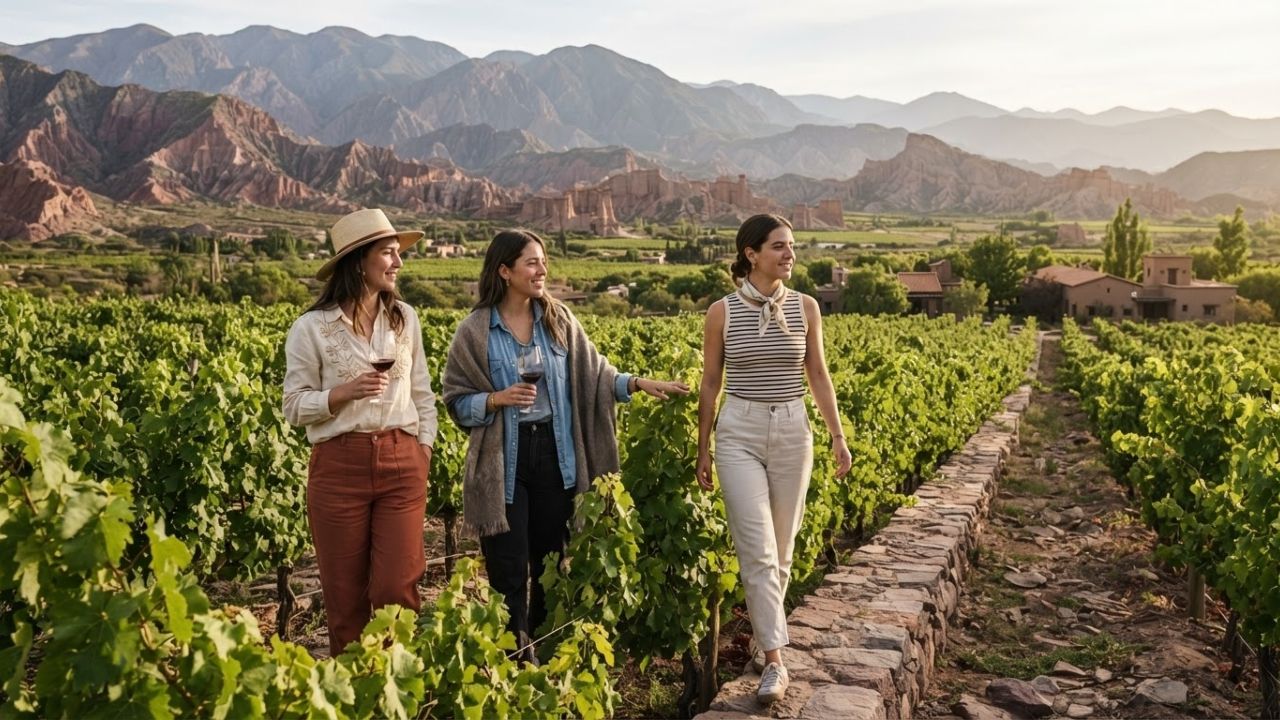
Image generated by AI
Cafayate — a small wine-producing town set within the Calchaquí Valleys in Argentina's Salta province — is gaining sustained international travel interest in 2026 as a destination that compresses high-altitude vineyard culture, one of northern Argentina's most dramatic canyon landscapes, indigenous cultural heritage, and the Museum of Grapevine and Wine into a geography small enough to explore meaningfully in three to five days.
The pattern driving visitors toward Cafayate is one that travel industry observers are tracking across multiple continents: experienced travelers who have already seen the obvious capitals are redirecting time and budget toward secondary destinations with distinct regional identities, where the experience of place is not mediated by mass-tourism infrastructure. Cafayate fits that profile precisely — its wine route, geological reserve, and cultural institutions are fully developed but operate at a human scale that Buenos Aires, Mendoza, and Patagonia's major circuits cannot replicate.
What Makes Cafayate Different From Argentina's Established Tourism Circuits
CAFAYATE, Salta Province, August 21, 2026 — Argentina's tourism geography has long been organized around a small number of iconic anchors: Buenos Aires, Iguazú Falls, Patagonia's lake districts, and the Mendoza wine region. Cafayate sits geographically and experientially outside all of them — located in Salta province in the far northwest of the country, within the Calchaquí Valleys that run between the Andes mountain ranges at elevations that place the town among the world's highest wine-producing areas.
The altitude is the starting point for understanding everything distinctive about Cafayate's wine identity. At approximately 1,700 metres above sea level, the vineyards operate under conditions — intense ultraviolet radiation, extreme diurnal temperature variation, low humidity — that produce grapes with unusual concentration and aromatic intensity. The signature variety is Torrontés, a white grape that reaches its most expressive form in the Calchaquí Valleys, producing wines with a combination of floral aromatics and crisp acidity that is essentially impossible to replicate at lower elevations. For wine travelers who have covered Mendoza's Malbec country, Cafayate offers a genuinely different regional wine proposition rather than a variation on a theme they already know.
The road into Cafayate from Salta city is itself part of the travel experience. The Quebrada de las Conchas Natural Reserve occupies the canyon corridor between the provincial capital and Cafayate — approximately 150 kilometres of road through polychrome rock formations sculpted by water and wind over geological timescales. The colours shift from deep ochre and sienna to chalky white and burgundy depending on mineral composition and the angle of the sun, creating a landscape that photographers and casual travelers alike consistently describe as among the most visually striking road journeys in South America.
The Quebrada de las Conchas: Geological Formations That Rival the Wine Route as Cafayate's Primary Draw
The Quebrada de las Conchas Natural Reserve — known locally by its alternative name, the Quebrada de Cafayate — is the canyon system that makes the approach to the town as significant as the destination itself. The reserve contains a series of named geological formations, each representing a different stage and process of the canyon's formation: eroded amphitheatres, narrow gorges, and free-standing rock columns whose shapes have accumulated folk names over generations of local observation.
The geological processes that created the Quebrada — the intersection of water erosion through sedimentary rock layers laid down over millions of years, combined with the structural uplift of the Andes pushing the region skyward — produced a landscape that operates at a different visual scale from the vineyard environment of the town itself. The canyon walls rise dramatically from the valley floor, their exposed strata reading like a geological diary of the region's deep history.
For travelers, the Quebrada works as both a destination in its own right and as a framing device for the Cafayate experience. Arriving through a canyon of this scale and visual intensity before reaching the intimate, low-key wine town creates a transition that defines the emotional character of the visit: from the raw geological drama of the reserve to the human-scale agriculture and culture of the valley floor.
The route through the reserve supports multiple engagement formats:
- Road trips from Salta city, with stops at the major named formations
- Landscape photography, for which the directional light of early morning and late afternoon produces the most saturated colour rendering
- Short walks near accessible geological features
- Nature observation, including the high-desert bird life and vegetation adapted to the extreme altitude and aridity
Cafayate's Wine Route: High-Altitude Vineyards and Direct Contact With Northern Argentina's Agricultural Heritage
The Wine Route is Cafayate's best-established tourism offering and the primary reason most international visitors add the town to their Argentina itinerary. Unlike Mendoza's scale — where the wine region extends across a vast irrigated plain and the major bodegas are industrial operations — Cafayate's wine geography is compact. The town itself is surrounded by vineyards, and many of the region's wineries are within walking or short cycling distance of the central plaza.
This proximity creates a materially different vineyard experience from what a day-trip wine tour from a major city delivers. Visitors staying in Cafayate can walk or cycle directly to winery gates, arrange tastings independently, and return on foot in the evening — a rhythm of engagement that allows the vineyard landscape to function as the ambient environment of the stay rather than a scheduled excursion within it.
The wineries range from family operations working small parcels of old-vine Torrontés to larger properties with formal tasting rooms and restaurant facilities. The range allows visitors to calibrate the formality of their wine engagement according to preference — from impromptu barrel-room tastings at small producers to structured pairing menus at the region's more developed bodegas.
Travel benefits of the Wine Route for international visitors include:
- Direct access to producers working at altitudes that no other major Argentine wine region replicates
- The opportunity to taste Torrontés in the specific microclimate that produces its most distinctive expression
- Cultural interaction with local communities whose livelihoods are organized around the vine and the annual harvest cycle
- Scenic vineyard-to-mountain sightlines that are absent from Mendoza's flatter landscape
- A relaxed, unhurried pace that the town's small scale enforces naturally
The Museum of Grapevine and Wine: Understanding Cafayate's Agricultural Identity
The Museum of Grapevine and Wine provides the historical and technical context that gives a wine-route visit its intellectual depth. The museum traces the development of viticulture in the Calchaquí Valleys — from the pre-Columbian agricultural traditions of the indigenous communities who worked the land before Spanish colonization, through the introduction of European grape varieties by Jesuit missionaries, to the contemporary wine industry that has made Cafayate internationally recognizable.
For travelers without a deep wine background, the museum functions as an orientation tool that makes the subsequent vineyard visits more intelligible — the connection between the specific altitude, soil composition, and water sources of the Calchaquí Valleys and the character of the wine in the glass becomes apparent once the agricultural history of the region has been established.
For more experienced wine travelers, the museum offers detailed documentation of the varietal and production history of Torrontés in this specific region — a level of specificity that the winery tastings themselves rarely provide in systematic form.
Indigenous Communities, Local Crafts, and the Cultural Dimension of Cafayate
The Calchaquí Valleys were inhabited long before European colonization by the Diaguita people, whose agricultural systems, ceramic traditions, and territorial organization left a cultural imprint on the region that remains visible in Cafayate's museums, markets, and the communities in the surrounding valleys.
Travelers with an interest in cultural depth beyond wine and landscape can extend their Cafayate itinerary to include visits to indigenous communities in the wider Calchaquí Valley system, where traditional crafts — particularly textiles woven from llama fiber using techniques and patterns derived from pre-Columbian traditions — are produced and sold directly by artisan communities. These interactions connect the aesthetic experience of Cafayate's landscape with its human history in a way that the wine route and geological reserve, taken alone, do not fully address.
The town's central streets and market spaces also support engagement with local handicraft production — hand-thrown ceramics, woven textiles, and carved wooden objects that reflect the region's blended indigenous and colonial heritage.
How to Plan a Cafayate Trip as Part of a Northern Argentina Itinerary
Cafayate functions most effectively within a broader northern Argentina circuit rather than as a standalone destination, and most international visitors arrive as part of a Salta province itinerary.
Getting there: The standard approach is to fly into Salta city — served from Buenos Aires by multiple daily domestic flights on a journey of approximately 2 hours — and then travel to Cafayate by road through the Quebrada de las Conchas. The road journey takes approximately 3 to 4 hours, depending on the number of stops made within the reserve.
How long to stay: Three to five days in Cafayate provides sufficient time to visit multiple wineries, explore the town's museums and cultural spaces, take a full road trip through the Quebrada, and include day excursions into the wider Calchaquí Valley. Shorter visits are possible but compress the wine route experience into a single day, which limits the depth of engagement with individual producers.
Seasonal planning: The Cafayate high season runs from March through May, when the harvest is complete and the weather is mild. Winter months (June to August) bring cold nights but clear skies and smaller crowds. Summer (December to February) brings heat and occasional rain, which can affect driving conditions in the Quebrada. The wine harvest itself — typically March — is the most atmospheric time to visit if the energy of the working winery is the priority.
Accommodation: Cafayate has a range of properties from small boutique hotels and guesthouses in the town center to estate-style bodegas offering accommodation within their vineyard grounds — the latter option providing an immersive wine-country stay that the town's own hotels cannot replicate.
FAQ: Cafayate Argentina Travel Guide 2026
Where is Cafayate in Argentina? Cafayate is located in Salta province in northwestern Argentina, within the Calchaquí Valleys — a high-altitude valley system in the Andes foothills approximately 150 kilometres south of Salta city. The town sits at approximately 1,700 metres above sea level, placing its vineyards among the world's highest wine-producing areas.
What is the Quebrada de las Conchas? The Quebrada de las Conchas Natural Reserve (also known as the Quebrada de Cafayate) is a canyon system on the road between Salta city and Cafayate, featuring dramatic polychrome rock formations created by millions of years of geological erosion. It is one of northern Argentina's most photographed landscapes and functions as the natural approach route to the town.
What wine is Cafayate known for? Cafayate is most closely associated with Torrontés, an aromatic white grape variety that reaches its most distinctive expression in the high-altitude, low-humidity conditions of the Calchaquí Valleys. The region also produces red varieties including Malbec and Cabernet Sauvignon at altitudes that give them a distinctive character compared with lower-elevation Argentine wine regions.
What is the Museum of Grapevine and Wine in Cafayate? The Museum of Grapevine and Wine in Cafayate documents the history of viticulture in the Calchaquí Valleys, tracing agricultural development from pre-Columbian indigenous traditions through Spanish colonial viticulture to the contemporary wine industry. It is an orientation resource for visitors beginning a wine-route exploration of the region.
Related Travel Guides
Disclaimer
This article is for informational and educational purposes only. It does not constitute legal, financial, or professional advice. While we strive to provide accurate and up-to-date information, travel policies, regulations, and conditions change rapidly. Always verify information with official sources before making travel decisions. Nomad Lawyer makes no representations about the accuracy, reliability, completeness, or suitability of the information provided. Readers should consult qualified professionals for advice specific to their circumstances. The views expressed in this article are those of the author and do not necessarily reflect the views of Nomad Lawyer.
Raushan Kumar
Founder & Lead Developer
Full-stack developer with 11+ years of experience and a passionate traveller. Raushan built Nomad Lawyer from the ground up with a vision to create the best travel and law experience on the web.
Learn more about our team →