Brazil Tornado Shuts Chapecó Airport as GOL Cancels Flights and Southern Travel Faces Gridlock

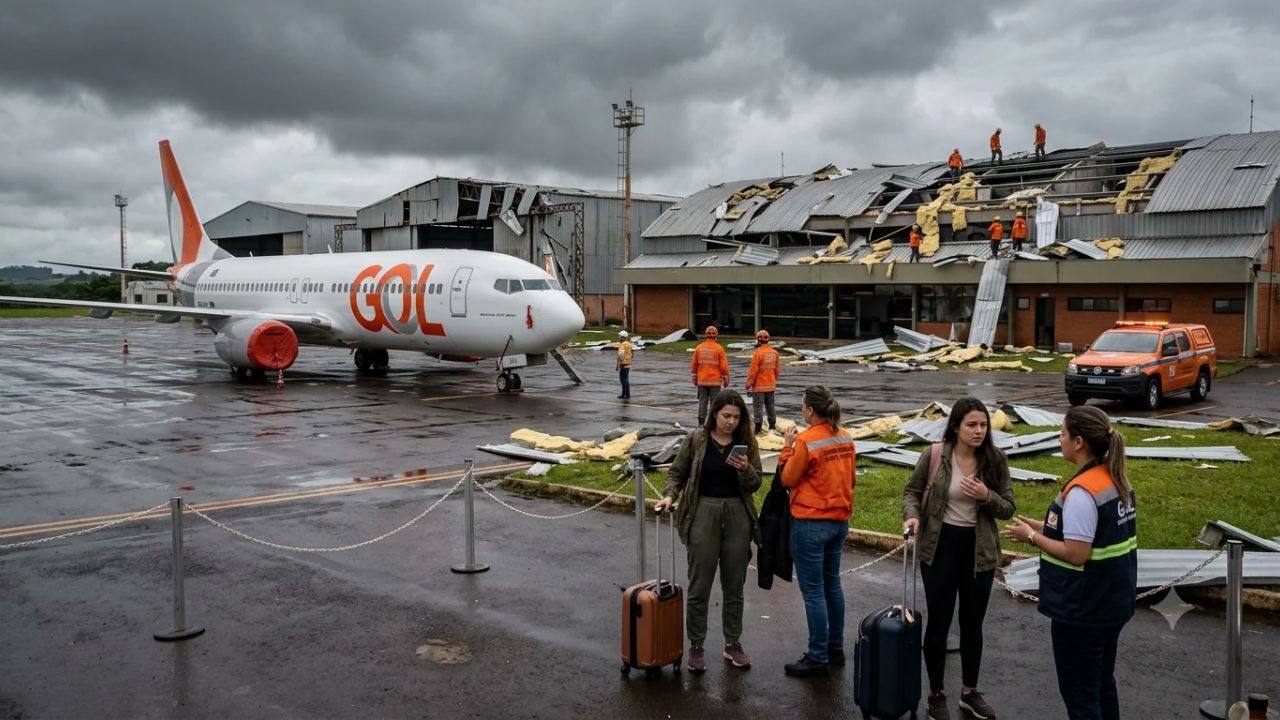
CHAPECÓ / FLORIANÓPOLIS — Regional air travel across southern Brazil has encountered severe disruption after a violent tornado struck the municipality of Chapecó in western Santa Catarina on the morning of Wednesday, 4 November 2026, tearing through Serafim Enoss Bertaso Airport (XAP), inflicting structural damage on passenger terminal halls and aircraft hangars, and forcing an indefinite suspension of all commercial flight operations.
The meteorological catastrophe prompted airport concessionaire Voe Xap, a division of Brazilian infrastructure group Socicam, to issue an immediate operational halt at 20:00 local time on Wednesday, barring passenger access to the damaged airfield while civil defense inspectors, structural engineers, and military firefighters assess the wreckage.
Major domestic carrier GOL Linhas Aéreas responded by cancelling all scheduled flights arriving at or departing from Chapecó through Saturday, 7 November inclusive, while partner airlines Azul and LATAM evaluate severe disruptions across their regional networks.
The unexpected shutdown paralyzes an essential aviation gateway that serves as the economic transport lifeline for western Santa Catarina, northwestern Rio Grande do Sul, and southwestern Paraná. Having handled nearly 648,000 passengers in 2025 and undergoing a R$40 million terminal expansion, Chapecó’s sudden paralysis highlights the operational vulnerability of secondary regional hubs to extreme convective weather, leaving thousands of business travelers, agribusiness executives, and connecting tourists stranded across Brazil's southern interior.
       CHAPECÓ AIRPORT (XAP) TORNADO IMPACT SNAPSHOT: 5 NOVEMBER 2026

  Affected Facility:      Serafim Enoss Bertaso Airport (IATA: XAP / ICAO: SBCH)
  Location:               Chapecó, Western Santa Catarina, Southern Brazil
  Operating Concession:   Voe Xap (Socicam Concession Group)
  Incident Date & Time:   Wednesday, 4 November 2026 (Morning Severe Storm)
  Operational Status:     ALL OPERATIONS SUSPENDED INDEFINITELY
  Infrastructure Damaged: Main passenger terminal hall, roofing, private hangars
  Confirmed Cancellations:GOL Linhas Aéreas: All flights halted through 7 November
  Airlines Impacted:      GOL, Azul Linhas Aéreas, LATAM Airlines Brasil
  Direct Flight Links:    São Paulo–Guarulhos (GRU), Campinas (VCP), Florianópolis (FLN)
  Passenger Directive:    DO NOT TRAVEL TO THE AIRPORT; Contact airlines directly
The Meteorological Assault: Supercell Tornado Strikes Western Santa Catarina
The atmospheric disaster unfolded following a series of high-severity meteorological warnings issued across southern Brazil. On 3 November, the Chapecó Municipal Civil Defense issued an emergency alert warning of a volatile convective storm system capable of generating lightning, hail, and destructive winds exceeding 80 km/h.
Simultaneously, the National Institute of Meteorology (INMET) placed western Santa Catarina and adjacent border regions under a red-level storm alert—its highest warning threshold—forecasting gusts surpassing 100 km/h and localized damage to transport infrastructure.
During the morning of 4 November, a severe convective supercell spawned a tornado that moved across the rural and semi-urban outskirts of Chapecó. Meteorologists analyzing Doppler radar signatures estimated peak localized rotational winds between 130 and 150 km/h as the vortex tracked across municipal terrain. The tornadic funnel made direct contact with the grounds of Serafim Enoss Bertaso Airport, unleashing violent wind shear that ripped extensive sections of corrugated metal roofing and industrial thermal insulation from the main passenger terminal.
The storm shattered reinforced perimeter glass panels, collapsed perimeter security fencing, and caused substantial structural deformation to private general aviation hangars housing light utility and agricultural aircraft. High-velocity debris was scattered across taxiways and the main aircraft parking apron, while torrential precipitation immediately infiltrated ticketing concourses, passenger security screening checkpoints, and subterranean baggage handling facilities.
Remarkably, despite the rapid onset of tornadic winds, airport ground personnel and airline station agents executed emergency evacuation protocols with textbook precision. Waiting passengers, airline gate staff, and security contractors were swiftly ushered out of the exposed glass terminal concourse and sheltered within reinforced interior service corridors, concrete baggage tunnels, and hardened administrative offices. This rapid response prevented serious physical trauma or fatalities among travelers, though several facility workers received on-site medical attention for cuts caused by flying debris and shattered glass.
                  CHRONOLOGY OF THE CHAPECÓ AIRPORT CLOSURE

  3 November (Afternoon): INMET & Civil Defense issue red-level severe storm alert
  4 November (Morning):   Tornado strikes Chapecó; hits terminal & hangars at XAP
  4 November (16:20):     GOL issues emergency NOTAM cancellation through 7 Nov
  4 November (20:00):     Voe Xap formally declares indefinite operational shutdown
  5 November (All Day):   Military fire crews & engineering teams assess damage
According to the Santa Catarina State Public Security Secretariat (Secretaria de Estado da Segurança Pública), military firefighters (Corpo de Bombeiros Militar de Santa Catarina - CBMSC) responded to 45 storm-related emergency calls across the municipality.
More than 200 emergency personnel and 99 specialized disaster-response vehicles were mobilized across the state, with all 17 regional disaster-response teams placed on high alert. While emergency crews rescued stranded residents and cleared fallen trees from municipal roads, priority was assigned to securing the airport perimeter and isolating severed electrical lines to prevent secondary fires.
Airline Cancellations: GOL Grounds Operations Through Saturday
The destruction of terminal infrastructure transformed what initially appeared as a temporary storm delay into a multi-day aviation crisis. At 16:20 on Wednesday, GOL Linhas Aéreas issued an official operational bulletin confirming the cancellation of every flight scheduled into and out of Chapecó between Wednesday, 4 November, and Saturday, 7 November inclusive.
The airline cited the official Notice to Airmen (NOTAM) issued by the Department of Airspace Control (DECEA), which closed the aerodrome to all commercial air traffic due to damaged ground infrastructure and the inability to safely screen passengers and baggage.
GOL operates high-frequency domestic links connecting Chapecó directly to Brazil’s primary international hub at São Paulo–Guarulhos (GRU) as well as the state capital of Florianópolis (FLN). The four-day cancellation window eliminates dozens of scheduled departures, stranding thousands of travelers who rely on these routes for business transit and onward global connections.
       AIRLINE ROUTE EXPOSURE AT CHAPECÓ AIRPORT (XAP)

  Operating Airline       Direct Destinations Served       Operational Status
  -----------------------------------------------------------------------------
  GOL Linhas Aéreas       São Paulo–Guarulhos (GRU)        ALL FLIGHTS CANCELLED
                          Florianópolis (FLN)              THROUGH 7 NOVEMBER

  Azul Linhas Aéreas      Campinas–Viracopos (VCP)         Operations suspended;
                          Florianópolis (FLN)              contact airline directly

  LATAM Airlines Brasil   São Paulo–Guarulhos (GRU)        Operations suspended;
                          (4 daily frequencies)            contact airline directly
The disruption extends directly to Chapecó’s other operating carriers:
- LATAM Airlines Brasil: Operates up to four daily frequencies linking Chapecó with São Paulo–Guarulhos. LATAM passengers holding bookings through the weekend are being instructed to manage their itineraries via the carrier's digital channels, with flights halted pending aerodrome recertification.
- Azul Linhas Aéreas: Operates double-daily services connecting Chapecó to its primary national hub at Campinas–Viracopos (VCP) and regional links to Florianópolis. With Viracopos serving as Azul’s central domestic connection nexus, the closure has disrupted passenger transfers connecting from western Santa Catarina to the Northeast, North, and Central-West regions of Brazil.
Importantly, aviation authorities and industry analysts emphasize that GOL’s 7 November cancellation window is an airline planning estimate rather than a legally guaranteed date for airport reopening. Concessionaire Voe Xap has pointedly avoided committing to a firm calendar date for the resumption of scheduled passenger operations.
In official statements issued through municipal media channels, the concessionaire clarified that passenger processing cannot resume until civil engineering teams complete structural load tests on damaged roof trusses, clear electrical distribution grids of moisture intrusion, and receive formal occupancy certification from both the State Military Fire Department and ANAC flight safety auditors.
In addition, airline operations directors point out that even after aerodrome certification is granted, restoring regular flight schedules requires complex aircraft and crew re-positioning. With commercial jets diverged from their standard rotational pairings across Campinas, Florianópolis, and Guarulhos, carriers will need between 24 and 48 hours to reposition aircraft, re-establish ground crew rosters, and recalibrate computer check-in networks once Voe Xap lifts its suspension order.
| Operational Indicator | Verified Status as of 5 November 2026 |
|---|---|
| Airport Name & Code | Serafim Enoss Bertaso Airport (IATA: XAP / ICAO: SBCH) |
| Municipal Location | Chapecó, Santa Catarina, Brazil |
| Operational Mandate | Commercial and private operations suspended indefinitely |
| Physical Facilities Damaged | Main passenger terminal roof, check-in hall, general aviation hangars |
| Runway Condition | Structural asphalt intact; apron and taxiway debris clearance underway |
| GOL Cancellation Scope | 4 to 7 November inclusive (all arrivals and departures) |
| Projected Reopening Date | Unconfirmed; pending National Civil Aviation Agency (ANAC) inspection |
| Passenger Travel Directive | Avoid visiting terminal; manage rebookings through digital channels |
The Strategic Value of Chapecó in Southern Brazil’s Aviation Network
To understand the broader economic impact of the closure, one must examine Chapecó’s position within the Brazilian domestic transport grid. Known as the "Capital of the West" (Capital do Oeste), Chapecó is the primary economic, medical, and educational hub for a vast agricultural region encompassing western Santa Catarina, northwestern Rio Grande do Sul, and southwestern Paraná.
The city is the heart of Brazil’s industrial poultry and pork agro-export sector, serving as the corporate birthplace and operational headquarters for major multinational food processors, including BRF (Sadia and Perdigão) and Cooperativa Central Aurora Alimentos. Corporate executives, agronomists, veterinary specialists, and international trade delegations travel through Chapecó Airport daily, utilizing scheduled flights to access corporate headquarters in São Paulo and financial centers in Rio de Janeiro.
       REGIONAL AIRLINE DEMAND CONDUIT (WESTERN SANTA CATARINA)

  Western Agro-Industrial Hub (Chapecó / Concórdia / Xanxerê)
                    |
      [ Chapecó Airport (XAP) ]  <-- INOPERABLE (Tornado Damage)
                    |
        +-----------+-----------+
        |                       |
  [ Campinas (VCP) ]      [ São Paulo (GRU) ] <===> [ Global Air Connections ]
  Azul Domestic Hub       LATAM & GOL Hub           (Europe, US, LatAm)
        |                       |
  [ Florianópolis (FLN) ] [ Brazil Domestic Network ]
According to official statistics published by the Santa Catarina Secretariat of Ports, Airports and Railways (Secretaria de Estado de Portos, Aeroportos e Ferrovias - SPAF), Chapecó Airport handled 647,900 passengers in 2025. Across the entire state of Santa Catarina, airport networks processed 8.5 million travelers that year, a 5.6 percent increase over 2024.
Data from the federal Ministry of Ports and Airports confirmed continued growth throughout 2026, with Chapecó alone handling 53,900 domestic passengers in July 2026.
This consistent demand drove significant airline capacity additions during the months preceding the disaster. In August 2026, LATAM expanded its São Paulo–Guarulhos schedule from three to four daily flights. In September, Azul doubled its Campinas–Viracopos offering from one to two daily flights.
Combined with GOL’s established operations, these expansions delivered a 25 percent increase in weekly seat capacity connecting Chapecó with the state of São Paulo. The tornado has severed this newly expanded air bridge, creating supply-chain delays for regional agribusinesses and stranding leisure travelers connecting to international flights.
Infrastructure Expansion Confronts Extreme Climate Resilience
The disaster highlights a sobering reality for airport planners: recent capital investment does not automatically guarantee immunity from extreme convective weather events.
Under the management of concessionaire Voe Xap and parent company Socicam, Chapecó Airport had completed a comprehensive R$40 million modernization and expansion program. The project modernized the passenger terminal, expanding floor space and tripling the facility's design capacity from 500,000 to 1.5 million passengers annually.
An additional R$5 million was invested in upgraded navigation aids, automated baggage conveyor belts, and enhanced apron lighting to support night flight operations.
CHAPECÓ AIRPORT MODERNIZATION BENCHMARKS
| Column 1 |
|---|
| PRE-DISASTER EXPANSION: |
| - R$40 Million Terminal Overhaul completed by Socicam Concession Group |
| - Passenger design capacity expanded threefold to 1.5 million travelers/year |
| - R$5 Million invested in apron lighting, ground gear & nav-aids |
| TORNADO STRUCTURAL DAMAGE PROFILE: |
| - Severe roof tearing across main departure and arrivals halls |
| - Rainwater flooding across passenger screening & electrical switchboards |
| - Structural deformation of private hangars and perimeter security fencing |
| - Runway pavement structurally sound; navigation calibration required |
While the airport’s physical capacity expanded, the tornado exposed the extreme vulnerability of lightweight commercial roofing structures to tornadic wind pressures. Preliminary engineering assessments confirm that while the main concrete frame and the asphalt runway pavement remained structurally intact, the roof envelope of the passenger terminal suffered severe tearing.
The recovery process requires a methodical engineering pathway:
- Structural Debris Removal: Clearing sheared metal panels, insulation, and shattered glass from passenger walkways, taxiways, and the aircraft parking apron.
- Weatherproofing and Roof Reconstruction: Installing temporary weatherproofing over exposed terminal areas to prevent water damage from subsequent spring rainfall.
- Electrical and Navigational Auditing: Inspecting subterranean electrical cabling, emergency generator systems, security X-ray scanners, and communications equipment that suffered water immersion.
- Regulatory Certification: Securing formal clearance from the National Civil Aviation Agency (Agência Nacional de Aviação Civil - ANAC) and the Aeronautical Accidents Investigation and Prevention Center (CENIPA) before reopening the terminal for public use.
Brazilian Passenger Rights: ANAC Resolution 400 and New 2026 Mandates
The unexpected shutdown of Chapecó Airport coincides with important updates to Brazil’s consumer aviation protection framework, governed by ANAC Resolution No. 400.
In September 2026, ANAC enacted Resolution No. 813, introducing amendments to modernise passenger rights during irregular operations. These updates were supplemented by Resolution No. 819, which established a phased implementation schedule:
- Core Provisions (In Effect Since 26 October 2026): Established expanded rules regarding reimbursement timelines, rebooking options, and material assistance during extraordinary disruptions.
- Communication Enhancements (Taking Effect 25 November 2026): Mandates specific digital notification protocols and expanded transparency disclosures under Article 20.
       ANAC RESOLUTION 400 / 813: PASSENGER ENTITLEMENT TIMELINE

  Delay Duration      Mandatory Airline Obligation (Even in Weather Emergencies)
  -----------------------------------------------------------------------------
  1 Hour Delay        Free communication assistance (internet access, phone calls)
  2 Hours Delay       Appropriate food vouchers or meal provisions
  4+ Hours Delay      Complimentary hotel accommodation & airport ground transfers
  Resident Passenger  Local transport to and from home (in lieu of hotel room)
  Flight Cancelled    Choice: 1) Full refund (7 days), 2) Rebooking, 3) Ground transit
The Limits of "Force Majeure" Under Brazilian Consumer Law
Under international aviation conventions, extreme weather events such as tornadoes are classified as acts of God (força maior), which exempt airlines from paying punitive cash compensation for intangible moral damages (danos morais).
However, Brazilian consumer protection law is unique. Under the Brazilian Consumer Defense Code (Código de Defesa do Consumidor) and ANAC regulations, airlines maintain an absolute, non-negotiable obligation to provide Material Assistance (Assistência Material) to stranded ticket holders, regardless of whether a cancellation is caused by mechanical maintenance or a severe natural disaster.
Airlines cannot abandon passengers stranded at origin or connection points:
- Food and Refreshment: If passengers experienced delays exceeding two hours prior to cancellation, the airline must supply meals or food vouchers.
- Overnight Accommodation: If a traveler is stranded away from their home city and departure cannot occur on the same calendar day, the carrier must provide hotel accommodations and round-trip transfers. For local Chapecó residents, the airline may satisfy this obligation by providing ground transport back to their home address.
- Full Refund or Rebooking: Passengers whose flights are cancelled are legally entitled to choose between an immediate, penalty-free cash refund (processed within seven days), rebooking on the next available flight (even on a competing airline if the operating carrier cannot provide transport within a reasonable window), or re-routing via alternative ground transport.
Travelers are strongly advised to preserve all digital booking records, cancellation text messages, boarding passes, and physical receipts for meals, rideshare services, and hotel rooms, as these documents are required to claim reimbursement from airlines under ANAC Resolution 813.
If an airline refuses to provide immediate lodging vouchers or delays processing full statutory refunds beyond the mandatory seven-day window, passengers possess immediate recourse through state and federal regulatory enforcement bodies. The Consumer Protection Directorate of Santa Catarina (PROCON-SC) maintains specialized municipal desks to mediate irregular airline disputes. Additionally, consumers can register binding administrative complaints via the federal digital portal Consumidor.gov.br, where Brazilian air carriers are legally mandated to respond and resolve claims within ten business days. Failure to comply can result in administrative fines levied against the operating carriers by the National Civil Aviation Agency.
Southern Brazil's Seasonal Weather Outlook: Spring Convective Risks
The tornado at Chapecó is part of a broader pattern of climate volatility affecting the interior of southern Brazil during the austral spring and early summer.
According to a seasonal climate outlook published on 29 October 2026 by the Santa Catarina Agricultural Research and Rural Extension Company (Epagri/Ciram) in coordination with the State Civil Defense, the region encompassing western Santa Catarina, western Paraná, and northern Rio Grande do Sul faces elevated precipitation and severe storm frequency through January 2027.
       CLIMATE DRIVERS OF SOUTHERN BRAZILIAN CONVECTIVE STORMS

  Warm, Humid Amazonian Air (Low-Level Jet)  <===+
                                                 |  Violent Convective Clashes
  Cold Antarctic Polar Air Masses           <===+  (Supercells, Hail, Tornadoes)
                                                 |
  Western Santa Catarina Topography         <===+  (High-Elevation Wind Shear)
Western Santa Catarina sits within a recognized subtropical storm corridor where warm, humid air masses flowing southward from the Amazon basin collide with cold polar fronts ascending from the South Atlantic. When these air masses meet over the elevated plateaus of the interior, they generate severe convective instability, producing supercell thunderstorms characterized by heavy downpours, damaging hail, and localized tornadic circulations.
For regional airport concessionaires and civil aviation authorities, these projections emphasize that climate resilience can no longer be an afterthought in facility design. Future capital programs must incorporate reinforced roofing specifications, impact-resistant glazing, subterranean electrical redundancies, and real-time Doppler radar integration to ensure that aerodromes can withstand convective wind shear and restore operations rapidly following severe weather strikes.
Operational Guidance for Travel Agents, Corporate Planners, and Travelers
For travel management companies, corporate logistics directors, and independent holidaymakers navigating the Chapecó disruption, aviation specialists recommend the following operational protocols:
       ACTIONABLE PLAYBOOK FOR TRAVELERS IMPACTED BY XAP CLOSURE

  [ Verification & Rebooking ]
  * Do NOT travel to Serafim Enoss Bertaso Airport; the terminal is closed
  * Monitor official notices via Voe Xap (chapeco-aero.com.br) & airline apps
  * Request free flight rescheduling, route credits, or full refunds under ANAC 813

  [ Rerouting via Alternative Regional Gateways ]
  * Passo Fundo Airport (PFB / SBPF): Approx. 130 km south (Rio Grande do Sul)
  * Cascavel Airport (CAC / SBCA): Approx. 260 km north (Paraná)
  * Foz do Iguaçu (IGU) / Curitiba (CWB): Accessible via interstate coach transit

  [ Documentation & Financial Protection ]
  * Retain all booking confirmations, cancellation SMS alerts & delay notices
  * Save physical and digital receipts for food, lodging, and road transit
  * Submit reimbursement claims to airlines within 30 days of the disrupted journey
1. Managing Alternative Regional Gateways
With Chapecó Airport closed indefinitely, travelers requiring urgent transport to São Paulo or Florianópolis must consider alternative regional aerodromes:
- Passo Fundo Airport (PFB - Lauro Kortz Airport): Located approximately 130 kilometers south of Chapecó in northern Rio Grande do Sul (a 2.5-hour drive via highway RS-324). Passo Fundo handles commercial flights operated by Azul and GOL to Campinas and Guarulhos, serving as the most practical overland diversion for western Santa Catarina residents.
- Cascavel Airport (CAC - Adalberto Mendes da Silva Airport): Positioned 260 kilometers north in western Paraná (roughly a 4-hour drive via BR-163). Cascavel offers commercial jet services to Curitiba, Campinas, and Guarulhos.
- Interstate Coach Transit: Travelers unable to secure regional flight seats can utilize long-distance executive sleeper buses (ônibus leito) departing from Chapecó’s central bus terminal (Terminal Rodoviário Raul Bartolamei) directly to Florianópolis, Curitiba, or Porto Alegre, connecting to major international flights without air cancellations.
2. Protecting Separate-Ticket Onward Flights
A major risk facing passengers departing Chapecó is the loss of onward international flights booked on separate tickets. Under international aviation regulations, an airline operating a domestic flight has no legal liability for a missed connection operated by a different carrier on a separate ticket.
Travelers facing cancellations at Chapecó who hold separate international tickets departing from São Paulo–Guarulhos must contact their international airline immediately before the international flight departs to explain the situation and request a force majeure flight modification. Many major international carriers will rebook stranded passengers for a nominal fee or waive change penalties when provided with an official airport closure NOTAM.
The tornado that devastated Chapecó Airport is a stark reminder that modern regional air transport remains vulnerable to the power of nature. As engineers work to rebuild terminal roofs and clear runway aprons, the resilience of western Santa Catarina’s aviation sector will be measured not only by the speed of reconstruction, but by the compassion and legal diligence with which airlines, concessionaires, and regulators protect the traveling public.
Related Travel Guides
- Aer Lingus Flight EI402 Diverts to French Air Base as Coordinated Bomb Threats Target 15 European Flights
- South Asia Mountain Travel Alert: Nepal, Bhutan, India, and Sri Lanka Disclose Distinct Flood and Landslide Risks
- Canada Ranked World's Safest Country for 2027 as US Travelers Prioritize Provincial Parks and Worry-Free Trails
- Austria and Slovenia Alert Motorists to Heavy Karawankentunnel A11 Congestion Amid Dual-Tube Construction
This article is for informational purposes. Flight routes, passenger regulations, visa rules, and transit advisories are subject to change by airlines and aviation authorities. Readers are advised to verify schedules and travel documentation with relevant carriers and border agencies before departure.
Related Stories

Haiti Marine Weather Alert 2026: Navigating 6-Foot Waves and Storm Risks on Northern Coast

Middle East Flight Disruptions: Over 820 Delays and 90 Cancellations Hit Dubai, Riyadh, and Istanbul