
Seconds From Disaster: Delta and American Airlines in Terrifying Runway Near-Miss at Boston Logan Airport
A catastrophic runway collision was narrowly avoided at Boston Logan Airport as a Delta A319 aborted landing while an American Airlines 737 initiated takeoff.

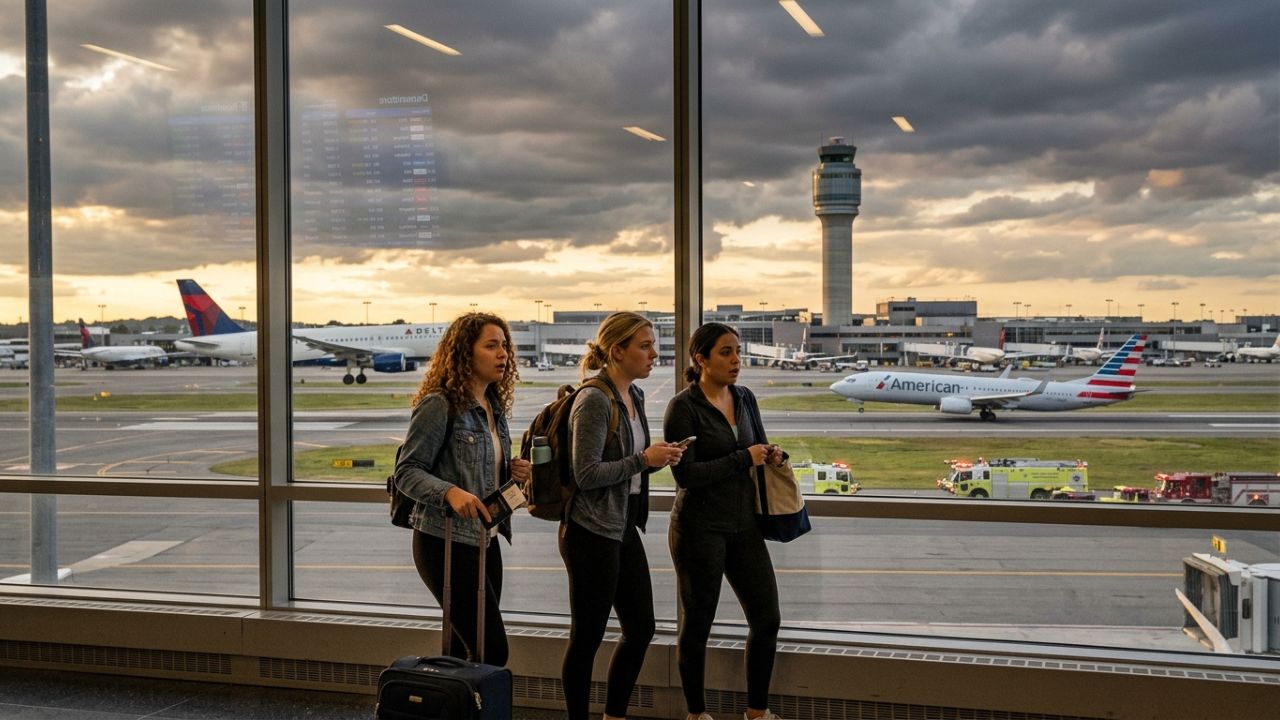
Image generated by AI
Boston Logan International Airport narrowly avoided a catastrophic aviation disaster when a Delta Air Lines jet and an American Airlines aircraft were involved in a terrifying runway incursion. The heart-stopping near-miss, which occurred on June 20, 2026, forced an aggressive emergency evasive maneuver that sent immediate shockwaves through the United States air traffic control system. The subsequent operational disruptions heavily impacted global flight schedules, triggering massive travel chaos across major international routes connecting the US to the UK, Canada, Ireland, Germany, and France.
Travel Chaos at Boston Logan: Seconds From Disaster
The terrifying sequence of events rapidly unfolded when an air traffic control operator permitted an American Airlines Boeing 737-800 to initiate takeoff on an intersecting runway precisely as a Delta Air Lines Airbus A319 was on final approach. Realizing the imminent danger of a high-speed, multi-fatality collision, the highly trained Delta pilots executed a rapid, emergency go-around maneuver. This split-second decision successfully averted a disaster that could have resulted in immense loss of life.
The Federal Aviation Administration (FAA) immediately acknowledged the terrifying close call and classified it as a severe runway incursion, instantly elevating the event to its highest investigation priority. While the aggressive evasive action ensured there were zero injuries and absolutely no damage to either aircraft, the incident severely disrupted the fragile sequencing of one of America's busiest transit hubs. The ripple effects of this sudden operational halt caused immediate airline delays and triggered widespread airport disruptions for the massive volume of 43 million passengers who heavily rely on Boston Logan annually.
Widespread Route Disruptions: A Global Ripple Effect
Although the terrifying near-miss directly involved only Delta and American Airlines, the sudden operational freeze at Boston Logan created an immediate, suffocating bottleneck that severely impacted other major carriers utilizing the airspace, including United Airlines, JetBlue, Lufthansa, and British Airways.
Boston Logan Airport Operations
At the local level, Boston Logan's highly complicated layout featuring multiple intersecting runways exacerbated the ensuing travel chaos. Following the incursion, air traffic controllers were fundamentally forced to drastically increase separation buffers between arriving and departing aircraft. This immediate, highly necessary safety measure heavily restricted the airport's hourly capacity, plunging domestic flight schedules into disarray and causing extensive tarmac delays for thousands of outbound travelers scrambling to navigate the peak traffic congestion.
International Transatlantic Spillover
Internationally, the incident starkly highlighted Boston's critical role as a primary gateway for transatlantic traffic. The operational slowdown inflicted minor cascading delays across highly lucrative, tightly scheduled global routes. Critical flight paths between London and Boston, Dublin and Boston, Frankfurt and Boston, and Paris and Boston were heavily subjected to temporary schedule adjustments and heightened operational monitoring. Furthermore, vital North American connections to Toronto, Montreal, and Halifax in Canada faced immediate sequencing delays, definitively proving how rapidly localized airport disruptions can degrade massive international aviation networks.
Flight Details and Operational Context
The following data outlines the specific operational profile of Boston Logan International Airport and the context surrounding this severe runway incursion:
Operational Context (Boston Logan Traffic Profile)
| Category | Data |
|---|---|
| Annual Passenger Volume | ~43 million+ |
| Major Carriers | Delta, American, JetBlue, United |
| International Routes | UK, Canada, Ireland, Germany, France |
| Primary Risk Type | Runway incursion, congestion delays |
Data accurately reflects the verified operational environment at Boston Logan International Airport.
Passenger Impact: Uncertainty and Cascading Delays
For the traveling public, the near-miss at Boston Logan triggered immediate, highly frustrating real-world consequences. While mass cancellations were aggressively avoided by the airlines, the temporary runway sequencing adjustments subjected passengers to agonizingly long tarmac holds and highly unexpected departure delays.
Travelers bound for Europe or Canada faced the terrifying prospect of missed international connections, a worst-case scenario that almost always results in unplanned overnight accommodation costs and entirely ruined travel itineraries. The psychological impact was equally severe; as news of the terrifying near-miss rapidly spread through the crowded terminals, heightened passenger anxiety regarding aviation safety added a massive layer of stress to an already chaotic travel day. For business commuters heavily reliant on JetBlue and United Airlines, the sudden bottleneck meant irrevocably missed meetings and highly volatile, frustrating rebooking scenarios.
Industry Analysis: The Crisis of Intersecting Runways
Aviation analysts and safety experts point to several critical, systemic infrastructural factors heavily contributing to this alarming runway incursion. Boston Logan is notorious globally for its highly complicated, intersecting runway system, which fundamentally limits the physical separation between high-speed take-off and landing pathways.
During intense periods of peak traffic congestion, this complex infrastructural layout places an immense, arguably unsustainable cognitive load on Air Traffic Control (ATC) operators. The FAA’s ongoing, high-priority investigation is meticulously evaluating ATC sequencing clearances, the exact authorization protocols utilized for crossing active runways, and the overall situational awareness of the involved flight crews. Crucially, no mechanical failures have been noted, strongly indicating that human-factor risks, massively compounded by relentless hub congestion, were the primary catalysts for this near-fatal aviation event.
What to Do if Your Flight is Delayed: Actionable Advice
Successfully navigating the chaotic aftermath of a severe airport disruption requires intense vigilance and rapid decision-making. If you are actively transiting through Boston Logan or affected by cascading delays across the network, follow these critical survival steps:
- Monitor Flight Status Obsessively: The situation remains highly fluid. Constantly check your airline's official app and actively sign up for SMS mobile alerts to receive the absolute fastest possible rebooking notifications.
- Arrive Exceptionally Early: The aggressively increased ATC separation buffers absolutely guarantee longer tarmac wait times. Arrive at the airport well ahead of schedule to safely navigate heavily congested security checkpoints.
- Utilize Flexible Ticketing: If financially possible, immediately leverage tickets that allow penalty-free changes to reroute through alternative, significantly less congested US hubs.
- Prepare for Rebooking: Operational disruptions of this severe magnitude mean rebooking is highly standard. Utilize your airline's online chat features to rapidly bypass overwhelmed, slow-moving physical customer service desks.
FAQ: Boston Logan Near-Miss 2026
Did a crash actually occur at Boston Logan Airport? No. A catastrophic crash was successfully avoided when the highly trained Delta Air Lines A319 crew executed an emergency go-around after an American Airlines Boeing 737 was cleared on a crossing runway.
Are flights being mass-cancelled due to this specific incident? There have not been massive waves of cancellations, but travelers will undoubtedly experience rolling, cascading schedule delays as the FAA investigation heavily restricts surface movement operations.
Who are the passengers most severely impacted by this disruption? Beyond domestic travelers, passengers flying lucrative routes connecting the UK, Canada, Ireland, Germany, and France through Boston Logan may incur highly frustrating delays due to diverted or heavily slowed transit traffic.
The Bigger Picture: A System on the Brink
The Boston Logan Airport near-miss stands as a terrifying, undeniable illustration that current operational solutions are dangerously failing to address the absolute most critical vulnerabilities in the modern aviation industry. As global passenger traffic continues its massive post-pandemic surge, major US airports wholly reliant on antiquated, intersecting runway systems are being pushed far beyond their absolute safety limits. Runway incursions remain one of the most heavily monitored, feared risks worldwide precisely because they inherently pose a rapidly increasing potential for catastrophic, mass-casualty failures. The industry is currently demonstrating a robust safety recovery overall, but the intense, mind-boggling complexity of managing peak congestion without drastically modernizing physical airport infrastructure remains an existential threat to safe global travel.
Key Takeaways
- A severe runway incursion occurred at Boston Logan Airport on June 20, 2026, directly involving a Delta Air Lines Airbus A319 and an American Airlines Boeing 737-800.
- The Delta crew brilliantly executed an emergency go-around to avoid a catastrophic, high-speed collision on intersecting runways.
- The FAA has officially launched a high-priority investigation into the near-miss, focusing heavily on ATC sequencing clearances and human-factor risks.
- The massive disruption caused immediate travel chaos, heavily impacting other major carriers operating at the hub like JetBlue, United, Lufthansa, and British Airways.
- Global flight schedules were highly disrupted, specifically affecting vital international routes to the UK, Canada, Ireland, Germany, and France.
- Passengers are heavily advised to obsessively monitor flight statuses and realistically expect rolling delays as Boston Logan fiercely manages peak traffic congestion under significantly heightened safety protocols.
Related Travel Guides
Istanbul Airport Flight Cancellations: Moscow, Kabul, and Algiers Routes Disrupted
London Heathrow Flight Cancellations Disrupt 26 Services Across British Airways
Disclaimer
This article is for informational and educational purposes only. It does not constitute legal, financial, or professional advice. While we strive to provide accurate and up-to-date information, travel policies, regulations, and conditions change rapidly. Always verify information with official sources before making travel decisions. Nomad Lawyer makes no representations about the accuracy, reliability, completeness, or suitability of the information provided. Readers should consult qualified professionals for advice specific to their circumstances. The views expressed in this article are those of the author and do not necessarily reflect the views of Nomad Lawyer.
Kunal K Choudhary
Co-Founder & Contributor
A passionate traveller and tech enthusiast. Kunal contributes to the vision and growth of Nomad Lawyer, bringing fresh perspectives and driving the community forward.
Learn more about our team →