Austria and Slovenia Alert Motorists to Heavy Karawankentunnel A11 Congestion Amid Dual-Tube Construction

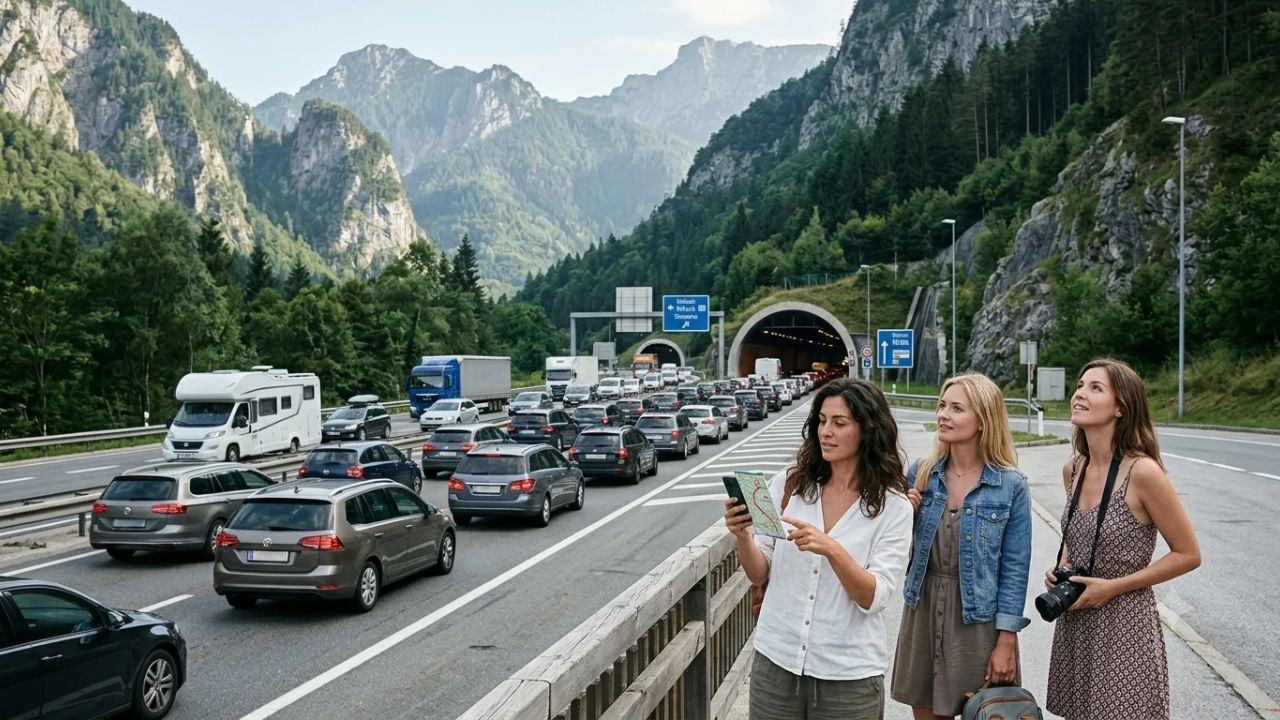
VILLACH / JESENICE — Highway authorities and automobile clubs across Austria and Slovenia have issued comprehensive travel advisories for motorists traveling along the Karawanken Autobahn (A11) corridor, warning of recurrent multi-kilometer traffic queues, automated tunnel metering, and extended journey delays at the Karawankentunnel.
Serving as the primary subterranean Alpine gateway linking Central Europe with Slovenia, the Adriatic coastline of Croatia, and northern Italy, this 7,864-meter mountain passage confronts severe operational strain caused by holidaymaker surges, commercial freight transit, and ongoing construction on a parallel second tube.
With the existing infrastructure operating under a bidirectional single-tube configuration, traffic managers in Carinthia and Upper Carniola must frequently impose controlled vehicle access protocols to prevent underground gridlock. For hundreds of thousands of independent travelers, family vacationers, and logistics operators from Germany, Austria, the Netherlands, and Switzerland, traveling through this Alpine bottleneck requires meticulous departure scheduling, compliance with dual-nation toll regimes, and a practical understanding of alternative mountain bypasses.
The Strategic Importance of the A11 Alpine Transit Corridor
The Karawankentunnel forms the centerpiece of the Austrian A11 Karawanken Autobahn, which branches southward from the A2 Southern Motorway (Süd Autobahn) near the transit hub of Villach. Crossing deep beneath the rugged limestone peaks of the Karawanken mountain range, the motorway connects directly with Slovenia's A2 motorway near the northern town of Jesenice. From this junction, traffic flows smoothly toward the capital city of Ljubljana, dispersing onward toward the Istrian peninsula, the Kvarner Gulf, the Dalmatian coast, and the Western Balkans.
                  CENTRAL EUROPE TO ADRIATIC TRANSIT SPINE

  [ Munich / Salzburg (Germany / Austria) ]
                    |
          [ A10 Tauern Autobahn ]
                    |
     [ Villach Motorway Interchange ] <=====> [ Italian Route via Tarvisio ]
                    |
        [ A11 Karawanken Autobahn ]
                    |
      [ KARAWANKENTUNNEL (7,864m) ]  <-- Bidirectional Single-Tube Bottleneck
                    |
          [ Jesenice (Slovenia) ]
                    |
           [ A2 Slovenian Motorway ]
                    |
        +-----------+-----------+
        |                       |
  [ Ljubljana ]           [ Koper / Trieste ]
        |                       |
  [ Zagreb & Dalmatia ]   [ Istrian Peninsula (Croatia) ]
According to data compiled by Austria’s Federal Ministry for Climate Action, Environment, Energy, Mobility, Innovation and Technology alongside road management agencies ASFINAG (Austria) and DARS (Slovenia), the corridor functions as an indispensable artery for international tourism. During the peak summer vacation window, tens of thousands of private vehicles traverse the tunnel daily, carrying vacationers seeking seaside resorts in Poreč, Rovinj, Pula, and Zadar, or mountain retreats in Slovenia's Triglav National Park and Lake Bled.
Simultaneously, the route carries a steady volume of heavy commercial freight vehicles transporting goods between Central European manufacturing centers and the northern Adriatic ports of Koper, Trieste, and Rijeka. When these disparate travel segments converge on a short, 21-kilometer stretch of motorway leading into an eight-kilometer single-tube passage, physical road capacity is rapidly overwhelmed.
| Corridor Metric | Technical Specification / Operational Detail |
|---|---|
| Austrian Approach Highway | A11 Karawanken Autobahn (approx. 21 km from Villach node) |
| Slovenian Approach Highway | A2 Gorenjska Motorway (connecting Jesenice to Ljubljana) |
| Total Tunnel Length | 7,864 meters (approx. 4,400m in Austria, 3,464m in Slovenia) |
| Current Operating Mode | Single tube, bidirectional traffic (one lane per direction) |
| Speed Limit in Passage | 80 km/h (strictly enforced via automated radar systems) |
| Special Tunnel Toll | €8.80 per passenger vehicle (single passage; separate from vignettes) |
| Primary Alternative Corridors | Wurzenpass, Loiblpass, and Italian Motorway via Tarvisio/Trieste |
Root Causes of Congestion: The Single-Tube Operating Bottleneck
The primary structural cause of recurring congestion along the A11 is the architectural limitation of the original tunnel tube, which opened to public traffic in June 1991. Unlike modern trans-Alpine highways that feature twin dual-lane tunnels separating opposing traffic streams, the existing Karawankentunnel accommodates bidirectional traffic within a single bore. Vehicles traveling north toward Austria and south toward Slovenia share the same enclosed subterranean roadway, separated only by roadway markings and flexible bollards.
Operating an eight-kilometer bidirectional tunnel carries strict safety constraints governed by European Union tunnel safety directives. To prevent catastrophic multi-vehicle head-on collisions, minimize breakdown hazards, and prevent hazardous accumulations of vehicle exhaust emissions, tunnel control centers in Rosenbach and Hrušica utilize automated traffic metering systems (Blockabfertigung).
KARAWANKENTUNNEL SAFETY METERING ARCHITECTURE
| Column 1 |
|---|
| TRIGGER CONDITIONS: |
| - Inbound traffic density exceeding safety thresholds |
| - Heavy vehicle breakdown, overheating engine, or tire blowout |
| - Exhaust particulate / carbon monoxide sensor alerts inside tube |
| - Minor vehicle collision or foreign debris on single roadway |
| OPERATIONAL INTERVENTIONS: |
| - Portal traffic signals turn red, halting vehicle entry |
| - Metered batch release: vehicles permitted entry in regulated groups |
| - Strict 80 km/h speed capping and mandatory 150m following distance |
| - Automatic closure of approach access ramps at St. Jakob and Jesenice |
When traffic density exceeds safe operating parameters, automated signals at the tunnel portals turn red, halting inbound vehicle flows and releasing traffic in controlled batches. While these measures protect motorist lives within the subterranean mountain passage, they cause vehicle queues on the open motorway approaches.
During peak weekends, waiting lines can stretch backward for 10 to 15 kilometers, creating stationary queues that extend past the St. Jakob im Rosental junction on the Austrian side and through the Upper Carniolan valleys on the Slovenian side.
The problem is compounded by commercial freight traffic. Heavy goods vehicles (HGVs) accelerating from standstill on the uphill approaches to the tunnel portals move slowly, extending waiting intervals. Additionally, periodic internal Schengen border surveillance checks conducted by federal police forces—deployed to monitor unauthorized migration corridors and cross-border transport security—introduce administrative checks that further reduce throughput speed.
Infrastructure Expansion: The Second Tube Construction Program
To permanently resolve this severe trans-Alpine bottleneck, ASFINAG and DARS initiated a major cross-border engineering project: the construction of a complete second tunnel tube running parallel to the existing structure.
       KARAWANKENTUNNEL DUAL-TUBE MODERNIZATION TIMELINE

  Phase 1: Construction of New Eastern Tube (2018–2025/2026)
  - Full excavation of 7.9 km parallel bore through complex geological strata
  - Installation of state-of-the-art ventilation, lighting, and drainage
  - Breakthrough achieved, followed by structural concrete lining

  Phase 2: Traffic Shift and Commissioning (2026/2027)
  - Completion of safety technology and traffic management systems
  - Temporary diversion of all bidirectional traffic into the new tube

  Phase 3: Comprehensive Refurbishment of Original Western Tube
  - Total closure of original 1991 tube for multi-year structural overhaul
  - Modernization of ventilation, fire protection, and emergency cross-passages

  Final State: Full Dual-Tube Four-Lane Motorway Operation
  - Two unidirectional lanes northbound + two unidirectional lanes southbound
  - Total elimination of bidirectional collision hazards and metering delays
Excavating the 7.9-kilometer second tube required overcoming immense geological challenges. Tunneling crews encountered complex geological fault zones, high subterranean water pressures, and swelling rock formations within the Karawanken mountain mass.
With tunneling finished and structural concrete linings installed, engineering teams are completing the installation of modern mechanical and electrical safety systems. These encompass high-pressure water mist fire suppression systems, thermal imaging scanners at portal approaches to detect overheating truck engines, modern LED illumination, and cross-passage escape tunnels situated every 350 meters linking the twin bores.
However, motorists must understand that the completion of the second bore does not immediately deliver unrestricted four-lane motorway transit. Under the project schedule, once the newly constructed tube is certified for operational service, all traffic will be temporarily shifted into the new tube under a temporary bidirectional configuration.
This shift will permit engineering crews to close the original 1991 tube completely for a comprehensive multi-year structural overhaul, upgrading its ventilation, concrete vaults, and emergency infrastructure to match contemporary European standards. Consequently, capacity restrictions, reduced construction-zone speed limits, and periodic traffic stoppages will continue to influence travel times along the A11 through the mid-2020s until both tubes operate simultaneously as a dual-bore system.
The engineering collaboration between ASFINAG and DARS represents a landmark in binational Alpine transport management. Operating across separate legal jurisdictions, procurement rules, and environmental protection frameworks, both national road agencies established unified technical working groups to synchronize construction milestones. The excavation of the northern section from Rosenbach, managed by ASFINAG, faced water-bearing carboniferous rock strata, requiring specialized grouting and ground freezing techniques. On the southern Slovenian section descending toward Jesenice, DARS managed drilling through brittle dolomite and limestone formations prone to sudden rock bursts.
The resulting dual-tube infrastructure incorporates advanced longitudinal ventilation systems with dedicated smoke extraction dampers every 100 meters, ensuring that in the event of an underground vehicle fire, toxic fumes can be isolated and evacuated without spreading through the passenger corridor. Environmental protection was equally central to the construction mandate: excavated spoil materials from both the Austrian and Slovenian portals were recycled directly into road embankments and regional concrete production, minimizing heavy truck transport through residential valley communities in Carinthia and Upper Carniola.
Traffic Congestion Windows: When Bottlenecks Peak
Motorists planning journeys between Austria, Slovenia, and Croatia must account for pronounced seasonal and diurnal fluctuations in traffic density. While weekday off-peak travel during the spring and autumn months is typically characterized by uninterrupted transit, specific calendar windows generate severe congestion.
       WEEKLY TRAFFIC CYCLE ALONG THE A11 KARAWANKEN CORRIDOR

  Day / Window               Congestion Level   Primary Traffic Driver
  -----------------------------------------------------------------------------
  Friday 13:00 - 20:00       Heavy              Weekend departures & commercial transit
  Saturday 06:00 - 16:00     Extreme            Southbound international vacationers
  Sunday 14:00 - 22:00       Heavy to Extreme   Northbound return journeys to Austria/Germany
  Monday 05:00 - 10:00       Moderate           Commercial freight & business mobility
  Midweek Midday             Low to Moderate    Commercial freight with steady throughput
Peak Seasonal Windows
The most intense congestion materializes during the central summer holiday window spanning from late June through early September. During this period, the school vacation calendars of Germany's southern federal states (Bavaria and Baden-Württemberg), Austria, the Netherlands, and northern European countries align, releasing millions of motorists onto trans-Alpine highways simultaneously.
Extended public holiday weekends represent another high-risk travel window. The Easter holiday period, Ascension Day (Christi Himmelfahrt), Whitsun/Pentecost (Pfingsten), and Corpus Christi (Fronleichnam) consistently produce multi-hour delays at the Karawanken portals. In the winter months, although overall volume is lower, heavy snowfall in the Alpine approaches, combined with ski-season weekend travel toward Carinthian and Julian Alps winter sports resorts, creates sudden travel slowdowns.
| Calendar Window | Directional Bias | Typical Queue Duration | Strategic Recommendation |
|---|---|---|---|
| Summer Saturdays (06:00–16:00) | Southbound (toward Slovenia) | 2 to 5 hours | Depart before 04:00 or transit after 19:00 |
| Summer Sundays (14:00–22:00) | Northbound (toward Austria) | 1.5 to 4 hours | Cross early morning or defer to Monday |
| Whitsun / Pfingsten Weekend | Southbound outward / Northbound return | 3 to 6 hours | Utilize Italian highway bypass |
| Winter Friday / Sunday Ski Peak | Alternating mountain flows | 45 minutes to 2 hours | Carry snow chains; check weather forecasts |
Navigating Alternative Routes: Mountain Passes and Regional Corridors
When the Karawankentunnel experiences severe congestion, satellite navigation systems frequently suggest alternative routing. However, mountain bypasses in this Alpine region feature significant physical, topographical, and vehicle-type limitations that require careful evaluation before diverting from the motorway.
                 ALTERNATIVE CORRIDORS: AVALABILITY MATRIX

  Route Name             Transit Type        Vehicle Suitability      Limitations
  -----------------------------------------------------------------------------
  Karawankentunnel A11   Motorway Tunnel     All vehicle classes      Metering & holiday queues
  Italian A23/A4 Route   Motorway Network    All vehicles & caravans  Adds 60–80 km; motorway tolls
  Wurzenpass (B109)      High Mountain Pass  Passenger cars only      18% gradient; NO caravans
  Loiblpass (B91)        Mountain Pass       Cars & light vehicles    Winter snow; steep grades
  Villach-Ljubljana Rail International Rail  Passengers (no autos)    Fixed timetable schedules
1. The Italian Motorway Corridor via Tarvisio and Trieste
For passenger cars towing caravans, heavy motorhomes, commercial transport, and drivers seeking a stress-free route, the Italian highway network represents the most reliable bypass during severe Karawanken blockages.
Instead of continuing south on the A11 toward Rosenbach, motorists remain on the Austrian A2 Southern Motorway past Villach, crossing the Italian border at Arnoldstein/Coccau near Tarvisio. From there, the Italian A23 motorway descends smoothly through the Tagliamento river valley to Udine, joining the multi-lane A4 motorway eastbound toward Palmanova, Monfalcone, and Trieste. Motorists then enter Slovenia via the Fernetti/Fernetiči border crossing or the H4 expressway, connecting back onto the Slovenian A1 motorway toward Ljubljana.
While this detour adds approximately 60 to 80 kilometers to the total journey distance, it consists entirely of modern, grade-separated, multi-lane divided expressways. It features gentle gradients, standard rest-stop services, and no vehicle-type restrictions, making it vastly superior to mountain passes for families towing boat trailers or driving large recreational vehicles. Motorists must account for Italian distance-based motorway tolls (Telepass or credit card toll lanes) alongside Austrian and Slovenian vignette requirements.
2. The Wurzenpass (Korensko Sedlo - B109)
The Wurzenpass links Villach with the Slovenian resort town of Kranjska Gora, cresting at an elevation of 1,073 meters. While the pass appears as a direct shortcut on digital navigation apps, it is a demanding mountain road.
The pass features extreme gradients reaching 18 percent on the Austrian ascent, narrow lanes, and sharp hairpin curves. Strict legal regulations prohibit the transit of passenger cars towing caravans, trailers of any type, and heavy vehicles exceeding 3.5 tonnes. In winter, the route is frequently blocked by heavy snowfall and ice, requiring winter tires and tire chains. The Wurzenpass is suitable solely for experienced mountain motorists operating well-maintained passenger cars with adequate engine cooling and braking capability during clear, dry weather.
3. The Loiblpass (Ljubelj - B91)
Positioned further east, the Loiblpass connects the Austrian provincial capital of Klagenfurt with the Slovenian industrial town of Tržič, passing beneath the mountain crest through a short, 1,570-meter tunnel at an elevation of 1,068 meters.
The approach roads on the Austrian B91 and Slovenian Route 101 feature steep inclines and sharp bends. While less extreme than the Wurzenpass, the Loiblpass is challenging for overloaded passenger vehicles and caravans. During the winter, adverse weather can result in sudden closures or mandatory chain requirements. Motorists diverting to the Loiblpass must leave the A2 motorway at Klagenfurt-Süd, adding significant regional road transit before rejoining the Slovenian motorway network south of Kranj.
4. International Rail Transit
For travelers who do not require private vehicles at their destination, passenger rail services operated by Austrian Federal Railways (ÖBB) and Slovenian Railways (Slovenske Železnice - SŽ) provide an attractive alternative.
Direct EuroCity and regional train services link Villach Hauptbahnhof directly with Ljubljana and Zagreb via the separate historic Karawanken railway tunnel. Rail travelers bypass highway congestion entirely, reaching central Ljubljana in comfortable, climate-controlled passenger coaches in under two hours.
Toll Regimes and Vignette Regulations: Avoiding Costly Fines
Navigating the Karawankentunnel corridor requires compliance with distinct, multi-layered road toll systems. Motorists frequently make the expensive mistake of assuming that purchasing a single motorway vignette or paying the tunnel toll covers their complete journey.
MULTI-TIERED TOLL REGIME ARCHITECTURE
| Column 1 |
|---|
| TIER 1: AUSTRIAN MOTORWAY VIGNETTE |
| - Mandatory for driving on the A11 Karawanken Autobahn approach |
| - Digital or adhesive vignette (1-day, 10-day, 2-month, or 1-year) |
| - Does NOT cover the Karawankentunnel special toll section |
| TIER 2: KARAWANKENTUNNEL SPECIAL SECTION TOLL (STRECKENMAUT) |
| - Dedicated passage charge: €8.80 per passenger vehicle (single trip) |
| - Payable at Rosenbach (Austria) or Hrušica (Slovenia) toll plazas |
| - Can be pre-purchased digitally via ASFINAG Video Toll (Videomaut) |
| - Separate from both Austrian and Slovenian national motorway vignettes |
| TIER 3: SLOVENIAN ELECTRONIC VIGNETTE (E-VINJETA) |
| - Mandatory immediately upon exiting the Hrušica toll plaza onto the A2 |
| - 100% digital system linked to license plate (7-day, 1-month, or 1-year) |
| - Must be purchased BEFORE driving onto Slovenian motorways |
The Special Section Tunnel Toll (Streckenmaut)
The Karawankentunnel is designated under Austrian law as a special toll section (Streckenmautstrecke). Because mountain tunnels require immense capital for ventilation, structural maintenance, and emergency response infrastructure, transit through the passage incurs an independent toll fee.
- Tariff Structure: For standard passenger cars and motorhomes up to 3.5 tonnes gross vehicle weight (GVW), the single passage toll is set at approximately €8.80.
- Payment Methods: Motorists traveling southbound pay at the Rosenbach toll plaza in Austria; northbound travelers pay at the Hrušica toll station in Slovenia. Payment is accepted via cash, major credit cards, and debit cards.
- Digital Video Toll (Videomaut): ASFINAG offers a digital video toll service that registers the vehicle’s license plate in advance. When an enrolled vehicle approaches the Rosenbach toll plaza, automated optical cameras recognize the plate, lift the barrier automatically, and charge the registered card, saving time during moderate traffic flows.
Motorway Vignette Requirements
Importantly, paying the €8.80 tunnel fee does not exempt motorists from national motorway vignettes:
- Austrian Approach (A11): To access the A11 motorway from Villach to the Rosenbach toll station, all passenger vehicles up to 3.5 tonnes must display a valid Austrian adhesive vignette or have an active digital vignette registered in ASFINAG’s central database. Options include 1-day, 10-day, 2-month, and annual vignettes. Driving on the A11 without a valid vignette triggers automated camera fines (Ersatzmaut) of €120 or higher.
- Slovenian Approach (A2): The moment a southbound vehicle clears the Hrušica toll station and accelerates onto the Slovenian A2 motorway toward Jesenice and Ljubljana, an active Slovenian electronic vignette (e-vinjeta) is legally mandatory. Slovenia has entirely eliminated physical stickers; all vignettes are purely digital and must be purchased online via the official DARS portal (evinjeta.dars.si) or at authorized fuel stations before entering the highway. DARS utilizes automated optical camera gantries along the A2 that scan license plates instantly. Unregistered vehicles incur severe administrative penalties ranging from €300 to €800.
Heavy Goods Vehicles (>3.5 Tonnes)
Commercial trucks, coaches, and large recreational motorhomes exceeding 3.5 tonnes GVW do not utilize vignettes. Instead, they are subject to distance-based electronic tolling:
- Austria: Vehicles must be equipped with an active GO-Box transponder registered with ASFINAG, which communicates via microwave beacons along the A11.
- Slovenia: Heavy vehicles must install a DarsGo electronic on-board unit to navigate the Slovenian A2 network.
Essential Motorist Preparations and Safety Protocols
When traversing high-altitude Alpine corridors during peak travel seasons, preparation can prevent dangerous situations. Extended delays in stationary motorway queues present genuine safety challenges, particularly during midsummer heatwaves or sudden winter blizzards.
       MOTORIST ESSENTIAL PREPARATION CHECKLIST

  [ Vehicle Readiness ]
  * Verify cooling system, engine coolant levels, and radiator fans
  * Ensure brake pads and fluid are in prime condition for mountain grades
  * Maintain at least half a tank of fuel or an 80% EV battery charge
  * Pack winter tires and snow chains between November 15 and April 15

  [ Cabin Supplies ]
  * Minimum 2 liters of drinking water per passenger in the vehicle
  * Non-perishable energy snacks, especially when traveling with children
  * Essential medications kept in the cabin rather than packed in the trunk
  * Portable mobile phone power banks and charging cables

  [ Regulatory Compliance ]
  * High-visibility reflective safety vests for EVERY occupant inside the cabin
  * First-aid kit compliant with European DIN standards & warning triangle
  * Pre-purchased Austrian and Slovenian digital vignettes linked to plate
Safe Driving Behavior Inside the Mountain Bore
Driving through an eight-kilometer single-tube mountain passage requires strict adherence to safety regulations:
- Strict Speed Adherence: Maintain a maximum speed of 80 km/h, monitoring variable digital speed displays at all times.
- Following Distances: Keep a mandatory minimum following distance of 150 meters from the vehicle ahead, even during slow-moving traffic. This gap provides an essential safety buffer and preserves clear sightlines for smoke extraction systems.
- Headlights On: Dip headlights must remain illuminated throughout the passage; sunglasses should be removed before entering the portal.
- Tunnel Stoppages: If traffic comes to a complete standstill underground, immediately activate hazard warning lights, turn off the vehicle engine to reduce carbon monoxide buildup, remain inside the vehicle, and listen for automated public address instructions broadcast over the tunnel radio frequencies.
- Breakdown Protocol: In the event of a vehicle breakdown or tire failure, guide the vehicle into an emergency layby (Pannenbucht), switch off the ignition, deploy the hazard lights, put on a reflective vest, and utilize the manual emergency call station located on the tunnel wall rather than a personal mobile phone, as wall stations immediately pinpoint the vehicle's exact physical coordinates to the control room.
Emergency Rescue Corridors and Real-Time Telematics
A legal mandate that motorists must observe on the motorway approaches in both Austria and Slovenia is the mandatory formation of an emergency corridor (Rettungsgasse). Under Austrian and Slovenian highway traffic laws, as soon as motorway traffic begins to decelerate to walking speed or comes to a halt, drivers are legally required to form a clear lane down the middle of the roadway for emergency vehicles.
Vehicles in the left-hand lane must steer as far to the left as possible against the median barrier, while vehicles in the right-hand lane (and middle lane on three-lane sections) must steer to the far right, including using the hard shoulder if necessary. Failing to establish the Rettungsgasse, or unlawfully driving through the formed corridor behind an emergency vehicle, results in immediate police enforcement penalties of up to €2,180 in Austria and substantial fines in Slovenia.
To maintain real-time situational awareness during volatile peak holiday periods, drivers should monitor official road broadcast frequencies. In Austria, Hitradio Ö3 broadcasts standardized traffic bulletins every thirty minutes, interrupting music programming immediately whenever dangerous wrong-way drivers (Geisterfahrer) or sudden tunnel closures occur. In Slovenia, Radio Slovenija 1 and Radio Koper broadcast multi-language summer traffic advisories in Slovenian, German, Italian, and English.
Additionally, motorists can utilize the official ASFINAG smartphone application and the Slovenian DARS Promet portal (promet.si), which display live optical traffic cameras stationed at the Rosenbach and Hrušica toll plazas, providing transparent, real-time visual verification of waiting times before reaching the final motorway diversion exits.
Commercial and Economic Impacts Across the Adriatic Tourism Market
The persistent capacity limitations of the Karawankentunnel generate ripple effects that extend far beyond the Carinthian and Slovenian borderlands. The corridor functions as the primary economic lifeline connecting northern European vacation spending with southern Adriatic coastal economies.
In Croatia, where the tourism sector accounts for approximately 20 percent of national gross domestic product, predictable road transit is fundamental to industry health. Independent self-drive holidaymakers from Germany, Austria, the Czech Republic, and Poland represent the backbone of the Istrian and Kvarner accommodation market, filling family-run campsites, coastal vacation apartments, and resort hotels.
When severe bottlenecks at the Karawankentunnel delay hundreds of thousands of arriving guests by four to six hours on peak changeover Saturdays, local businesses experience severe friction:
- Hospitality Operations: Hotels and resort reception desks face concentrated late-night arrival surges, straining staffing levels and delaying room check-in procedures.
- Dining and Gastronomy: Independent restaurants in coastal towns like Umag, Poreč, and Rovinj experience canceled dinner reservations as weary travelers remain stranded hundreds of kilometers away on the Austrian motorway.
- Commercial Transport Schedules: Perishable food shipments, hotel supply deliveries, and industrial freight moving between Austrian production hubs and Slovenian logistics warehouses face driver duty-hour violations and delayed dock schedules.
Consequently, both the Austrian and Slovenian governments recognize that modernizing the Karawanken corridor is an economic necessity. Until the comprehensive dual-tube four-lane infrastructure program is fully commissioned, motorists must approach the A11 with respect, flexibility, and thorough preparation, ensuring that their trans-Alpine journey remains safe and predictable.
Related Travel Guides
- Spain Sustainable Tourism Accord: Seville, Benidorm, Calvià, and Lloret de Mar Partner with British Travel Industry
- Paris, Madrid, and London Anchor European City Breaks as Early 2027 Bookings Reveal Shifting Urban Travel
- Europe Solo Travel Rankings 2026: Prague Leads While Zürich Ranks Lowest as Cost and Safety Reshape Journeys
- Spain Tourism SMEs Reach 49% Digital Maturity as Italian and European Arrivals Accelerate Booking Tech
This article is for informational purposes. Flight routes, passenger regulations, visa rules, and transit advisories are subject to change by airlines and aviation authorities. Readers are advised to verify schedules and travel documentation with relevant carriers and border agencies before departure.
Related Stories
Haiti Marine Weather Alert 2026: Navigating 6-Foot Waves and Storm Risks on Northern Coast

Middle East Flight Disruptions: Over 820 Delays and 90 Cancellations Hit Dubai, Riyadh, and Istanbul