Australia Scales Up Coral Restoration Tourism as Cairns and Great Barrier Reef Deploy Next-Generation Larval Robotics

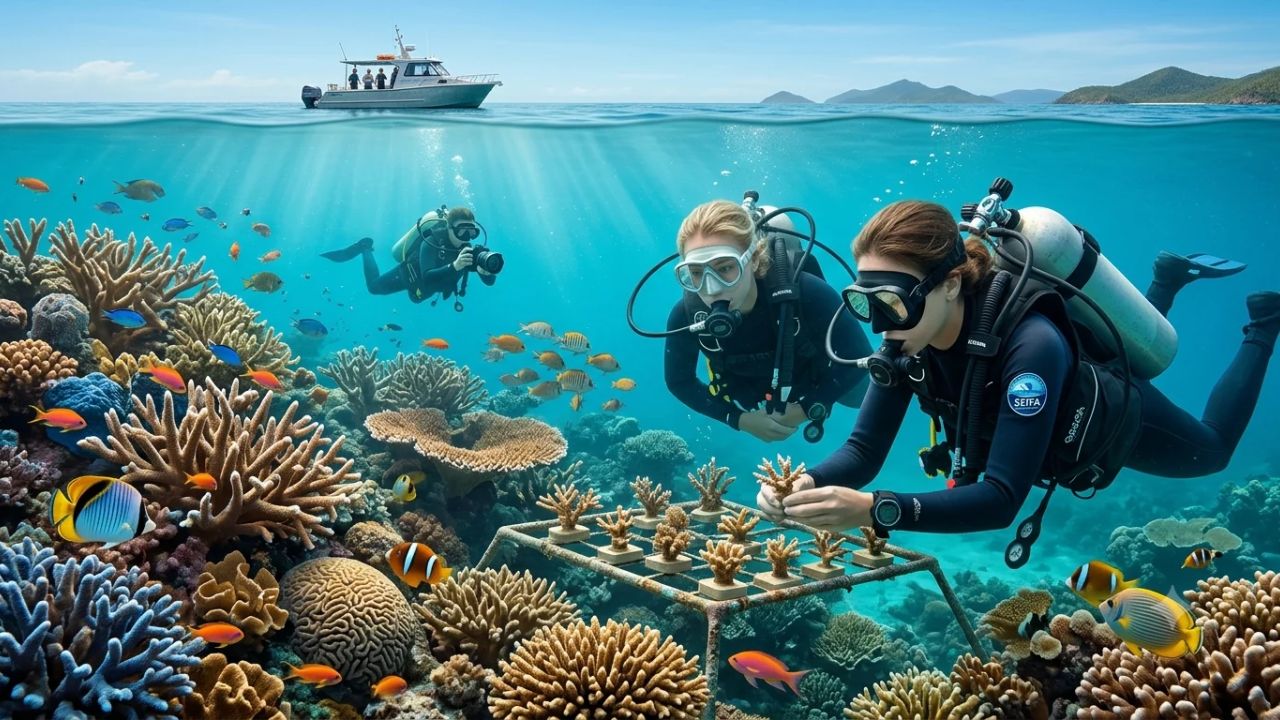
CAIRNS / TOWNSVILLE — Australia’s marine tourism industry is spearheading a global paradigm shift from passive ecological preservation toward industrialized biological restoration, deploying automated larval robotics, containerized mariculture hatcheries, and sovereign First Nations Sea Country governance across the Great Barrier Reef. Catalyzed by recurring oceanic marine heatwaves, marine scientists at the Australian Institute of Marine Science (AIMS), commercial dive tourism operators, and Traditional Owner ranger groups across Queensland have established a transformative regenerative travel model. Moving far beyond the historical boundaries of spatial marine parks, this alliance integrates high-throughput biotechnology directly into commercial tourism operations, converting leisure passenger catamarans into deployment craft and transforming coastal island resorts into functional mariculture production centers.
The economic and ecological stakes underlying this technological transformation are monumental. According to economic assessments by Deloitte Access Economics, the Great Barrier Reef represents an asset with a total social, economic, and icon value of 95 billion Australian dollars, generating approximately 9 billion Australian dollars in annual value-added economic contribution and supporting more than 77,000 full-time equivalent positions across coastal hospitality, marine transport, and scientific research. However, spatial data from the Great Barrier Reef Marine Park Authority (GBRMPA) reveals that 86 percent of all tourism visitation is concentrated within just 7 percent of the marine park expanse—principally off Cairns, Port Douglas, and the Whitsundays. Protecting these high-density visitor nodes from thermal degradation has compelled authorities to scale up industrialized coral propagation, shifting the Oceania marine tourism renaissance from laboratory prototypes to hundred-thousand-unit ocean deployments.
       GREAT BARRIER REEF REGENERATIVE TECHNOLOGY & TOURISM ECOSYSTEM (2026)
       ====================================================================

       [ MACROECONOMIC & SPATIAL BASELINE ]
       * GBR Asset Value: A$95 Billion | Annual Value-Added: A$9 Billion | 77,000 Jobs
       * Spatial Concentration: 86% of Visitor Activity Clustered in 7% of Marine Park
       * High-Density Hubs: Cairns, Port Douglas, Whitsundays, Keppel Islands
                                       |
                                       v
       [ BIOTECHNOLOGY INTERVENTION: REEFSEED MARICULTURE ]
       * Intermodal Containerized Modular Hatcheries (Plug-and-Play)
       * Autospawner Robotics: Skim flumes & optical fluidic fertilization control
       * Settled on Hydrodynamic Self-Stabilizing Ceramic Tabs (Zero chemical epoxy)
       * Deployment Trajectory: 16k ===> 44k ===> 120,000 Engineered Units
                                       |
                 +---------------------+---------------------+
                 |                                           |
                 v                                           v
       [ SOVEREIGN FIRST NATIONS CUSTODIANSHIP ]   [ REGENERATIVE TOURISM INTEGRATION ]
       * Accredited TUMRA Frameworks               * Master Reef Guides lead scientific dives
       * Indigenous Biobanking Cultural Safety     * Island Resorts host on-site hatcheries
       * Sea Country co-management: Woppaburra     * GBRMPA High Standard Tourism Operators
         (Keppels) & Wanjuru (Russell River)         secure 20-year operational permits
                 |                                           |
                 +---------------------+---------------------+
                                       |
                                       v
       [ INTERNATIONAL TECHNOLOGY TRANSFER HORIZON ]
       * Maldives: Maniyafushi Island containerized spawning trials
       * Caribbean: Curaçao & Dominican Republic mariculture transfers
       * Pacific SIDS: Fiji (i qoliqoli grounds), Vanuatu & Samoa deployments
From Passive Protection to Biological Engineering: The Limits of Marine Reserves
For more than half a century, the international marine conservation architecture was anchored almost exclusively in passive ecosystem preservation. Marine protected areas, spatial fishing closures, no-take zones, and anchor damage mitigations were employed by management authorities as the primary instruments to safeguard delicate biogenic reef systems. While local anthropogenic disturbances—such as overfishing, anchor dragging, and direct physical diver contact—were mitigated by these custodial frameworks, consecutive Pacific thermal anomalies demonstrated that shallow-water hermatypic corals cannot be insulated from systemic climatic stress through spatial boundaries alone.
When oceanic heatwaves drive sea surface temperatures two to three degrees Celsius above historical summer averages, thermal stress induces a breakdown in the obligate symbiosis between the coral host and its photosynthetic dinoflagellates (Symbiodiniaceae). Deprived of their primary metabolic energy source, corals turn stark white and face widespread mortality within weeks if elevated temperatures persist.
Because traditional marine park boundaries do not alter sea temperatures, relying solely on passive protection leaves tourist reefs vulnerable to mass mortality events.
MANUAL FRAGMENTATION VS. AUTOMATED REEFSEED MARICULTURE
| Entity / Facility | Delays | Cancellations | Details |
|---|---|---|---|
| Operational Vector | Traditional Manual Micro-Fragmentation | Plug-and-Play ReefSeed Mariculture | Strategic Biological Advantage |
| Reproductive Mode | Asexual cutting & | Automated sexual | Maximizes genetic |
| clonal propagation | mass outcrossing | diversity & adaptability | |
| Labor Intensity | 100 to 200 divers | 2 to 3 technicians | Drastically reduces |
| & lab volunteers | supervising systems | per-coral restoration costs | |
| Facility Scale | Fixed multi-million | Standardized 20-ft | Mobile; deployable to |
| land laboratories | shipping containers | remote island dive hubs | |
| Substrate Fixing | Manual underwater | Hydrodynamic self- | No toxic adhesives; |
| Method | chemical epoxy | stabilizing tabs | 10x faster seabed placement |
| Genetic Resilience | Clonal monoculture; | High recombination; | Introduces heat-tolerant |
| zero thermal drift | selective thermal | traits to wild populations |
To bridge the gap between ecological research and landscape-scale restoration, the Australian Government directed funding through the Reef Trust into the multi-institution Reef Restoration and Adaptation Program (RRAP). Led by the Australian Institute of Marine Science (AIMS) in collaboration with CSIRO, James Cook University, and the Great Barrier Reef Foundation, RRAP developed the Pilot Deployments Program. This initiative aims to transition coral restoration from artisanal, low-yield manual gardening into an automated, mass-scalable bio-manufacturing discipline.
Historically, community-led coral gardening relied on micro-fragmentation—the practice of breaking adult corals into small clones, growing them on underwater nursery trees, and manually gluing them back onto degraded reefs using chemical epoxies. While effective for small dive sites, manual fragmentation suffers from fundamental biological limitations. Because fragments are asexual clones of existing colonies, they introduce zero new genetic variation, leaving restored areas equally susceptible to the next heatwave.
Additionally, manual fragmentation is labor-intensive, requiring hundreds of dive hours to glue a few thousand corals. In contrast, RRAP's biological engineering strategy focuses on sexual larval propagation, harnessing the immense genetic diversity generated during annual synchronized mass coral spawning events.
The ReefSeed System: Containerized Larval Robotics and Hydrodynamic Settlement
The technical cornerstone of Australia’s biological intervention is the ReefSeed modular aquaculture system. Engineered through technical pipelines at the Australian Institute of Marine Science with international support from the Coral Research and Development Accelerator Program (CORDAP), ReefSeed transforms the complex biology of coral sexual reproduction into an automated, containerized mariculture platform.
Historically, mass coral larval rearing required permanent land-based marine laboratories or specialized oceanographic research vessels, confining restoration initiatives to metropolitan scientific centers. ReefSeed overcomes these spatial bottlenecks by packaging comprehensive life support systems, automated gamete handling, and controlled larval settlement infrastructure into standardized 20-foot intermodal shipping containers. Powered by self-contained solar-battery hybrid microgrids and supplied through temporary offshore seawater intake pipelines, a biosecure, plug-and-play coral hatchery can be established on commercial wharf docks, coastal aquaculture farms, or remote island dive resorts within forty-eight hours of delivery.
       THE REEFSEED AUTOMATED REPRODUCTIVE CYCLE ARCHITECTURE
       ======================================================

       [ STAGE 1: SYNCHRONIZED SPAWNING & SKIM HARVESTING ]
       * Gravid wild colonies placed in modular outdoor raceways
       * Buoyant egg-sperm bundles released post-sunset
       * Surface skim flumes guide bundles into separation chambers automatically
                                       |
                                       v
       [ STAGE 2: OPTICAL FLUIDIC FERTILIZATION CONTROL ]
       * In-line optical sensors measure real-time sperm cell concentration
       * Controlled micro-fluidic injection optimizes fertilization ratios
       * Completely prevents polyspermic fertilization mortality
                                       |
                                       v
       [ STAGE 3: FLOW-THROUGH EMBRYONIC & LARVAL REARING ]
       * Embryos develop into swimming planula larvae in 5,000L cylindrical tanks
       * Ultra-fine cartridge filtration (1 µm) & UV sterilization
       * Microbial conditioning prevents pathogenic bacterial blooms
                                       |
                                       v
       [ STAGE 4: HYDRODYNAMIC CERAMIC SUBSTRATE SETTLEMENT ]
       * Planulae settle onto engineered ceramic & calcium carbonate tabs
       * Settlement induced via biological crustose coralline algae (CCA) cues
       * Ceramic tabs wedge into reef crevices by gravity (Zero chemical epoxy)
Within each module, labor-intensive coral husbandry is replaced by automated biological process controls executing four synchronized phases:
- Automated Gamete Harvesting: During annual synchronized nocturnal spawning events, wild gravid colonies housed in modular raceways release millions of buoyant egg-sperm bundles. Instead of overnight technicians manually scooping gametes with plastic beakers, surface skim flumes channel the floating bundles into specialized separation chambers, preserving gamete viability.
- Controlled Mass Fertilization: In unmanaged environments, excessive sperm density causes polyspermy—where multiple sperm penetrate a single egg, inducing fatal chromosomal abnormalities and embryo death. Within ReefSeed, optical fluidic sensors continuously monitor sperm concentration, automatically diluting the mixture to maintain optimal sperm-to-egg ratios that maximize fertilization rates while eliminating polyspermic mortality.
- Larval Rearing and Microbial Management: Fertilized embryos are transferred into high-volume flow-through conical rearing tanks. Supported by precision cartridge filtration, protein skimmers, and ultraviolet sterilization, water quality is maintained without antibiotics. Once the planula larvae reach developmental competency, chemical peptides and natural biological cues from crustose coralline algae (Porolithon onkodes) are introduced to trigger settlement.
- Hydrodynamic Substrate Settlement: Rather than releasing unprotected, free-swimming planulae into open pelagic waters—where up to 99 percent are lost to fish predation and oceanic current dispersal—the larvae are settled onto purpose-engineered ceramic and composite tabs.
These 12-pointed star and cross-shaped ceramic substrates represent an engineering breakthrough. Designed using computational fluid dynamics, the tabs are weighted and shaped to tumble into natural crevices between dead coral rubble and calcareous reef matrix. Once settled, hydrodynamic drag and gravity wedge the tabs securely into place, resisting storm surges and tidal currents without requiring divers to apply toxic chemical adhesives or drive mechanical anchors into the reef floor.
The scalability of this approach was demonstrated across consecutive operational campaigns under the Pilot Deployments Program: 16,000 seeding devices were deployed in the initial seasonal trials, expanding to 44,000 devices in the subsequent phase, with current campaigns targeting 120,000 engineered units. By standardizing hardware and eliminating diver bottlenecks, ReefSeed slashes the cost per surviving coral recruit by more than 80 percent compared to traditional diving methods.
The Queensland Deployment Network: Coastal Hubs and Husbandry Integration
Rather than operating as isolated academic experiments, conservation aquaculture across Queensland is structured as an interconnected deployment network spanning four major economic gateways along the East Australian coastline:
QUEENSLAND REGENERATIVE REEF RESTORATION NETWORK
| Entity / Facility | Delays | Cancellations | Details |
|---|---|---|---|
| Coastal Hub & Base | Commercial & Civic | Primary Technological | Operational Reef |
| Partners | Infrastructure | Deployment Focus | |
| Townsville | AIMS National Sea | World's largest | Scientific calibration, |
| (Cape Cleveland) | Simulator (SeaSim) | automated marine | ranger training & heat- |
| & James Cook Univ. | simulation facility | tolerance outcrossing | |
| Cairns & | Cairns Marine, | Containerized | Outer Ribbon Reefs & |
| Port Douglas | Quicksilver Cruises | ReefSeed modules & | Opal Reef recreational |
| & Master Guides | high-speed vessels | dive sites replenishment | |
| Innisfail | Aus Fish Coral & | Integrated onshore | Russell River nearshore |
| (Cassowary Coast) | Jaragun Ecoservices | raceways & river | reef lines & sediment- |
| (Wanjuru Rangers) | catchment filters | impact mitigation zones | |
| Keppel Islands | Woppaburra People | MARRS Reef Stars & | Shelving Beach & Monkey |
| (Southern GBR) | & Great Keppel | modular larval | Reef structural rubble |
| Island Resort | settlement units | field stabilization |
Townsville: The SeaSim Scientific Training Epicentre
The technological nerve center of the network is situated at Cape Cleveland, south of Townsville, within the National Sea Simulator (SeaSim). As the world's most sophisticated marine research aquarium, SeaSim can precisely simulate ocean warming trends, ocean acidification, photoperiod cycles, and nutrient regimes across 365 days a year. Under the Pilot Deployments Program, SeaSim serves as the advanced training ground where Traditional Owner ranger groups, commercial aquaculture operators, and international technical fellows master ReefSeed robotics, automated fertilization systems, and larval settlement protocols before deploying hardware into remote coastal waters.
Cairns and Port Douglas: Commercial Husbandry and Eco-Tourism Corridors
While Cairns functions as northern Queensland's international aviation gateway, vessel departures for the pristine outer Ribbon Reefs and Opal Reef are staged from Port Douglas. Within this commercial corridor, containerized ReefSeed modules are operated directly by Cairns Marine at its shorefront facility. As one of the world's largest certified collectors and exporters of marine life, Cairns Marine contributes decades of professional holding capacity, biological filtration expertise, and animal husbandry protocols.
During annual mass coral spawning cycles in November and December, high-speed passenger catamarans operated by premier dive operators are integrated into the deployment pipeline. Vessels carry tens of thousands of seeded ceramic substrates out to high-value recreational dive sites, allowing marine biologists, certified Master Reef Guides, and paying passengers to participate in mass deployments across degraded tourism reefs.
Innisfail: Catchment Remediation Meets Marine Mariculture
Further south in Innisfail, an operational alliance unites commercial aquaculture company Aus Fish Coral with Jaragun Ecoservices, representing Wanjuru Traditional Owners. This regional partnership pairs marine mariculture with landward catchment remediation along the Russell River basin—one of Queensland's wettest agricultural catchments.
By restoring coastal freshwater wetlands, planting riparian vegetation, and trapping agricultural sediment runoff before it reaches the sea, the alliance ensures that juvenile corals outplanted on nearshore reefs are protected from smothering silt and chemical fertilizer plumes.
Keppel Islands: Woppaburra Sea Country Stabilization
At the southern boundary of the marine park, large-scale restoration is demonstrated across the ancestral Sea Country of the Woppaburra People in the Keppel Islands archipelago. Operations based at Konomie (North Keppel Island) bring together researchers, vessel operators, and Woppaburra custodians under the Woppaburra Coral Project.
Here, larval ReefSeed deployments are synchronized with physical seafloor stabilization systems, including Mars Assisted Reef Restoration System (MARRS) Reef Stars—hexagonal sand-coated steel structures deployed across loose coral rubble fields at Shelving Beach, Monkey Reef, and Humpy Island to bind the shifting seabed and provide a solid foundation for new coral colonies.
Sovereign First Nations Custodianship: Free, Prior, and Informed Sea Country Governance
A fundamental distinction of Australia's coral restoration revolution is the structural integration of sovereign First Nations stewardship. Meaningful co-management grounded in the principles of Free, Prior, and Informed Consent (FPIC) has replaced outdated frameworks where Indigenous participation was limited to superficial, non-binding advisory panels.
       SOVEREIGN SEA COUNTRY CO-MANAGEMENT ARCHITECTURE
       ================================================

       [ TRADITIONAL USE OF MARINE RESOURCE AGREEMENTS (TUMRA) ]
       * Accredited statutory authority ratified with Commonwealth & State bodies
       * Custodial rights over sacred waters, sea lanes & biological resources
                                       |
                 +---------------------+---------------------+
                 |                                           |
                 v                                           v
       [ INDIGENOUS BIOBANKING ACCORDS ]           [ PROFESSIONAL APPRENTICESHIPS ]
       * Cultural safety protocols shield coral    * Indigenous Aquaculture Traineeships
         genetic material from patenting             at SeaSim (e.g. Woppaburra rangers)
       * Protects customary intellectual property  * Certified technicians managing hardware
       * Shared governance of cryogenic banks      * Direct vessel skippering & monitoring
Custodial sovereignty across Keppel Bay is exercised by the Woppaburra People under an accredited Traditional Use of Marine Resource Agreement (TUMRA) ratified jointly with the Great Barrier Reef Marine Park Authority and the Queensland Department of Environment. Under this statutory instrument, Traditional Custodians co-author scientific research proposals, direct the geographical placement of mariculture installations in culturally sensitive waters, and maintain ownership over customary intellectual property.
An international institutional milestone was established through the codification of the Indigenous Biobanking Cultural Safety Protocol, developed in partnership with the Taronga Conservation Society Australia, the Great Barrier Reef Foundation, and scientific agencies. Under this legal framework, coral tissue and cryopreserved sperm samples collected from ancestral Sea Country cannot be patented, commercially exploited, or subjected to unauthorized genetic modification without formal approval and benefit-sharing agreements with the custodial Traditional Owner clans.
Simultaneously, the program creates long-term environmental careers through the Indigenous Aquaculture Traineeship scheme. Woppaburra and Wanjuru rangers complete technical apprenticeships at the National Sea Simulator, mastering coral biology, fluidic sensor maintenance, and water quality chemistry. Rangers like Woppaburra practitioner Jamiga-Marie Cummins have transitioned into certified mariculture supervisors, directing field operations in home waters.
Along the Russell River, Wanjuru Rangers of Jaragun Ecoservices skipper deployment vessels, monitor underwater acoustic stations, and operate ReefSeed modules. This active involvement enriches regional cultural tourism: international visitors can book guided Sea Country diving excursions where traditional custodians interpret both ancient songlines and cutting-edge larval biotechnology.
The Regenerative Tourism Model: Master Reef Guides and Resort Hatcheries
The integration of automated mariculture hardware with sovereign First Nations governance has revolutionized coastal travel economics across Oceania, replacing low-yield passive sightseeing with high-value regenerative practices.
PASSIVE SIGHTSEEING VS. REGENERATIVE TOURISM (2026)
| Entity / Facility | Delays | Cancellations | Details |
|---|---|---|---|
| Operational Model | Traditional Passive Marine Tourism | Regenerative Technology Tourism | Economic & Ecological Dividend |
| Passenger Role | Passive observers; | Active citizen- | Deeper educational |
| spectator diving | scientists; coral | engagement; premium tour | |
| & snorkeling tours | deployment helpers | ticket pricing power | |
| Guiding Standard | General dive masters | Accredited Master | Expert interpretation; |
| with basic ecology | Reef Guides trained | rigorous data collection | |
| briefings | by AIMS & GBRMPA | for national databases | |
| Resort Integration | Activities desks | On-site modular | Fulfills corporate ESG; |
| selling generic | ReefSeed hatcheries | protects living marine | |
| boat excursions | & coral nurseries | assets of the resort | |
| Statutory Incentive | Standard short-term | 20-year operational | Grants long-term commercial |
| marine operating | permits under High | investment security for | |
| permits (3–5 years) | Standard Operator | eco-certified operators |
Casual, unstructured voluntourism activities—such as hand-tying coral fragments to metal frames with plastic zip-ties—have been systematically phased out due to poor biological survival rates and lack of spatial control. In their place, international travelers are embedded within structured scientific workflows led by accredited Master Reef Guides. Developed through a partnership involving the Great Barrier Reef Marine Park Authority, Tourism and Events Queensland, and the Association of Marine Park Tourism Operators (AMPTO), Master Reef Guides undergo intensive ecological and cultural training.
Under their supervision, visiting divers conduct non-invasive fluorescence imaging surveys, using specialized blue-light torches and yellow barrier filters to quantify larval recruit settlement on ceramic substrates, with biological records submitted directly into GBRMPA's Eye on the Reef monitoring database.
Simultaneously, standalone resort activities desks on islands such as Great Keppel, Green Island, and Fitzroy Island have been upgraded into functional mariculture production centers. Luxury hospitality operators host containerized ReefSeed modules on-site to fulfill Environmental, Social, and Governance (ESG) criteria. Tens of thousands of juvenile corals are produced and outplanted annually onto adjacent house reefs, establishing a closed-loop conservation model that protects the living marine assets upon which island tourism depends.
Under the High Standard Tourism Operator (HSTO) framework administered by GBRMPA, commercial operators who maintain independent eco-certification, contribute vessel logbooks to scientific monitoring, and participate in biological restoration receive statutory incentives, including extended twenty-year operational permits. This regulatory stability enables tourism businesses to invest in low-emission hybrid catamarans and advanced dive hardware, aligning private capital with marine preservation.
International Technology Transfer: Scaling Across the Pacific and Beyond
The engineering principles proven across Queensland’s waters are being actively exported to vulnerable coral nations worldwide, demonstrating that modular aquaculture can operate in remote archipelagos lacking extensive land infrastructure.
       GLOBAL MARICULTURE TECH TRANSFER CORRIDORS
       =========================================

       [ GREAT BARRIER REEF ENGINE (AIMS / SEASIM / QUEENSLAND) ]
       Proven modular robotics, automated Autospawners & hydrodynamic tabs
                                       |
                 +---------------------+---------------------+
                 |                                           |
                 v                                           v
       [ PACIFIC REEF SEEDING INITIATIVE ]         [ INDIAN OCEAN & CARIBBEAN ]
       * Deployments to Fiji, Vanuatu & Samoa      * Maldives: Maniyafushi Island
       * Customary marine tenure integration:        containerized atoll hatchery
         Fijian i qoliqoli tribal fishing grounds  * Caribbean: Curaçao & Dominican Rep.
       * Local practitioners trained at SeaSim       via Global Coral Tech Transfer
In the Indian Ocean, rapid deployment capability was validated in the Maldives through a partnership involving AIMS, CORDAP, and the Maldives Marine Research Institute (MMRI). A containerized ReefSeed installation was established on Maniyafushi Island in South Malé Atoll. Maldivian marine biologists utilized the automated system to harvest, fertilize, and rear millions of coral larvae from wild acroporid spawning events, outplanting settled substrates across two dozen atoll sites with high recruit survival rates documented during follow-up monitoring.
In the Caribbean, the Global Coral Tech Transfer Project introduced automated larval rearing hardware into Curaçao and the Dominican Republic, confirming marked improvements in larval yields and fertilization control over traditional manual methods.
Across Oceania, the Pacific Reef Seeding Initiative is deploying mobile ReefSeed systems to Pacific Small Island Developing States (SIDS). Marine practitioners and traditional custodians from Fiji, Vanuatu, and Samoa complete intensive residencies at the National Sea Simulator in Townsville before managing containerized installations within customary marine tenures, such as Fijian i qoliqoli fishing grounds. By pairing Western biotechnology with ancestral Pacific traditional ecological knowledge, the initiative establishes an enduring defense against regional climate disruptions.
Strategic Traveler Blueprint: How to Participate in Regenerative Reef Tourism
For international travelers planning to visit the Great Barrier Reef and Queensland’s coastal archipelagos in 2026 and 2027, engaging in regenerative marine tourism requires conscious planning and operator selection:
       REGENERATIVE REEF TRAVEL PLAYLIST: FIVE ESSENTIAL PROTOCOLS
       ===========================================================

       [ 1. OPERATOR CERTIFICATION AUDIT ]
       * Verify High Standard Tourism Operator (HSTO) accreditation
       * Select vessels staffed by accredited Master Reef Guides
       * Confirm active participation in RRAP or Eye on the Reef programs
                                       |
                                       v
       [ 2. TIME DEPARTURES WITH ANNUAL CORAL SPAWNING ]
       * Target November / December full moon windows for outer reef night dives
       * Witness synchronized mass spawning & live larval harvesting
                                       |
                                       v
       [ 3. EMBRACE CITIZEN-SCIENCE CITATION ]
       * Download the Eye on the Reef mobile application
       * Participate in Rapid Monitoring Surveys & fluorescence night dives
       * Log marine fauna sightings and benthic substrate condition scores
                                       |
                                       v
       [ 4. ENGAGE FIRST NATIONS CULTURAL EXPERIENCES ]
       * Book Sea Country dive tours guided by Traditional Custodians
       * Visit Woppaburra (Keppel Bay) or Wanjuru (Cassowary Coast) projects
       * Learn customary marine tenure principles and reef stewardship songlines
- Prioritize High Standard Tourism Operators: Look for operators certified under the GBRMPA High Standard Tourism Operator framework. Operators displaying the Master Reef Guide insignia ensure that your journey directly funds scientific monitoring, adheres to strict carbon-offset standards, and contributes vessel logbook data to marine park authorities.
- Synchronize Trips with Mass Coral Spawning: If scheduling an expedition during late spring (November or December), align your travel dates with the annual mass coral spawning window, which typically occurs four to six nights after the full moon. Premier dive liveaboards departing Cairns and Port Douglas offer dedicated spawning expeditions where guests can witness millions of colorful gamete bundles rising through the water column and observe live mariculture operations aboard support vessels.
- Engage with Citizen-Science Monitoring: Download the official Eye on the Reef mobile application before boarding your vessel. During snorkeling or scuba excursions, submit geo-tagged photographs of coral health, megafauna sightings (including green turtles, manta rays, and reef sharks), and crown-of-thorns starfish observations directly to marine park rangers.
- Choose Island Resorts with Functional Marine Nurseries: When selecting accommodation, consider properties such as Fitzroy Island, Green Island, or Great Keppel Island, where on-site coral restoration centers and sea turtle rehabilitation facilities offer guided educational tours, allowing guests to observe juvenile coral propagation firsthand.
- Support Indigenous Sea Country Enterprises: Deepen your cultural and environmental connection by booking tours operated by Traditional Owners. Experiencing ancestral Sea Country through the perspective of Woppaburra or Wanjuru custodians provides profound insights into thousands of years of sustainable marine stewardship.
Australia’s coral restoration revolution demonstrates that the future of travel lies not in passive sightseeing, but in active ecological stewardship. By combining cutting-edge biotechnology, commercial tourism logistical scale, and sovereign First Nations knowledge, the Great Barrier Reef is writing a new chapter in marine conservation—ensuring that the world's most magnificent underwater wilderness continues to flourish for generations to come.
Related Travel Guides
- Japan Autumn Travel Guide: How to Navigate Tokyo and Kyoto Foliage, Temple Illuminations, and November Bookings
- Paris and Brussels Launch Joint European Gastronomy Pass Promoting Organic Dining
- Japan Overhauls Tax-Free Shopping as Tourists Must Pay Upfront Consumption Tax
- European Business Travel Spending to Surge to €404 Billion in 2026 as Germany and UK Lead
- Haiti Issues Marine Weather Warning as Six-Foot Waves and Thunderstorms Threaten Northern Waters
This article is for informational purposes. Flight routes, passenger regulations, visa rules, and transit advisories are subject to change by airlines and aviation authorities. Readers are advised to verify schedules and travel documentation with relevant carriers and border agencies before departure.
Related Stories
Australia Scales ReefSeed Technology in Cairns: A New Era of Coral Restoration Tourism 2026
Oceania Shifts Tourism Into the Night: How Twilight Events, Thermal Engineering, and Overlanding Reshape Regional Economies