
Australia Celebrates Queensland’s Stanthorpe as the 2026 Top Tourism Town After a Remarkable Tourism Rise
Stanthorpe claims gold at the 2026 Australian Top Tourism Town Awards in Canberra, showcasing the cool-climate vineyards and granite wonders of Queensland.

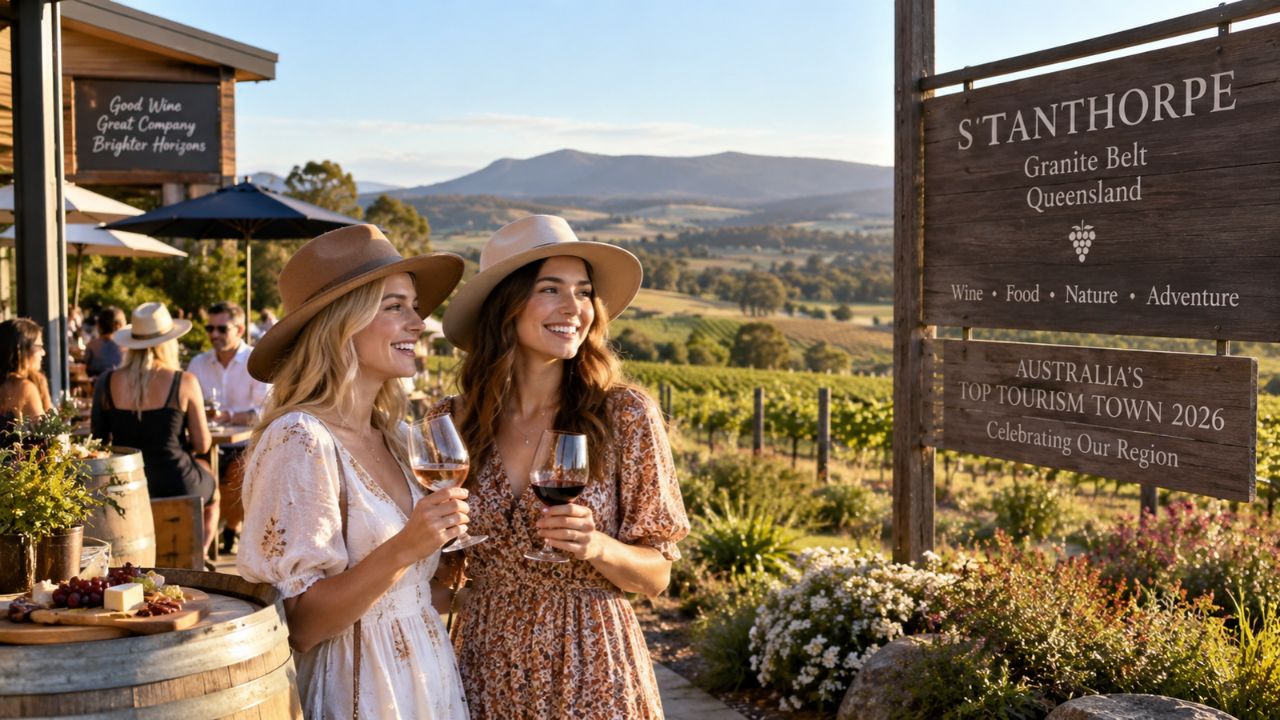
Image Source Australia Tourism
While international travelers reflexively associate Queensland with sun-drenched coral reefs and golden surf beaches, Australia's highest tourism accolade just celebrated a mountain town where winter mornings bring frost and apple orchards thrive beside giant granite boulders. When industry delegates assembled at Parliament House in Canberra for the 2026 Australian Top Tourism Town Awards, it was Stanthorpe that took home the coveted national gold award in the premier category honoring communities with populations above 5,000 residents. Perched 800 metres above sea level in Queensland's renowned Granite Belt, this elevated rural enclave has outshone coastal heavyweights by championing cool-climate viticulture, paddock-to-plate dining, and community-led hospitality.
The Rise of the Granite Belt on Australia's National Stage
The annual Australian Top Tourism Town Awards evaluate destinations against rigorous benchmarks, including visitor infrastructure, heritage preservation, accommodation quality, geographic accessibility, and the capacity of local hosts to deliver authentic cultural encounters. Taking top honors in the primary division marks a watershed moment for inland Queensland travel, celebrated widely by regional advocates and Tourism Australia. In the main division for towns exceeding 5,000 residents, Stanthorpe secured gold ahead of coastal favorite Kiama in New South Wales, which earned silver, and Quechua in Victoria, which claimed bronze.
Queensland’s exceptional showing at Parliament House extended across every level of the national competition:
- Top Tourism Town Division (Populations above 5,000): Stanthorpe captured gold, highlighting a nationwide travel movement toward unhurried country retreats and agricultural heartlands.
- Small Tourism Town Division (Populations between 1,500 and 5,000): Airlie Beach, Queensland's gateway to the Great Barrier Reef and Whitsunday Islands, clinched gold after previously earning bronze in the same competitive class.
- Tiny Tourism Town Division (Populations under 1,500): Portsea in Victoria claimed gold for its coastal heritage, while Toogoolawah in Queensland's Somerset Region earned silver, and historic Port Arthur in Tasmania was awarded bronze.
This clean sweep demonstrated that holidaymakers are actively recalibrating their travel priorities. Supported by statewide initiatives through Queensland Tourism, travelers are seeking destinations that combine pristine natural environments, artisan food producers, and genuine rural character rather than heading exclusively to crowded coastal corridors.
What Makes Stanthorpe Different
Stanthorpe’s geographic identity is defined by elevation and ancient geology. Situated around 800 metres above sea level along the Great Dividing Range, the town enjoys a temperate microclimate completely distinct from the subtropical warmth that characterizes coastal Queensland. Crisp alpine air, distinct four-season weather patterns, and rich decomposed granite soils have combined to create one of Australia’s most intriguing high-altitude agricultural zones.
Viticulture in the surrounding Granite Belt does not mirror the sun-baked plains of traditional Australian wine valleys. Here, boutique winemakers focus on "Strange Bird" alternative varieties that thrive in cool conditions and granitic earth, such as Verdelho, Tempranillo, Nebbiolo, Saperavi, and Fiano. Cellar door visits across Ballandean and Severnlea offer personal conversations with the growers themselves, far removed from corporate tasting rooms.
Beyond the vines, the terrain is dominated by prehistoric granite monoliths and balancing boulders. Protected wilderness areas managed under the Queensland Parks and Wildlife Service, such as nearby Girraween National Park, feature massive granite domes, wildflower valleys, and deep gorges carved by mountain streams. This juxtaposition of rugged nature, high-altitude orchards, and artisanal food production creates an inland retreat unlike anywhere else in the nation.
Visitor Insider Tips
Navigating the Granite Belt requires an appreciation for country roads and seasonal changes that catch many first-time visitors by surprise.
- Seasonal Windows and Timing Hacks: Summer brings bountiful orchard harvests, but winter between June and August is when the region displays its true personality. Known locally as the "Brass Monkey Season," winter brings roaring log fires, morning frosts, and occasional snow flurries. To experience wine tastings without weekend crowds from Brisbane, plan your cellar door visits from Tuesday to Thursday. Many boutique growers close on Mondays to tend their vines, while weekends see full tasting rooms.
- Transit and Navigational Strategy: Stanthorpe sits roughly 220 kilometers southwest of Brisbane and 200 kilometers from the Gold Coast, accessible via the scenic Cunningham Highway through Cunningham's Gap. Having your own car is non-negotiable; public transport between Stanthorpe and outlying vineyards along the New England Highway is virtually nonexistent. If you plan an afternoon of tastings, book a local boutique tour operator or designate a sober driver ahead of time.
- Local Etiquette and Farm-Gate Protocol: Many orchard stalls and boutique providores operate on an honor-box cash system or request contactless card payments at farm gates. Respect private property when driving down dirt tracks, and never pick fruit from orchard rows without explicit permission from the grower. Casual layered attire with sturdy boots is the local uniform; temperatures can drop by 15 degrees Celsius between mid-afternoon sunshine and dusk.
- Culinary Specialties and Base Stays: Skip generic highway dining and seek out regional treasures: warm spiced apple pies in Applethorpe, sheep's milk cheeses, freshly gathered truffles in mid-winter, and artisan sourdough from local wood-fired bakeries. For accommodation, base yourself along Quart Pot Creek near the town center for easy walking access to heritage cafes, or reserve a secluded stone cottage in Ballandean to enjoy unobstructed southern night skies.
Cultural and Environmental Context
The cultural character of Stanthorpe is anchored by generations of agricultural stewardship. In the mid-20th century, European migrant families, particularly Italian settlers, introduced traditional grape growing and vegetable farming to these rocky granite plateaus, laying the foundations for today's thriving wine industry. Today, that heritage blends with proud local farming lineages who have worked the soil through prolonged droughts, mountain bushfires, and severe winter freezes.
Because the Granite Belt sits atop an elevated granite ridge, water security is an ever-present environmental concern. The region does not rely on major river networks, depending instead on seasonal rainfall, private on-farm dams, and community conservation practices. The town’s tourism model directly supports this ecological resilience. By visiting farm gates and staying at family-run bed-and-breakfasts, travelers inject capital directly into regenerative agriculture, native revegetation corridors, and bushfire management efforts.
The recognition bestowed at Parliament House highlights how small Australian communities can cultivate sustainable, community-first tourism that protects their pastoral identity rather than sacrificing it to overdevelopment. Stanthorpe’s triumph proves that honoring local produce, preserving natural formations, and welcoming guests with genuine warmth creates an enduring travel experience.
FAQ: Visiting Stanthorpe 2026
What is the best time of year to visit Stanthorpe? Autumn and winter offer the most memorable experiences. March through May features vibrant vineyard foliage and apple harvests, while June through August brings crisp frost, cozy fireplaces, and seasonal winter events.
How do travelers get to Stanthorpe from Brisbane? Drive southwest along the Cunningham Highway (National Highway 15) through Warwick. The scenic 220-kilometer drive takes approximately two and a half to three hours depending on mountain traffic through Cunningham’s Gap.
What makes Granite Belt wine unique in Australia? Sitting 800 metres above sea level, Stanthorpe's cold-climate plateau and decomposed granite soils produce distinct alternative grape varieties, celebrated across the region's famous Strange Bird wine trail.
Is Stanthorpe suitable for families and outdoor adventurers? Yes, families enjoy apple picking, roadside maze attractions, and gentle bushwalks among the balancing boulders and granite domes of nearby Girraween National Park.
Stanthorpe proves that Australia's most captivating travel stories unfold when you leave the coast behind and head into the high granite hills.
Related Travel Guides
Disclaimer
This article is for informational and educational purposes only. It does not constitute legal, financial, or professional advice. While we strive to provide accurate and up-to-date information, travel policies, regulations, and conditions change rapidly. Always verify information with official sources before making travel decisions. Nomad Lawyer makes no representations about the accuracy, reliability, completeness, or suitability of the information provided. Readers should consult qualified professionals for advice specific to their circumstances. The views expressed in this article are those of the author and do not necessarily reflect the views of Nomad Lawyer.
Preeti Gunjan
Contributor & Community Manager
A passionate traveller and community builder. Preeti helps grow the Nomad Lawyer community, fostering engagement and bringing the reader experience to life.
Learn more about our team →