
Athens Travel Guide 2026: Beyond the Parthenon to Discover Authentic Greek Urban Culture
Explore the hidden depths of Athens in 2026, moving beyond the Acropolis to uncover the political, social, and residential heart of Greece's vibrant capital.

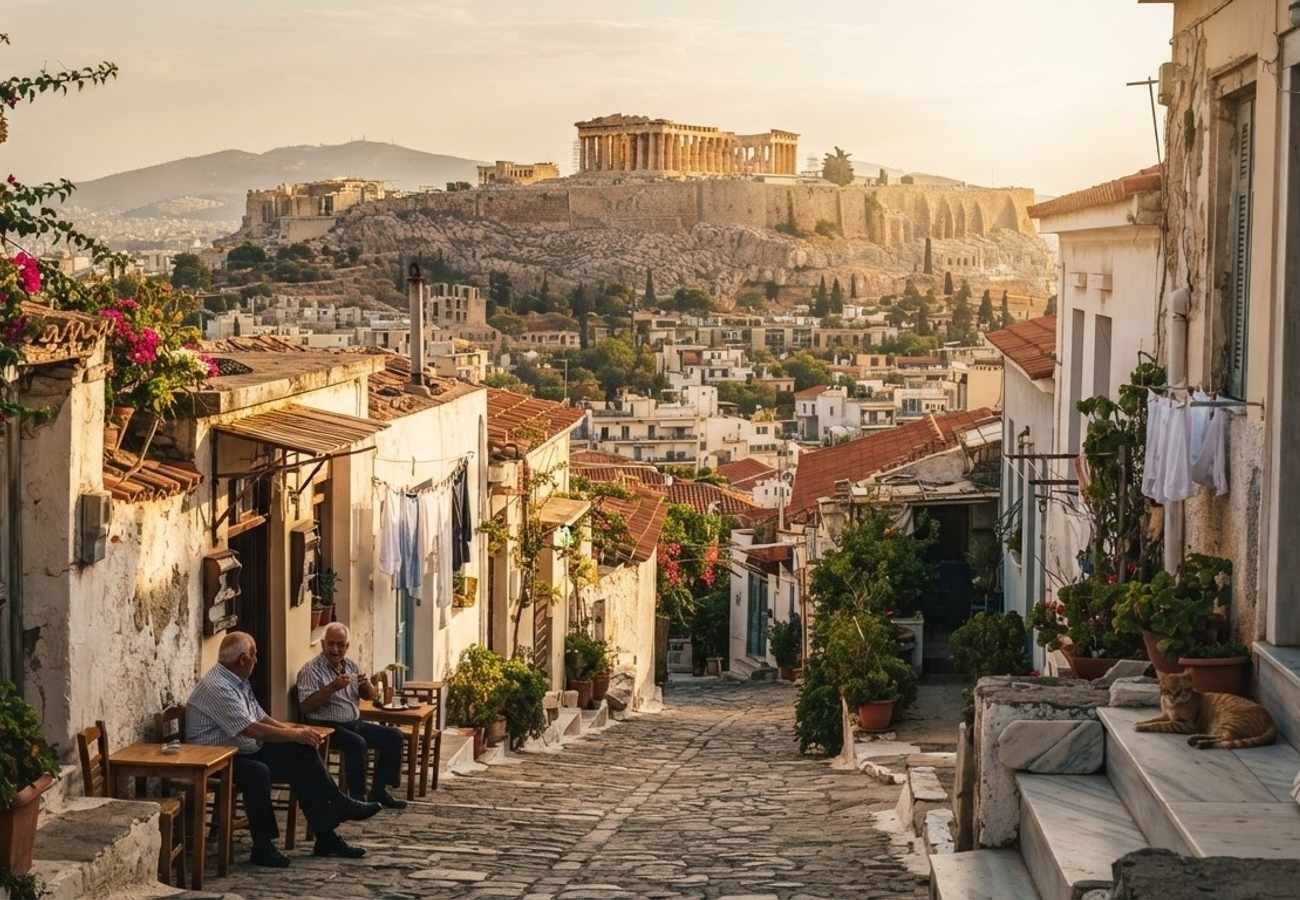
Image generated by AI
Many travelers make the critical error of treating Athens as a mere transit hub, spending a few hours at the main monuments before rushing to the islands. In doing so, they bypass the visceral energy of a city where the scent of roasting coffee in narrow alleys blends with the sight of sunlight hitting ancient marble and the chaotic symphony of street vendors. Athens does not curate a sanitized experience for tourists; instead, it offers a raw, cinematic backdrop of urban chaos and timeless beauty that demands a slower pace of exploration.
Redefining the Athenian Experience Beyond the Acropolis
To truly understand the identity of the Greek capital, one must look past the standard checklists. While the Acropolis and the winding paths of Plaka are essential, they represent only a fraction of the city's soul. Athens is a sprawling metropolis that stretches from the rugged inner mountain ranges down to the coastal roads leading toward Sounio.
This urban landscape serves as a living archive, where 19th-century neoclassical buildings stand alongside modern Olympic infrastructure, working-class districts, and quiet suburban pockets. For the modern traveler, shifting the focus from "sightseeing" to "experiencing" means supporting local businesses in residential areas and respecting the city as a living organism rather than a museum.
Navigating Ancient Democracy and the Roots of Philosophy
The ascent to the Acropolis to view the Parthenon remains a non-negotiable experience, but the real value lies in looking outward from the summit to see the vastness of the city. To ground this visual experience in fact, a visit to the Acropolis Museum is imperative. The museum's design, featuring excavations beneath the floors, reveals over 4,500 years of continuous human habitation, providing a stratigraphic history of the city.
Beyond the citadel, the Ancient Agora serves as the operational center of classical antiquity. This was the site of daily commerce and governance, far removed from the ceremonial nature of the Acropolis. Nearby, the Pnyx stands as the birthplace of democratic assembly, where citizens once debated public policy. The adjacent hill of Areopagus further bridges the gap between eras, marking the spot where Saint Paul addressed classical philosophers, linking ancient intellectualism with the rise of early Christian theology. To see how this history integrates with modern life, travelers should wander through the neighborhoods of Anafiotika, Monastiraki, Psiri, and Koukaki.
Political Counterculture and Archaeological Depth in Exarchia
For those seeking a comprehensive view of Greek history, the National Archaeological Museum is the premier institution. Unlike the site-specific ruins of the citadel, this museum offers a nationwide perspective, showcasing how various regional cultures merged into a single national identity over millennia.
Directly adjacent to this center of history is Exarchia, a district that provides a stark contrast to the polished museum halls. Exarchia is a center for student activism, independent bookstores, and provocative street art. While often viewed through a polarizing lens, the neighborhood is essential for anyone wanting to understand contemporary Greek political thought and social resistance. Exploring these politicized spaces allows visitors to see how historic struggles for autonomy continue to shape modern community dynamics.
Civic Governance and the Neoclassical Legacy of Panepistimiou Street
The transition into modern statehood is most visible at Syntagma Square. Here, the precision of the Evzones during the changing of the guard at the Tomb of the Unknown Soldier serves as a powerful symbol of national continuity. For a change in perspective, visitors can observe the urban flow from the Public building or the historic Hotel Grande Bretagne, highlighting the intersection of commercial energy and architectural luxury.
Along Panepistimiou Street, the "Athenian Trilogy" stands as a testament to 19th-century nation-building. These three neoclassical structures were designed to link the newly independent Greek state to its classical ancestors:
| Building | Purpose | Architectural Style |
|---|---|---|
| The Academy of Athens | Higher Learning & Research | Neoclassical |
| The University of Athens | Academic Instruction | Neoclassical |
| The National Library of Greece | Preservation of Knowledge | Neoclassical |
These structures, along with the Old Parliament House, remind the observer that the history of the post-independence era is as vital to the Greek identity as the ruins of the Golden Age.
Residential Charm and Panoramic Vistas of Lycabettus Hill
The neighborhood of Kolonaki offers a glimpse into the refined side of Athens, with its high-end boutiques and elegant café culture. This area leads toward the peak of Lycabettus Hill, which provides the most comprehensive panoramic view of the Athenian basin stretching toward the Saronic Gulf.
The summit is home to the small Church of Agios Georgios, a site often tied to deep personal and family histories for locals. Moving further into the residential fabric of the city, districts like Pangrati and Mets offer an authentic look at daily life. In these quarters, domesticity unfolds in the shadow of the Panathenaic Stadium, creating a unique urban environment where the mundane and the monumental coexist seamlessly.
Geopolitics and the Evolution of Democratic Freedom
The political complexity of 20th-century Greece is reflected in the Tatoi estate near Mount Parnitha. As the former royal residence, Tatoi symbolizes the nation's volatile transitions between monarchy, republic, and dictatorship.
The influence of the Cold War is physically manifested in the city center via the Statue of Harry Truman, commemorating the 1947 Truman Doctrine. This monument remains a point of contention and discussion regarding foreign strategic influence in Greek domestic affairs.
Perhaps the most poignant site of modern resistance is the Polytechneio (National Technical University of Athens). This location commemorates the student uprising of November 1973 against the military junta. The struggle for civil liberties at the Polytechneio mirrors the democratic debates once held at the Pnyx, proving that the fight for freedom is a continuous thread in the Athenian narrative.
Athens is not a city to be checked off a list, but a living entity to be felt in its contradictions.
Related Travel Guides
Disclaimer
This article is for informational and educational purposes only. It does not constitute legal, financial, or professional advice. While we strive to provide accurate and up-to-date information, travel policies, regulations, and conditions change rapidly. Always verify information with official sources before making travel decisions. Nomad Lawyer makes no representations about the accuracy, reliability, completeness, or suitability of the information provided. Readers should consult qualified professionals for advice specific to their circumstances. The views expressed in this article are those of the author and do not necessarily reflect the views of Nomad Lawyer.
Preeti Gunjan
Contributor & Community Manager
A passionate traveller and community builder. Preeti helps grow the Nomad Lawyer community, fostering engagement and bringing the reader experience to life.
Learn more about our team →