Asia Travel Disrupted: 4,304 Delays and 373 Cancellations Hit Delhi, Beijing, and Kuala Lumpur Megahubs

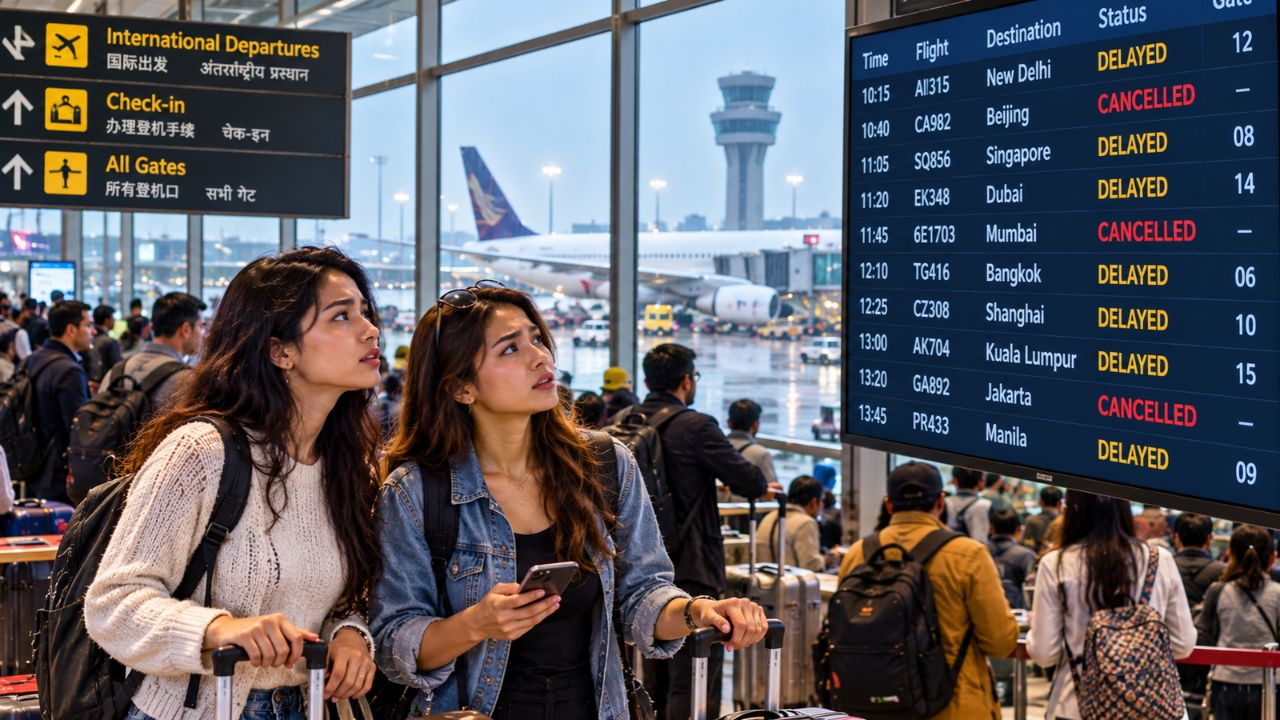
Across Asia's high-density aviation corridors, a cascading operational crunch grounded 373 flights and delayed 4,304 departures and arrivals within a single monitoring window on October 29–30, 2026, as an unusual confluence of post-cyclonic squalls, peatland wildfire smoke, and regional airspace constraints overwhelmed major transit hubs. Verified real-time tracking compiled through FlightAware on October 29, 2026, at 4:19 PM ET (12:19 AM on October 30, 2026) revealed that South Asia, East Asia, Southeast Asia, and connecting Gulf hubs simultaneously absorbed severe knock-on schedule impacts. For transcontinental flyers and regional commuters alike, the simultaneous disruption across India's golden triangle, China's eastern commercial corridors, and Malaysian transfer points demonstrated how rapidly localized weather events can paralyze trans-Eurasian itineraries.
Compound Atmospheric and Operational Pressures Strain Asian Skyways
The disruption across South Asia was spearheaded by unsettled weather following Cyclone Arnab, which made landfall along the Andhra Pradesh coastline on October 28, bringing infrastructure damage, high winds, and downpours. The India Meteorological Department warned of continuing rain, squalls, thunderstorms, and localized hail across Delhi and northern and eastern regional flight corridors through October 29–30. These storm bands created rolling ground delays that rippled across India's domestic network.
Indira Gandhi International Airport in New Delhi experienced the highest individual airport impact, recording 511 delayed flights and 12 cancellations. Chhatrapati Shivaji Maharaj International Airport in Mumbai followed closely with 428 flight delays and 17 cancellations. Regional centers also faced severe operational friction: Kempegowda International Airport in Bengaluru posted 154 delays and 10 cancellations, Rajiv Gandhi International Airport in Hyderabad logged 105 delays and 3 cancellations, while Pune recorded 46 delays and 10 cancellations. Cochin International tallied 44 delays and 8 cancellations, Jaipur registered 33 delays and 3 cancellations, and the newly operational Navi Mumbai International logged 25 delays alongside 10 cancellations. Smaller secondary airports registered acute localized impact, with Calicut logging 7 delays and 3 cancellations (7% origin cancellation rate), Gorakhpur noting 6 delays and 3 cancellations (20% origin cancellation rate), and Jammu posting 4 delays and 4 cancellations (11% cancellation rate).
Among Indian carriers, IndiGo bore the heaviest volume burden, absorbing 644 delays representing a 29% delay rate, alongside 4 cancellations (0% cancellation rate). Budget competitors experienced even higher proportional friction: SpiceJet recorded 49 delayed flights at a 42% delay rate and 18 cancellations (15% cancellation rate), while Akasa Air registered 43 delays at 16% and 37 cancellations, representing a 14% cancellation rate.
East Asia and Southeast Asia: Industrial Corridors and Peatland Haze
In China, dual-hub metropolitan operations in Shanghai and Beijing registered substantial delay queues. Shanghai Pudong International Airport logged 183 delays and 5 cancellations, while Shanghai Hongqiao recorded 84 delays and 4 cancellations. In the capital, Beijing Capital International Airport posted 71 delays and 13 cancellations, while Beijing Daxing recorded 38 delays and 2 cancellations.
Regional Chinese provincial gateways absorbed significant flow control delays: Xianyang logged 51 delays and 4 cancellations, Wuhan Tianhe registered 50 delays and 8 cancellations, Hangzhou Xiaoshan posted 49 delays and 5 cancellations, Urumqi Tianshan reported 40 delays and 3 cancellations, and Zhengzhou Xinzheng recorded 40 delays and 4 cancellations. Kunming Changshui logged 39 delays and 14 cancellations, Xiamen Gaoqi recorded 37 delays and 4 cancellations, and Sanya Phoenix posted 27 delays and 3 cancellations. Qingdao Jiaodong, Lanzhou Zhongchuan, and Dalian Zhoushuizi each reported 22 delays, with Zhoushuizi absorbing 7 cancellations. In remote northern sectors, severe localized disruptions grounded flights: Heilongjiang's Jiagedaqi saw no delays but 6 cancellations representing an extraordinary 60% cancellation rate, while Heihe registered 1 delay and 4 cancellations with a 42% destination cancellation rate, and Siberian cross-border gateway Yakutsk logged a 66% origin cancellation rate.
Chinese carriers absorbed extensive schedule drag. China Eastern led the volume with 170 delays (7%) and 42 cancellations (1%). China Southern Airlines recorded 93 delays (4%) and 1 cancellation (0%), while flag carrier Air China reported 82 delays (4%) and 11 cancellations (0%). Regional players felt acute pressure: Hainan Airlines absorbed 43 delays (6%) and 14 cancellations (1%), China Express recorded 43 delays (10%) and 2 cancellations (0%), Spring Airlines logged 44 delays (8%) and 1 cancellation, XiamenAir noted 32 delays (5%) and 2 cancellations, and Shenzhen Airlines reported 30 delays (4%) and 3 cancellations. Specialized regional operators including Colorful Guizhou (20 delays at 14%), 9 Air (19 delays at 13% and 4 cancellations), and Chengdu Airlines (10 delays and 3 cancellations) demonstrated that schedule slippage permeated both trunk and interior routes.
Across Southeast Asia, an ongoing environmental crisis compounded flight patterns. Severe peatland and forest fires across Sumatra and Kalimantan generated widespread regional haze that drifted over the Malacca Strait, affecting air corridors across Indonesia, Malaysia, and Singapore. Following earlier reports noting that nearly 2,000 flights were affected between August 11 and October 12, the October 29–30 monitoring window recorded 380 delays and 3 cancellations at Sepang/Kuala Lumpur International Airport. Jakarta's Soekarno-Hatta International Airport recorded 212 delays and 15 cancellations, while Manila's Ninoy Aquino International Airport posted 179 delays and 13 cancellations. Regional island gateways felt the strain: Bali's I Gusti Ngurah Rai Airport logged 68 delays and 2 cancellations, Mactan-Cebu recorded 58 delays and 3 cancellations, and Makassar's Sultan Hasanuddin registered 50 delays and 7 cancellations.
Regional Southeast Asian airlines mirrored these station delays. AirAsia recorded 140 delays (26% delay rate) and 4 cancellations. Lion Group's Batik Air logged 48 delays (16%) and 19 cancellations (6%), while Garuda Indonesia posted 39 delays (16%) and 1 cancellation. Philippine Airlines registered 52 delays (34%) and 10 cancellations (6%), accompanied by PAL Express with 42 delays (20%) and 5 cancellations. Vietnam Airlines absorbed 50 delays (12%) and 2 cancellations, while Cambodia Angkor Air recorded 7 delays (20%) and 2 cancellations (5%).
Middle Eastern Crossroads: Intercontinental Hub Repercussions
Because Asian long-haul itineraries heavily depend on Gulf transfer hubs, disruptions in the East coincided with operational friction in the Middle East, where airspace adjustments and security directives have forced ongoing reroutings. Dubai International Airport reported 174 delays and 9 cancellations, Hamad International Airport in Doha logged 132 delays and 3 cancellations, and Hong Kong International Airport registered 154 delays and 3 cancellations.
Across Saudi Arabia, King Abdulaziz International Airport in Jeddah recorded 107 delays and 18 cancellations, King Fahd International in Dammam reported 45 delays and 4 cancellations, Madinah's Prince Mohammad Bin Abdulaziz logged 35 delays and 2 cancellations, and King Khaled International in Riyadh posted 16 delays alongside 17 cancellations. Bahrain International noted 29 delays and 10 cancellations. Among Gulf carriers, Qatar Airways absorbed 109 delays (17%) and 3 cancellations, Emirates recorded 103 delays (19%) and 2 cancellations, Saudia registered 82 delays (15%) and 11 cancellations (2%), and Air Arabia logged 53 delays (23%) and 1 cancellation. Turkish Airlines, managing trans-Eurasian flows, recorded 106 delays (7%) and 3 cancellations.
Asian Airport and Airline Disruption Performance (October 2026)
The table below compiles verified delay and cancellation records across key Asian airports and operating airlines during the October 29–30, 2026 monitoring window:
| Aviation Hub / Carrier | Delayed Flights (Delay Rate) | Cancelled Flights (Cancel Rate) | Primary Operational Factor |
|---|---|---|---|
| Indira Gandhi Intl, Delhi (DEL) | 511 delays | 12 cancellations | Post-Cyclone Arnab rain, storms, and air queue holding |
| Chhatrapati Shivaji Intl, Mumbai (BOM) | 428 delays | 17 cancellations | Runway congestion and rotational domestic delays |
| Kuala Lumpur Intl, Sepang (KUL) | 380 delays | 3 cancellations | Peatland wildfire haze and Malacca Strait convective storms |
| Soekarno-Hatta, Jakarta (CGK) | 212 delays | 15 cancellations | Peat smoke haze, localized rain, and terminal ground stops |
| Shanghai Pudong (PVG) | 183 delays | 5 cancellations | Air traffic flow management and coastal weather holds |
| Ninoy Aquino Intl, Manila (MNL) | 179 delays | 13 cancellations | Convective tropical activity and runway slot spacing |
| Dubai International (DXB) | 174 delays | 9 cancellations | Connecting Eurasian flight banks and regional reroutings |
| Hong Kong International (HKG) | 154 delays | 3 cancellations | Transpacific and South Asian arrival sequencing |
| Kempegowda Intl, Bengaluru (BLR) | 154 delays | 10 cancellations | Southern Indian feeder delay cascades |
| Hamad International, Doha (DOH) | 132 delays | 3 cancellations | Transcontinental connecting bank delays |
| King Abdulaziz Intl, Jeddah (JED) | 107 delays | 18 cancellations | Airspace security adjustments and schedule restructuring |
| IndiGo (India) | 644 delays (29%) | 4 cancellations (0%) | Domestic aircraft turnaround and weather holding patterns |
| China Eastern Airlines | 170 delays (7%) | 42 cancellations (1%) | Eastern Chinese flow control and regional aircraft repositioning |
| AirAsia (Malaysia / ASEAN) | 140 delays (26%) | 4 cancellations (0%) | Dense short-haul rotations across haze-affected sectors |
| SpiceJet (India) | 49 delays (42%) | 18 cancellations (15%) | Fleet rotation pinch and regional storm diversions |
| Akasa Air (India) | 43 delays (16%) | 37 cancellations (14%) | Concentrated schedule adjustments at tier-1 hubs |
Visitor Insider Tips: Navigating Asia's Airport Delays Like a Pro
- Audit Aircraft Turnaround Times Before Heading to the Terminal: Rather than relying solely on your flight's scheduled departure time, track the inbound aircraft registration on FlightAware or airline applications. An aircraft flying Kolkata–Delhi–Mumbai that departs Kolkata two hours late will inevitably delay your departure from Delhi, regardless of gate boarding announcements.
- Secure Transit Security Clearance Early at Delhi Terminal 3: If you are connecting from an international flight to an Indian domestic sector at Delhi T3 during storm periods, bypass the central shopping concourses immediately. Re-clearing security at domestic transfer piers can take over 45 minutes during evening flight banks when delayed aircraft arrive simultaneously.
- Buffer Long Inter-Terminal Transfers in Jakarta and Kuala Lumpur: At Jakarta (CGK), traveling between Terminal 2 and Terminal 3 requires the automated Skytrain, which experiences severe overcrowding during schedule irregular operations. Allow at least 90 minutes for transfer. In Kuala Lumpur (KUL), verify whether your connection departs from Main Terminal (KLIA1) or KLIA2, as transit between them requires an airport train or shuttle bus that requires passing immigration if tickets are unlinked.
- Retain Every Boarding Pass and Expense Receipt: If your flight is cancelled or delayed past statutory thresholds, airline desks in India and Southeast Asia require original printed boarding cards or digital PDF passes to process complimentary hotel vouchers, transit meal coupons, or refund claims under Directorate General of Civil Aviation (DGCA) or ASEAN passenger protection charters.
- Check High-Speed Rail Alternatives for Short-Haul Routes in China: When thunderstorms or military flow control slow flights between Shanghai and Beijing, cancel your domestic air leg and switch to the Jinghu High-Speed Railway. Trains depart Shanghai Hongqiao for Beijing South every 15 to 20 minutes, completing the journey in 4 hours and 18 minutes without weather holds.
Cultural and Environmental Context: Cyclonic Storms, Peat Fires, and Regional Skies
The severe schedule disruptions across Asian aviation highlight how deeply interconnected modern commercial flight paths are with volatile seasonal meteorology. In South Asia, post-monsoon cyclonic formations in the Bay of Bengal and Arabian Sea regularly generate intense squall lines that strike peninsular India, dislocating airline crew rosters and aircraft positioning for days after the initial storm dissipates.
In Southeast Asia, agricultural peatland burning represents both an ecological emergency and a systemic aviation hazard. Drained peat soils ignite easily during dry spells, producing thick particulate haze containing PM2.5 concentrations that drop runway visual range below Category I approach minimums. In secondary Indonesian airports across Sumatra and Kalimantan, low-visibility conditions regularly halt twin-engine turboprop operations, severing air links for isolated rural communities.
As air traffic across Asia-Pacific surges toward historic volumes, civil aviation regulators and meteorological agencies face the shared task of improving precision radar systems, green approach descent profiles, and coordinated regional cross-border slot allocations to prevent localized atmospheric events from triggering continent-wide flight disruptions.
FAQ: Asia Flight Disruptions and Airport Delays 2026
What caused the widespread flight disruptions across Asia on October 29–30, 2026? The disruptions stemmed from a combination of post-cyclone storms in India following Cyclone Arnab, seasonal peatland wildfire haze across Indonesia and Malaysia, and airspace reroutings across the Middle East.
Which Asian airports recorded the highest delay numbers? Indira Gandhi International Airport in Delhi led with 511 delays, followed by Mumbai with 428 delays, Kuala Lumpur with 380 delays, Jakarta with 212 delays, and Shanghai Pudong with 183 delays.
What rights do passengers have if their flight in India is severely delayed? Under DGCA guidelines, airlines must provide complimentary meals and refreshments for delays exceeding statutory limits, offer free rebooking or full refunds for prolonged cancellations, and arrange hotel accommodations for overnight delays.
How can transit passengers minimize disruption during Asian storms? Book single-ticket itineraries to ensure luggage is checked through, build layover windows of at least 3 hours at major transfer hubs, and monitor incoming aircraft tail numbers to anticipate gate holds before arriving at the terminal.
When tropical storm fronts and seasonal haze cross the world's most densely traveled skies, seasoned travelers know that patience, real-time aircraft tracking, and generous layovers are the ultimate boarding passes.
Related Travel Guides
The 10 Best Airport Transit Lounges and Layover Hotels Across Asia, According To Reddit (Coming Soon)
This article is for informational purposes. Flight routes, passenger regulations, visa rules, and transit advisories are subject to change by airlines and aviation authorities. Readers are advised to verify schedules and travel documentation with relevant carriers and border agencies before departure.
Related Stories
Aviation Gridlock Sweeps Asia with 320 Cancellations and 2,010 Delays Across Mumbai, Jakarta, and Delhi

Villa Vie Odyssey Financial Collapse Strands 200 Residents in Cambodia, Canceling India Route