
Asia Aviation Crisis 2026: 7,947 Flight Delays and 302 Cancellations Hit Bangkok, Tokyo, and Delhi
Massive travel disruptions sweep across Asia with 7,947 delays and 302 cancellations affecting major hubs in China, Japan, Saudi Arabia, India, Thailand, and Indonesia.

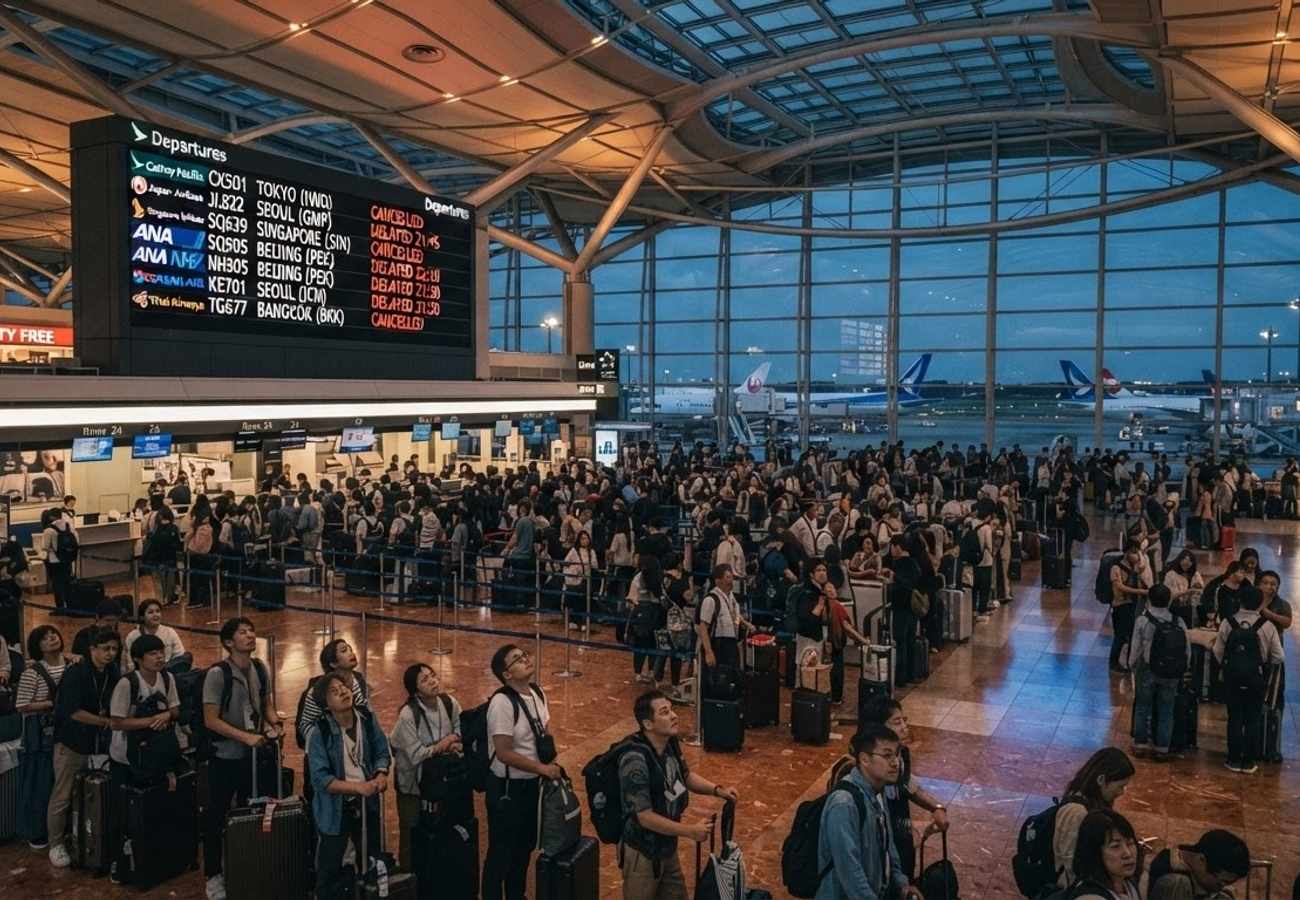
Image generated by AI
Flight disruptions have surged across Asia, resulting in 7,947 reported delays and 302 cancellations. The crisis is concentrated in major hubs including Tokyo, Shenzhen, Jakarta, Delhi, Guangzhou, Shanghai, and Bangkok.
Regional Disruption Breakdown
Flight tracking data indicates a systemic failure across multiple Asian aviation corridors. The disruption is not uniform, stemming from a combination of airspace restrictions, regional security tensions, and operational bottlenecks.
China: The Primary Epicenter
China recorded the highest volume of instability, accounting for 5,898 delays and 191 cancellations. The disruption was heavily concentrated in the following hubs:
- Guangzhou Baiyun: 1,143 delays and 48 cancellations (Highest in Asia).
- Shanghai Pudong: 890 delays and 13 cancellations.
- Shenzhen Bao’an: 626 delays and 16 cancellations.
- Hangzhou Xiaoshan: 571 delays.
- Shanghai Hongqiao: 520 delays and 21 cancellations.
- Nanjing Lukou: 462 delays.
- Beijing Capital: 339 delays and 20 cancellations.
- Beijing Daxing: 254 delays and 14 cancellations.
Saudi Arabia, Japan, and India
Outside of China, significant operational failures were recorded in the Middle East and East Asia:
- Saudi Arabia: 215 delays and 65 cancellations. King Khalid International reported 124 delays and 24 cancellations, while King Abdulaziz International recorded 91 delays and 14 cancellations. Notably, Gizan Regional and Najran Domestic recorded 15 and 12 cancellations respectively, with zero reported delays.
- Japan: 760 delays and 12 cancellations. Tokyo Haneda was the primary hotspot with 539 delays and 4 cancellations. New Chitose recorded 138 delays and 3 cancellations, while Osaka Itami saw 83 delays and 5 cancellations.
- India: 436 delays and 23 cancellations. Indira Gandhi International (Delhi) led with 236 delays and 17 cancellations. Chatrapati Shivaji International (Mumbai) recorded 147 delays and 2 cancellations.
Southeast Asia Impact
- Thailand: Suvarnabhumi Bangkok recorded 272 delays; Phuket reported 78 delays and 2 cancellations.
- Indonesia: Jakarta’s Soekarno-Hatta International Airport recorded 288 delays and 8 cancellations.
Airline Impact Analysis
Our analysis of the operational data shows that carriers with heavy footprints in the Chinese market suffered the most significant losses in schedule integrity.
| Airline | Reported Delays | Reported Cancellations |
|---|---|---|
| China Eastern | 1,158 | 57 |
| China Southern | 1,062 | 49 |
| Air China | 484 | 26 |
| Japan Airlines | 187 (Haneda) + others | Multiple (All 3 JP hubs) |
| All Nippon | 161 (Haneda) + others | Multiple |
| Saudia | Not specified | 63 (Across 4 hubs) |
Passenger Rights & Advisory
For the affected passenger, these disruptions trigger specific legal and operational protections depending on the jurisdiction and the carrier's home country.
Rebooking and Duty of Care If your flight is cancelled or delayed significantly, airlines are generally required to offer a choice between a full refund or re-routing to your final destination at the earliest opportunity. Our analysis of international aviation policy suggests that for delays exceeding a specific threshold (typically 2-4 hours), passengers are entitled to "duty of care," which includes vouchers for meals and refreshments, and hotel accommodation if an overnight stay is required.
Compensation Frameworks
- EU/UK Flights: For passengers flying into or out of the EU/UK on a European carrier, EU261/2004 or UK261 regulations apply. This means you may be eligible for cash compensation (up to €600) unless the airline can prove "extraordinary circumstances" (e.g., severe weather or security threats).
- US-Bound Flights: DOT guidelines require airlines to provide prompt refunds for cancelled flights if the passenger chooses not to travel.
- Asian Domestic/Regional: Rights vary by nation. In India and Thailand, passengers should refer to the DGCA and CAAT guidelines respectively for mandated refreshments and hotel provisions during long delays.
Actionable Steps for Travelers
- Document Everything: Take screenshots of the cancellation notification and keep all receipts for food, water, and hotels.
- Request Written Proof: Ask the airline for a "Flight Delay/Cancellation Certificate" to support insurance claims.
- Avoid "Voluntary" Rebooking: Be cautious when an airline asks you to "volunteer" for a later flight, as this can sometimes waive your right to statutory compensation.
Industry Analyst View
The current volatility in Asian airspace is a result of three distinct catalysts. First, China’s disruption is likely linked to its heavily managed airspace, where military priorities often override civilian schedules, leaving zero margin for error when capacity is constrained.
Second, the anomaly in Saudi Arabia—where Gizan and Najran saw cancellations without delays—points toward regional security risks. The proximity to Yemen and escalating tensions suggest these are security-driven cancellations rather than operational failures.
Finally, Japan's instability reflects a fragility in ground infrastructure. Recent flooding near Narita demonstrates that when rail and road links fail, the airport becomes a bottleneck, creating a cascade of delays that affect flight crews and aircraft rotations across the region.
Travelers are advised to monitor real-time flight status via FlightAware or official airline apps before departing for the airport.
Related Travel Guides
Disclaimer
This article is for informational and educational purposes only. It does not constitute legal, financial, or professional advice. While we strive to provide accurate and up-to-date information, travel policies, regulations, and conditions change rapidly. Always verify information with official sources before making travel decisions. Nomad Lawyer makes no representations about the accuracy, reliability, completeness, or suitability of the information provided. Readers should consult qualified professionals for advice specific to their circumstances. The views expressed in this article are those of the author and do not necessarily reflect the views of Nomad Lawyer.
Preeti Gunjan
Contributor & Community Manager
A passionate traveller and community builder. Preeti helps grow the Nomad Lawyer community, fostering engagement and bringing the reader experience to life.
Learn more about our team →