
American Airlines AAL2416 Operated with a Boeing 737-823 from Dallas to Richmond and Diverted at Washington Dulles International Airport, United States: What to Know About the Flight Diversion
American Airlines flight AAL2416 diverted to Washington Dulles International Airport due to severe weather in Virginia.

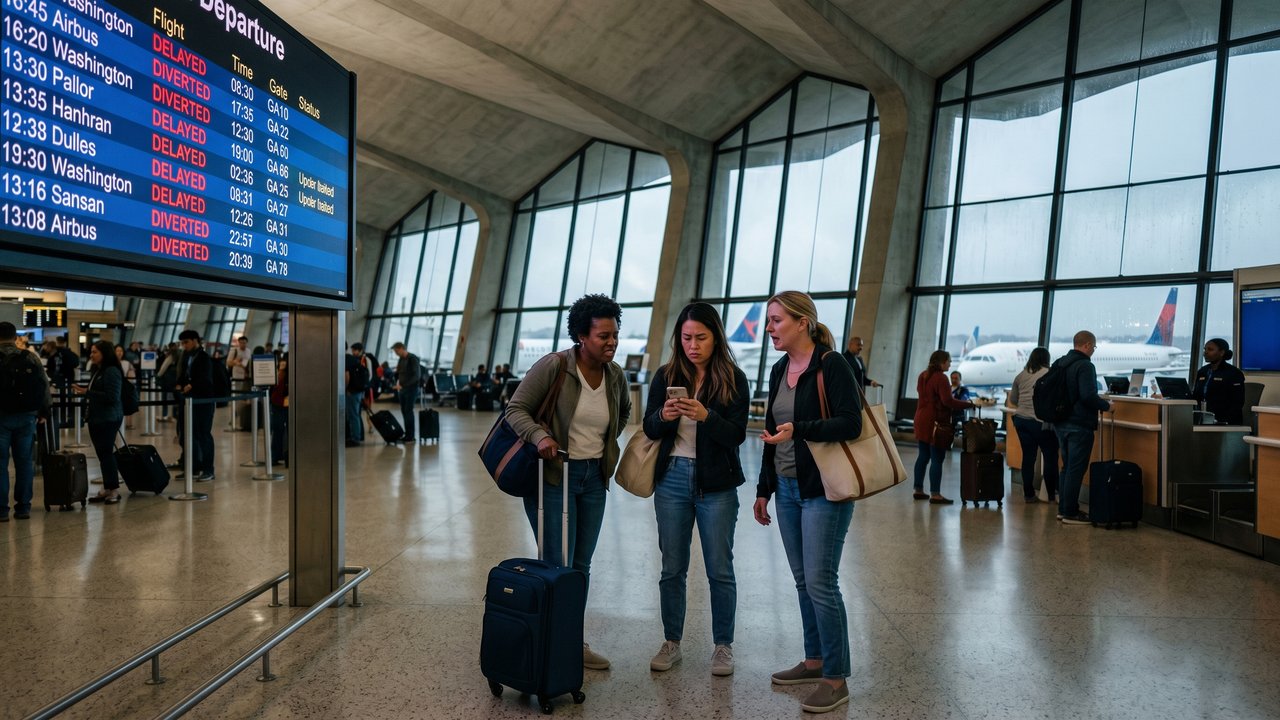
Image generated by AI
[Washington D.C., June 29, 2026] — An American Airlines flight traveling from Dallas to Richmond was forced to divert to Washington Dulles International Airport today after severe weather systems closed the airspace over Virginia. The aircraft, flight AAL2416, landed safely at the alternate hub after flight crews determined that conditions at the original destination were too hazardous for a safe approach.
Severe Weather Triggers Emergency Diversion in Virginia
The disruption occurred when a series of intense summer thunderstorms developed rapidly across the Virginia coastline, creating significant visibility issues and atmospheric instability. These weather cells blanketed the approach paths to Richmond International Airport, leading air traffic control to suspend all incoming arrivals to maintain safety protocols.
As American Airlines AAL2416 entered the region, the flight crew encountered convective weather hazards. After spending time in an air traffic holding pattern, the pilots observed that fuel reserves were depleting while the weather window at Richmond remained closed. To prioritize passenger safety and fuel conservation, the command decision was made to redirect the aircraft to Washington Dulles International Airport, which sat outside the immediate impact zone of the storms.
Technical Profile of the Boeing 737-823
The flight was operated using a Boeing 737-823, a narrow-body twin-engine jet known for its efficiency and reliability in domestic high-frequency networks. This specific aircraft model is frequently utilized for its robust performance capabilities, which are essential when executing sudden route changes or navigating unpredictable weather patterns.
Flight telemetry data confirmed that the aircraft maintained a stable cruise until the atmospheric disruptions near the East Coast necessitated a shift in the flight plan. The onboard navigation systems enabled the crew to maintain precise coordination with regional radar centers, ensuring a seamless transition from the original Richmond trajectory to the runways at Dulles.
Air Traffic Coordination and Safety Maneuvers
The diversion of AAL2416 required precise synchronization between the flight deck and regional radar controllers. As storm cells intensified over the destination, controllers provided a series of vectors to steer the Boeing 737-823 away from the most severe turbulence.
Once the decision to divert was finalized, air traffic control prioritized the aircraft's arrival sequence into the congested national capital airspace. By clearing a dedicated path into Washington Dulles International Airport, controllers ensured that the aircraft could touch down without further operational delays, mitigating the risks associated with extended holding patterns.
Federal Regulations and Crew Duty Limitations
Following the safe landing at Washington Dulles, the operation became subject to strict federal aviation regulations regarding crew flight time limitations. These legal mandates are designed to prevent pilot fatigue by enforcing mandatory rest thresholds and limiting the number of consecutive hours a crew can operate.
Because the diversion significantly extended the total duration of the trip, airline management had to conduct a legal review of the crew's remaining duty hours. If the total time spent in the air and on the ground exceeded the legal daily limit, the carrier was required to secure a relief crew to fly the final leg from Washington D.C. to Richmond.
Passenger Recovery and Ground Logistics
Upon arrival at the alternate airport, ground logistics teams focused on passenger accommodation. Since Washington Dulles International Airport is located approximately 100 miles north of Richmond, the airline had to coordinate various transit alternatives to get travelers to their final destination.
Industry reports indicate that customer service agents organized a mix of rebooked shuttle flights and ground transportation vouchers. A significant number of passengers opted for intercity motor coaches to reach Richmond more quickly than waiting for a repositioning flight. While some travelers departed via road, others remained in the terminal while engineers performed necessary checks on the Boeing 737-823.
Flight Operational Summary
| Flight Detail | Specification |
|---|---|
| Flight Number | AAL2416 |
| Operating Airline | American Airlines |
| Aircraft Type | Boeing 737-823 |
| Departure City | Dallas |
| Intended Destination | Richmond |
| Diversion Airport | Washington Dulles International Airport (IAD) |
| Primary Cause | Severe Weather / Thunderstorms |
| Date of Incident | June 29, 2026 |
Impact Analysis
The diversion of AAL2416 underscores the volatility of summer aviation in the Mid-Atlantic region, where rapid-onset thunderstorms can paralyze regional hubs. The event highlights the critical role of "alternate airport" planning in aviation safety. By diverting to a major hub like Washington Dulles, the airline was able to utilize superior infrastructure and ground support that might not have been available at smaller diversion fields.
Furthermore, the incident illustrates the tension between operational efficiency and safety regulations. The necessity of monitoring "crew duty days" means that a simple weather diversion can trigger a secondary logistical challenge: the need for replacement crews to avoid violating federal safety laws.
Why This Matters (Information Gain)
This incident serves as a case study in the resilience of modern aviation safety systems, specifically the integration of real-time telemetry and air traffic control (ATC) coordination. The shift from a planned destination to an alternate hub in a high-traffic corridor like the D.C. airspace demonstrates the precision of current vectoring techniques.
From an industry perspective, the use of the Boeing 737-823 in this scenario validates the preference for narrow-body versatility in domestic fleets. The ability to quickly pivot to a larger hub for passenger recovery—utilizing ground transport and shuttle flights—shows a maturing of "disruption management" protocols. This event emphasizes that safety in the modern era is not just about the landing, but about the comprehensive logistical recovery of the passengers and the strict adherence to fatigue laws for the crew, ensuring that the final leg of a journey is as safe as the first.
Related Travel Guides
Disclaimer
This article is for informational and educational purposes only. It does not constitute legal, financial, or professional advice. While we strive to provide accurate and up-to-date information, travel policies, regulations, and conditions change rapidly. Always verify information with official sources before making travel decisions. Nomad Lawyer makes no representations about the accuracy, reliability, completeness, or suitability of the information provided. Readers should consult qualified professionals for advice specific to their circumstances. The views expressed in this article are those of the author and do not necessarily reflect the views of Nomad Lawyer.
Raushan Kumar
Founder & Lead Developer
Full-stack developer with 11+ years of experience and a passionate traveller. Raushan built Nomad Lawyer from the ground up with a vision to create the best travel and law experience on the web.
Learn more about our team →