
Flights Cancelled at Calgary International Airport as Jazz, Air Canada, and More Cancel Seven Flights with Numerous Delays, Affecting Major Cities Including Chicago, Guadalajara, Hamilton, Edmonton, Detroit, and Beyond
Calgary International Airport reports 7 flight cancellations and 60 delays involving Jazz and Air Canada, affecting trav

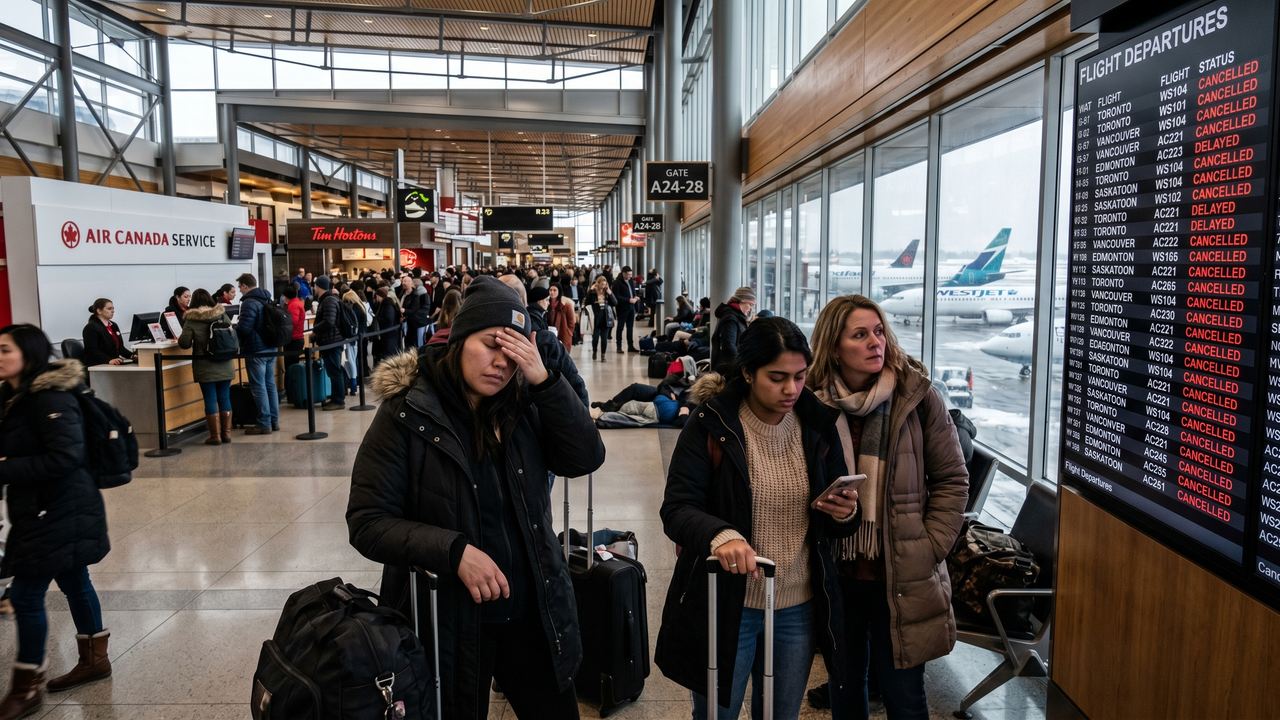
Image generated by AI
[Calgary, June 29, 2026] — Major flight disruptions have hit Calgary International Airport, where Jazz and Air Canada have cancelled seven flights and triggered a wave of delays affecting key routes across North America and Europe. The operational instability has impacted travel to major hubs including Chicago, Guadalajara, Detroit, and Hamilton, leaving thousands of passengers to navigate revised schedules and connection uncertainties.
The disruptions originated at the Calgary hub but quickly rippled through international networks. According to flight tracking data, the instability is not confined to a single carrier, as multiple subsidiaries of the Air Canada group are managing the fallout. This cascading effect underscores the vulnerability of hub-and-spoke aviation models, where a localized issue in a primary Canadian gateway can delay arrivals and departures in Mexico, the United States, and the European Union.
Regional Disruptions Across North America and Europe
The scale of the disruption is evident in the wide array of affected cities. Within Canada, the impact was felt heavily in Vancouver, Winnipeg, Toronto, Montreal, Kamloops, Kelowna, Penticton, Edmonton, Halifax, Ottawa, Regina, Saskatoon, Fort St. John, and Abbotsford.
Beyond Canadian borders, the operational delays extended to several high-traffic international destinations. In the United States, passengers traveling to or from Dallas, Houston, Minneapolis, Chicago, San Francisco, Atlanta, Detroit, and Seattle reported significant schedule shifts. The reach of the disruption also extended to Mexico with flights to Guadalajara, and into Europe and the North Atlantic, affecting routes to London, Paris, Zurich, and Keflavik.
Detailed Breakdown of Calgary International Airport Cancellations
Operational data indicates that Calgary International Airport bore the brunt of the cancellations. The disruptions were split across three primary operators, with Jazz (operating as Air Canada Express) and Air Canada Rouge contributing to the total.
The following table provides the specific breakdown of cancelled and delayed flights at the terminal:
| Airport | Airline | Cancelled Flights | Delayed Flights |
|---|---|---|---|
| Calgary Int’l | Jazz (ACA) | 3 | 1 |
| Calgary Int’l | Air Canada Rouge (ACA) | 2 | 1 |
| Calgary Int’l | Air Canada | 2 | 5 |
Reports indicate that Calgary experienced a total of seven cancellations and 60 delayed flights. In the first phase of the disruption, the airport saw three cancellations and 36 delays, representing approximately 12% of scheduled movements. A second wave of instability resulted in four additional cancellations and 24 further delays.
Other Canadian hubs also reported instability, though to a lesser degree. Vancouver International Airport recorded four cancellations and six delays, while Toronto Pearson International Airport saw two cancellations and four delays. Winnipeg International Airport reported one cancellation and three delays.
Passenger Guidance for Handling Flight Cancellations
Industry observers suggest that passengers facing these disruptions should take immediate steps to secure alternative travel arrangements. When a flight is cancelled, the first priority is to monitor official communication channels, including airline mobile apps, email, and SMS alerts, for rebooking confirmations.
Travelers are encouraged to contact airline customer service via digital chat systems or phone lines to avoid the lengthy queues typically found at airport service desks. It is also advised that passengers review their legal rights regarding compensation. In certain jurisdictions, such as the European Union, passengers may be entitled to financial compensation if the cancellation falls within the airline's control.
If the airline cannot provide a timely alternative, passengers should explore secondary options, such as booking with a different carrier or utilizing ground transportation, including rail or bus services, for domestic legs.
Impact on Global Aviation Networks
The current situation at Calgary International Airport demonstrates how a concentrated set of cancellations can create a "domino effect" across a global network. Because Calgary serves as a critical link for passengers moving between Western Canada and international destinations, the seven cancelled flights caused a backlog that affected aircraft positioning and crew scheduling in cities as far apart as Zurich and Guadalajara.
The reliance on a few key hubs means that any operational glitch in Calgary creates a vacuum of available aircraft in other cities. For example, a cancelled flight from Calgary to Chicago does not just affect the passengers on that plane; it affects the subsequent flight departing Chicago for another destination, as the aircraft is not in the required location.
Why This Matters: Expert Perspective on Hub Vulnerability
This incident highlights a systemic fragility in modern aviation: the high degree of interdependence between regional feeders and international long-haul flights. When Jazz and Air Canada experience operational friction in Calgary, it is not merely a local Alberta issue; it is a network failure that impacts the fluidity of transatlantic and transborder travel.
The fact that only seven flights were cancelled yet 60 flights were delayed suggests that the primary issue is not a lack of aircraft, but rather a disruption in the "flow" of the network. This "flow disruption" leads to crew timing-out (reaching their legal flying limit) and aircraft being out of position, which explains why cities like Keflavik or Paris feel the impact of a Calgary-based delay.
For the travel industry, this serves as a reminder that resilience depends on the ability to pivot schedules in real-time. As airlines continue to optimize for efficiency, the margin for error shrinks. Passengers are now more dependent than ever on real-time data and flexible rebooking policies to mitigate the impact of these inevitable operational shocks.
Related Travel Guides
Disclaimer
This article is for informational and educational purposes only. It does not constitute legal, financial, or professional advice. While we strive to provide accurate and up-to-date information, travel policies, regulations, and conditions change rapidly. Always verify information with official sources before making travel decisions. Nomad Lawyer makes no representations about the accuracy, reliability, completeness, or suitability of the information provided. Readers should consult qualified professionals for advice specific to their circumstances. The views expressed in this article are those of the author and do not necessarily reflect the views of Nomad Lawyer.
Raushan Kumar
Founder & Lead Developer
Full-stack developer with 11+ years of experience and a passionate traveller. Raushan built Nomad Lawyer from the ground up with a vision to create the best travel and law experience on the web.
Learn more about our team →