
Always Something New to Discover: Why Berlin is Europe’s Top Destination For Global Event Planners
Always Something New to Discover: Why Berlin is Europe’s Top Destination For Global Event Planners

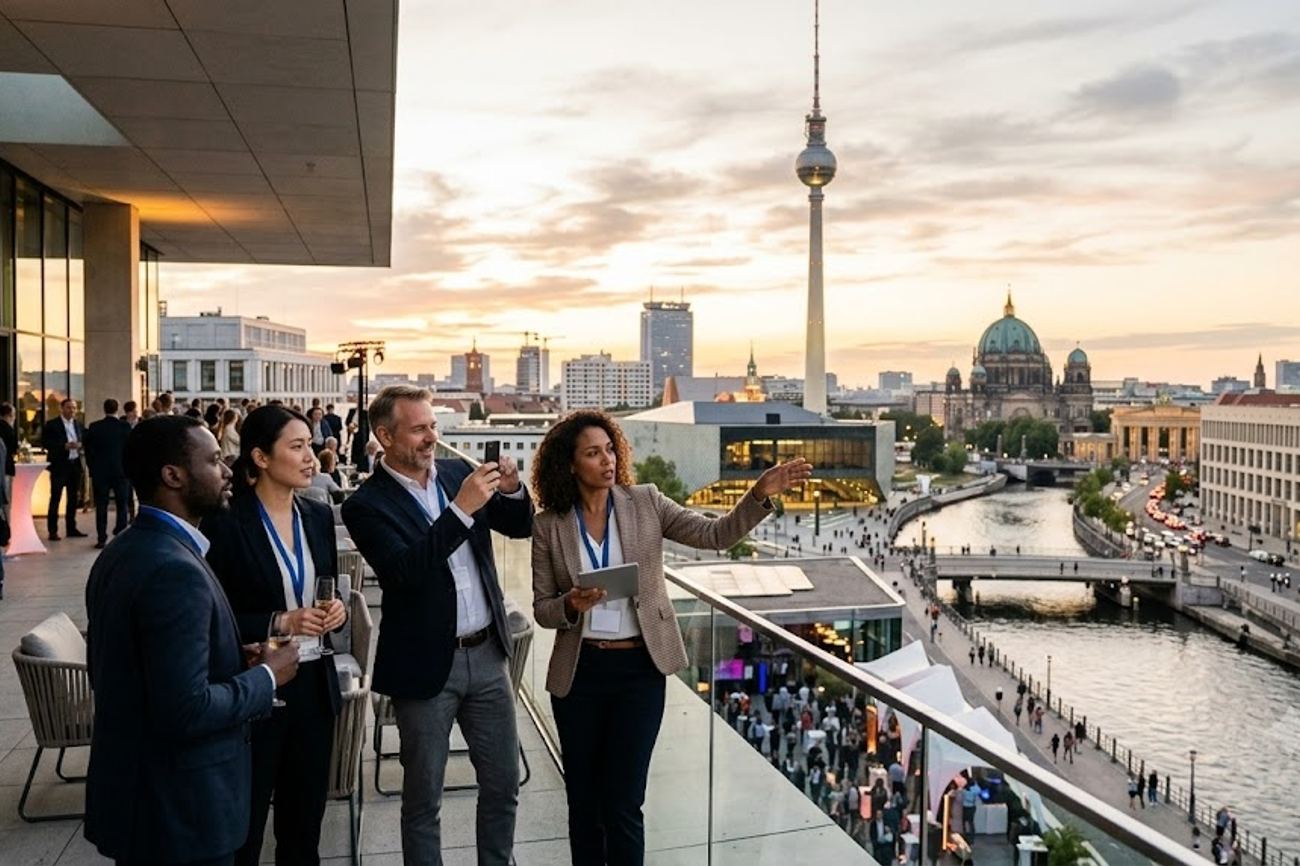
Image generated by AI
Are you coordinating a large-scale corporate summit or a scientific conference in Germany's capital? Here is how the upcoming expansion of Berlin's convention infrastructure and sustainability mandates will change your logistics planning for 2026 and beyond.
The Berlin Convention Expansion
Berlin is currently undergoing a massive scaling of its professional event infrastructure to maintain its status as Europe's primary hub for business tourism. The most significant development is the expansion of the Estra complex, which already holds the title of the largest hotel and meeting center in Europe. To meet the rising global demand for high-capacity gatherings, the city is adding two new large-scale convention halls to the Estra site.
Simultaneously, the city's established fairgrounds are seeing a surge in construction, with additional exhibition and meeting halls being integrated into the existing layout. This growth is not merely about square footage; these new facilities are being equipped with advanced technologies to support hybrid events and high-density international delegations. For the traveler and the planner, this means a shift in where the "center of gravity" for events lies within the city, moving toward these modernized, high-capacity zones.
Route and Schedule Details
While specific flight numbers vary by carrier, the primary transit arteries into Berlin are optimized for the business traveler. The following table outlines the primary access points for delegates arriving for events at the Estra complex and the city's fairgrounds.
| Route | Frequency | Primary Aircraft | Average Duration | Status |
|---|---|---|---|---|
| Global Hubs to BER | High (Hourly) | A350 / B787 / B777 | 7-12 Hours | Operational |
| European Capitals to BER | Very High | A320 / B737 | 1.5-3 Hours | Operational |
| BER Airport to City Center | Every 15-30 Min | FEX / RE8 / RB23 | 30-45 Minutes | Operational |
| City Center to Estra Complex | Regular Intervals | S-Bahn / U-Bahn | 20-40 Minutes | Operational |
Traveler Logistics Guide
Navigating Berlin for a professional event requires a different strategy than leisure travel. To optimize your transit and stay, follow these operational steps:
1. Airport Arrival and Transit Upon landing at Berlin Brandenburg Airport (BER), avoid taxis for peak-hour transit. The Airport Express (FEX) is the most efficient route to the city center. If your event is located at the Estra complex or the fairgrounds, check the integrated VBB (Verkehrsverbund Berlin-Brandenburg) app for real-time S-Bahn and U-Bahn connections. Berlin's transit system is highly integrated; a single ticket covers all modes of transport within the designated zones.
2. Accommodations and Proximity With the Estra complex expanding, hotel availability in the immediate vicinity will be under pressure during major summits. Book your stay at least 4-6 months in advance. If the Estra complex is fully booked, look for hotels along the S-Bahn ring; the efficiency of the rail network allows you to stay further out while maintaining a commute of under 30 minutes.
3. Navigating Sustainability Mandates Berlin has implemented the "Sustainable Meetings Berlin" and "Berlin Impact Program" frameworks. For the corporate traveler, this means:
- Reduced reliance on single-use plastics at venues.
- Incentives for using public transport over private chauffeurs.
- Digital-first registration processes to eliminate paper waste. Ensure your corporate travel policy aligns with these local mandates to avoid logistical friction during event check-ins.
4. Customs and Business Visas Depending on your citizenship, a Schengen visa may be required. For those attending scientific or high-level industry summits, ensure your invitation letter explicitly mentions the venue (e.g., Estra complex or the fairgrounds) to expedite customs processing.
Regional Connectivity Impact
The expansion of the Estra complex and the addition of new convention halls fundamentally reshape the regional travel economy. By increasing capacity, Berlin is reducing the "overflow" effect where delegates previously had to stay in outlying cities or smaller hotels across the region. This centralization allows for a more streamlined experience, where the transition from the hotel room to the conference hall is nearly seamless.
Furthermore, the integration of academic hubs with these new commercial facilities creates a unique "knowledge corridor." Travelers attending scientific meetings can now move between university research centers and large-scale exhibition halls without leaving the city's efficient transit loop. This synergy makes Berlin a more attractive destination than other European capitals that separate their academic and commercial districts.
The focus on the Berlin Impact Program also means that the city is attracting a new demographic of "impact travelers"—professionals who prioritize destinations with a proven track record of carbon neutrality and community welfare. This shift is forcing local transport providers to accelerate the electrification of their fleets and the expansion of green transit corridors.
FAQ: Berlin Business Transit 2026
Do I need a transit visa for a business event in Berlin? It depends on your nationality. Citizens of non-Schengen countries typically require a Schengen visa. Always verify current requirements via the official German diplomatic missions website before booking flights.
How long should I allow for the commute from BER Airport to the Estra complex? Allow 60 to 90 minutes. This includes deplaning, customs, and taking the FEX or regional train to the city center, followed by a short S-Bahn or U-Bahn connection to the venue.
Can I use a single pass for all ground transport in Berlin? Yes. The VBB system allows you to use one ticket or digital pass for the FEX, S-Bahn, U-Bahn, trams, and buses, provided you are traveling within the correct zones.
Are the new convention halls accessible via public transport? Yes. Berlin's infrastructure strategy ensures that all major expansions, including the new halls at the Estra complex and the fairgrounds, are integrated into the existing public transit network.
Prepare your itinerary for a city that balances massive industrial capacity with a strict commitment to the planet.
#BerlinEvents2026 #EstraComplex #SustainableMeetingsBerlin #BERAirportLogistics #BerlinBusinessTravel
Related Travel Guides
Disclaimer
This article is for informational and educational purposes only. It does not constitute legal, financial, or professional advice. While we strive to provide accurate and up-to-date information, travel policies, regulations, and conditions change rapidly. Always verify information with official sources before making travel decisions. Nomad Lawyer makes no representations about the accuracy, reliability, completeness, or suitability of the information provided. Readers should consult qualified professionals for advice specific to their circumstances. The views expressed in this article are those of the author and do not necessarily reflect the views of Nomad Lawyer.
Kunal K Choudhary
Co-Founder & Contributor
A passionate traveller and tech enthusiast. Kunal contributes to the vision and growth of Nomad Lawyer, bringing fresh perspectives and driving the community forward.
Learn more about our team →