
Spain's Fairytale Alcázar of Segovia Draws Global Travelers With Royal Suites, Tower Panoramas, and 2026 Ticket Savings
Discover Spain's fairytale Alcázar of Segovia with 2026 ticket guides, Tower of Juan II climb tips, royal history, and high-speed rail access from Madrid.

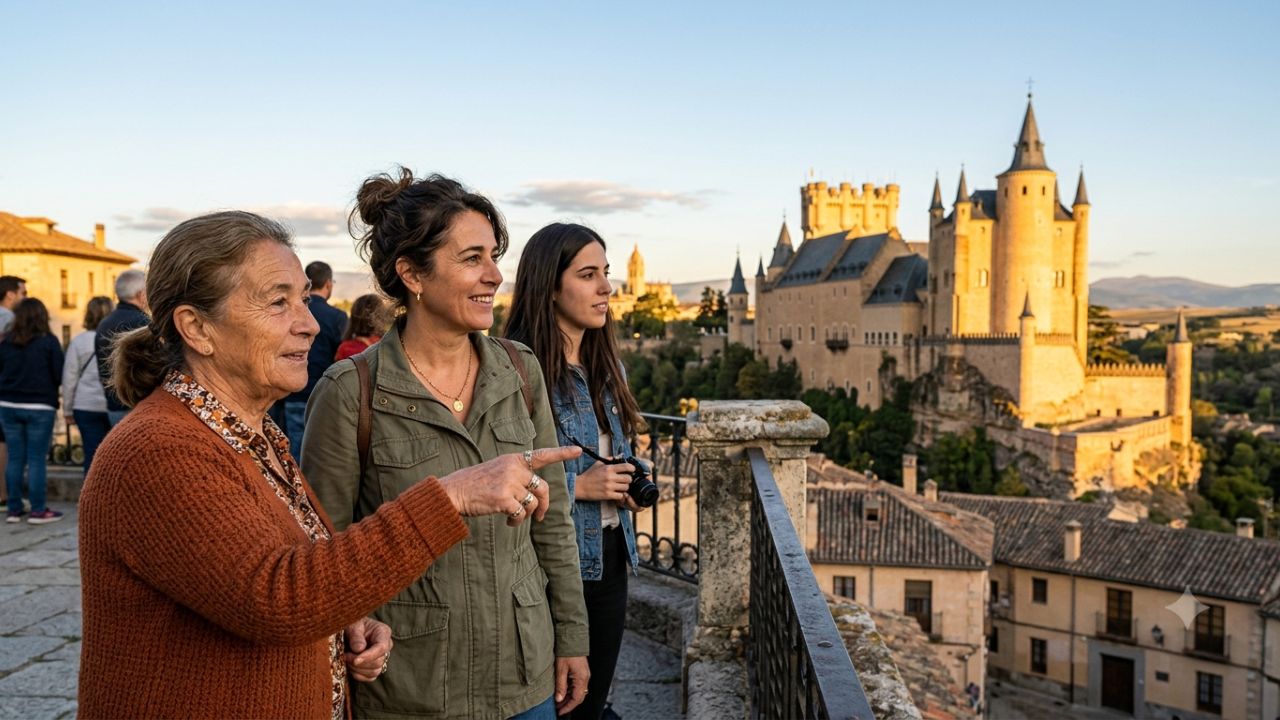
Perched on a dramatic limestone precipice above the confluence of two rushing river valleys, the Alcázar of Segovia stands as one of the world's most romantic medieval fortresses, welcoming international travelers in 2026 with accessible €7 to €10 ticketing packages, restored royal state apartments, and soaring panoramic vistas across Castile and León.
Rising like the prow of an enormous stone vessel above the rolling Spanish plateau, this 12th-century stronghold is celebrated globally for its fairytale silhouette. Featuring conical slate spires, crenelated bastions, and a formidable dry moat cut directly into living rock, the fortress served as a preferred residence for Castilian monarchs, a fortified royal treasury, a state prison, and the historic birthplace of modern European ballistics education.
Operating under the joint stewardship of the Patronato del Alcázar de Segovia and Turismo de Segovia, the castle pairs centuries of royal statecraft with smart visitor capacity management, providing travelers with budget-friendly access just 30 minutes from Madrid via high-speed electrified rail.
===================================================================================
        TOPOGRAPHICAL PROFILE: ALCÁZAR DE SEGOVIA ON THE RIVER PROMONTORY
===================================================================================
                       [Tower of Juan II - 80m Elevation]
                                     |
                       +-------------+-------------+
                       |    Upper Royal Apartments |
                       |   & Hall of the Kings     |
   (West Precipice)    +-------------+-------------+     (East Moat & Town)
         |                           |                           |
         v                           v                           v
  [Clamores Valley] <==== Rocky Limestone Ridge ====> [Plaza Reina Victoria Eugenia]
  (Sheer 80m Drop)    \                             / (Moat & Defensive Bridge)
                       \                           /
                        \                         /
                         v                       v
               [Eresma River Bed]     [Clamores River Bed]
                        \                     /
                         \=== Confluence ====/
===================================================================================
Nine Centuries of Fortress Engineering and Royal Statecraft
The strategic positioning of the Alcázar explains why human settlements have defended this limestone spur since Celtic, Roman, and Moorish times. Documented accounts of the fortress first emerged in 12th-century Latin archives following the Christian reconquest of Segovia by King Alfonso VI.
Subsequent Castilian rulers recognized that the narrow promontory—flanked by sheer ravines plunging down to the Eresma and Clamores rivers—offered an impregnable defense against invading armies.
CHRONOLOGY OF CASTILIAN MONARCHS AT THE ALCÁZAR
| Category / Entity | Details / Impact |
|---|---|
| ERA / MONARCH | ARCHITECTURAL MILESTONE & HISTORICAL FUNCTION |
| King Alfonso VIII | Transformed frontier military garrison into a permanent |
| (1158–1214) | royal court; constructed initial stone Romanesque chambers |
| King John II | Built the iconic 80-meter Keep (Tower of Juan II) featuring |
| (1405–1454) | Gothic turrets, heraldic crests, and defensive machicolations |
| King Henry IV | Expanded royal residential quarters; hosted coronation |
| (1454–1474) | ceremonies and guarded the Castilian royal treasury |
| Queen Isabella I | Departed from the Alcázar on December 13, 1474, to be |
| (1474–1504) | crowned Queen of Castile in Segovia's historic Plaza Mayor |
| Philip II & | Introduced Central European slate roofs, conical spires, |
| Francisco de Mora | and Herrerian courtyard symmetry following a 1587 revamp |
| King Charles III | Established the Royal College of Artillery inside the |
| (1759–1788) | fortress in 1764, founding Spain's military academy |
Under King Alfonso VIII and his English queen, Eleanor of England, the fortress evolved into a sophisticated European court. Gothic embellishments, coffered Mudéjar ceilings, and gilded heraldic reliefs were added throughout the 14th and 15th centuries.
Most notably, the castle served as the backdrop for one of the most consequential moments in world history: on December 13, 1474, upon learning of the death of her half-brother King Henry IV, Isabella I rode out from the gates of the Alcázar into Segovia's Plaza Mayor to claim the Crown of Castile, laying the political foundation for modern unified Spain.
In the late 16th century, King Philip II commissioned royal architect Francisco de Mora to remodel the palace roofs with sharply pitched slate spires inspired by Central European castles. This architectural choice created the distinctive fairytale silhouette that later inspired romantic European painters, 19th-century photographers, and Hollywood animators.
2026 Ticket Pricing Architecture and Concession Tiers
A major appeal of visiting the Alcázar of Segovia in 2026 is its accessible pricing model. While many premier historic landmarks across Western Europe charge upwards of €20 to €30 for baseline admission, the Patronato maintains an affordable fee structure designed to keep Spain's cultural heritage accessible to independent travelers, backpackers, and families.
ALCÁZAR DE SEGOVIA: OFFICIAL 2026 ADMISSION TIERS
| Entity / Facility | Delays | Cancellations | Details |
|---|---|---|---|
| TICKET CATEGORY | STANDARD PRICE | REDUCED RATE | ACCESS SCOPE |
| Palace & Artillery Museum | €7.00 | €5.00 | 12 State Rooms, |
| (Palacio y Museo de Artillería) | Armory, Gardens | ||
| Palace, Museum & Tower of Juan II | €10.00 | €8.00 | Full Palace plus |
| (Combined Experience) | 152-Step Tower | ||
| Palace & Museum with Audioguide | €10.50 | €8.50 | Entry plus phone |
| (Multilingual Smartphone App) | audio streaming | ||
| Guided Tour with Tower (Spanish) | €13.50 | €11.50 | Official guide |
| (Visita Guiada Completa) | & timed climb | ||
| European Union Free Window | €0.00 (Free) | N/A | Palace only; |
| (Non-Holiday Tuesdays 14:00-16:00) | Tower excluded | ||
| Outer Plaza Victoria Eugenia | €0.00 (Free) | €0.00 (Free) | Esplanade open |
| (Public Landscaped Gardens) | 08:00 to 22:00 |
Digital Smartphone Audioguides
For visitors who prefer independent exploration, the €10.50 audioguide ticket provides access to a cloud-based web application that turns any modern smartphone into a personal multimedia guide.
Narratives are professionally translated and narrated across six languages: English, French, German, Italian, Japanese, and Mandarin Chinese. Travelers should bring personal headphones to ensure clear listening inside the stone-vaulted halls.
Free Admission Policy for European Union Residents
In accordance with Spanish national cultural heritage regulations, the Alcázar offers free palace admission on non-holiday Tuesdays between 14:00 and 16:00 for citizens and legal residents of the European Union.
Visitors wishing to utilize this window must present a valid EU national ID card, EU passport, or valid residency permit (TIE) at the ticket office. The Tower of Juan II is excluded from the free entry window to prevent safety bottlenecks on its narrow staircase.
Climbing the Tower of Juan II: 152 Steps to the Clouds
The climb to the top of the Tower of Juan II (Torre de Juan II) is widely regarded as the physical and visual highlight of the Alcázar experience. Soaring 80 meters above the valley floor, this Gothic keep was originally designed as a high-security lookout post, archers' platform, and noble detention chamber.
TOWER OF JUAN II CLIMB: PHYSICAL PARAMETERS
| Category / Entity | Details / Impact |
|---|---|
| Total Steps to Terrace | 152 spiral stone steps (single continuous helix) |
| Staircase Diameter | ~1.2 meters (strictly single-file ascent/descent) |
| Intermediate Rest Landings | 2 narrow passing niches with arrow-slit windows |
| Summit Elevation | 80 meters above valley floor / 1,000m above sea level |
| Capacity Control | Maximum 30 visitors per 30-minute timed entry window |
| Panoramic Views | Segovia Cathedral, Guadarrama Mountains, Old Town |
Staircase Navigation and Safety Advisory
The ascent requires climbing 152 stone steps up a tightly wound spiral staircase. Because the staircase accommodates single-file traffic only, the patronato enforces strict capacity limits, releasing visitors in timed groups.
Visitors should carefully consider their physical comfort before booking:
- Mobility Restrictions: The tower lacks elevator access and cannot accommodate wheelchairs, strollers, or visitors using walking canes.
- Health Precautions: The sustained cardiovascular climb in a confined space is not recommended for individuals with severe respiratory ailments, cardiovascular conditions, acute vertigo, or claustrophobia.
- Footwear Requirements: Smooth leather soles and high-heeled shoes are strictly discouraged; rubber-soled walking sneakers or hiking shoes provide the best grip on the centuries-worn limestone treads.
Once visitors emerge onto the open crenelated rooftop, they are rewarded with an uninterrupted 360-degree panorama: the golden stone nave of Segovia Cathedral rising like a ship on the eastern horizon, the jagged pine-covered peaks of the Sierra de Guadarrama to the south, and the silver ribbon of the Eresma River winding through poplar groves below.
Inside the Royal Chambers and the Artillery Museum
Beyond its fortified exterior walls, the Alcázar houses twelve restored royal state rooms, displaying one of Spain's finest collections of medieval armor, Flemish tapestries, and Mudéjar craftsmanship.
KEY HISTORIC ROOMS INSIDE THE ROYAL ALCÁZAR
| Category / Entity | Details / Impact |
|---|---|
| ROOM NAME | HIGHLIGHT ARTWORK & HISTORICAL SIGNIFICANCE |
| Hall of the Galley | Vaulted inverted-hull wooden ceiling resembling a ship; |
| (Sala de la Galera) | mural depicting the 1474 coronation of Queen Isabella I |
| Hall of the Kings | 52 polychrome gilded wooden statues depicting kings |
| (Sala de los Reyes) | and queens of Asturias, León, and Castile |
| Throne Room | Mudéjar plasterwork friezes, twin royal thrones under |
| (Sala del Trono) | crimson velvet canopies with the motto "Tanto Monta" |
| Royal Armory | Medieval plate armor, tournament lances, crossbows, |
| (Armería Real) | and 15th-century Castilian siege weaponry |
| Artillery Museum | Scientific treatises, brass astrolabes, scale cannons, |
| (Colegio de Artillería) | and 18th-century Enlightenment ballistics models |
The Hall of the Kings (Sala de los Reyes)
Commissioned by King Alfonso X "The Wise" and redesigned under Philip II, this gilded hall features an elaborate ceiling frieze displaying 52 carved and painted wooden sculptures representing every sovereign who ruled over Asturias, León, and Castile from Pelagius to Joanna the Mad. The heraldic accuracy and expressive woodcarving make it one of Spain's premier monarchical monuments.
The Royal College of Artillery Museum
In 1764, King Charles III established the Royal College of Artillery within the Alcázar, establishing the fortress as a leading European center for Enlightenment-era mathematics, metallurgy, chemistry, and ballistics.
Although a devastating fire gutted parts of the upper barracks in 1862, the on-site Artillery Museum meticulously preserves early brass cannons, laboratory scales, powder horns, and tactical war maps, offering a fascinating transition from medieval romance to 18th-century military science.
Operational Hours and 2026 Seasonal Calendar Adjustments
The Alcázar operates year-round with hours adjusted by season to make the most of Spain's natural daylight.
2026 SEASONAL OPERATING HOURS & SPECIAL SCHEDULES
| Entity / Route | Metrics | Operational Status |
|---|---|---|
| SEASON / DATE | OPENING WINDOW | LAST ADMISSION CUT-OFF |
| Summer (1 April to 31 October) | 10:00 to 19:30 | Desks close at 19:00 |
| Winter (1 November to 31 March) | 10:00 to 18:00 | Desks close at 17:30 |
| Special Date: 6 November 2026 | 11:30 to 18:00 | Delayed opening for protocol |
| Christmas Eve: 24 December 2026 | 10:00 to 14:30 | Reduced afternoon schedule |
| Christmas Day: 25 December 2026 | FULL DAY CLOSURE | Entire monument closed |
| Plaza Gardens (Year-Round) | 08:00 to 22:00 | Free access via outer gates |
Visitors should note that ticket counters and turnstiles close strictly 30 minutes before the official closing time. Those planning to climb the Tower of Juan II should reserve an admission slot at least 90 minutes before closing to allow enough time to tour both the palace chambers and the 152-step tower.
Intermodal Transit: High-Speed Rail Connections from Madrid
Visiting Segovia from Madrid is one of the easiest and most popular day trips in Spain, thanks to direct high-speed rail connections operated by Renfe.
===================================================================================
                  MADRID TO SEGOVIA INTERMODAL TRANSIT CORRIDOR
===================================================================================
 [Madrid-Chamartín-Clara Campoamor Station]
                   |
                   |  (High-Speed AVE / Avant Train: ~27–30 Minutes)
                   v
 [Segovia-Guiomar Railway Station] (6 km outside historic core)
                   |
         +---------+---------+
         |                   |
         v                   v
   [Bus Line 11]       [Local Taxi] (~€10–€14 / 10 Minutes)
   (Every 15 mins)           |
         |                   |
         +--------->+<-------+
                    |
                    v
 [Plaza del Azoguejo: Roman Aqueduct]
                    |
                    |  (Pedestrian Walking Trail: 1.6 km / ~20-25 Mins)
                    v
 [Calle Real] ===> [Plaza Mayor & Cathedral] ===> [Alcázar de Segovia]
===================================================================================
High-Speed Rail vs. Regional Highway Transit
- Renfe Avant High-Speed Rail: Departing frequently from Madrid-Chamartín station, modern Avant trains reach Segovia-Guiomar in just 27 to 30 minutes, gliding beneath the Guadarrama mountains through the 28-kilometer Guadarrama rail tunnel. Round-trip fares typically range from €14 to €25 when booked in advance.
- Local Bus Connection (Line 11): Because the high-speed Guiomar station sits six kilometers south of the historic center, travelers should board municipal bus Line 11 directly outside the station doors. The bus costs €2.00 and drops passengers at the base of the Roman Aqueduct in roughly 15 minutes.
- Overland Highway Driving: Motorists can make the journey from northern Madrid along the AP-6 and AP-61 toll motorways in approximately 60 to 75 minutes. However, private vehicles are strictly barred from entering Segovia’s historic center, requiring motorists to use underground parking garages near the Aqueduct.
The UNESCO Walking Route: Aqueduct to the Castle Gates
The walk from the Roman Aqueduct to the Alcázar covers 1.6 kilometers along a well-preserved medieval pedestrian street. Inscribed jointly on the UNESCO World Heritage List in 1985, this route connects three distinct architectural eras in a single morning stroll:
SEGOVIA UNESCO HERITAGE ITINERARY
| Category / Entity | Details / Impact |
|---|---|
| STOP 1: Plaza del Azoguejo | Marvel at the 1st-century Roman Aqueduct, built with |
| 20,400 granite blocks without a drop of mortar | |
| STOP 2: Calle Real | Stroll past Casa de los Picos and Renaissance courtyards |
| lined with traditional Castilian ceramic tile shops | |
| STOP 3: Plaza Mayor | Relax at sidewalk cafés facing the late-Gothic |
| Segovia Cathedral ("The Lady of Cathedrals") | |
| STOP 4: Jewish Quarter | Explore the quiet cobbled alleys of the historic |
| Judería and the Old Main Synagogue | |
| STOP 5: Alcázar Promontory | Cross the stone moat bridge into the royal castle |
| and ascend the Tower of Juan II for sunset panoramas |
After exploring the castle, visitors can sample local specialties at traditional taverns along the route. Segovia's culinary scene is famous for Cochinillo Asado (slow-roasted suckling pig with crisp skin so tender it is traditionally carved with the edge of a porcelain plate) and Judiones de La Granja (rich white bean stew simmered with chorizo and wild herbs).
Essential Tips for Visiting the Alcázar
To enjoy a smooth visit to the castle, keep these practical tips in mind:
- Book Tower Time Slots in Advance: Standard palace tickets are usually available at the door, but Tower of Juan II capacity is capped at 30 visitors per half-hour. These tower tickets routinely sell out days ahead on weekends and holidays.
- Wear High-Traction Footwear: The polished limestone cobblestones along Calle Real and the worn spiral stone steps of the tower become slippery when wet. Leave dress shoes and smooth sandals at your hotel.
- Carry Government Photo Identification: If you purchase reduced-rate tickets (for students, seniors, or children) or plan to use the free Tuesday EU entry window, passport or national ID checks are strictly enforced at the gate.
- Time Your Visit for Late Afternoon Light: The golden granite of Segovia Cathedral and the slate spires of the Alcázar glow in the late afternoon sun. Booking a 16:30 or 17:00 ticket during summer months offers the best lighting for photography from the tower parapets.
Frequently Asked Questions
What are the official ticket prices for the Alcázar of Segovia in 2026?
Official 2026 tickets cost €7 for the palace and Artillery Museum, and €10 for the combined ticket including the Tower of Juan II. Audioguide packages cost €10.50, while fully guided Spanish tours with tower access cost €13.50.
How do I travel from Madrid to the Alcázar of Segovia?
Take a Renfe Avant high-speed train from Madrid-Chamartín to Segovia-Guiomar station in 30 minutes. From there, board local municipal bus Line 11 to the Roman Aqueduct, then take an easy 20-minute walk through the historic old town.
What physical requirements apply to climbing the Tower of Juan II?
Climbing the Tower of Juan II involves walking up 152 steep stone steps through a narrow spiral staircase without elevator access. It is not recommended for visitors with reduced mobility, severe cardiovascular issues, acute vertigo, or claustrophobia.
When is admission to the Alcázar of Segovia free?
Eligible European Union citizens and legal residents can access free palace admission on non-holiday Tuesdays from 14:00 to 16:00 upon presenting valid photo ID. Tower entry is excluded from the free entry window.
Related Travel Guides
Disclaimer
This article is for informational and educational purposes only. It does not constitute legal, financial, or professional advice. While we strive to provide accurate and up-to-date information, travel policies, regulations, and conditions change rapidly. Always verify information with official sources before making travel decisions. Nomad Lawyer makes no representations about the accuracy, reliability, completeness, or suitability of the information provided. Readers should consult qualified professionals for advice specific to their circumstances. The views expressed in this article are those of the author and do not necessarily reflect the views of Nomad Lawyer.
Raushan Kumar
Founder & Lead Developer
Full-stack developer with 11+ years of experience and a passionate traveller. Raushan built Nomad Lawyer from the ground up with a vision to create the best travel and law experience on the web.
Learn more about our team →