
Palm Beach County Crowned Florida's Sea Turtle Capital: How Coastal Conservation Powers a $1.5 Billion Eco-Tourism Boom
Palm Beach County is named Florida's Sea Turtle Capital, driving $1.5B in eco-tourism across 47 miles of coastline and protecting 2M Atlantic hatchlings.

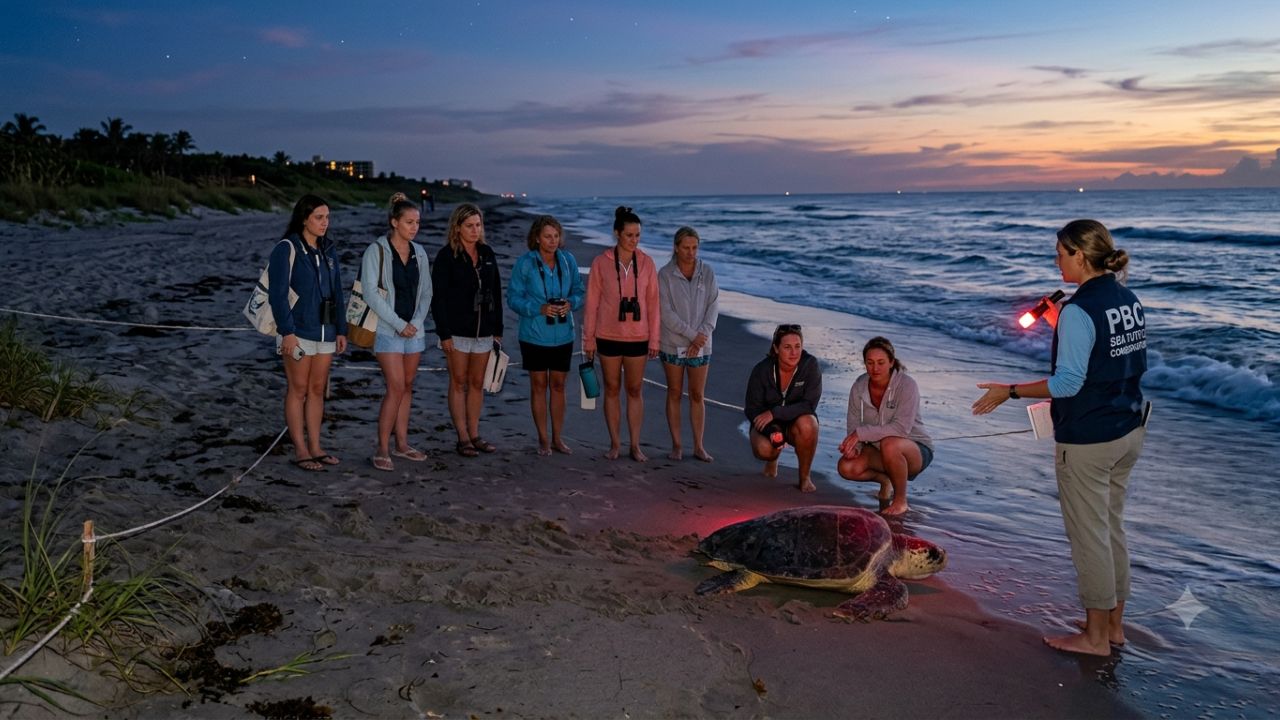
Image generated with AI
Palm Beach County has officially earned the statutory designation as the Sea Turtle Capital of Florida, cementing a 47-mile coastal sanctuary stretching from Boca Raton to Jupiter that produces approximately 25 percent of all sea turtle nests in the state and releases over two million hatchlings into the Atlantic Ocean each year. Celebrated by state tourism body Discover The Palm Beaches and conservation leaders at the Loggerhead Marinelife Center, the title honors decades of stringent municipal dark-sky ordinances, dune restoration engineering, and veterinary wildlife rehabilitation. This ecological milestone is simultaneously powering a massive economic transformation: nature-based travel now accounts for $1.5 billion of the county's $10 billion tourism footprint, successfully countering historical summer hospitality lulls through high-yield educational wildlife expeditions.
The region's barrier island beaches provide vital nesting habitats for three threatened and endangered marine reptiles: the loggerhead (Caretta caretta), green turtle (Chelonia mydas), and giant leatherback (Dermochelys coriacea). By marrying strict environmental stewardship with upscale hospitality, Palm Beach County has pioneered an eco-tourism paradigm proving that endangered species preservation and robust commercial prosperity can reinforce one another.
Geographic Sanctuaries: Micro-Density Nesting Corridors Along 47 Miles of Coast
Palm Beach County's global prominence in marine biology stems from an extraordinary spatial concentration of nesting activity. While sea turtles crawl ashore across Florida's peninsular coastline, nesting densities peak dramatically within specific micro-geographic coastal zones in northern and central Palm Beach County.
In the northern reaches of Juno Beach and Jupiter Inlet, the nesting concentration ranks among the highest in the entire Western Hemisphere. Monitored continuously by the Loggerhead Marinelife Center across 9.5 miles of pristine shoreline, this single sector records an astonishing 1,000 to 1,500 nests per linear mile each nesting season.
Further south, the barrier dune ecosystems of Singer Island and John D. MacArthur Beach State Park safeguard two miles of undisturbed subtropical maritime hammock and coastal strand, producing 1,500 to 2,500 total nests annually. Anchoring the southern boundary, the city of Boca Raton—overseen by the Gumbo Limbo Nature Center across five miles of beach—consistently tallies over 1,000 active clutches per season.
===========================================================================
               PALM BEACH COUNTY 47-MILE NESTING CORRIDOR
===========================================================================

 [NORTH: JUPITER & JUNO BEACH]
  - Monitored by: Loggerhead Marinelife Center (9.5-Mile Primary Sector)
  - Nesting Density: 1,000 - 1,500 Nests Per Mile (Western Hemisphere Peak)
  - Key Species: Early Leatherbacks (Feb-June) & High-Density Loggerheads
               |
               v
 [CENTRAL: SINGER ISLAND & MACARTHUR BEACH STATE PARK]
  - Monitored by: Florida State Parks & County Environmental Resources
  - Protected Habitat: 2 Miles of Intact Natural Dunes & Maritime Hammock
  - Annual Clutches: 1,500 - 2,500 Nests Per Season
               |
               v
 [SOUTH: BOCA RATON]
  - Monitored by: Gumbo Limbo Nature Center (5-Mile Urban Beach Sector)
  - Annual Clutches: 1,000+ Active Nests
  - Key Focus: Urban Dark-Sky Compliance & Inshore Estuarine Telemetry
===========================================================================
To safeguard these habitats against urban encroachment, coastal engineering teams place hundreds of thousands of cubic yards of non-compacted, native-grain sand during targeted beach nourishment projects, ensuring work concludes prior to the March 1 nesting kickoff. The root systems of native sea oats (Uniola paniculata) stabilize the frontal dunes, absorbing up to 50 percent of incoming wave energy during autumn tropical storms. Under strict Florida Fish and Wildlife Conservation Commission (FWC) permits, specialized researchers relocate fewer than 5 percent of vulnerable clutches laid below the mean high-tide line to protected natural hatcheries.
| Sea Turtle Species | Regional Nest Share | Clutch Size (Eggs/Nest) | Annual Clutch Frequency | Regional Nesting Window | Adult Weight / Size |
|---|---|---|---|---|---|
| Loggerhead (Caretta caretta) | >80% of County Nests | 100 – 120 eggs | 4 – 7 clutches/season | April through September | 100 – 160 kg (Carnivorous) |
| Green Turtle (Chelonia mydas) | 15% – 18% of County Nests | 110 – 140 eggs | 3 – 5 clutches/season | May through September | 130 – 200 kg (Herbivorous) |
| Leatherback (Dermochelys coriacea) | 1% – 2% of County Nests | 80 – 90 eggs | 4 – 6 clutches/season | February through July | 250 – 500 kg (Gelatinivorous) |
The Economics of Nature: Driving $1.5 Billion in Sustainable Travel
Palm Beach County welcomes over nine million visitors annually, delivering an economic footprint that exceeds $10 billion across regional employment, dining, retail, and lodging. Historically, South Florida's tourism calendar endured steep summer revenue declines following the winter peak. However, the sea turtle nesting season—active from May through August—has flattened this seasonal volatility, boosting coastal hotel occupancy rates by 12 to 18 percent during summer months.
Wildlife-focused eco-tourism now represents between 15 and 20 percent of direct visitor spending, injecting approximately $1.5 billion into the local economy. More than 45 coastal resorts across West Palm Beach, Palm Beach, Singer Island, and Jupiter have achieved certification under the Florida Green Lodging program. These properties maintain an 82 percent average occupancy rate throughout the active nesting window.
Consumer spending profiles reveal that visitors participating in educational wildlife programs generate premium economic yields:
- Daily Spending: Certified eco-tourists spend an average of $210 to $285 per day on sustainable accommodations, farm-to-table dining, and green retail, generating over $45 million in annual municipal sales tax revenues.
- Guided Night Walks: State-permitted turtle walks hosted by Loggerhead Marinelife Center, Gumbo Limbo, and MacArthur Beach State Park charge $20 to $35 per participant, routinely selling out within 48 hours of ticket release.
- Community Events: Signature conservation gatherings such as TurtleFest in Juno Beach draw single-day crowds of 10,000 to 15,000 attendees, generating over $1.2 million in weekend commerce for regional merchants and culinary purveyors.
- Volunteer Labor Capital: A dedicated network of over 1,000 local volunteers contributes more than 25,000 hours annually conducting dawn patrols and community outreach, providing an operational labor value surpassing $750,000.
Dark-Sky Compliance and Amber LED Optical Standards
Artificial lighting along developed shorelines represents the single greatest human threat to sea turtle reproduction. For millions of years, emerging hatchlings instinctively oriented toward the brightest horizon—the natural reflection of moonlight and starlight off the open Atlantic. Unshielded beachfront fixtures invert this navigational cue, drawing disoriented hatchlings inland toward busy coastal highways and predatory storm drains.
To combat coastal disorientation, all municipalities across Palm Beach County enforce strict dark-sky lighting codes from March 1 through October 31 between 9:00 PM and 6:00 AM nightly.
+-------------------------------------------------------------------------+
|             MUNICIPAL TURTLE-FRIENDLY LIGHTING COMPLIANCE STANDARDS     |
+-------------------------------------------------------------------------+
  LONG WAVELENGTH RULE:
  Fixtures must emit narrow-spectrum amber/red light at 560 nm or higher.
  (Shorter blue, green, and white wavelengths are strictly prohibited).
                                     |
                                     v
  SHIELDING & MOUNTING:
  - Downward-directed, fully shielded fixtures (zero upward glare).
  - Fixtures mounted at low elevations to avoid visibility from sand.
                                     |
                                     v
  INDOOR WINDOW MANAGEMENT:
  - Oceanfront residential & hotel units must draw blinds after 9:00 PM.
  - Tinted glass installations must meet 45% or lower inside-to-outside
    light transmittance standards.
                                     |
                                     v
  IMPACT REDUCTION:
  Full compliance reduces hatchling disorientation events by 70% to 80%.
+-------------------------------------------------------------------------+
Properties failing to comply face escalating municipal citations, while retrofitted resorts report that amber lighting installations improve evening aesthetic ambiance without compromising guest safety.
Autonomous Drone Surveillance and Thermal Sand Imaging
Technological modernization has overhauled how marine biologists monitor beach habitats without disturbing fragile nests. Traditional monitoring relied on dawn physical patrols, where researchers manually prodded sand with wooden dowels to locate buried egg clutches—a practice that risked puncturing delicate shells or collapsing subterranean chambers.
Today, research teams deploy autonomous drone fleets equipped with high-resolution radiometric thermal sensors. Flying at low altitudes of 15 to 25 meters, these unmanned aerial systems cover up to 15 miles of coastline per hour. By measuring microscopic thermal differential signatures between disturbed sand and untouched dunes, infrared payloads pinpoint buried egg chambers with a verified 94 percent mapping accuracy.
Complementing aerial optics, specialized computer-vision algorithms analyze crawl patterns in high-resolution orthomosaic imagery. Within three seconds of image capture, the software differentiates between the symmetrical flipper tracks of a loggerhead, the alternating crawl of a green turtle, and the massive, undulating furrow of a leatherback. This remote sensing integration has reduced physical sand probing by over 80 percent, dramatically improving research safety and speed.
Marine Hospital Medicine and Inshore Estuarine Telemetry
At the Loggerhead Marinelife Center's hospital in Juno Beach, advanced veterinary medicine provides life-saving intervention for stranded and injured sea turtles. The facility admits between 80 and 120 adult and juvenile turtles alongside thousands of delicate "washback" hatchlings each year.
Equipped with digital radiography, dedicated surgical theaters, and hyperbaric oxygen chambers, the hospital treats severe traumas including boat-strike shell fractures, commercial fishing line entanglements, and plastic foreign-body ingestion (which afflicts over 60 percent of admitted patients). Through intensive medical therapy, the hospital achieves a rehabilitation and release rate exceeding 75 percent.
===========================================================================
               INSHORE ACOUSTIC TELEMETRY & SLOW-SPEED ZONES
===========================================================================

 [Lake Worth Lagoon & Intracoastal Waterway (20+ Sq Miles)]
     |
     +--> 50+ Submerged Acoustic Receivers (Continuous Ping Logging)
     |
     +--> Telemetry Findings: Juvenile green turtles utilize estuarine
     |    seagrass nurseries for 3 to 5 consecutive developmental years.
     |
     +--> Seasonal Marine Enforcement: Mandatory 10-knot slow-speed zones
          enforced during nesting months reduce vessel-strike fatalities
          by 35% to 45% across surface transit corridors.
===========================================================================
Concurrently, a network of more than 50 acoustic hydrophone receivers deployed throughout the Lake Worth Lagoon and the Intracoastal Waterway tracks acoustic-tagged juvenile green turtles. The data proves that young turtles rely on inland estuarine seagrass beds for three to five years before migrating to pelagic Atlantic feeding grounds, justifying seasonal 10-knot vessel speed limits that curb propeller collisions.
Legal Precedents and Decades of Population Recovery
The resurgence of Palm Beach County's sea turtle nesting population stands as one of modern conservation's greatest empirical victories. Following the passage of the federal Endangered Species Act of 1973 and Florida's Marine Turtle Protection Act, nesting counts have rebounded dramatically.
In the late 1980s, statewide green sea turtle surveys recorded fewer than 500 total nests. Today, annual green turtle counts routinely surpass 50,000 to 66,000 nests—a staggering hundredfold increase over four decades. Because green and loggerhead turtles require 20 to 30 years to reach reproductive maturity, today's nesting surges validate the visionary protection policies enacted a generation ago.
While conservationists celebrate these milestones, ongoing threats require relentless vigilance. Climate change poses a severe biological challenge: sea turtle sex determination is temperature-dependent. Sandy incubation temperatures of 29°C produce a balanced 50/50 sex ratio, but nest temperatures exceeding 31°C induce thermal feminization, yielding nearly 100 percent female hatchlings. Combined with intensifying storm surges and microplastic pollution, maintaining Palm Beach County's nesting sanctuaries remains an enduring ecological priority.
Frequently Asked Questions: Palm Beach County Sea Turtle Travel
When does sea turtle nesting season take place in Palm Beach County?
Sea turtle nesting season runs annually from March 1 through October 31. Leatherbacks begin nesting as early as February, followed by loggerheads in April and green turtles throughout the peak summer months.
Where can travelers participate in guided sea turtle nesting walks?
State-permitted nighttime walks are organized by the Loggerhead Marinelife Center in Juno Beach, Gumbo Limbo Nature Center in Boca Raton, and John D. MacArthur Beach State Park on Singer Island. Advance reservations are essential.
What are the legal lighting rules along Palm Beach County beaches?
Oceanfront properties must install turtle-friendly amber LED fixtures (wavelength ≥ 560 nm), direct fixtures downward, and lower window blinds nightly between 9:00 PM and 6:00 AM from March 1 through October 31.
What should beachgoers do if they find an injured sea turtle or hatchling?
Never touch, illuminate, or handle the turtle. Maintain a 50-foot perimeter and immediately contact the Florida Fish and Wildlife Conservation Commission (FWC) wildlife alert hotline at 1-888-404-3922.
Related Travel Guides
Disclaimer
This article is for informational and educational purposes only. It does not constitute legal, financial, or professional advice. While we strive to provide accurate and up-to-date information, travel policies, regulations, and conditions change rapidly. Always verify information with official sources before making travel decisions. Nomad Lawyer makes no representations about the accuracy, reliability, completeness, or suitability of the information provided. Readers should consult qualified professionals for advice specific to their circumstances. The views expressed in this article are those of the author and do not necessarily reflect the views of Nomad Lawyer.
Raushan Kumar
Founder & Lead Developer
Full-stack developer with 11+ years of experience and a passionate traveller. Raushan built Nomad Lawyer from the ground up with a vision to create the best travel and law experience on the web.
Learn more about our team →