
Alcázar of Segovia 2026 Ticketing and Logistics: Managing Regional Heritage Inflows from Madrid

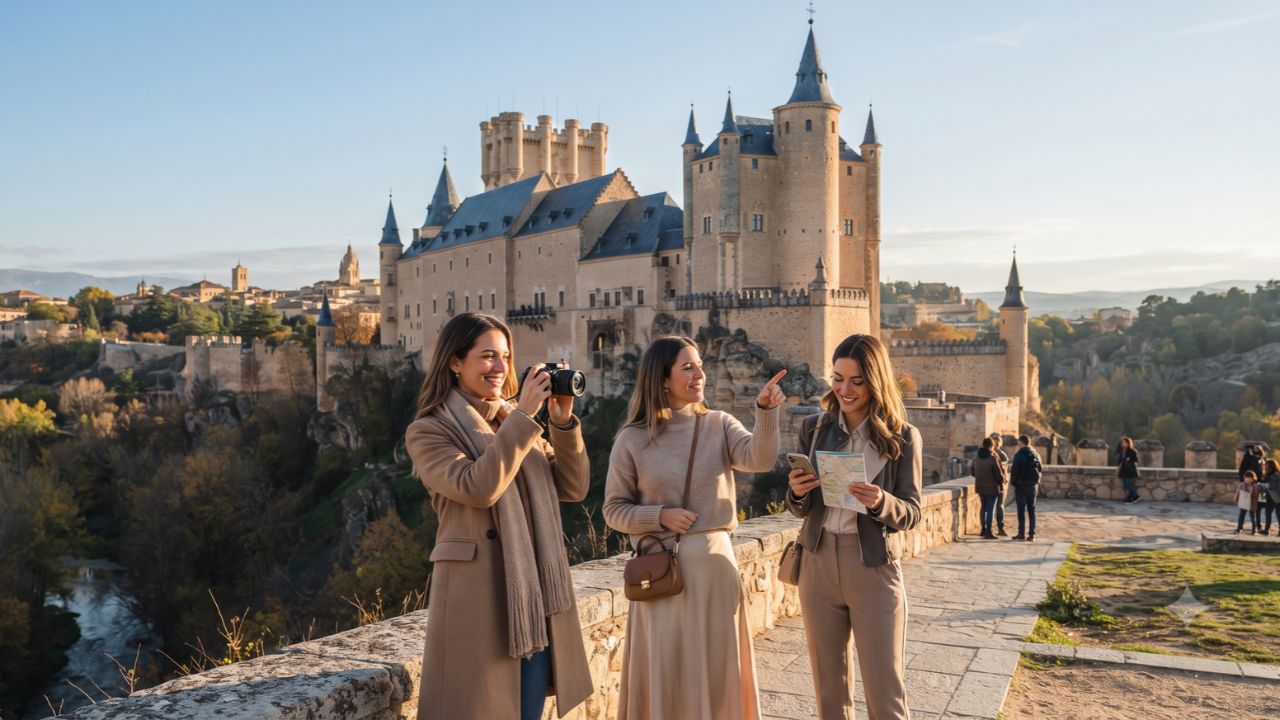
Anchored by an accessible €7 baseline palace admission and a €10 all-inclusive ticket covering the Tower of Juan II in 2026, the UNESCO-recognized Alcázar of Segovia has consolidated its standing as Castile and León's premier historical draw while absorbing surging day-trip outflows from Madrid. Positioned on a rocky promontory where the Eresma and Clamores river valleys converge, this 12th-century fortress and royal residence operates under the direct oversight of the Patronato del Alcázar de Segovia, offering travelers an integrated look into royal Castilian court life and European military science. With high-speed trains from the Spanish capital delivering passengers to Segovia-Guiomar in just 30 minutes, the fortress has become a focal point for regional heritage dispersal, attracting travelers seeking deep architectural history outside Spain's overcrowded coastal resorts.
Yet, behind the romantic turreted silhouette—frequently cited as an aesthetic inspiration for global fairytale castles—lies an intricate operational balance between tourist accessibility and strict heritage conservation. Managed alongside the city's broader UNESCO World Heritage perimeter by Turismo de Segovia, the monument enforces strict capacity caps on vertical ascents and distinct seasonal operating hours. For independent international travelers, exploring this historic landmark requires understanding ticket categories, strict stairwell physical guidelines, and the intermodal transfer required between high-speed rail terminals and the medieval city walls.
Architectural Evolution: From Frontier Stronghold to Artillery Academy
The physical fortress reflects nine centuries of deliberate royal fortification and aesthetic refinement. While the earliest documented references trace back to the 12th century during the Christian reconquest era, Castilian monarchs progressively transformed what began as a defensive wooden and stone redoubt into a permanent royal court. King Alfonso VIII established the site as an official residence, followed by extensive Gothic and early Renaissance structural expansions commissioned during the reigns of John II and Henry IV. In the late 16th century, master architect Francisco de Mora introduced slate conical spires and central courtyard revisions, defining the distinctive architectural profile seen today.
Beyond monarchical living quarters, the fortress preserves a defining chapter of Spain's military industrialization. In 1764, King Charles III established the Royal College of Artillery within the palace perimeter, positioning Segovia as an intellectual hub for ballistics, metallurgy, and military engineering. Today, the on-site Artillery Museum showcases original field pieces, uniforms, treatises, and technical instruments, giving visitors an educational counterweight to the gilded heraldic ceilings and throne rooms of the upper palace.
2026 Ticketing Architecture and Access Logistics
Admission policies for 2026 provide transparent, tiered pricing designed to accommodate varying tourist schedules and budgets. Basic entry to the palace and Artillery Museum retails at €7, while a €10 combined ticket grants access to the palace, museum, and the Tower of Juan II. Travelers requiring language support can purchase an audioguide package for €10.50, featuring comprehensive audio narratives available via smartphone in English, French, German, Italian, Japanese, and Chinese. For deep immersion, full Spanish-language guided tours that include tower access are priced at €13.50, while eligible students and seniors can access reduced rates of €5 for the palace or €8 for the full combined experience.
| Admission Category | Official 2026 Price | Concession / Reduced Rate | Included Facilities & Access Parameters |
|---|---|---|---|
| Palace & Artillery Museum | €7.00 | €5.00 | Access to royal staterooms, armory, courtyards, and military galleries |
| Palace, Museum & Tower of Juan II | €10.00 | €8.00 | Full ground access plus scheduled climb of the 152-step tower |
| Palace & Museum with Audioguide | €10.50 | N/A | Entry plus multilingual smartphone guide (EN, FR, DE, IT, JA, ZH) |
| Complete Guided Visit with Tower | €13.50 | N/A | Certified Spanish-language guide covering palace, museum, and tower |
| EU Free Admission Window | Free (€0.00) | N/A | Non-holiday Tuesdays, 14:00–16:00 (EU citizens/residents only; tower excluded) |
| Plaza de la Reina Victoria Eugenia | Free (€0.00) | Free (€0.00) | Outer landscaped esplanade open daily from 08:00 to 22:00 |
Ascending the Tower of Juan II represents the physical highlight of the visit, but it requires advance planning and physical readiness. Visitors must ascend 152 steep stone steps up a narrow, enclosed spiral staircase to reach the panoramic crenelated rooftop, which delivers unobstructed 360-degree views across the city, the Cathedral, and the Guadarrama mountain range. Because the staircase accommodates single-file traffic only, access is managed through strictly timed entry sessions. The climb is not recommended for individuals with reduced mobility, severe cardiovascular conditions, vertigo, or claustrophobia.
Intermodal Transit: High-Speed Rail Connections from Madrid
The surge in visits to the Alcázar is directly tied to rail infrastructure modernization executed by Renfe. High-speed Avant and AVE services operating out of Madrid-Chamartín-Clara Campoamor station connect to Segovia-Guiomar station in approximately 30 minutes, converting an overland journey into a straightforward excursion. However, travelers must manage a secondary transit leg: the Guiomar station is situated roughly six kilometers outside the historic center, requiring an onward ride aboard local municipal bus lines (Line 11 or Line 12) or a short taxi trip to reach the Roman Aqueduct.
From the monumental arches of the Aqueduct, visitors follow a classic pedestrian corridor through the walled city, ascending along Calle Real, passing the Plaza Mayor and Segovia Cathedral, before arriving at the Plaza de la Reina Victoria Eugenia esplanade fronting the fortress. Motorists can complete the journey from central Madrid via the AP-6 and AP-61 highways in approximately one hour, though parking near the old town remains highly restricted.
Operating schedules follow strict seasonal divisions: summer hours run from 1 April to 31 October (10:00 to 19:30), while winter hours operate from 1 November to 31 March (10:00 to 18:00). Admissions and ticket desks close 30 minutes prior to final closing. Travelers should also register specific seasonal schedule shifts announced for late 2026: operating hours run from 11:30 to 18:00 on 6 November, 10:00 to 14:30 on 24 December, and the complex remains closed all day on 25 December. The patronato administrative office can be contacted directly at +34 921 210 515.
Expert Analysis: Heritage Carrying Capacities and Regional Dispersion Economics
Segovia's tourism dynamic demonstrates the broader decentralization strategy undertaken by Spanish regional tourism boards to relieve carrying capacity pressures in Madrid. By packaging rapid rail transit with low-cost cultural entry, regional authorities have turned the Alcázar into a powerful economic magnet.
For travelers booking this route, the direct consequence is an experience that demands surgical booking precision despite the deceptive ease of transit. Because Renfe high-speed commuter trains to Segovia-Guiomar frequently sell out during weekend morning slots, arriving without reserved outbound and return rail tickets often leaves travelers stranded or forced onto two-hour regional buses. At the fortress itself, the strict quota on Tower of Juan II tickets means that day-trippers who purchase standard walk-up tickets at the ticket window typically find tower capacity exhausted for the day. Securing the complete experience requires coordinating train reservations with timed fortress admissions at least two weeks in advance.
The pricing pressure this creates means that local hospitality operators and dining establishments within Segovia's old town can capture premium yields from day-trippers without expanding hotel bed stock. Discretionary capital saved on €7 fortress admission tickets is redirected into traditional Castilian gastronomy—most notably the city's famed roasted suckling pig—and local artisanal retail along Calle Real. For Spanish tourism authorities, the Alcázar serves as a textbook example of high-volume, low-impact heritage management: visitors arrive on electrified public rail, explore pedestrianized historic sectors on foot, fund museum conservation through structured admission fees, and return to Madrid before straining local residential housing markets.
Key Takeaways
- Tiered 2026 Pricing: Standard palace and museum admission costs €7, while full access including the Tower of Juan II is priced at €10, with reduced tiers available at €5 and €8.
- Tower Physical Parameters: Climbing the Tower of Juan II requires tackling 152 steps via a narrow spiral staircase operated under strict capacity-controlled time slots.
- 30-Minute Rail Access: High-speed trains connect Madrid-Chamartín to Segovia-Guiomar in 30 minutes, requiring a short six-kilometer municipal bus connection to the historic quarter.
- Seasonal Operating Hours: Summer hours (10:00–19:30) run through 31 October, transitioning to winter hours (10:00–18:00) on 1 November, with holiday adjustments on 6 November, 24 December, and closure on 25 December.
- Free Entry Window: European Union citizens and legal residents can access free palace admission on non-holiday Tuesdays from 14:00 to 16:00, excluding the tower.
FAQ: Visiting the Alcázar of Segovia 2026
How much are tickets to the Alcázar of Segovia in 2026?
Standard palace and artillery museum admission is €7. A combined ticket including the Tower of Juan II costs €10. Audioguide packages cost €10.50, and guided tours cost €13.50.
How do I travel from Madrid to the Alcázar of Segovia?
Take a Renfe high-speed train from Madrid-Chamartín to Segovia-Guiomar station in 30 minutes, then take local bus Line 11 or a taxi to the historic center.
Is climbing the Tower of Juan II difficult?
Yes. The climb involves 152 steps up a steep, narrow spiral staircase and is not recommended for visitors with reduced mobility, claustrophobia, or respiratory difficulties.
When is the Alcázar of Segovia open for visitors?
From 1 April to 31 October, hours are 10:00 to 19:30. From 1 November to 31 March, hours are 10:00 to 18:00. Ticket sales end 30 minutes before closing.
[By pairing high-speed rail efficiency with smart advance booking, travelers can unlock one of Europe’s most storied royal strongholds without falling victim to tourist bottlenecks.]
Related Travel Guides
Disclaimer
This article is for informational and educational purposes only. It does not constitute legal, financial, or professional advice. While we strive to provide accurate and up-to-date information, travel policies, regulations, and conditions change rapidly. Always verify information with official sources before making travel decisions. Nomad Lawyer makes no representations about the accuracy, reliability, completeness, or suitability of the information provided. Readers should consult qualified professionals for advice specific to their circumstances. The views expressed in this article are those of the author and do not necessarily reflect the views of Nomad Lawyer.
Kunal K Choudhary
Co-Founder & Contributor
A passionate traveller and tech enthusiast. Kunal contributes to the vision and growth of Nomad Lawyer, bringing fresh perspectives and driving the community forward.
Learn more about our team →