
Breaking Airline News: Alaska Airlines and Korean Air Launch Massive Transpacific Codeshare to Aggressively Bypass Terrifying Asian Travel Chaos
Breaking airline news: Amidst terrifying global flight cancellations, Alaska Airlines and Korean Air aggressively launch a massive Seattle-Seoul codeshare to shield passengers from severe travel chaos.

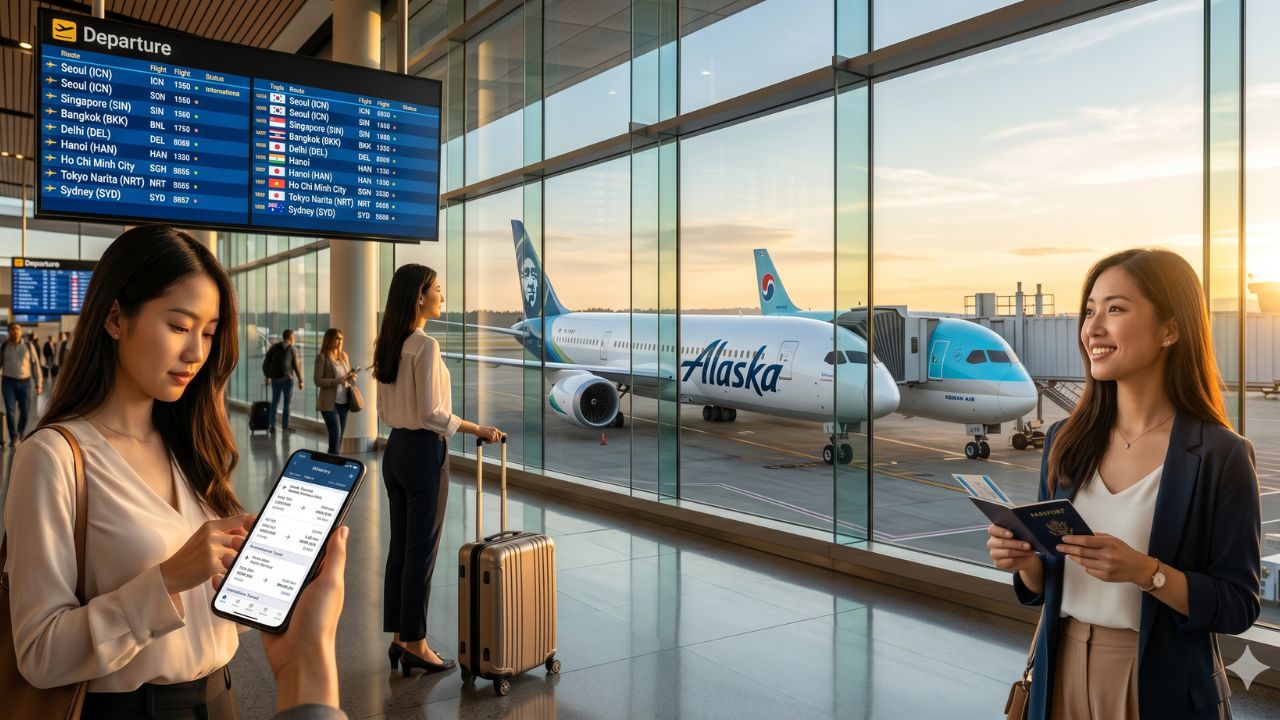
Image representing the massive Alaska Airlines and Korean Air partnership combating transpacific travel chaos.
Breaking Airline News: Alaska Airlines and Korean Air Launch Massive Transpacific Codeshare to Aggressively Bypass Terrifying Asian Travel Chaos
To aggressively protect transpacific passengers from a catastrophic wave of global airport disruptions, Alaska Airlines and Korean Air have violently overhauled their networks, deploying a massive strategic codeshare to avoid complete international gridlock.
In a highly terrifying and completely unexpected display of industrial evolution, the global commercial aviation sector is actively fighting back against the massive wave of travel chaos that has severely crippled traditional transit hubs. Delivering highly urgent, breaking airline news, Alaska Airlines and Korean Air have officially filed an unprecedented joint request with the U.S. Department of Transportation. Plagued by sudden flight cancellations and agonizing delays at congested mega-hubs across the globe, modern travelers are fiercely demanding highly reliable alternative routing. To prevent a total logistical collapse, these two legacy carriers are aggressively linking Seattle–Tacoma International Airport (SEA) directly with Seoul Incheon International Airport (ICN). This massive strategic codeshare is specifically designed to physically shield tourists and corporate executives from terrifying airport disruptions, allowing them to completely bypass broken networks while accessing the most critical trade hubs in Asia.
Expanded Overview: The Massive Scale of the Codeshare Paradigm Shift
The highly publicized execution of this massive network expansion serves as an absolute game-changer for tourists desperate to escape international transit gridlock. For decades, global tourism operated under a rigid framework that mathematically guaranteed severe exposure to sudden flight cancellations across fragmented Asian networks. However, this old, terrifying model is rapidly being aggressively overwritten.
Led heavily by passengers who absolutely refuse to be stranded in terrifying terminal bottlenecks, Alaska Airlines (AS) is aggressively utilizing Korean Air’s (KE) massive operational footprint. By violently shifting capacity away from collapsing alternative mega-hubs and launching direct codeshare flights into Seoul, carriers are completely redefining transpacific travel. This massive response allows Alaska to sell tickets directly to several Asian cities without risking the severe operational strain of expanding their own long-haul fleet. This fundamentally alters the baseline of international travel, replacing the terrifying threat of sudden airport disruptions with highly resilient, single-ticket transpacific pipelines.
Section-Wise Breakdown of the Terrifying Airport Disruptions Bypass
The Southeast Asian Lifeline (Bangkok, Ho Chi Minh City, Hanoi)
Violent operational disruptions across massive Asian mega-hubs are aggressively bypassed as the codeshare expands direct lines deep into Southeast Asia. With this new, massive partnership, passengers originating in Seattle can seamlessly connect through highly efficient Seoul directly into Bangkok (BKK), Ho Chi Minh City (SGN), and Hanoi (HAN). This violently precise routing allows American travelers to completely avoid massive domestic connection failures that have traditionally plagued Southeast Asian itineraries, securing their summer tourism plans against severe travel chaos.
The Corporate Heavyweight Corridors (Singapore, Tokyo, Delhi, Busan)
The terrifying travel chaos historically isolating critical global economies is aggressively neutralized by direct, single-ticket corporate routes. Alaska and Korean Air are aggressively bypassing traditional transpacific bottlenecks to fly high-yield passengers straight into Singapore (SIN), Tokyo Narita (NRT), Delhi (DEL), and Busan (PUS). By fiercely utilizing Seoul Incheon as the ultimate, ultra-reliable firewall against regional delays, business executives completely bypass the terrifying, overcrowded transit lounges of lesser-equipped Asian capitals.
The Down Under Expansion (Sydney, Australia)
Looking aggressively toward the future, the massive codeshare framework actively hints at extending this protective network all the way to Sydney (SYD). As global travel demand violently surges post-pandemic, securing long-haul routes into Australia via reliable alliances permanently protects passengers from the extreme psychological stress of missing connections in congested South Pacific hubs.
Verified Flight Details: Global Destination & Airline Route Matrix
To completely comprehend the incredible scale of this massive, highly coordinated counter-offensive against global travel chaos, the following mandatory table accurately reflects the exact flight pipelines securing the international grid while the massive codeshare awaits full DOT approval:
| Route | Flight | Operated by | Flight Time | Aircraft |
|---|---|---|---|---|
| Seattle (SEA) → Seoul (ICN) | AS8471 | Alaska and Hawaiian Airlines codeshare | 11h 55m | Boeing 787 |
| Seattle (SEA) → Seoul (ICN) | KAL42 / KE42 | Korean Air | 11h 55m | Boeing 787‑10 |
| Seoul (ICN) → Seattle (SEA) | KAL41 / KE41 | Korean Air | 9h 50m | Boeing 787‑10 |
(Current flight options forcefully support the extremely high demand for this transpacific routing. Both carriers aggressively provide nonstop, well-timed, and highly competitive flights utilizing massive Boeing wide-body aircraft to completely mitigate the terrifying risk of regional delays.)
Passenger Impact: Surviving the Terrifying Terminal Friction
For the desperate global commuter actively navigating this incredibly hostile environment, these highly protected, single-ticket codeshare flights provide an absolutely critical lifeline. When fragmented networks buckle, they mathematically resort to sudden flight cancellations, violently stranding innocent tourists inside suffocating transit lounges. By actively flying via a unified Alaska-Korean Air itinerary, travelers completely bypass the excruciating reality of lost baggage, terrifying terminal friction, and the exorbitant out-of-pocket expenses associated with violently missed connections. This single-ticket structure legally forces the operating carriers to violently protect your itinerary across the entire Pacific Ocean.
Industry Analysis: What Triggered the Transpacific Network Overhaul?
According to strict operational frameworks, establishing these unprecedented codeshare links demands an incredibly aggressive overhaul of traditional competitive strategy. To prevent catastrophic mass delays and massive operational financial losses, Alaska Airlines and Korean Air recognized that solo operations were completely unsustainable. The aviation industry is actively suffering from extreme, localized infrastructure strain, meaning airlines must violently consolidate their routing through ultra-efficient mega-hubs like Seoul Incheon. This massive consolidation allows both carriers to fiercely maximize flight utilization and drastically minimize their exposure to sudden meteorological shifts or violent airspace congestion elsewhere in Asia.
Conclusion: A Highly Disruptive Industrial Evolution
The massive, highly publicized launch of the Alaska Airlines and Korean Air codeshare actively acts as an absolutely incredible victory over the terrifying physical fragility of the modern commercial aviation sector. By actively demonstrating that strategic alliances can completely bypass the severe travel chaos rotting the core of fragmented international networks, these global airlines aggressively protect both vital business travel and massive leisure markets. The industry is officially abandoning superficial, disconnected booking platforms to secure a highly resilient travel framework built entirely on reliable, unified routing.
What Guests Get: Immediate Passenger Ramifications
- Shielded Itineraries: Massive codeshare routes violently bypass inefficient third-country hubs to permanently prevent sudden flight cancellations.
- Single-Ticket Security: Passengers aggressively secure seamless, flexible booking across the entire Pacific, violently eliminating the terrifying risk of missed self-transfers.
- Massive Southeast Asian Access: Unprecedented, highly reliable connections actively protect tourists heading to Thailand and Vietnam from regional travel chaos.
- Fleet Optimization: Alaska Airlines violently expands its global reach without the terrifying financial risk of purchasing massive new long-haul aircraft.
What This Means for Travelers: Navigating the Travel Chaos
If you are actively booked to fly transpacific, you must immediately abandon terrifying, multi-ticket transit itineraries. Securing single-ticket codeshare flights on these newly expanded cultural routes is absolutely essential to completely bypass the extreme, localized disruptions ravaging traditional Asian mega-hubs. Should legacy systems suffer a sudden, terrifying collapse, your Alaska-Korean Air itinerary will massively protect your holiday from completely unexpected disaster. Passengers are strongly advised to aggressively monitor DOT approval status to immediately capitalize on these highly protected Asian pipelines.
FAQ: Alaska Airlines and Korean Air Codeshare 2026
Why are Alaska Airlines and Korean Air launching this massive codeshare? The airlines are aggressively teaming up to completely shield their passengers from terrifying flight cancellations and widespread airport disruptions by utilizing Seoul as an ultra-reliable, highly efficient Pacific gateway.
Which new Asian cities are completely protected by this codeshare? The massive agreement violently expands single-ticket access to Bangkok, Ho Chi Minh City, Hanoi, Singapore, Delhi, Busan, Tokyo Narita, and potentially Sydney.
When will this massive codeshare aggressively take effect? The incredibly powerful partnership is actively awaiting full approval from the U.S. Department of Transportation, but passengers can already utilize the highly reliable existing direct flights between SEA and ICN.
Related Travel Guides
- United Airlines A380 Expansion: Global Routes Resume March 2026
- Massive US Flight Cancellations and Delays Disrupt American, United, and Delta Air Lines with Thousands Grounded Across New York, Charlotte, Denver, and San Francisco: New Airline News and Aviation Updates
- Why McDonnell Douglas's Audacious Plan to Commercialize the C-17 Globemaster Never Got Off the Ground
Disclaimer
This article is for informational and educational purposes only. It does not constitute legal, financial, or professional advice. While we strive to provide accurate and up-to-date information, travel policies, regulations, and conditions change rapidly. Always verify information with official sources before making travel decisions. Nomad Lawyer makes no representations about the accuracy, reliability, completeness, or suitability of the information provided. Readers should consult qualified professionals for advice specific to their circumstances. The views expressed in this article are those of the author and do not necessarily reflect the views of Nomad Lawyer.
Kunal K Choudhary
Co-Founder & Contributor
A passionate traveller and tech enthusiast. Kunal contributes to the vision and growth of Nomad Lawyer, bringing fresh perspectives and driving the community forward.
Learn more about our team →