
Akasa Air Launches AME Training Programme: Inside India's MRO Aviation Boom

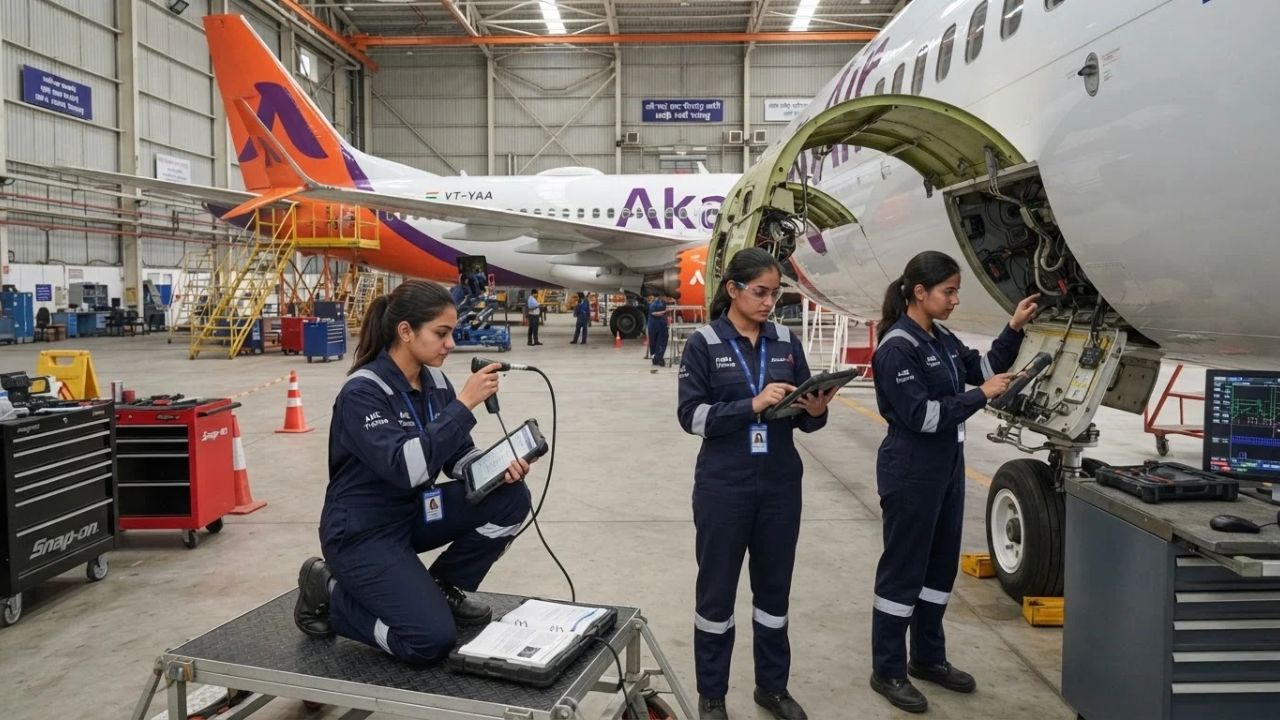
While millions of passengers admiring the gleaming terminals of Mumbai, Delhi, and Bengaluru focus on boarding gates and inflight menus, India's most consequential aviation revolution is unfolding behind hangar doors. Akasa Air operates an active fleet of 43 aircraft and holds a massive order book of 226 Boeing 737 MAX jets, with 183 more aircraft slated for delivery over the next six years—a timeline that requires building an elite army of domestic maintenance engineers from the ground up.
On September 15, 2026—celebrated nationwide across India as Engineer's Day—the carrier officially unveiled its Aircraft Maintenance Engineering (AME) Training Programme. Developed to construct a reliable, homegrown talent pipeline for India's rapidly expanding Maintenance, Repair, and Overhaul (MRO) industry, the initiative reflects a strategic realization: an airline can purchase hundreds of next-generation jetliners, but maintaining operational punctuality across the subcontinent requires deep technical expertise stationed right on Indian tarmac.
Engineering the Ascent: Akasa Air’s Landmark MRO Training Alliance
India's commercial aviation sector is experiencing unprecedented growth. Skyrocketing passenger volumes and rapid fleet inductions by domestic carriers have placed immense strain on local engineering infrastructure. Historically, Indian airlines relied heavily on sending airframes and complex turbine assemblies abroad for heavy C-checks and engine overhauls—an expensive practice that drained foreign exchange and introduced costly scheduling delays.
To build domestic self-reliance, Akasa Air structured its AME Training Programme around direct industry-academia collaboration. The airline partnered with four premier aviation technical academies located in key aviation corridors:
- Thakur Institute of Aviation Technology in Mumbai
- Pune Institute of Aviation Technology (PIAT) in Pune
- JRN Institute of Aviation Technology (JRNIAT) in Delhi
- Hindustan Aviation Academy (HAA) in Bengaluru
The programme is specifically designed for students who have successfully earned their Higher Secondary Certificate (HSC). By capturing talent immediately following secondary education, the curriculum bridges theoretical physics and aeronautics with hands-on mechanical discipline. Trainees gain direct exposure to next-generation avionics, CFM LEAP-1B powerplant systems, airframe structural integrity audits, and rigorous safety protocols regulated by the Directorate General of Civil Aviation.
Highlighting the long-term vision, Belson Coutinho, Co-Founder and Chief Operating Officer of Akasa Air, emphasized that the trajectory of India's aviation sector will be defined not merely by the scale of fleet expansion, but by the pipeline of talent and depth of capability that supports it. Coutinho noted that the AME training programme reflects Akasa Air's ongoing commitment to building a resilient, globally competitive aviation ecosystem by enabling aspiring engineers to gain early exposure to modern airline operations, new-generation aircraft, and world-class safety standards.
What Makes Akasa Air and India’s MRO Ecosystem Different
Since launching commercial revenue operations in August 2022, Akasa Air has maintained an aggressive yet calculated growth trajectory. Unlike legacy carriers burdened by mixed fleets of aging aircraft, Akasa built its foundation entirely upon a single, standardized airframe family: the Boeing 737 MAX.
Operating a homogenous fleet provides distinct engineering advantages. Line engineers, hangar technicians, and parts logistics specialists focus on a unified suite of components. With 43 aircraft currently in active service and 183 additional deliveries scheduled across the coming six years to fulfill its 226-aircraft order, Akasa is establishing an integrated maintenance network where routine A-checks, line inspections, and predictive diagnostic monitoring happen seamlessly across its primary bases.
This focus aligns with India's broader ambition to transform into an international MRO hub for South Asia and the Middle East. By developing certified engineers across Mumbai, Pune, Delhi, and Bengaluru, the country is transitioning from an aviation consumer into an engineering powerhouse. Students graduating through this pathway enter an industry characterized by high-demand technical careers, reducing reliance on foreign maintenance facilities and accelerating aircraft turnaround times at congested domestic hubs.
Visitor Insider Tips
For domestic and international travelers navigating India's skies during this period of fleet expansion, understanding how airline operations interact with major airport hubs can save hours of transit stress.
First, master terminal logistics in dual-terminal cities. In Mumbai (BOM), Akasa Air operates primarily from Terminal 1 for domestic flights, distinct from international Terminal 2. If connecting between terminals, allow at least two and a half hours; the transit shuttle traverses heavy city traffic along Western Express Highway. In Delhi (DEL), pay close attention to your boarding pass: domestic departures split between Terminal 1 and Terminal 3.
Second, time your domestic flights around airport congestion banks. Early morning departures between 05:30 and 08:30 offer the highest on-time performance across Indian airspace. Mid-evening slots between 18:00 and 21:30 regularly experience runway holding patterns over Mumbai and Delhi due to dense commercial traffic.
Third, explore regional culinary highlights around the airport perimeter. Near Mumbai's domestic terminal in Vile Parle East, step out for authentic Maharashtrian batata vada and piping hot chai. In Bengaluru (BLR), Kempegowda International Airport's Terminal 2 features stunning indoor botanical gardens; before boarding, grab freshly brewed south Indian filter coffee and crisp ghee roast dosas from authentic regional stalls located in the transit arrivals hall.
Fourth, download the DigiYatra biometric app before your journey. DigiYatra allows paperless, face-recognition entry at Delhi, Bengaluru, Mumbai, and Pune airports, letting you breeze past physical identity checks in under sixty seconds.
Cultural and Environmental Context
Aviation in India is not merely a commercial sector; it is the physical fabric uniting distant linguistic cultures, ancient pilgrimage routes, and emerging regional economies. From the sacred temple architecture of Varanasi to the historic hill fortresses recognized by UNESCO World Heritage, affordable and dependable air connectivity allows domestic and international travelers to explore regions that once required arduous multi-day rail journeys.
The growth of regional air routes supported by national tourism campaigns through Incredible India has opened remote valleys in the Northeast and coastal enclaves in Karnataka and Maharashtra. However, expanding flight frequency requires responsible ecological stewardship.
Aviation's environmental footprint is a serious consideration across the subcontinent. By committing its fleet renewal exclusively to the Boeing 737 MAX, Akasa Air incorporates advanced CFM LEAP-1B engines and aerodynamic winglets that reduce carbon emissions and fuel burn by approximately 15 to 20 percent compared to previous-generation narrowbody aircraft. Additionally, quieter engine signatures minimize acoustic disturbance over populated residential areas surrounding urban airports like Mumbai Santacruz and Delhi Palam.
Investing in local engineering talent ensures these advanced, fuel-efficient systems remain tuned to peak mechanical efficiency. Proper engine washes, precise aerodynamic surface maintenance, and optimized maintenance scheduling directly contribute to lower fuel consumption, demonstrating that skilled engineering is the foundation of environmentally conscious commercial aviation.
FAQ: Flying Domestic Airlines in India 2026
What is the best time to book domestic flights across India? Book flights three to six weeks in advance for regular routes, or two to three months ahead when traveling during festival seasons like Diwali, Durga Puja, or year-end holidays when domestic fares rise sharply across all major carriers.
How does DigiYatra streamline domestic air travel in India? DigiYatra uses facial recognition technology linked to your Aadhaar identity card and boarding pass. It enables contactless, paperless clearance at terminal entry gates, pre-security checkpoints, and boarding doors, reducing terminal processing time to seconds.
Which terminals does Akasa Air operate from at major Indian airports? Akasa Air primarily departs from Terminal 1 at Mumbai Chhatrapati Shivaji Maharaj International Airport and Terminal 1 or 2 at Delhi Indira Gandhi International Airport. Always verify your specific terminal on your boarding pass before departure.
What are the hand baggage allowances for domestic flights in India? Standard economy class domestic tickets generally permit one cabin bag weighing up to 7 kg, plus one small personal item like a laptop bag or handbag. Checked baggage allowances typically start at 15 kg per passenger.
True aviation resilience begins on the hangar floor, where precision engineering transforms soaring ambition into reliable human connection.
Related Travel Guides
Disclaimer
This article is for informational and educational purposes only. It does not constitute legal, financial, or professional advice. While we strive to provide accurate and up-to-date information, travel policies, regulations, and conditions change rapidly. Always verify information with official sources before making travel decisions. Nomad Lawyer makes no representations about the accuracy, reliability, completeness, or suitability of the information provided. Readers should consult qualified professionals for advice specific to their circumstances. The views expressed in this article are those of the author and do not necessarily reflect the views of Nomad Lawyer.
Raushan Kumar
Founder & Lead Developer
Full-stack developer with 11+ years of experience and a passionate traveller. Raushan built Nomad Lawyer from the ground up with a vision to create the best travel and law experience on the web.
Learn more about our team →