AirBorneo Launches Jakarta–Kuching Flights: Sarawak Expands International Connectivity Amid RM85.9M Tourism Investment and UNESCO Gastronomy Surge

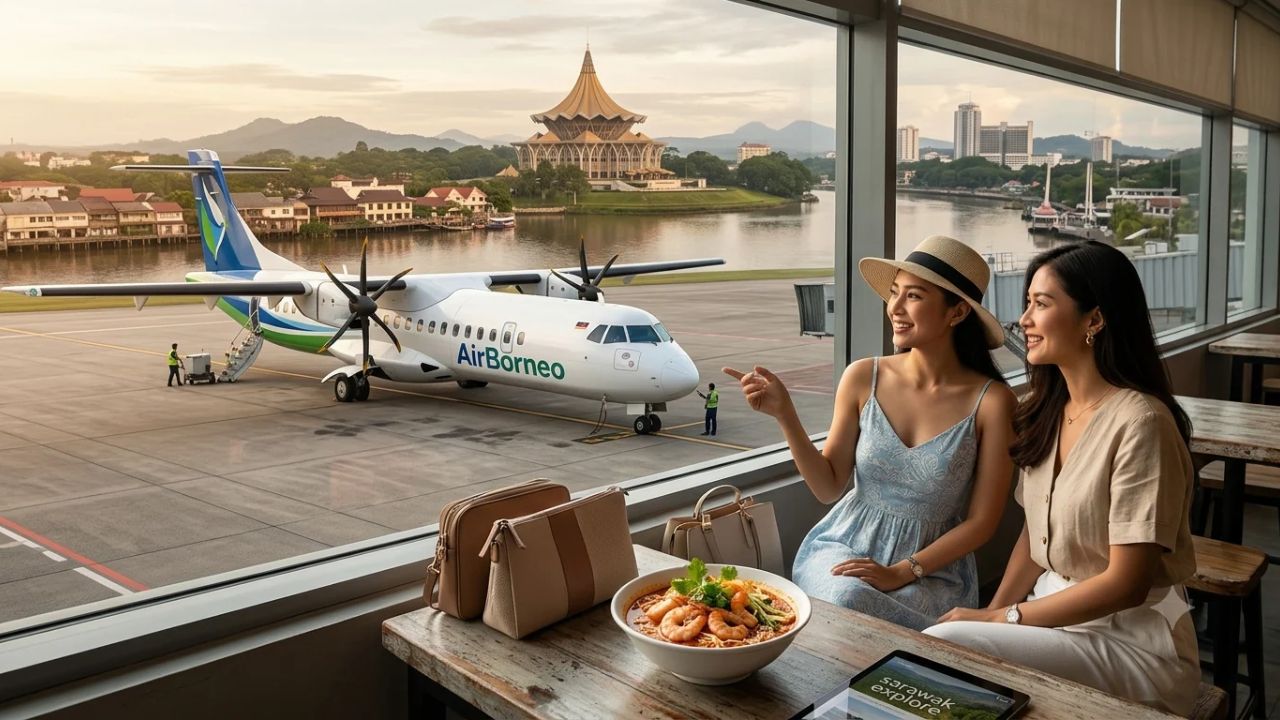
KUCHING, Malaysia — In a decisive step toward expanding regional connectivity across Borneo, regional carrier AirBorneo has finalized preparations to launch direct scheduled flights linking Jakarta with Kuching before the close of 2026.
Formally confirmed by the Sarawak State Government on 21 October 2026 through the Sarawak Public Communications Unit (UKAS), the cross-border service will bridge Soekarno-Hatta International Airport (CGK) in the Indonesian capital with Kuching International Airport (KCH), establishing a direct air corridor that eliminates multi-hour transit stops in Singapore or Kuala Lumpur.
The introduction of the Jakarta route marks the latest milestone in AirBorneo's rapid network expansion across Southeast Asia.
Following the successful launch of its Kuala Lumpur connection on 20 July and its Singapore service on 22 July 2026, the carrier is positioning Kuching as an accessible international gateway for short-break city breaks, eco-tourism, and gastronomic exploration.
The route provides an immediate travel option for Jakarta's massive metropolitan population of over ten million residents, offering an easy escape focused on heritage, riverfront leisure, and culinary discoveries.
The timing of the route launch aligns with a substantial capital commitment from the Sarawak Government.
State authorities have allocated RM85.9 million for tourism infrastructure modernization, headlined by a flagship RM70 million transformation of the Old State Legislative Assembly (DUN) building into a world-class performing arts center.
With official targets set at welcoming 5.1 million visitor arrivals and generating RM14.0 billion in tourism receipts by 2027, the direct Jakarta–Kuching air link establishes a vital economic bridge that accelerates cross-border tourism integration across Borneo.
AIRBORNEO REGIONAL NETWORK & SARAWAK TOURISM TARGETS
| Performance Metric / Corridor | Operational Specification | Strategic Travel Meaning |
|---|---|---|
| New Route: Jakarta to Kuching | CGK to KCH Non-Stop Link | Direct Indonesian Gateway |
| Confirmed Launch Timeline | Before Year-End 2026 | Captures Year-End Travel |
| Network Predecessor: Kuala Lumpur | Launched 20 July 2026 | Domestic Capital Trunk |
| Network Predecessor: Singapore | Launched 22 July 2026 | Premier Regional Hub |
| State Tourism Infrastructure Budget | RM85.9 Million Capital Outlay | Preserves Heritage & Arts |
| Old DUN Performing Arts Project | RM70.0 Million Allocation | Cultural Venue Modernization |
| Official 2027 Visitor Target | 5.1 Million Total Arrivals | Long-Term Tourism Goal |
| Official 2027 Revenue Target | RM14.0 Billion Tourism Yield | High-Value Economic Model |
| August 2026 Monthly Arrivals | 439,968 Visitors (+6.53% YoY) | Expanding Summer Baseline |
| August 2026 Tourism Receipts | Approx. RM1.14 Billion | Solid Monthly Cash Inflow |
Regional Aviation Architecture: AirBorneo's Cross-Border Expansion
The launch of non-stop flights between Jakarta and Kuching addresses a longstanding connectivity bottleneck within Southeast Asia.
Although Indonesia and Malaysia share the massive landmass of Borneo—divided between Indonesian Kalimantan and the Malaysian states of Sarawak and Sabah—commercial passenger air connections between the island's premier cities and primary national capitals have historically remained limited.
Travelers journeying between Jakarta and Kuching were routinely forced to book circuitous connecting flights through Kuala Lumpur or Singapore, turning what should be a direct 90-minute flight into an exhausting four-to-six-hour transit journey.
By deploying AirBorneo into the Jakarta market, the Sarawak State Government is actively diversifying its source market portfolio.
Indonesian outbound leisure travel has demonstrated rapid expansion, characterized by a burgeoning middle class seeking affordable, high-quality weekend getaways in neighboring ASEAN destinations.
AirBorneo's direct link provides competitive flight timing that enables Indonesian travelers to depart Jakarta on a Friday afternoon and arrive in Kuching in time for an evening dinner along the waterfront, maximizing actual holiday time without requiring extended annual leave.
                               REGIONAL CONNECTIVITY EVOLUTION

   PREVIOUS ROUTING (4 to 6 Hours Transit):
   [Jakarta (CGK)] ===> Layover in Kuala Lumpur or Singapore ===> [Kuching (KCH)]

   NEW DIRECT AIRBORNEO CORRIDOR (Approx. 90 Minutes Non-Stop):
   [Jakarta (CGK)] ============================================> [Kuching (KCH)]
            |                                                           |
            +---> Eliminates Connecting Hub Delays                      +---> Unlocks Weekend Travel
            +---> Lowers Round-Trip Transit Costs                       +---> Direct Heritage Access
In addition, the expansion reflects broader regional synergy across Borneo.
With Indonesia progressing on the construction of its new administrative capital, Nusantara (IKN), in East Kalimantan, cross-border commercial and diplomatic mobility across the island is accelerating.
Strengthening direct air connections between Jakarta and Sarawak's administrative capital fosters greater business cooperation, encourages bilateral trade delegations, and establishes Kuching as a natural transit hub for international visitors exploring the wider island of Borneo.
The Short-Break Formula: Structuring Two- and Three-Night Itineraries
The commercial viability of the Jakarta–Kuching route hinges on delivering a satisfying, low-friction holiday experience within a compact timeframe.
Travel industry analysts observe that short-break vacations demand realistic itinerary planning: attempting to cover excessive geographic distances across Sarawak's sprawling rainforest territory during a two- or three-night stay leads to travel fatigue and logistical frustration.
Instead, the most successful weekend getaways establish a clear geographic center of gravity, focusing on Kuching's walkable heritage core, animated riverside promenades, and concentrated culinary enclaves.
RECOMMENDED SHORT-BREAK ITINERARY ARCHITECTURE
| Entity / Route | Metrics | Operational Status |
|---|---|---|
| Duration Category | Core Experiential Focus | Operational Planning Priority |
| Two-Night Weekend | Urban Heritage, Waterfront & Gastronomy | Protect the primary full day |
| (Friday to Sunday) | Museum visits, food tours, sunset cruise | Avoid distant wilderness travel |
| Three-Night Extended | City Exploration plus Single Excursion | Check weather for boat transfers |
| (Thursday to Sunday) | Bako National Park or Orangutan Center | Maintain flexible backup plans |
For a focused two-night visit, the ideal itinerary begins with a relaxed Friday evening arrival, allowing guests to settle into riverside accommodations and enjoy an introductory dinner at a local open-air food market.
Saturday should be preserved entirely for urban cultural exploration: an unhurried morning walking tour through the colonial heart of old Kuching, an afternoon exploring the comprehensive ethnographic galleries of the Borneo Cultures Museum, and a sunset cruise along the Sarawak River, culminating in an authentic Dayak dinner.
Sunday morning provides time for souvenir shopping at the Main Bazaar and a final sampling of local breakfast noodles before departing for the airport.
An additional third night fundamentally shifts the holiday pace, creating space for a substantial outdoor nature excursion without compromising urban exploration.
Travelers can dedicate their extra full day to an immersive expedition—such as observing semi-wild orangutans during morning feeding sessions at Semenggoh Wildlife Centre or taking a guided boat trek into the coastal sandstone cliffs of Bako National Park—returning to the city for evening relaxation.
By matching itinerary commitments to confirmed flight arrival and departure schedules, visitors ensure that every hour spent in Sarawak feels rewarding and unhurried.
                               WEEKEND VALUE OPTIMIZATION FUNNEL

   +---------------------------------------------------------------------------------+
   | DIRECT FLIGHT ARRIVAL: 90-minute flight from Jakarta leaves travelers refreshed |
   +---------------------------------------------------------------------------------+
                                           |
                                           v
   +---------------------------------------------------------------------------------+
   | COMPACT URBAN CORE: 20-minute transfer from airport to Kuching Waterfront       |
   +---------------------------------------------------------------------------------+
                                           |
                                           v
   +---------------------------------------------------------------------------------+
   | IMMERSIVE DIVERSITY: Walkable museums, heritage shophouses & world-class dining |
   +---------------------------------------------------------------------------------+
                                           |
                                           v
   +---------------------------------------------------------------------------------+
   | HIGH VISITOR RETENTION: Rewarding compact stay drives repeat multi-week bookings|
   +---------------------------------------------------------------------------------+
UNESCO Creative City of Gastronomy: Kuching's Culinary Competitive Edge
A defining asset that elevates Kuching as a premier weekend getaway is its exceptional food culture.
In November 2021, Kuching achieved global recognition when it was formally designated as a member of the prestigious UNESCO Creative Cities Network in the gastronomy category.
This international accolade acknowledges a food culture shaped by indigenous rainforest botanical ingredients, multi-generational Chinese immigrant techniques, Malay coastal spices, and regional trade routes.
Unlike commercial urban dining landscapes dominated by international franchise chains, Kuching's food culture remains intimately connected to local smallholders, traditional family-run food stalls, and lively morning wet markets.
KUCHING SIGNATURE GASTRONOMIC PROFILE
| Entity / Route | Metrics | Operational Status |
|---|---|---|
| Iconic Culinary Dish | Heritage Origin & Ingredients | Flavor Profile & Experience |
| Sarawak Laksa | Sambal belacan, coconut, herbs | Aromatic, complex, tangy broth |
| Kolo Mee | Springy egg noodles, shallots | Savory, fragrant, dry-tossed |
| Midin Jungle Fern | Wild rainforest fern, belacan | Crisp, tender, earthy greens |
| Manok Pansoh | Chicken in bamboo with tapioca | Succulent, wood-smoked, herb |
| Tuak Artisanal Brew | Fermented glutinous rice | Sweet, delicate tribal wine |
Among the city's signature dishes, Sarawak Laksa stands supreme.
Celebrated internationally by renowned culinary critics, this breakfast staple features rice vermicelli submerged in an aromatic broth brewed from coconut milk, tamarind, chicken bones, and a complex spice paste incorporating dozens of local herbs, garnished with fresh prawns, shredded chicken, omelet strips, and fresh calamansi lime.
Equally ubiquitous is Kolo Mee, a dry-tossed egg noodle dish served with fragrant shallot oil, minced meat, and savory slices of barbecued meat, available at almost every neighborhood coffeeshop (kopitiam).
Beyond street food classics, Kuching provides travelers with access to authentic indigenous Dayak cuisine.
Dishes such as Midin—a wild jungle fern harvested from swamp forests that remains crisp and tender when stir-fried with garlic and fermented shrimp paste (belacan)—and Manok Pansoh, a traditional Iban preparation where marinated chicken, ginger, and wild tapioca leaves are stuffed inside hollow green bamboo stalks and slow-roasted over an open wood fire, provide dining experiences that cannot be replicated outside Borneo.
For culinary tourists, Kuching offers an intoxicating journey of discovery where every meal connects visitors with the botanical richness of the surrounding rainforest.
                               KUCHING GASTRONOMIC VALUE CYCLE

   [Rainforest Foragers & Smallholders] ===> Fresh Midin Ferns, Bario Rice & Jungle Herbs
                                                        |
                                                        v
   [Independent Street Stalls & Kopitiams] => Traditional Family Cooking Techniques
                                                        |
                                                        v
   [UNESCO Creative City Recognition] ====> Attracts Discerning International Foodies
                                                        |
                                                        v
   [Direct Tourist Expenditure] ==========> Supports Rural Farmers & Cottage Food Artisans
Urban Cultural Anchors: The Waterfront, Borneo Cultures Museum, and Heritage Precincts
For weekend visitors navigating Kuching on foot, the city's historic center offers a compact, pedestrian-friendly environment where architectural heritage and modern cultural facilities coexist gracefully.
The central gathering place of the city is the Kuching Waterfront, an expansive 900-meter paved pedestrian esplanade that lines the southern bank of the scenic Sarawak River.
Flanked by landscaped gardens, historic gazebos, and open-air food stalls, the promenade provides sweeping views across the river to the Astana—the historic 1870 palace of the White Rajahs—and the dramatic golden roof of the New State Legislative Assembly building.
As dusk approaches, the promenade comes alive with local families, buskers, and river ferries (penambang), traditional wooden watercraft that have ferried commuters across the river for over a century.
KUCHING CORE URBAN CULTURAL ATTRACTIONS
| Entity / Route | Metrics | Operational Status |
|---|---|---|
| Cultural Landmark | Architectural Character | Primary Visitor Insight |
| Kuching Waterfront Promenade | 900-Meter Riverfront Walkway | Sunset views, cafes, ferries |
| Borneo Cultures Museum | Modern 5-Story State Museum | 2nd largest museum in ASEAN |
| Chinese History Museum | 1912 Colonial Shophouse | Immigrant trade & culture |
| Main Bazaar & Carpenter Street | 19th-Century Shophouse Arcades | Crafts, antiques, street eat |
| Fort Margherita & Brooke Gallery | 1879 Hilltop Fortress | History of the White Rajahs |
Directly adjacent to the waterfront lies the historic commercial core, centered along Main Bazaar and Carpenter Street.
Here, rows of continuous 19th-century Chinese shophouses feature sheltered covered walkways (five-foot ways) housing family-run handicraft shops, traditional tinsmiths, herbal apothecaries, and boutique coffee roasters.
Visitors can explore the Chinese History Museum, situated in the historic 1912 court chamber of the Chinese community, which documents the migration, trading partnerships, and cultural contributions of dialect groups that helped establish Kuching.
The institutional crown jewel of Sarawak's cultural landscape is the Borneo Cultures Museum, located a short walk from the waterfront.
Opened in 2022, this architectural marvel spans over 30,000 square meters across five floors, standing as the second largest museum in Southeast Asia and one of the finest cultural institutions in the Asia-Pacific.
The museum's gold-clad facade, inspired by traditional Sarawakian craft motifs, houses world-class interactive galleries dedicated to prehistoric archaeology, ancient tribal migrations, intricate beadwork, traditional ikat textile weaving, and rainforest anthropology.
Equipped with advanced multi-sensory displays and digital interactive galleries, the museum provides visitors with an unforgettable introduction to the cultural diversity of Borneo's indigenous ethnic groups.
                               BORNEO CULTURES MUSEUM GALLERY WALK

   +---------------------------------------------------------------------------------+
   | LEVEL 1 & 2: Grand Foyer, Auditorium, Educational Labs & Children's Gallery     |
   +---------------------------------------------------------------------------------+
                                           |
                                           v
   +---------------------------------------------------------------------------------+
   | LEVEL 3: In Harmony with Nature (Rainforest Ecology & Indigenous Adaptation)    |
   +---------------------------------------------------------------------------------+
                                           |
                                           v
   +---------------------------------------------------------------------------------+
   | LEVEL 4: Time Changes (Archaeological Treasures, Niah Caves & Trade Artifacts)   |
   +---------------------------------------------------------------------------------+
                                           |
                                           v
   +---------------------------------------------------------------------------------+
   | LEVEL 5: Objects of Desire (Royal Regalia, Sacred Weaving, Master Craftsmanship)|
   +---------------------------------------------------------------------------------+
Nature and Wilderness Calibration: Bako National Park and Wildlife Sanctuaries
For travelers who extend their weekend stay to three nights, Sarawak's natural rainforest wilderness lies within easy striking distance of the capital.
Unlike other Southeast Asian destinations where accessing primary rainforest requires domestic flights or grueling multi-day road journeys, Kuching serves as a basecamp for exceptional ecological encounters located less than an hour from downtown hotels.
The premier nature excursion from Kuching is Bako National Park, Sarawak's oldest declared national park, established in 1957.
Occupying a rugged, coastal peninsula jutting into the South China Sea, Bako encompasses almost every vegetation type found in Borneo, ranging from coastal mangrove swamps and kerangas (heath forest) to dense dipterocarp rainforest and open scrub plateaus.
SARAWAK WILDLIFE & NATURE SANCTUARY GUIDE
| Entity / Route | Metrics | Operational Status |
|---|---|---|
| Sanctuary Destination | Transit Logistics from City | Defining Wildlife Encounter |
| Bako National Park | 45-min taxi + 20-min boat | Wild proboscis monkeys, pigs |
| Semenggoh Wildlife Centre | 40-minute drive south of city | Semi-wild orangutan feeding |
| Kubah National Park | 35-minute drive west of city | Rare palms, frogs & cascades |
| Matang Wildlife Centre | 45-minute drive from city | Wildlife rescue & education |
Bako is globally renowned for its population of wild proboscis monkeys—an endangered primate endemic to Borneo, instantly recognizable by its pendulous nose and reddish-brown coat—which can be observed feeding in coastal mangrove trees along the beach.
Visitors can also encounter wild bearded pigs, silvered langurs, monitor lizards, and hundreds of bird species along well-marked trail networks that lead to secluded rocky coves and towering sea stacks.
However, travel planners emphasize that visitors must calibrate nature excursions against seasonal weather patterns.
Access to Bako requires a 20-minute open boat crossing from Bako Village across open sea waters.
Official guidance from the Sarawak Tourism Board identifies the period from March to October as the optimal window for trekking and wildlife observation due to drier, calmer seas.
During the northeast monsoon season (November through February), sea swells can become turbulent, occasionally disrupting boat schedules.
Travelers planning an excursion during late autumn or winter should check maritime forecasts closely and maintain flexible backup itineraries, such as visiting Semenggoh Wildlife Centre, which is located inland and completely accessible by paved roadways year-round.
                               SEASONAL NATURE CALIBRATION MODEL

   DRY SEASON (March to October):
   [Optimal Bako Park Excursions] ===> Calm boat crossings, active coastal wildlife

   MONSOON TRANSITION (November to February):
   [Check Maritime Conditions] ======> If seas are rough, pivot to inland sanctuaries
            |                                  |
            v                                  v
   [Semenggoh Orangutans]             [Kubah Frog & Palm Trails]
   (Paved Highway Access)             (Protected Mountain Valleys)
Sarawak Tourism Macroeconomic Benchmarks: August Surge and 2027 Milestones
The expansion of AirBorneo's international flight schedule comes at a critical juncture for Sarawak's broader tourism economy.
Official statistical reports published by the Sarawak Public Communications Unit (UKAS) for August 2026 illustrate a solid, expanding monthly baseline, alongside broader annual recovery dynamics.
During August 2026, Sarawak recorded 439,968 visitor arrivals, representing a healthy year-on-year expansion of 6.53 percent compared to August 2025.
Monthly tourism receipts generated approximately RM1.14 billion, demonstrating robust consumer spending across hospitality, food services, domestic transportation, and retail shopping.
SARAWAK TOURISM OFFICIAL PERFORMANCE METRICS (2026)
| Performance Metric Indicator | Official Statistical Benchmark | Economic Evaluation Context |
|---|---|---|
| Monthly Visitor Arrivals (Aug 2026) | 439,968 Total Arrivals | +6.53% Year-on-Year Growth |
| Monthly Tourism Receipts (Aug 2026) | Approx. RM1.14 Billion | High consumer cash inflow |
| Cumulative Arrivals (Jan - Aug 2026) | 3,160,448 Total Arrivals | -1.41% Year-on-Year Change |
| Official Target for Full-Year 2027 | 5.10 Million Arrivals | Substantial growth baseline |
| Projected Receipts for Full-Year 2027 | RM14.0 Billion Total Revenue | High-yield tourism target |
However, cumulative performance across the first eight months of 2026 highlights the ongoing challenge of sustaining momentum.
Between 1 January and 31 August 2026, cumulative arrivals reached 3,160,448 travelers, representing a slight contraction of roughly 1.41 percent compared to the corresponding period in 2025.
This metric confirms that while individual holiday months like August show strong recovery, overall volume remains sensitive to airline seat availability, airfare volatility, and broader regional economic conditions.
For the Sarawak Ministry of Tourism, Creative Industry and Performing Arts, these figures reinforce the urgent necessity of establishing direct international air routes.
Relying on connecting flights through peninsular hubs introduces friction that suppresses visitor volume.
The launch of AirBorneo's direct Jakarta service is expected to provide an immediate injection of high-yield international travelers during the final quarter of the year, supporting the state's progress toward its long-term 2027 milestone of welcoming 5.1 million visitors and achieving RM14.0 billion in tourism receipts.
                               SARAWAK VISITOR MOMENTUM TRAJECTORY

   6.0M +
        |                                                                 [2027 Target: 5.1M Arrivals]
   5.0M +                                                                               *
        |                                                                              /
   4.0M +                                                                [2026 Pace]  /
        |                                                 [Jan-Aug: 3.16M] *---------/
   3.0M +------------------------------------------------------------------|-------------------------
        |   2022          2023          2024          2025                 2026               2027
        |
     0M +--------------------------------------------------------------------------------------------
Capital Investment Pipeline: The RM85.9 Million Infrastructure Transformation
To ensure that expanding flight connectivity translates into high-quality visitor experiences on the ground, the Sarawak State Government is backing its aviation ambitions with substantial capital infrastructure investments.
An official budget update published by state planning authorities identifies RM85.9 million in dedicated public funding allocated for tourism infrastructure development, site enhancements, and heritage modernization across the state.
The flagship project anchoring this capital allocation is an RM70 million investment dedicated to transforming the historic Old State Legislative Assembly (DUN) building into a world-class performing arts center.
Situated prominently along the northern bank of the Sarawak River, the iconic colonial-era legislative chamber will be retrofitted with state-of-the-art acoustic engineering, modern staging mechanics, and cultural exhibition halls.
Once operational, the venue will host international performing arts festivals, traditional Dayak dance theater, orchestral performances, and cross-cultural music events, providing Kuching with an elite performing arts venue that complements its rich architectural heritage.
SARAWAK TOURISM CAPITAL EXPENDITURE ALLOCATION
| Entity / Route | Metrics | Operational Status |
|---|---|---|
| Capital Project Allocation | Allocated Funding Amount | Strategic Tourism Purpose |
| Old State Legislative Assembly (DUN) | RM70.0 Million Dedicated Fund | World-Class Performing Arts |
| Total Infrastructure Development Pool | RM85.9 Million Aggregate Fund | Statewide Site Modernization |
| Indigenous Craft Center Upgrades | Multi-Million Sub-Allocation | Empowers artisan communities |
| Mangrove & Wetland Tourism Facilities | Multi-Million Sub-Allocation | Sustainable boardwalks & eco |
| Heritage Building Conservation | Multi-Million Sub-Allocation | Preserves colonial history |
The remaining RM15.9 million from the infrastructure allocation is channeled into targeted rural and coastal initiatives: upgrading visitor facilities at mangrove eco-tourism reserves, expanding community craft centers to support indigenous artisans, and restoring heritage architecture across secondary historical towns.
By pairing aviation growth with public cultural investment, Sarawak ensures that its tourism expansion creates tangible civic assets that enrich the lives of local residents while offering exceptional value to international travelers.
                               CAPITAL EXPENDITURE ALLOCATION FLOW

   +---------------------------------------------------------------------------------+
   | SARAWAK TOURISM INFRASTRUCTURE FUND: RM85.9 MILLION PUBLIC CAPITAL ALLOCATION   |
   +---------------------------------------------------------------------------------+
               |                                                         |
               v                                                         v
   +---------------------------------------+   +-------------------------------------+
   | FLAGSHIP PERFORMING ARTS CENTER:      |   | REGIONAL ECO & HERITAGE ENHANCEMENT:|
   | RM70.0 Million Old DUN Transformation |   | RM15.9 Million Craft & Eco Upgrades |
   +---------------------------------------+   +-------------------------------------+
               |                                                         |
               v                                                         v
   +---------------------------------------+   +-------------------------------------+
   | World-class performing arts, concerts |   | Mangrove boardwalks, craft centers  |
   | and indigenous cultural productions   |   | and secondary town preservation     |
   +---------------------------------------+   +-------------------------------------+
The International Traveler's Strategic Field Guide to Kuching
For travelers preparing to take advantage of AirBorneo's direct flights to Kuching, thoughtful travel preparation ensures a seamless and memorable weekend escape.
INTERNATIONAL TRAVELER STRATEGIC FIELD GUIDE
| Entity / Route | Metrics | Operational Status |
|---|---|---|
| Travel Dimension | Recommended Traveler Action | Key Operational Insight |
| Flight & Transit Logistics | Book Non-Stop CGK to KCH | Saves 4+ hours connecting |
| Airport to Hotel Transfer | Grab App or Airport Taxi | 20-minute direct drive |
| Cashless Payment Integration | Touch 'n Go, SPay or Credit | Widely accepted in stores |
| Museum Planning | Pre-Book Borneo Cultures Mus. | Morning visits have less crw |
| Tropical Attire & Footwear | Lightweight cottons & walkers | High humidity & rain gear |
Step 1: Maximize Usable Time via Direct Flight Scheduling
When booking tickets on AirBorneo, scrutinize published flight schedules to select itineraries that maximize ground time in Sarawak.
A flight arriving Friday evening allows for immediate check-in at waterfront boutique hotels, leaving the entirety of Saturday and Sunday morning open for leisure without lost daytime hours in transit.
Upon landing at Kuching International Airport, clearance through Malaysian immigration is typically swift.
The airport is situated just eleven kilometers south of the city center; travelers can hail a metered airport taxi or use the Grab mobile ride-hailing application to reach downtown hotels in approximately twenty minutes for a modest fare.
Step 2: Navigate Payments and Local Currency
While credit cards are universally accepted across major hotels, restaurants, and supermarkets, sampling Kuching's renowned street food requires cash or local mobile payment wallets.
Many small hawker stalls at traditional open-air food courts (such as Top Spot Food Court or Lau Ya Keng) accept domestic Malaysian digital payment systems like Touch 'n Go eWallet or SPay Global (Sarawak Pay).
International visitors should withdraw an initial sum of Malaysian Ringgit (MYR) from airport ATMs to ensure frictionless transactions when purchasing street food, fruit from wet markets, or taking traditional penambang river ferries across the Sarawak River.
Step 3: Respect Cultural and Environmental Etiquette
Sarawak is celebrated across Southeast Asia for its harmonious multicultural society, where indigenous Dayak, Malay, Chinese, and Melanau communities live side by side.
When visiting religious landmarks such as the historic Tua Pek Kong Temple or the Kuching City Mosque, dress respectfully with covered shoulders and knees.
When exploring national parks like Bako or Kubah, observe strict Leave No Trace environmental ethics: stay on marked boardwalk trails, never feed wild monkeys or native animals, and pack out all personal plastic waste to preserve Borneo's pristine rainforest habitats.
Strategic Horizons: Borneo's Cross-Border Renaissance in Southeast Asian Travel
The launch of AirBorneo's direct Jakarta–Kuching service represents more than a single commercial route addition; it signifies the awakening of Borneo as an integrated regional destination in Southeast Asian travel.
For decades, the geographic vastness and administrative boundaries of Borneo fragmented its tourism identity, obscuring its cultural and ecological wonders behind complex flight connections.
By linking Indonesia's dynamic commercial metropolis directly with Sarawak's cultural and culinary capital, AirBorneo is proving that regional air travel can unlock authentic, high-value travel experiences that respect both the traveler's time and the host community's heritage.
As Kuching continues to elevate its UNESCO gastronomy status, invest in world-class performing arts infrastructure, and protect its ancient rainforest sanctuaries, the city stands ready to welcome a new generation of conscious travelers who understand that the deepest adventures are often found just a short flight away.
Related Travel Guides
- Polaris Airlines Launches Commercial Operations from Chișinău as Winter Capacity Surges 11.8%
- Western Ireland Becomes Europe's Cool Climate Refuge: Kerry, Mayo, Sligo, and Roscommon
- California Pacific Coast Highway Reopens: Big Sur Restoration and Santa Ynez Surge
- Shanghai Inbound Tourism Surges to 5.31M Visitors: Jinshan Expansion and Luxury Rates
- China Revolutionizes Cultural Souvenir Tourism: Dongguan's Agile Manufacturing and Museum Retail
This article is for informational purposes. Flight routes, passenger regulations, visa rules, and transit advisories are subject to change by airlines and aviation authorities. Readers are advised to verify schedules and travel documentation with relevant carriers and border agencies before departure.