Air New Zealand Delays Skynest Sleep Pods to May 2027: Impact on Auckland–New York Flights and Summer Travel

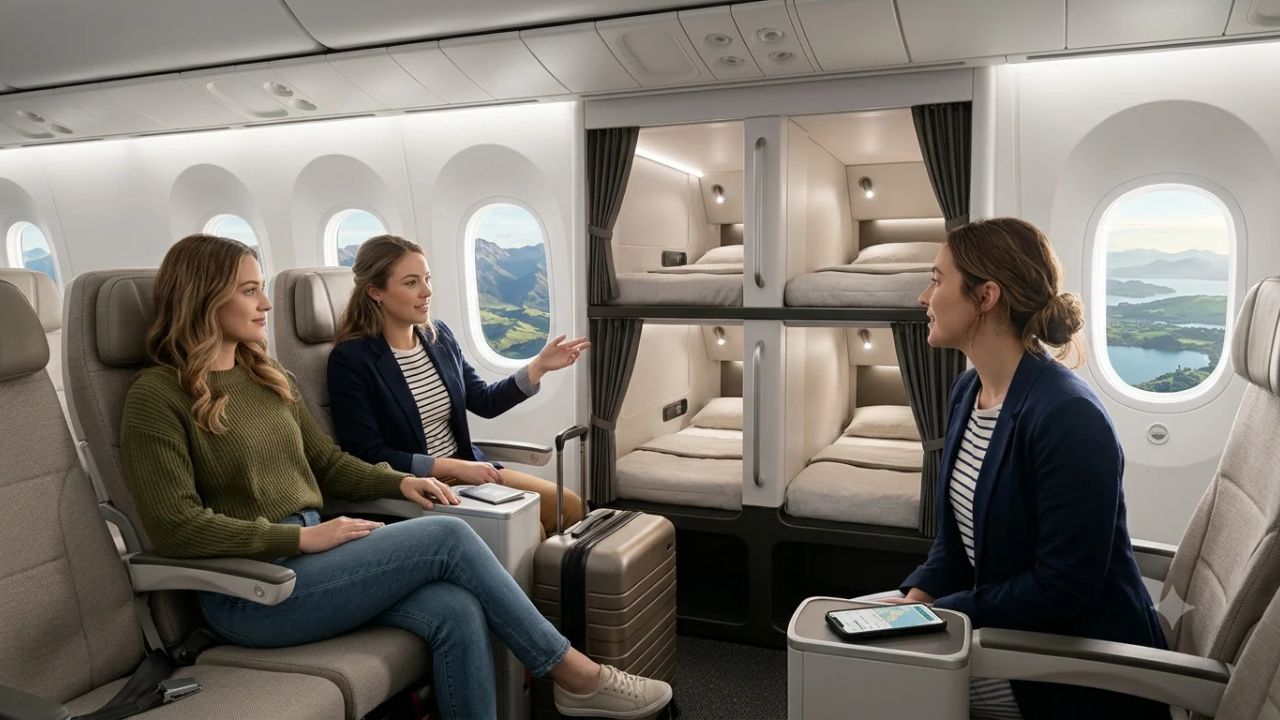
Air New Zealand has adjusted the operational debut of its world-first Skynest lie-flat sleep pods on the flagship Auckland–New York route, rescheduling commercial availability to May 2027
[AUCKLAND, Oct 30, 2026] — Air New Zealand has rescheduled the commercial debut of its world-first Skynest sleeping pods on its flagship Auckland to New York route, pushing back the operational launch from December 2026 to May 2027 and shifting arrival planning for thousands of international holidaymakers heading to the Southern Hemisphere for the upcoming summer travel season.
[!NOTE] Key Operational Update: Official booking channels for Air New Zealand updated schedules in late October 2026 to advertise the Skynest product on the ultra-long-haul Auckland (AKL) to New York (JFK) route for flights departing from May 2027 onward, moving past the carrier's previously announced December 2026 timeline. Designed as a standalone six-pod communal sleep bunk installed on retrofit Boeing 787-9 Dreamliners, Skynest offers eligible Economy and Premium Economy travelers a pre-booked four-hour lie-flat sleep session while retaining their primary aircraft seat. The postponement comes as New Zealand’s tourism sector approaches pre-pandemic parity—with Tourism and Hospitality Minister Louise Upston reporting August overseas arrivals at 99% of 2019 baselines (+32% year-on-year from China and +4.9% from Australia)—reinforcing the need for travelers to base arrival strategies on confirmed ground services rather than anticipated in-flight comforts.
AIR NEW ZEALAND SKYNEST DEPLOYMENT TIMELINE & ARCHITECTURE
| [ FLIGHT CORRIDOR: AUCKLAND (AKL) <-> NEW YORK (JFK) ] |
|---|
| - Aircraft: Retrofit Boeing 787-9 Dreamliner Fleet |
| +----------------------------+-----------------------------+ |
| v v |
| [ SCHEDULE REVISION ] [ SKYNEST POD SPECIFICATIONS ] |
| - Previous Target: December 2026 - Capacity: 6 Bunk Pods (V-Shape) |
| - Updated Availability: May 2027 - Duration: Fixed 4-hour session |
| - Impact: Misses peak NZ summer (Dec–Feb) - Eligibility: Economy & Premium Econ |
| +----------------------------+------------------------+ - Minimum Age: 15 Years Old |
| v |
| [ GROUND REALITIES & VISITOR STRATEGY ] |
| - In-flight rest is partial; 4 hours does not replace arrival day accommodation |
| - Early hotel check-in must be guaranteed in writing or booked for the prior calendar night |
| - Waka Kotahi NZ Transport Agency rest mandate: Do not drive immediately after landing |
| - Tourism Baseline: August arrivals reached 99% of 2019 levels (Upston announcement) |
The Skynest Vision: Reimagining Economy Class Comfort
For decades, the commercial airline industry maintained a rigid separation between seating tiers. Passengers paying for Business Class or First Class enjoyed lie-flat beds, chef-designed multi-course dining, and dedicated flight attendant service. Meanwhile, passengers in the economy cabin were confined to upright seats with standard pitch ranging between 30 and 32 inches, enduring long flights across transoceanic distances with limited opportunities for genuine restorative sleep.
Air New Zealand challenged this status quo when it unveiled the Skynest concept: a modular sleep structure containing six full-length lie-flat sleeping bunks designed specifically for Economy and Premium Economy travelers. Engineered over five years of research and passenger testing at the airline's Innovation Lab in Auckland, Skynest was conceived as an equalizer on ultra-long-haul flights.
SKYNEST PHYSICAL ARCHITECTURE & POD GEOMETRY
| Column 1 |
|---|
| [ TWO-TIER V-SHAPED BUNK STRUCTURE: 6 INDIVIDUAL PODS ] |
| +------------------------------------+------------------------------------+ |
| +------------------------------------+------------------------------------+ |
| +------------------------------------+------------------------------------+ |
| +------------------------------------+------------------------------------+ |
| [ OPERATIONAL HYGIENE & CHANGEOVER CYCLE ] |
| - 4-Hour Sleeping Window: Controlled lighting transitions (gentle dawn wake-up light) |
| - 30-Minute Crew Servicing Window: Complete linen change, sanitization, and safety inspection |
| - Maximum Daily Yield: Up to 18 passengers per ultra-long-haul flight segment (3 sessions) |
The physical architecture of Skynest arranges six pods in a two-wide, three-high vertical bunk formation positioned between the Premium Economy and standard Economy cabins on retrofitted Boeing 787-9 Dreamliners. Each private pod measures over 200 centimeters (6.5 feet) in length and approximately 58 centimeters (23 inches) in width at the shoulder.
Inside the pod, travelers receive hotel-grade bedding:
- A full-size pillow and mattress topper.
- A fresh duvet, clean sheets, and earplugs.
- Individual reading lights and personal air conditioning vents.
- USB charging ports for personal electronic devices.
- A full-length privacy curtain that shields the occupant from aisle light and foot traffic.
Crucially, passengers do not occupy the pod for the entire flight. Travelers purchase access to a single, non-renewable four-hour block during the cruise portion of the journey. Once the four-hour session concludes, gentle lighting transitions awake the occupant. Cabin crew members then conduct a 30-minute turnover cycle, stripping the bed, sanitizing surfaces, and installing fresh, sealed linen packs for the next scheduled passenger. Throughout the entire process, travelers retain their standard economy seats for taxi, takeoff, meal services, and landing.
Route Dynamics: The Auckland–New York (JFK) Proving Ground
Air New Zealand selected its premier ultra-long-haul corridor—non-stop service between Auckland Airport (AKL) and New York John F. Kennedy International Airport (JFK)—as the debut stage for Skynest.
Spanning approximately 14,200 kilometers (8,828 statute miles), the Auckland–New York service (designated flight numbers NZ1 and NZ2) ranks among the top five longest commercial airline routes on Earth. Operating against prevailing Pacific jet streams, the northbound flight from Auckland to New York requires approximately 16 hours of flying time, while the southbound return journey frequently stretches beyond 17 hours and 30 minutes.
ULTRA-LONG-HAUL ROUTE PROFILE: AUCKLAND <-> NEW YORK
| Route Metric Northbound (AKL -> JFK) Southbound (JFK -> AKL) |
|---|
| -------------------------------------------------------------------------------------------- |
| Flight Number NZ2 NZ1 |
| Great Circle Distance 14,200 Kilometers (8,828 Miles) 14,200 Kilometers (8,828 Miles) |
| Average Scheduled Duration 16 Hours 05 Minutes 17 Hours 35 Minutes |
| Operating Aircraft Boeing 787-9 Dreamliner Boeing 787-9 Dreamliner |
| Time Zones Crossed 16 to 18 Hours (Crosses Date Line) 16 to 18 Hours (Date Line) |
| Primary Cabin Challenge Severe circadian disruption Extensive overnight exhaustion |
Operating flights of this distance pushes aircraft performance and human physiology to their limits. For economy passengers sitting upright, maintaining physical comfort over seventeen consecutive hours in dry, pressurized cabin air presents significant challenges. Blood pooling in the lower extremities, back stiffness, deep-vein thrombosis (DVT) risks, and cognitive disorientation from crossing up to eighteen time zones make arrival day recovery demanding.
Skynest was designed precisely to mitigate this fatigue on the JFK route. By providing four hours of true horizontal sleep, the airline aimed to give budget-conscious travelers an affordable way to rest during the longest flight on its global network.
However, retrofitting sleep pods into existing aircraft cabins involves complex engineering. Air New Zealand's Boeing 787-9 Dreamliner fleet is undergoing a comprehensive nose-to-tail interior redesign, introducing all-new Business Premier Luxe suites, updated Premium Economy recliners, and the central Skynest structure. Installing six bunk beds requires removing several rows of standard economy seats, rewiring cabin electrical harnesses, altering overhead oxygen mask delivery systems, and certifying structural bulkhead attachments against rigorous emergency deceleration standards (16G impact testing) mandated by the U.S. Federal Aviation Administration (FAA) and the Civil Aviation Authority of New Zealand (CAA NZ).
Global supply chain constraints affecting aerospace manufacturing—specifically the production of lightweight composite bunk frames, fire-retardant mattress assemblies, and specialized curtain fabrics meeting stringent flammability criteria—extended the installation schedule at retrofitting facilities. In addition, regulators required exhaustive evacuation simulation trials to prove that passengers occupying the upper and middle bunks could rapidly egress into main cabin aisles during sudden in-flight turbulence or emergency ditching procedures. These technical and certification hurdles ultimately led the airline to revise its deployment timetable, moving the first revenue flights with Skynest from December 2026 to May 2027.
The Planning Reality: Four Hours Onboard Cannot Determine an Entire Arrival Day
While the prospect of sleeping in a lie-flat pod at 36,000 feet captured worldwide headlines, travelers must view the product realistically. A four-hour sleep session represents an incremental comfort upgrade rather than a comprehensive arrival day solution.
FLIGHT DURATION VS. SLEEP WINDOW REALITY (17.5-HOUR FLIGHT)
| Column 1 |
|---|
| [ 0h00 - 1h30 ] Boarding, Taxi, Takeoff Climb, Initial Drink & Snack Service |
| [ 1h30 - 3h30 ] Primary Meal Service across Economy & Premium Economy Cabins |
| [ 3h30 - 7h30 ] SKYNEST SESSION 1 (First Group of 6 Passengers) |
| [ 7h30 - 8h00 ] Cabin Crew Linen Stripping, Sanitization & Bed Reset Cycle |
| [ 8h00 - 12h00] SKYNEST SESSION 2 (Second Group of 6 Passengers) |
| [ 12h00 - 12h30] Cabin Crew Linen Stripping, Sanitization & Bed Reset Cycle |
| [ 12h30 - 16h30] SKYNEST SESSION 3 (Third Group of 6 Passengers) |
| [ 16h30 - 17h35] Pre-Arrival Breakfast Service, Descent, Approach, Touchdown & Gate Taxi |
| * Critical Reality: Passengers remain in standard upright seats for 13+ hours of the journey! |
Human sleep architecture typically cycles through light sleep, deep slow-wave sleep, and rapid eye movement (REM) sleep in 90- to 110-minute intervals. While a four-hour rest window allows an adult to complete approximately two full sleep cycles, it is frequently interrupted by cabin announcements, turbulence-induced seatbelt requirements, and unfamiliar environmental noise.
In addition, on a 17.5-hour flight, a passenger who completes a four-hour Skynest session still spends over thirteen hours sitting upright in their standard seat. The time of the booked session also dictates its physiological value:
- A session allocated between flight hours 4 and 8 may correspond to midday at the passenger's home origin, making rapid sleep onset difficult.
- Conversely, a session scheduled between flight hours 12 and 16 may awake the passenger just prior to descent, leaving them groggy upon deplaning.
Travelers must recognize that an in-flight sleep pod does not eliminate post-flight fatigue. Arrival day functioning remains governed by the physical stresses of air travel: border control queues, baggage reclaim waits, customs declarations, airport transfers, and adjusting to local daylight. Relying on an in-flight comfort upgrade to power through a busy arrival schedule without planned rest remains an unreliable travel strategy.
Arrival Day Strategy: Securing Accommodation and Managing Opening Hours
With Skynest unavailable for the 2026–2027 Southern Hemisphere summer high season, international visitors arriving in New Zealand must structure their arrival day around confirmed ground accommodations rather than anticipated in-flight sleep.
ARRIVAL DAY DECISION FRAMEWORK & CHECKLIST
| Column 1 |
|---|
| [ ACCOMMODATION ACCESS STRATEGY ] |
| - Standard Hotel Check-In: Typically 14:00 to 15:00 local time |
| - Morning Flight Inbound: NZ1 from New York arrives at Auckland around 06:00 to 07:30 local time |
| - The 8-Hour Gap: 07:30 arrival creates an eight-hour gap before room access is permitted |
| - Solution A: Book and pay for the previous calendar night to guarantee immediate room access |
| - Solution B: Reserve a certified day-use room or arrange early check-in in writing with hotel |
| v |
| [ AIRPORT TRANSFERS & GROUND LOGISTICS ] |
| - Pre-book private transfers, airport express buses (SkyDrive), or taxis to central lodging |
| - Avoid picking up rental vehicles immediately if arriving exhausted after long transits |
| - Store heavy baggage with hotel concierge if room is unavailable before mid-afternoon |
| v |
| [ DAY ONE ACTIVITY SCHEDULING ] |
| - Plan low-stress, flexible outdoor activities (gentle harbor strolls, outdoor café dining) |
| - Avoid non-refundable tours, strenuous hikes, or boat charters on the arrival morning |
| - Maximize exposure to natural outdoor sunlight to accelerate circadian clock re-synchronization |
Navigating the Morning Arrival Gap
Flights arriving in New Zealand from North America—including Air New Zealand’s non-stop service from New York JFK, Los Angeles, and San Francisco—typically touch down at Auckland Airport between 05:30 and 08:00 local time. After clearing border control, biosecurity screening, and baggage reclaim, passengers generally arrive at central Auckland hotels by 08:30 or 09:30.
Standard international hotel check-in times across Auckland, Rotorua, and Christchurch rarely occur before 14:00 or 15:00. This timing discrepancy creates an awkward six- to eight-hour gap during which fatigued travelers find themselves stranded in hotel lobbies with luggage, unable to shower, change clothes, or rest.
To manage this gap effectively, travelers have several practical options:
- Pre-Register for the Prior Night: For guaranteed immediate room access upon morning arrival, travelers should book the hotel room starting the night before their scheduled landing date. Informing the hotel of your early morning arrival ensures the front desk will hold the room, allowing you to walk directly to bed at 09:00.
- Request Paid Early Check-In: Many premium Auckland properties—such as the Park Hyatt Auckland, The Grand by SkyCity, or the Cordis—offer confirmed early check-in options for an additional fee, subject to advance reservation.
- Use Day-Use Airport Hotels: Properties located directly adjacent to Auckland Airport's international terminal (including the Novotel and Pullman Auckland Airport) provide short-stay day-use rooms bookable in four- to eight-hour increments, providing a quiet space to rest before picking up rental cars or catching domestic connecting flights.
Travelers opting to store luggage and explore central Auckland before check-in should plan low-exertion, daylight-rich itineraries. Auckland Airport operates the SkyDrive express bus service, running every fifteen minutes between the international terminal and SkyCity in central Auckland. Once luggage is stored with hotel concierges, travelers can take a gentle 15-minute ferry crossing across Waitematā Harbour to historic Devonport for casual café dining, or take a flat walk around the Wynyard Quarter and Viaduct Harbour promenades. Exposure to natural morning sunlight accelerates the suppression of melatonin, helping reset the brain’s circadian clock faster than resting in dim hotel lobbies.
Road Safety First: Waka Kotahi NZ Transport Agency Guidance
For self-drive holidaymakers, arriving well-rested is an essential road safety requirement. Driving in New Zealand presents unique challenges that can overwhelm fatigued international visitors.
VISITING DRIVER SAFETY: ROAD CONDITIONS & REST MANDATE
| Column 1 |
|---|
| [ NEW ZEALAND DRIVING REALITIES ] |
| - Left-Hand Traffic: Vehicles travel on the left-hand side of the road |
| - Topography: Narrow, winding two-lane rural highways with limited overtaking lanes |
| - Single-Lane Bridges: Frequent one-way bridges requiring strict right-of-way compliance |
| - Variable Weather: Mountain corridors subject to rapid rain, fog, and crosswinds |
| v |
| [ WAKA KOTAHI REST RECOMMENDATIONS ] |
| - Official Guidance: Never drive immediately following an ultra-long-haul flight |
| - First-Day Rest: Spend the first night in your arrival city (Auckland, Christchurch, Queenstown) |
| - Rental Collection: Defer vehicle pickup until Day 2 after a full night of natural sleep |
| - Transit Options: Use airport shuttles, rideshares, or scheduled intercity buses on Day 1 |
Waka Kotahi NZ Transport Agency publishes explicit guidance for overseas visitors, advising travelers to avoid driving immediately after completing long-haul flights. Long flights, cabin dehydration, and time-zone shifts impair reaction times, spatial awareness, and cognitive decision-making in ways comparable to alcohol intoxication.
In New Zealand, traffic moves on the left side of the road. Most rural highways consist of single lanes in each direction separated by painted lines rather than physical median barriers. Mountain corridors—such as the Crown Range Road between Queenstown and Wanaka, the Desert Road (State Highway 1) in the central North Island, or the winding coastal sections of the Coromandel Peninsula—are steep and narrow, with sharp switchbacks and single-lane bridges where drivers must yield based on directional arrow signs.
Accident analysis from the New Zealand Ministry of Transport indicates that international visiting drivers are disproportionately involved in head-on collisions and run-off-road crashes during their first forty-eight hours in the country. The primary causal factor is micro-sleep and spatial confusion when turning at rural intersections, where exhausted drivers unintentionally revert to driving on the right side of the road.
For travelers renting campervans or large motorhomes, the hazards are amplified. These high-sided vehicles handle differently from passenger sedans, reacting strongly to crosswinds on open coastal plains and requiring longer braking distances on downhill mountain grades.
Responsible travel planners advise spending the first night in Auckland or your initial arrival hub. Taking an airport bus or taxi to a central hotel, exploring urban waterfront precincts on foot, and sleeping a full night in a stationary bed ensures drivers are alert before collecting a rental vehicle or campervan the following morning. Rental operators at Auckland and Christchurch airports increasingly require international customers to sign visiting driver safety pledges and review left-hand driving simulation tutorials before releasing vehicle keys.
Accessibility and Family Travel: Evaluating Cabin Realities
When evaluating Skynest for future travel, passengers should understand that the product is not suited for every traveler demographic. The physical configuration of double-tiered bunk beds introduces distinct accessibility considerations.
SKYNEST ACCESSIBILITY & ELIGIBILITY PARAMETERS
| Column 1 |
|---|
| [ AGE & PASSENGER RESTRICTIONS ] |
| - Minimum Age: Strictly 15 years old; unaccompanied minors and young children are ineligible |
| - Single Occupancy: Only one person permitted per pod; co-sleeping with infants is prohibited |
| [ PHYSICAL MOBILITY & ACCESS REQUIREMENTS ] |
| - Middle and Upper Bunks: Require climbing an integrated vertical ladder and maneuvering legs |
| - Lower Bunks: Require bending, kneeling, and crawling horizontally into the recessed sleeping |
| compartment; interior height does not permit standing upright |
| - Mobility Limitations: Unsuitable for travelers with severe knee, hip, or back restrictions |
| [ ALTERNATIVE LONG-HAUL COMFORT OPTIONS ] |
| - Economy Skycouch: Air New Zealand’s flexible triple-seat row converting into a flat couch |
| - Suitable for: Couples, parents with small children, and travelers desiring unhurried rest |
Age Restrictions and Family Dynamics
Air New Zealand established a strict minimum age requirement of 15 years for Skynest bookings. The pods are single-occupancy compartments; parents cannot share a pod with toddlers or young children. Families traveling with younger children during the summer school holidays cannot use Skynest to manage their children's rest.
For families, Air New Zealand’s established Economy Skycouch remains the practical alternative. The Skycouch utilizes a dedicated row of three economy seats equipped with footrests that swing up 90 degrees to form a continuous, flat surface spanning 1.55 meters (5.1 feet). Parents can relax alongside young children, creating an adaptable shared rest space for the duration of the flight.
Physical Agility Requirements
Entering and exiting a Skynest pod requires reasonable physical flexibility:
- Reaching the top and middle bunks involves climbing an aircraft-style vertical ladder and crawling head-first onto the mattress.
- Accessing the lower bunks requires bending and sliding horizontally into a semi-enclosed alcove.
The internal vertical clearance of each pod is designed for reclining rather than sitting upright. Passengers who experience claustrophobia, individuals managing chronic joint pain, and travelers with mobility impairments will find standard Premium Economy recliners or the Economy Skycouch more practical and comfortable options.
New Zealand Tourism Recovery: The Macroeconomic Landscape
The rescheduling of the Skynest rollout to May 2027 comes at a time when New Zealand’s tourism sector is experiencing a solid post-crisis recovery.
NEW ZEALAND TOURISM RECOVERY BENCHMARKS (OCTOBER 2026)
| Column 1 |
|---|
| [ OVERALL VISITOR VOLUME RECOVERY ] |
| - August 2026 Overseas Arrivals: Reached 99% of August 2019 baseline (Louise Upston release) |
| - National Strategic Goal: Fully restore international arrivals to pre-pandemic parity in 2026 |
| +----------------------------+-----------------------------+ |
| v v |
| [ KEY INBOUND GROWTH MARKETS (YOY) ] [ HIGH-VALUE EXPENDITURE DATA ] |
| - China Inbound: +32.0% Year-on-Year - Annual Chinese Spend: NZ$1.5B (+26%) |
| - Australia Inbound: +4.9% Year-on-Year - Average Length of Stay: 12-16 days |
| - Consistent Growth: United States, Japan, Malaysia - Preference: Independent road trips |
| +----------------------------+-----------------------------+ |
| v |
| [ THE VISITOR EXPERIENCE PRIORITY ] |
| - High arrival volumes increase demand on regional hotel capacity and rental vehicle fleets |
| - Quality of complete journey—from aircraft cabin to regional lodges—drives visitor satisfaction |
On October 14, 2026, New Zealand Tourism and Hospitality Minister Louise Upston announced that monthly overseas visitor arrivals in August 2026 reached 99% of the levels recorded in August 2019, positioning the nation to complete its full tourism recovery during the 2026 calendar year.
The government’s data highlighted strong performance across key international source markets:
- Arrivals from mainland China expanded by 32% year-on-year, driven by restored direct flight capacity and an innovative electronic travel authority (NZeTA) pilot for eligible travelers connecting via Australia.
- Australia, New Zealand’s largest inbound market, grew 4.9% year-on-year, providing consistent visitor traffic across both islands.
- Steady growth was also recorded from the United States, Japan, Malaysia, and Indonesia, with North American holidaymakers showing strong interest in South Island alpine tours and cultural excursions.
As arrival numbers approach pre-crisis highs, international travel patterns are evolving. Independent travelers are staying longer, spending more on regional food, wine, and guided outdoor experiences, and exploring beyond major gateways like Auckland and Queenstown into regional areas such as Northland, the Coromandel, Hawke's Bay, and the West Coast.
This strong inbound demand creates operational bottlenecks during the southern summer high season (December through February). Trans-Pacific flights from Los Angeles, San Francisco, Vancouver, and Houston operate at load factors exceeding 90%, while rental campervan fleets and hotel accommodations in Queenstown, Wanaka, and Lake Tekapo experience tight inventory. When long-haul travelers arrive without pre-arranged lodging or flexible vehicle pickup arrangements, finding same-day hotel rooms or adjusting itineraries becomes exceptionally challenging. In this high-demand environment, the overall quality of the visitor journey—from in-flight comfort to airport transfers and regional lodging—remains central to sustaining New Zealand's reputation as a world-class travel destination.
Comparative Long-Haul Comfort Solutions
To evaluate how Air New Zealand's Skynest compares with alternative airline products, the table below outlines long-haul economy comfort offerings across international carriers.
| Airline | Product Name | Cabin Tier | Core Configuration & Sleeping Mechanism | Dedicated Seat Retained? | Booking Model & Availability |
|---|---|---|---|---|---|
| Air New Zealand | Skynest | Economy & Premium Economy | Six modular bunk beds (lie-flat) in 3-high, 2-wide pod module | Yes (Passenger keeps main seat) | 4-hour pre-booked session (Auckland–JFK from May 2027) |
| Air New Zealand | Economy Skycouch | Economy | Triple-seat row with footrests raising 90 degrees to form a flat couch | Yes (This IS your main seat) | Reserved for entire flight duration across widebody fleet |
| Lufthansa | Sleeper's Row | Economy | Entire row of 3 to 4 economy seats with mattress topper and blanket | Yes (Covers entire row) | Bookable at check-in or gate, subject to seat availability |
| Vietnam Airlines | Sky Sofa | Economy | Two or three adjacent economy seats packaged with bedding accessories | Yes (Purchased at booking) | Available on select long-haul routes to Europe and the US |
| Qantas | Project Sunrise Cabins | Economy (A350-1000) | Ergonomic seating with 33-inch pitch and dedicated onboard Wellbeing Zone | Yes (Standard seating) | Entering commercial service on non-stop London/NY flights in 2026/27 |
Practical Summary: Protecting Your First 24 Hours in New Zealand
For travelers planning a New Zealand holiday, the postponement of Skynest to May 2027 serves as a reminder to focus on foundational travel planning principles. Protecting the opening twenty-four hours of your journey ensures a smooth transition into your vacation:
- Base Plans on Confirmed Services: Verify the specific cabin layout and seat inclusions attached to your ticket. Never plan a travel itinerary assuming that unconfirmed comfort products will be available.
- Secure Morning Hotel Access: If arriving on a morning flight from North America or Asia, reserve your hotel starting the night before, or confirm an early check-in package in writing to guarantee access to a quiet room and hot shower.
- Respect Road Safety Guidelines: Heed Waka Kotahi NZ Transport Agency advice by avoiding long driving stints on your arrival day. Spend your first night relaxing in your arrival city, and schedule vehicle collection for your second morning.
- Build Flexibility Into Your Schedule: Avoid non-refundable excursions, connecting regional flights with tight layovers, or strenuous hikes on your arrival day. Gentle outdoor walks in natural sunlight will help reset your body clock naturally.
By combining realistic expectations regarding in-flight rest with thoughtful ground arrangements, international visitors can arrive ready to enjoy the landscapes, outdoor adventures, and warm hospitality that define New Zealand.
Frequently Asked Questions (PAA)
When will Air New Zealand launch Skynest sleep pods?
Air New Zealand’s official booking channels advertise the Skynest product on the Auckland to New York (JFK) route for flights departing from May 2027 onward. The carrier previously targeted a December 2026 debut, but updated schedules indicate the service will become operational in late autumn 2027.
How does Air New Zealand Skynest work?
Skynest is a modular bunk-bed compartment containing six individual sleep pods installed on retrofitted Boeing 787-9 Dreamliners. Eligible Economy and Premium Economy passengers can book a single four-hour sleep session during the cruise phase of the flight. The pod features a full-length lie-flat bed, clean linens, a pillow, a privacy curtain, USB power, and reading lights.
Does Skynest replace a passenger's regular aircraft seat?
No. Skynest does not replace your assigned seat. Passengers retain their standard Economy or Premium Economy seat throughout the entire journey for taxi, takeoff, meal services, and landing, using the Skynest pod only during their scheduled four-hour sleep window.
Who is eligible to book a Skynest sleep pod?
Passengers traveling in Economy and Premium Economy on equipped flights can book a Skynest pod, subject to availability. Travelers must be at least 15 years old to occupy a pod. The bunks are strictly single-occupancy; parents cannot share a pod with infants or young children.
Why is driving immediately after an ultra-long-haul flight to New Zealand discouraged?
Waka Kotahi NZ Transport Agency strongly advises international visitors to rest before driving on New Zealand roads. Long-haul travel fatigue, dehydration, and circadian disorientation impair reaction times and decision-making. Because New Zealand traffic travels on the left-hand side along narrow, winding rural roads, driving while sleep-deprived significantly increases accident risks.
Related Travel Guides
This article is for informational purposes. Flight routes, passenger regulations, visa rules, and transit advisories are subject to change by airlines and aviation authorities. Readers are advised to verify schedules and travel documentation with relevant carriers and border agencies before departure.
Related Stories
Ultra-Comfortable Budget Flights: How Singapore, Japan, Malaysia, and Spain Are Redefining Long-Haul Low-Cost Air Travel
Brazil Nears 100 Million Air Passengers in 2026 Amid Divergent Global Aviation Growth