
Adak Leads America's Most Isolated Cities as Alaska Reveals an Untamed Frontier Beyond the Road Grid
Adak and Atka top the national index of America's most isolated incorporated cities, sitting over 1,100 miles from Anchorage in a state where 82% of communities lack road links.

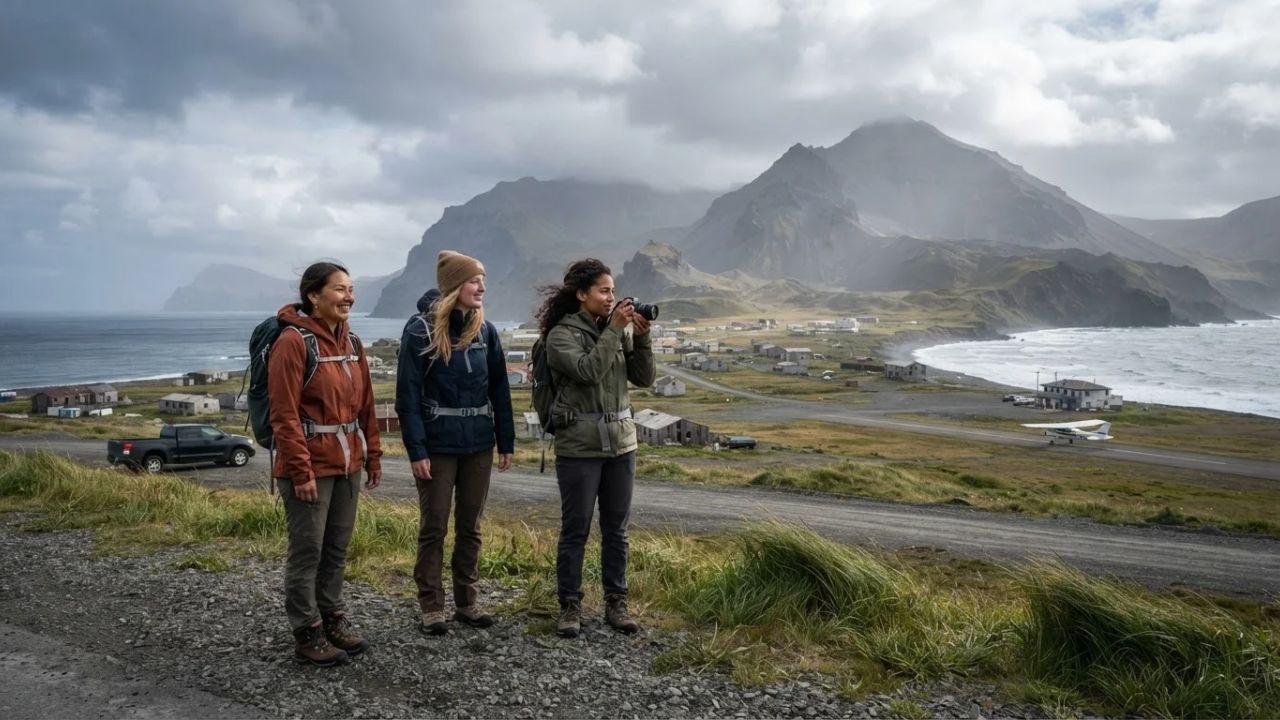
Image generated by AI
In the windswept western arc of the Aleutian Islands, you can drive along paved municipal streets in the city of Adak, yet not a single mile of road connects you to the rest of the American continent—placing you 1,208.1 great-circle miles from Anchorage. While ordinary road maps depict the United States as an interconnected web of interstate freeways, the reality beyond the continental highway grid is astonishing: all 25 of America’s most geographically isolated incorporated places are located entirely within Alaska. According to data compiled from the US Census Bureau Vintage 2025 series, federal transport databases, and the Alaska Department of Transportation and Public Facilities, 82 per cent of Alaska's communities have zero connection to a continuous road system. Leading this national index is Adak with an unmatched Combined Isolation Score of 96.7, followed immediately by its neighboring island settlement of Atka at 96.2, establishing an extreme tier of remoteness that challenges every conventional notion of domestic travel.
The Geography of Isolation: How Alaska Dominates the National Index
The ranking of America's most remote incorporated places reveals a stark geographic reality. No community within the contiguous Lower 48 states registers in the top 25. Instead, the list is commanded by communities scattered across the Aleutian Chain, the volcanic Pribilof Islands, the Bering Sea shelf, the Seward Peninsula, and the Arctic North Slope.
Adak, home to just 171 residents according to the 2020 Census, sits at the apex. Whether you benchmark proximity against a regional hub of 10,000 residents or raise the threshold to 50,000 or 100,000 people, Anchorage remains Adak's nearest qualifying urban center at 1,208.1 miles away. Right beside it sits Atka, home to 53 people, positioned 1,119.7 great-circle miles from Anchorage. Neither community possesses a continuous overland route to another population center.
The national index highlights a secondary tier of profound remoteness. St George (population 67, distance 790.0 miles, score 82.5) and St Paul (population 413, distance 790.1 miles, score 81.9) anchor the seal-rich Pribilof Islands in the Bering Sea. Unalaska, home to 4,254 residents and North America's busiest commercial fishing port at Dutch Harbor, sits 808.7 miles from Anchorage with an isolation score of 81.9, followed by Akutan (population 158, distance 775.5 miles, score 81.4).
Farther north and west, recent demographic updates have shifted the calculations. With Wasilla’s official 1 July 2025 Census estimate climbing to 10,556 residents, it surpassed the 10,000-resident threshold, becoming the official benchmark city for western settlements including Gambell on St. Lawrence Island (718.2 miles, score 76.5), Savoonga (680.0 miles, score 73.4), Mekoryuk on Nunivak Island (568.0 miles, score 65.5), Hooper Bay (546.7 miles, score 62.9), and Scammon Bay (526.9 miles, score 61.8). Along the Arctic coastline, Utqiagvik (population 4,927, score 64.3) sits 501.3 miles from Fairbanks, but when benchmarked against a major metropolitan center of at least 100,000 residents, its true distance rises to 726.3 miles from Anchorage. Other remote incorporated communities completing the top 25 include False Pass (pop 397, 671.3 miles), Diomede on Little Diomede Island (pop 83, 614.5 miles), Cold Bay (pop 50, 638.9 miles), King Cove (pop 757, 632.8 miles), Wales (pop 168, 590.9 miles), Point Hope (pop 830, 572.7 miles), Wainwright (pop 628, 513.7 miles), Sand Point (pop 578, 572.9 miles), Brevig Mission (pop 435, 547.9 miles), Teller (pop 249, 543.9 miles), Shishmaref (pop 576, 535.3 miles), Kivalina (pop 444, 507.5 miles), and Atqasuk (pop 276, 464.2 miles).
What Makes Adak and the Aleutians Different: The Runway Paradox and Ghost Bases
What makes visiting Adak surreal is the profound contrast between its extreme maritime seclusion and its oversized infrastructure. Unlike remote Arctic villages accessed via gravel airstrips, Adak is a former Cold War naval air base that once housed over 6,000 military personnel. Today, commercial passenger jets land on massive concrete runways at Adak Airport, situated just three miles from the main settlement.
Stepping into Adak feels like walking through an eerie, fog-draped outdoor museum. Abandoned residential cul-de-sacs, an empty high school, and hollow military barracks stand against a dramatic volcanic backdrop of snow-capped peaks and treeless maritime tundra. The island sits within the federally protected wilderness of the Alaska Maritime National Wildlife Refuge, where millions of oceanic seabirds, tufted puffins, and sea otters thrive along wave-battered sea stacks.
Across the bay, the history of World War II's Aleutian Campaign—the only military campaign fought on North American soil during the war—is preserved through the Aleutian World War II National Historic Area. In contrast to Atka, where indigenous Unangan traditions dominate and subsistence sealing and salmon drying endure, Adak represents an accidental modern ghost town reclaimed by wind, wild herds of introduced caribou, and dedicated wilderness travelers who treat it as the ultimate edge of the continent.
Visitor Insider Tips: Navigating the Edge of the Aleutians
Traveling to the outer Aleutians requires a logistical mindset closer to an expedition than a typical domestic vacation:
- Build Mandatory Three-Day Weather Buffers: Do not schedule tight connections. Fog, Bering Sea gales, and shifting crosswinds frequently cause flights to "pucker" (abort landings) and return to Anchorage. Always keep at least three flexible buffer days at the end of your trip before any non-refundable onward international flights.
- Respect Native Allotments and Private Land Rights: In Adak and surrounding islands, vast tracts of land are private property owned by regional and village Native corporations like the Aleut Corporation. Obtain recreational land-use permits online before hiking, camping, or hunting caribou across backcountry valleys.
- Pack Your Own Food Supplies and Spares: Adak has a small community general store with limited, expensive staples that arrive via periodic coastal barge. Carry dehydrated meals, high-calorie trail snacks, essential prescription medications, and satellite communication devices like a Garmin inReach.
- Local Culinary Traditions: Sample authentic coastal subsistence staples when invited by local residents: fresh Pacific halibut pulled from cold kelp beds, King Crab legs, and smoked silver salmon. At local gatherings, you may be offered pilot bread topped with seasoned salmon spread or rich caribou stew simmered with wild root vegetables.
- Transport and Lodging Hacks: Book flights well in advance on scheduled jet services from Anchorage, which operate only a few times per week. Lodging in Adak consists of repurposed military duplex housing units managed by local outfitters; reserve your rental vehicle (usually a rugged four-wheel-drive truck) simultaneously, as vehicles are strictly limited.
Cultural and Environmental Context: Unangan Heritage and Climate Vulnerability
The deep isolation of western Alaska and the Aleutian archipelago is inextricably tied to the resilient culture of the Unangan (Aleut) people, who have navigated these tempestuous waters in skin-covered baidarkas (kayaks) for over 9,000 years. Their seafaring knowledge, intricate grass weaving, and deep understanding of marine ecosystems allowed thriving communities to flourish in environments that early European explorers considered uninhabitable.
Today, these communities face unprecedented environmental shifts. The Bering Sea and Arctic Ocean are warming rapidly, leading to the dramatic loss of seasonal sea ice that historically shielded coastal villages from autumn storm surges. In barrier-island communities like Shishmaref and Kivalina, coastal erosion is forcing multi-million-dollar community relocation discussions.
For travelers, venturing into remote Alaska means acknowledging that you are visiting living subsistence communities, not tourist attractions. High-latitude aviation consumes substantial energy, and local waste disposal on small islands is complex. Travelers must practice strict "Pack It In, Pack It Out" waste protocols, support Native-owned cooperatives, and heed local guidance regarding wildlife observation, ensuring that the remarkable cultural heritage of the Bering Sea remains protected.
FAQ: Traveling to America's Most Isolated Communities 2026
How do travelers reach Adak without a road network?
Adak is accessed exclusively by air or sea. Scheduled passenger flights operate from Anchorage to Adak Airport twice weekly on commercial aircraft, covering 1,208 miles over the North Pacific in roughly three hours.
Do visitors need permits to travel across Adak Island?
While entering the townsite requires no permit, exploring backcountry terrain, hiking outside the municipal boundary, or hunting caribou requires a recreational land-use permit issued by the Aleut Corporation.
What wildlife can you encounter in Adak and the outer Aleutians?
Visitors can observe massive herds of wild caribou, sea otters playing in coastal kelp beds, harbor seals, bald eagles, and millions of migratory seabirds, including tufted puffins and emperor geese.
What is the best time of year to visit Adak?
Late summer from July through early September provides the mildest temperatures, averaging 10°C to 15°C, along with lush green tundra, peak wildflower blooms, and the best conditions for hiking and wildlife photography.
Where the paved road ends and the North Pacific swells begin, Adak stands as a solitary sentinel reminding us how wild and vast the American continent remains.
Related Travel Guides
Disclaimer
This article is for informational and educational purposes only. It does not constitute legal, financial, or professional advice. While we strive to provide accurate and up-to-date information, travel policies, regulations, and conditions change rapidly. Always verify information with official sources before making travel decisions. Nomad Lawyer makes no representations about the accuracy, reliability, completeness, or suitability of the information provided. Readers should consult qualified professionals for advice specific to their circumstances. The views expressed in this article are those of the author and do not necessarily reflect the views of Nomad Lawyer.
Raushan Kumar
Founder & Lead Developer
Full-stack developer with 11+ years of experience and a passionate traveller. Raushan built Nomad Lawyer from the ground up with a vision to create the best travel and law experience on the web.
Learn more about our team →