Hastings Line Reopens: Grove Hill Tunnel Repairs Complete Major Kent and East Sussex Rail Upgrades

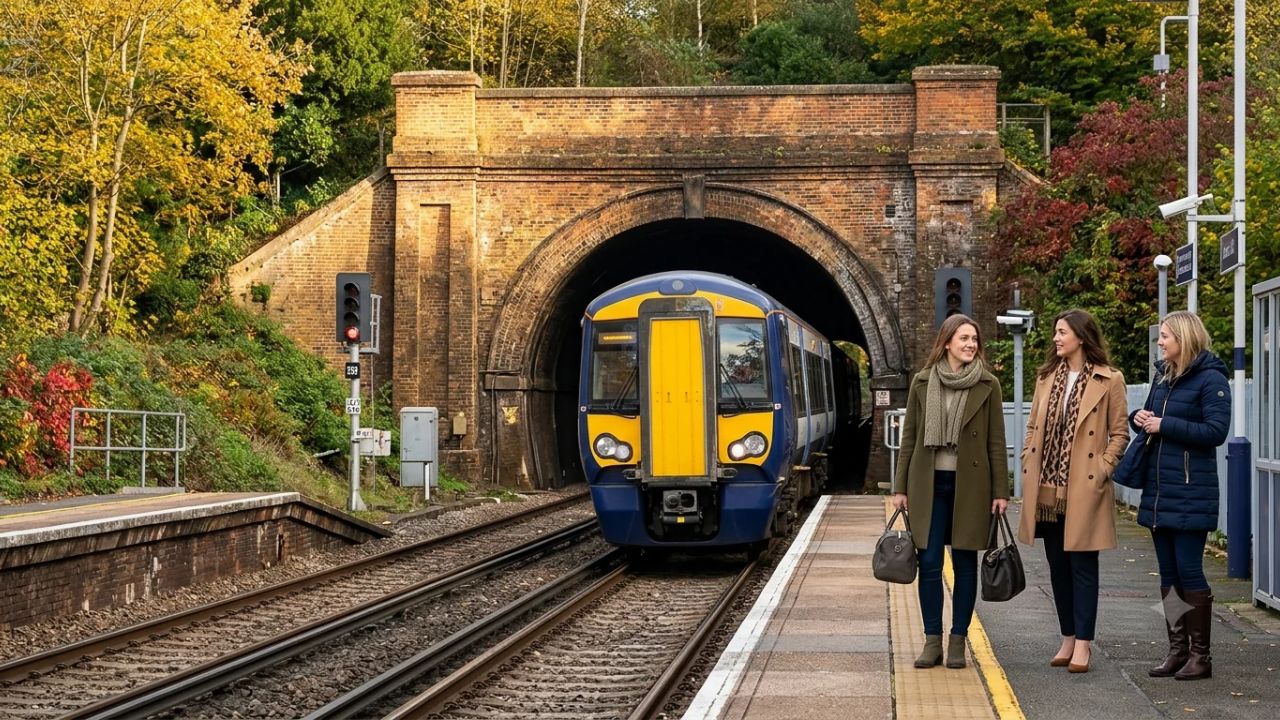
Southeastern passenger train resuming operations along the Hastings Line following the successful completion of a nine-day engineering blockade centered on Grove Hill Tunnel.
TUNBRIDGE WELLS, November 3, 2026 — Rail passenger services along the historic Hastings Line connecting London with the Sussex coast officially resumed regular commercial operations on Monday, November 2, 2026, following the successful completion of an intensive nine-day engineering blockade. Passenger train operator Southeastern and infrastructure manager Network Rail confirmed that scheduled electric passenger services returned to the route between Tonbridge, Tunbridge Wells, Wadhurst, and Hastings following a comprehensive capital renewal program focused on Grove Hill Tunnel. The £multi-million project saw specialized civil engineering teams replace life-expired concrete slab track, remediate climate-induced earthwork damage, and eliminate three disruptive temporary speed restrictions across Kent and East Sussex.
[!NOTE] Key Operational Summary: The nine-day blockade (October 24 to November 1, 2026) severed rail connectivity between Tonbridge and Wadhurst, extending south to Battle on its final day. Engineering teams completely renewed the specialized concrete slab track inside Grove Hill Tunnel south of Tunbridge Wells, securing an anticipated 50-year asset life. Additionally, autumn rainfall allowed engineers to stabilize heat-desiccated clay embankments and eliminate three temporary speed restrictions between Crowhurst and Battle, and Etchingham and Robertsbridge, setting the stage for a new 78-minute Hastings-to-London express service launching on December 14, 2026.
HASTINGS LINE INFRASTRUCTURE RENEWAL & WORK ZONES
| Column 1 |
|---|
| [ LONDON TERMINI ] <== Charing Cross, Cannon Street, London Bridge |
| v (Mainline services operated normally throughout possession) |
| [ TONBRIDGE JUNCTION ] <=== NORTHERN POSSESSION LIMIT (Replacement bus interchange) |
| v (Line completely severed for 9 days: Oct 24 – Nov 1, 2026) |
| [ TUNBRIDGE WELLS ] |
| [ GROVE HILL TUNNEL ] <=== CORE ENGINEERING SITE |
| * Replacement of life-expired concrete slab track (50-year structural design life). |
| * Drainage remediation and precision laser track realignment. |
| [ WADHURST TUNNEL & STATION ] <=== SOUTHERN BLOCKADE LIMIT (Extended to Battle on Nov 1) |
| * Tunnel shaft structural inspections and portal masonry repointing. |
| [ STONEGATE AREA ] |
| * Deep earthworks analysis, cutting stabilization, and trackbed drainage assessments. |
| [ ETCHINGHAM & ROBERTSBRIDGE ] |
| * Etchingham: New uninterruptible power supply (UPS) unit installed; canopy repaired. |
| * Track: Removal of 1 temporary speed restriction (TSR) between Etchingham & Robertsbridge. |
| * Robertsbridge to Mountfield: Track component renewals and Mountfield Tunnel inspections. |
| [ CROWHURST TO BATTLE ] |
| * Removal of 2 temporary speed restrictions (TSRs) following clay embankment rehydration. |
| [ HASTINGS & ORE TERMINI ] <=== Sussex coastal terminus restored to direct London trains |
The Strategy Behind the Nine-Day Blockade: Concentrated Engineering vs. Weekend Closures
The execution of the Hastings Line renewal represents a continued shift in British railway asset management away from disruptive, multi-weekend track possessions in favor of concentrated, round-the-clock blockade engineering. Historically, renewing tunnel track and rehabilitating complex civil structures across constrained double-track routes required railway operators to schedule work across six to ten consecutive weekends. That piecemeal approach imposed severe cumulative disruptions on weekend leisure travelers, complicated rolling stock rosters, and incurred substantial overhead costs from repeatedly assembling and dismantling heavy site machinery.
By scheduling the Hastings Line possession across nine consecutive days—from the early hours of Saturday, October 24, through the late evening of Sunday, November 1, 2026—Network Rail and Southeastern maximized engineering productivity. The timing coincided with the autumn school half-term holiday, an operating window characterized by a predictable drop in daily commuter journeys between East Sussex and the City of London.
This nine-day operational window provided continuous, unrestricted track access for engineering contractors, rail-mounted cranes, concrete delivery fleets, and geotechnical stabilization teams. Specialist crews worked continuously across twelve-hour shift rotations inside Grove Hill Tunnel while satellite maintenance gangs mobilized simultaneously along a thirty-mile corridor stretching south to Battle. The strategic consolidation of work enabled infrastructure managers to deliver heavy track renewals, drainage upgrades, and structural inspections within a single unified blockade, sparing passengers months of recurring weekend rail replacement bus operations.
The economic calculus behind intensive railway blockades has become increasingly persuasive for passenger transport executives. When engineering work is fragmented across sequential weekends, up to thirty percent of each productive working window is consumed by site mobilization and demobilization—setting up safety lighting, securing third-rail power isolation, moving heavy plant into position, and conducting mandatory pre-dawn safety inspections before handing the tracks back to operational service. By establishing a continuous nine-day possession, engineers eliminated eight complete mobilization and demobilization cycles, dramatically lowering project delivery overhead and minimizing the risk of delayed early-morning handbacks that frequently snarl Monday commuter schedules.
Equally significant is the psychological advantage for regional travelers and hospitality businesses. Transport user research demonstrates that prolonged series of intermittent weekend rail disruptions induce widespread travel fatigue, causing passengers to abandon public transport entirely in favor of private automotive travel. In contrast, a well-publicized, finite closure scheduled during a recognized school holiday provides clarity. Commuters can make structured remote-working arrangements or schedule annual leave, while retail and tourism operators in Royal Tunbridge Wells and Hastings can adjust staffing and marketing campaigns around a defined, predictable disruption window.
Grove Hill Tunnel: Engineering the 50-Year Concrete Slab Track Replacement
At the heart of the nine-day engineering program was the total replacement of the permanent way inside Grove Hill Tunnel. Situated immediately south of Tunbridge Wells station, the 287-yard tunnel penetrates a dense sandstone and clay ridge, carrying the twin tracks of the Hastings Line through a constrained Victorian bore engineered by Peter William Barlow and opened in 1846.
Unlike the overwhelming majority of Great Britain's rail network, where rails are secured to timber or pre-stressed concrete sleepers embedded within a loose bed of crushed granite ballast, Grove Hill Tunnel utilizes specialized slab track. In a slab track installation, the rails are mounted directly onto a rigid reinforced concrete foundation slab using heavy-duty resilient baseplates and vulcanized elastomeric pads. Slab track is engineered for confined subterranean environments where standard ballasted track is vulnerable to rapid degradation. In tight tunnels, the repeated pounding of heavy passenger trains pulverizes traditional ballast stone, while persistent groundwater seepage turns ballast dust into a destructive slurry that destroys track geometry.
SLAB TRACK vs. CONVENTIONAL BALLASTED PERMANENT WAY
| Column 1 |
|---|
| [ CONVENTIONAL BALLASTED TRACK ] |
| * Construction: Rails fastened to sleepers resting on 300mm crushed granite stone ballast. |
| * Vulnerabilities: Ballast pulverization under heavy axle loads, track settlement, water slurry. |
| * Maintenance: Requires regular tamping and ballast cleaning every 3 to 5 years. |
| * Tunnel Suitability: Poor in tight Victorian bores due to vertical height clearance constraints. |
| [ REINFORCED CONCRETE SLAB TRACK (Grove Hill Tunnel Installation) ] |
| * Construction: Continuous reinforced concrete slab anchored directly into tunnel floor bed. |
| * Rail Fastening: Direct fastening systems with elastomeric pads for acoustic vibration damping. |
| * Design Durability: Anticipated engineering operational life of approximately 50 years. |
| * Operational Stability: Maintains millimeter-precise track gauge and vertical alignment. |
| * Clearance Advantage: Maximizes vertical clearance for 750V DC third-rail passenger EMUs. |
However, when concrete slab track reaches the end of its structural life, replacing it demands intensive civil engineering. Within Grove Hill Tunnel, the original concrete slab infrastructure, installed several decades ago, had suffered severe material fatigue, concrete spalling, and compromised fastener seatings resulting from persistent moisture infiltration through the tunnel lining.
During the nine-day possession, engineering teams completely broke out and excavated the deteriorated concrete track bed. After clearing tons of debris and preparing the underlying geological formation, contractors poured high-early-strength, fiber-reinforced concrete slabs. Precision laser-guided surveying equipment was deployed to align the baseplates and new steel rails to sub-millimeter tolerances before the concrete achieved full structural cure. Associated track circuits, cabling troughs, and 750V DC conductor rails were completely renewed. The resulting permanent way provides a resilient, smooth-riding foundation with an anticipated operating lifespan of approximately fifty years, drastically reducing the necessity of future tunnel maintenance closures.
Beyond raw structural longevity, the new concrete slab installation delivers meaningful environmental and mechanical advantages. In Victorian masonry tunnels running directly beneath suburban communities, ground-borne vibrations from passing train wheels can transmit through the bedrock into residential basements above. The modern direct-fixation baseplate systems installed within Grove Hill Tunnel incorporate advanced micro-cellular polyurethane elastomeric pads positioned beneath the rail seats. These resilient dampeners attenuate low-frequency acoustic vibrations and dynamic impact forces, substantially reducing subterranean rumbling while protecting both the tunnel's historic brick arch and neighboring surface properties.
The engineering methodology also addressed long-standing hydrological vulnerabilities. Before the final concrete pours were executed, contractors completed ground-penetrating radar surveys to identify hidden voids behind the tunnel sidewalls and flushed historic drainage weep-holes that had accumulated mineral deposits over decades. A geotextile drainage membrane was integrated into the sub-base, channeling groundwater runoff into newly excavated perimeter collection troughs. This comprehensive water diversion design prevents standing water from ponding around electrical cabling troughs, eliminating the corrosive environment that historically accelerated rail fastener deterioration.
Clay Embankment Desiccation and the Removal of Three Speed Restrictions
While the tunnel slab replacement formed the headline engineering objective, the successful elimination of three temporary speed restrictions (TSRs) delivered the most immediate operational benefit for daily timetable punctuality. Southeastern confirmed that two temporary speed restrictions were removed between Crowhurst and Battle, with an additional restriction eliminated along the section linking Etchingham and Robertsbridge.
The origin of these speed restrictions lay in the extreme weather patterns experienced across southeast England during the summer of 2026. The region endured record-breaking temperatures and prolonged drought conditions, which exerted severe environmental stress on the historic earthworks supporting the railway. The railway lines across Kent and East Sussex traverse the Wealden geological basin, an area characterized by over-consolidated, highly shrinkable clay formations.
WEALDEN CLAY EMBANKMENT DESICCATION & RECOVERY
| Column 1 |
|---|
| [ PHASE 1: SUMMER 2026 DROUGHT ] |
| * Exceptional heat and zero rainfall extract deep soil moisture from shrinkable clay. |
| * Clay soil contracts, creating deep volumetric shrinkage fissures inside railway embankments. |
| * Embankment shoulders settle unevenly, causing differential settlement of the trackbed. |
| * Consequence: Track geometry drops out of tolerance ==> Network Rail imposes 20–40 mph TSRs. |
| [ PHASE 2: AUTUMN 2026 REHYDRATION ] |
| * Sustained autumn precipitation gradually re-saturates the desiccated clay matrix. |
| * Soil moisture equilibrium restored, stabilizing the mechanical shear strength of earthworks. |
| [ PHASE 3: BLOCKADE TAMPING & REALIGNMENT ] |
| * Specialist engineering crews deploy high-output dynamic track tampers and stoneblowers. |
| * Ballast packed beneath sleepers, track realigned to high-speed geometry standards. |
| * Outcome: Three TSRs removed permanently between Crowhurst, Battle, Etchingham, & Robertsbridge. |
When shrinkable clay loses moisture during severe heatwaves, it undergoes volumetric contraction, forming deep fissures and causing embankments to subside unevenly. This differential settlement distorts the geometric plane of the railway tracks above, creating dips and twists that exceed high-speed track safety standards. To safeguard passenger trains against the risk of derailment or severe vehicle oscillation, Network Rail safety inspectors were forced to impose emergency speed restrictions—limiting passenger trains to speeds as low as 20 to 40 mph along affected sections.
These speed restrictions inflicted cumulative delays across the Hastings Line, disrupting commuter schedules and degrading fleet turnaround times at London termini. During the October blockade, subsequent autumn rainfall had naturally restored essential moisture content to the Wealden clay matrix, stabilizing the core of the embankments. Taking advantage of the train-free possession, geotechnical teams and heavy track-tamping machines regraded the trackbed, packed stone ballast beneath sleepers, and restored the track to its design line and level. The successful removal of all three restrictions eliminates chronic timetable friction, restoring line-speed running for both northbound and southbound services.
The challenge of earthwork stability across the High Weald reflects a broader national challenge confronting Great Britain's Victorian railway network. Network Rail's Weather Resilience and Climate Change Adaptation Strategy classifies southeast England's historic railway embankments as particularly vulnerable to accelerating climatic volatility. Constructed in the mid-nineteenth century by navvy labor using uncompacted local Wealden clays and silts, these steep railway embankments were never engineered to withstand the modern alternation between intense prolonged summer heatwaves and heavy autumn cloudbursts. When soil moisture deficits reach critical thresholds, shrinkage creates deep tension cracks that can destabilize slope equilibrium within days.
By deploying dynamic track stabilization and automated stoneblowing machines during the train-free blockade, permanent way engineers restored the uniform stiffness of the ballast bed across the affected stretches between Battle and Etchingham. Eliminating the three speed restrictions generates cumulative operational dividends beyond simple timetable minutes. When trains no longer need to brake aggressively from 70 mph down to 20 mph and subsequently accelerate back to line speed, energy consumption across Southeastern's electric fleet declines measurably. Concurrently, reducing severe braking cycles decreases mechanical wear on brake friction pads and wheel profiles, improving rolling stock availability across the entire southeast passenger pool.
Corridor-Wide Modernization: Wadhurst, Stonegate, Etchingham, and Robertsbridge
To extract maximum value from the nine-day possession, Network Rail and Southeastern deployed multiple maintenance gangs to execute proactive structural examinations, electrical modernizations, and vegetation clearance across the broader corridor.
CORRIDOR-WIDE ASSET UPGRADES: TONBRIDGE TO BATTLE
| Column 1 |
|---|
| [ WADHURST TUNNEL ] |
| * Detailed 360-degree structural laser scanning of tunnel lining, portals, and shafts. |
| * Preventative masonry repointing and water diversion channels cleared. |
| [ STONEGATE CUTTINGS & DRAINAGE ] |
| * Deep-level geotechnical sampling and drainage channel clearing along high-risk cuttings. |
| * Embankment slope inclinometers inspected to provide real-time ground movement monitoring. |
| [ ETCHINGHAM SUBSTATION & STATION CANOPY ] |
| * Installation of high-capacity Uninterruptible Power Supply (UPS) unit for signaling systems. |
| * Heritage station canopy timber repairs and rainwater downpipe replacement. |
| [ ROBERTSBRIDGE TO MOUNTFIELD ] |
| * Track component renewal, insulated block joint replacements, and ballast consolidation. |
| * Mountfield Tunnel interior inspections and proactive tree clearance along third-rail corridors. |
At Wadhurst Tunnel, an 822-yard structure built in 1851, engineers completed comprehensive structural inspections covering the brick-lined arch, ventilation shafts, and tunnel portals. These regular detailed examinations allow structural engineers to identify micro-cracking or water seepage before they evolve into structural failures.
In the vicinity of Stonegate station, maintenance teams focused on drainage remediation and earthwork stability. Uncontrolled surface water runoff is the primary catalyst for railway landslips across the steep cuttings of the High Weald Area of Outstanding Natural Beauty. Specialist teams excavated silted trackside ditches, cleared culverts, and inspected slope-monitoring telemetry designed to detect subterranean ground movements.
Further south at Etchingham, engineering specialists upgraded the railway's electrical infrastructure by installing a modern uninterruptible power supply (UPS) unit. This critical electrical asset safeguards signaling power distribution, ensuring that train detection equipment and lineside color-light signals remain fully energized even during unexpected national grid outages. Concurrently, station maintenance workers restored Etchingham's historic timber station canopies, repairing structural woodwork and clearing drainage systems.
Between Robertsbridge and Mountfield, track gangs replaced worn rail components, insulated block joints, and refreshed lineside switches. Mountfield Tunnel underwent specialized geological surveys to assess the structural integrity of its lining, while forestry teams cleared encroaching trackside vegetation to prevent autumn leaf-fall contamination along the 750V DC conductor rails.
Comprehensive Infrastructure Verification Matrix
The completed engineering works along the Hastings Line represent an integrated balance of heavy civil track replacement, geotechnical remediation, and electrical modernization. The following matrix details the verified scope of improvements completed during the nine-day October 2026 possession:
| Railway Corridor Segment | Primary Asset Involved | Engineering Intervention Executed | Verified Technical Outcome | Long-Term Operational Benefit |
|---|---|---|---|---|
| Grove Hill Tunnel (South of Tunbridge Wells) | Subterranean slab track bed & 750V DC conductor rail | Total breakout and excavation of life-expired concrete slab; casting of new fiber-reinforced track slab. | Installation of millimeter-aligned slab track; renewal of electrical conductor equipment. | Anticipated 50-year engineering lifespan; eliminates water slurry contamination and track degradation. |
| Crowhurst to Battle (East Sussex corridor) | Wealden clay railway embankments | Post-drought earthwork stabilization, ballast tamping, and dynamic mechanical track realignment. | Permanent removal of two temporary speed restrictions (TSRs). | Restores line-speed running; recovers lost minutes on coastal commuter services to Hastings. |
| Etchingham to Robertsbridge | Trackbed alignment and formation | Heavy mechanized stoneblowing, ballast packing, and formation geometry remediation. | Permanent removal of one temporary speed restriction (TSR). | Eliminates acceleration and braking delays; improves timetable predictability. |
| Wadhurst Tunnel (North of Wadhurst Station) | Victorian brick-lined tunnel bore & ventilation shafts | Comprehensive 360-degree structural examinations, masonry repointing, and portal stability audits. | Detailed structural condition baseline established; clearance of drainage weep-holes. | Prevents unpredicted brick spalling; enhances safety through preventative maintenance. |
| Stonegate Embankments | Cutting earthworks and lineside drainage channels | Silt removal from trackside ditches, culvert jetting, and geotechnical slope inspection. | Optimized stormwater drainage management across High Weald cuttings. | Mitigates risk of autumn landslips and embankment instability following severe storms. |
| Etchingham Station Precinct | Signalling electrical supply & station structures | Installation of new industrial uninterruptible power supply (UPS); station canopy woodwork repairs. | Hardened electrical redundancy for lineside signalling; restored historic station fabric. | Prevents signal blackouts during commercial grid surges; improves passenger station environment. |
| Robertsbridge to Mountfield | Permanent way switches, crossings, and tunnel lining | Component renewal, insulated block joint replacement, Mountfield Tunnel surveys, and tree clearance. | Modernized track components; cleared vegetation buffer along third-rail electrical boundary. | Minimizes leaf-fall wheel slip and electrical arcing during autumn operating conditions. |
The South Eastern Railway Model: A Blueprint for Great British Railways
The flawless execution of the nine-day Hastings Line blockade serves as an operational validation of the structural reforms currently reshaping railway management across southeast England. On June 18, 2025, the British transport sector witnessed the formal creation of South Eastern Railway—an integrated public-sector partnership that combined passenger train operator Southeastern (operated under the public ownership of DfT OLR Holdings Limited) and Network Rail's Kent Route into a single unified management organization.
Prior to this structural integration, British railway governance was divided by institutional fragmentation. The infrastructure owner (Network Rail) and the passenger train operating company operated under separate balance sheets, separate executive leadership, and conflicting commercial incentives. Engineering closures were frequently subject to protracted legal negotiations, financial compensation disputes under Schedule 4 of the Railways Act, and siloed passenger communications.
THE SOUTH EASTERN RAILWAY INTEGRATED ALLIANCE
| Column 1 |
|---|
| [ PRE-JUNE 2025: FRAGMENTED DUAL-ENTITY STRUCTURE ] |
| * Network Rail Kent Route (Infrastructure owner) <== CONFLICT ==> Southeastern (Train operator) |
| * Protracted negotiations over track possession windows and financial compensation penalties. |
| * Disjointed customer communications during engineering disruptions and emergency repairs. |
| [ POST-JUNE 2025: SOUTH EASTERN RAILWAY UNIFIED ALLIANCE ] |
| * Single Managing Director and joint executive team directing both tracks and trains. |
| * Unified engineering and timetable planning: Closures designed for maximum passenger utility. |
| * Collaborative problem-solving: Opportunistic speed restriction removal added to blockade scope. |
| * Prototype for national railway governance under the forthcoming Great British Railways (GBR). |
Under the unified South Eastern Railway structure, a single Managing Director and joint executive leadership oversee both track maintenance and train service delivery. This organizational alignment paid substantial dividends during the Hastings Line closure. When geotechnical engineers identified that autumn rainfall had stabilized the desiccated embankments between Battle and Etchingham, the integrated alliance rapidly expanded the blockade's work scope to incorporate heavy track tamping—successfully removing all three speed restrictions without extending the planned nine-day duration or requiring separate future weekend closures.
In addition, passenger management during the closure was executed through unified coordination. Southeastern deployed a fleet of high-capacity replacement road coaches linking Tonbridge and Wadhurst (with travel times of approximately 30 minutes to Tunbridge Wells and 55 minutes to Wadhurst), while simultaneously activating ticket acceptance across Southern's Uckfield line and Southeastern's high-speed Javelin services via Ashford International and London St Pancras. This operational agility provides an empirical blueprint for how the British railway network will function once the government's Railways Bill establishes Great British Railways nationwide.
The December 2026 Horizon: The 78-Minute Hastings to London Express Pilot
The completion of the Grove Hill Tunnel renewal and the elimination of corridor speed restrictions lay the operational groundwork for a major timetable enhancement scheduled to take effect on Monday, December 14, 2026. South Eastern Railway has confirmed that its winter timetable restructuring will introduce a high-speed weekday express passenger pilot connecting Hastings directly with central London.
HASTINGS TO LONDON EXPRESS PILOT TIMETABLE (EFFECTIVE DEC 14, 2026)
| Column 1 |
|---|
| [ MORNING PEAK EXPRESS: HASTINGS ==> LONDON CHARING CROSS ] |
| * Departure: Hastings Station at 8:05 AM. |
| * Fast Transit: London Bridge arrival at 9:23 AM (1 HOUR 18 MINUTES / 78 MINUTES!). |
| * Final Terminus: London Charing Cross arrival at 9:33 AM (1 hour 28 minutes total journey). |
| * Operational Achievement: 14 MINUTES FASTER than previous comparable morning peak services. |
| [ EVENING PEAK EXPRESS: LONDON CHARING CROSS ==> HASTINGS ] |
| * Departure: London Charing Cross at 4:11 PM (Calling at London Waterloo East & London Bridge). |
| * Final Terminus: Hastings Station arrival at 5:42 PM (1 hour 31 minutes total journey). |
| [ OFF-PEAK TIMETABLE ENHANCEMENTS ] |
| * Tunbridge Wells to London Charing Cross semi-fast services restored to half-hourly frequencies. |
| * Operates across weekday off-peak periods and throughout Saturdays, boosting regional leisure. |
The flagship element of the December enhancement is a fast morning commuter express departing Hastings Station at 8:05 AM. Reaching London Bridge in just 1 hour and 18 minutes (78 minutes) before terminating at London Charing Cross at 9:33 AM (88 minutes total journey time), the new service trims approximately 14 minutes off the fastest comparable morning peak transit time currently available. In the evening, a matching return express will depart London Charing Cross at 4:11 PM, arriving back in Hastings at 5:42 PM.
The introduction of the express pilot reflects significant regional demand from East Sussex business leaders, commuters, and tourism agencies. For decades, the Hastings Line has suffered from slower average speeds compared to neighboring main lines, due to its winding Victorian alignment through the High Weald, severe curvature, and historically narrow tunnel clearances that once required specialized narrow-bodied rolling stock (the famous Hastings Diesel Multiple Units). By smoothing line-speed running through Grove Hill Tunnel and removing embankment speed restrictions, operators can finally exploit the high acceleration capabilities of modern Class 375 and Class 377 Electrostar electric fleets.
The introduction of faster express transit holds profound economic implications for the 1066 Country coastal corridor. Hastings and the adjacent borough of St Leonards-on-Sea have undergone significant cultural regeneration in recent years, attracting creative professionals, digital entrepreneurs, and independent hospitality ventures seeking coastal lifestyles within commuting range of the capital. However, a traditional peak journey time exceeding ninety minutes has historically functioned as a psychological barrier for prospective residents and commercial investors. Compressing the transit to London Bridge down to 78 minutes enhances the corridor's competitive positioning, strengthening economic ties between the East Sussex coast and the capital's knowledge economy.
In addition to the peak express pilot, the December 14 timetable restores regular half-hourly semi-fast services between Tunbridge Wells and London Charing Cross during off-peak weekday periods and across Saturdays. This frequency boost significantly enhances leisure transit connectivity for regional market towns, supporting visitor access to historic destinations such as Royal Tunbridge Wells, Wadhurst, and Battle Abbey.
Passenger Travel Advisory and Post-Reopening Network Navigation
With commercial train services fully restored along the Hastings Line, passengers, daily commuters, and autumn visitors should observe several practical travel guidelines:
- Verify Regular Timetables: The temporary bus substitution service operating between Tonbridge, Tunbridge Wells, Wadhurst, and Battle has officially ceased. All passengers should consult live digital timetables on National Rail Enquiries or the Southeastern app to check scheduled train departure times and platform allocations.
- Distinguish Correlated Network Works: Travelers connecting through Tonbridge should note that separate emergency earthwork stabilization projects have recently affected the Tonbridge-to-Redhill corridor. These emergency repairs are geographically distinct from the Hastings Line and should not be confused with the successfully reopened Tonbridge–Hastings route.
- Review Alternative Ticket Acceptance Rules: Temporary ticket acceptance arrangements that permitted Hastings passengers to travel via Ashford International onto high-speed Javelin services to London St Pancras have terminated with the resumption of direct Hastings Line rail services. Standard route-specific ticketing conditions now apply.
- Monitor December Express Timetable Adjustments: Commuters planning to utilize the new 78-minute Hastings to London Bridge express service must note that the pilot officially begins on Monday, December 14, 2026. Advance seat reservations and peak season tickets will reflect the revised calling pattern upon schedule publication.
- Utilize Centralized Passenger Assist: Passengers with reduced mobility, luggage, or accessibility requirements can book free assistance across all reopened stations via the National Rail Passenger Assist portal or Southeastern customer services up to two hours prior to travel.
Frequently Asked Questions About the Hastings Railway Reopening
When did train services resume between Tonbridge and Wadhurst?
Full commercial train services officially resumed on Monday, November 2, 2026, following the completion of the nine-day engineering blockade that began on Saturday, October 24.
What was the primary engineering work completed in Grove Hill Tunnel?
Specialist civil engineering teams completely removed and replaced life-expired concrete slab track located immediately south of Tunbridge Wells station. The new fiber-reinforced slab track provides an anticipated design lifespan of approximately 50 years, ensuring millimeter-precise track alignment and eliminating water slurry degradation.
Why were three temporary speed restrictions removed during the closure?
The speed restrictions were originally imposed after the severe summer drought of 2026 caused shrinkable Wealden clay embankments to contract, leading to uneven track settlement. Subsequent autumn rainfall rehydrated and stabilized the soil, enabling engineering teams to utilize heavy tamping machinery to realign the track between Crowhurst and Battle, and Etchingham and Robertsbridge during the blockade.
How does the South Eastern Railway integrated alliance benefit passengers?
Established on June 18, 2025, the integrated alliance unites passenger train operator Southeastern and Network Rail's Kent Route under a single leadership team. This unified management eliminated contractual disputes, streamlined engineering delivery, and enabled teams to add opportunistic track repairs to the planned blockade without causing additional delays.
What are the details of the new Hastings to London express service launching in December 2026?
Beginning December 14, 2026, South Eastern Railway will introduce a weekday express pilot departing Hastings at 8:05 AM, reaching London Bridge in 1 hour 18 minutes (78 minutes) and London Charing Cross at 9:33 AM—saving approximately 14 minutes compared to previous peak schedules. An evening return service departs Charing Cross at 4:11 PM.
Related Travel Guides
- UK Celebrates 25 Years of Harry Potter: Five Magical Rail Journeys Across Famous Filming Sites
- UK Rail Trips Beyond London: Five Harry Potter Film Sites Face Major November Disruptions for 25th Anniversary
- UK Launches Everitt Transport Review: Rail Governance and Passenger Coordination Across Europe
- Century Cruises Expands European River Travel with New Century Star Sailings
This article is for informational purposes. Flight routes, passenger regulations, visa rules, and transit advisories are subject to change by airlines and aviation authorities. Readers are advised to verify schedules and travel documentation with relevant carriers and border agencies before departure.
Related Stories
Japan Announces Major Narita Express Service Changes for November 6–8 as Tokyo Tunnel Repairs Sever Direct Lines

UK Celebrates 25 Years of Harry Potter: Five Magical Rail Journeys Across Famous Filming Sites