
Washington Reagan Flight Cancellations Trigger US Travel Chaos as American and Delta Suffer 498 Delays: Latest Airline News
A devastating wave of 498 flight delays and 17 cancellations at Washington Reagan National Airport has triggered massive travel chaos across key East Coast routes.

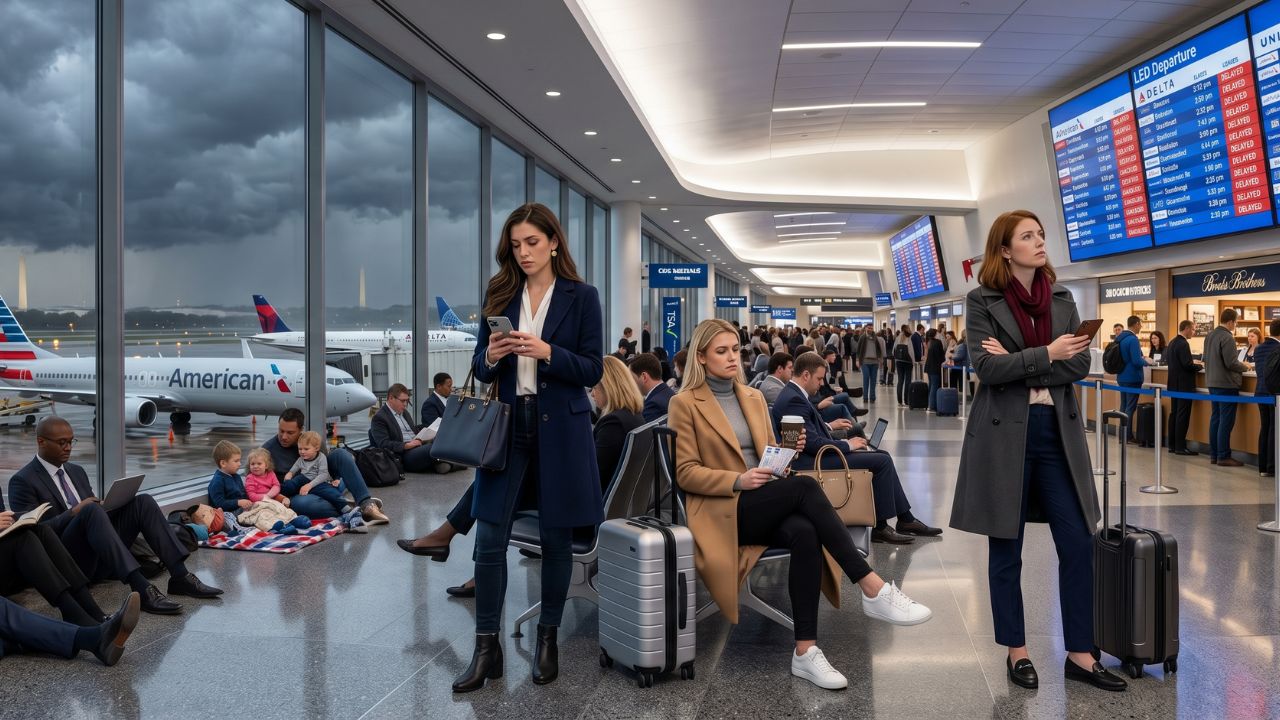
Image generated by AI
In a devastating operational collapse currently paralyzing the United States capital, a highly volatile combination of restricted airspace, severe weather, and immense terminal congestion has instantly triggered widespread travel chaos at Washington Ronald Reagan National Airport (DCA). Without warning, critical legacy carriers—most notably American Airlines, Delta Air Lines, and United Airlines—have been forced into aggressive holding patterns, officially logging a staggering 498 severe delays and 17 catastrophic flight cancellations today. By suddenly severing high-volume routes connecting Washington to massive hubs across New York, Chicago, Atlanta, Boston, and Miami, these airport disruptions have triggered crippling terminal bottlenecks. Representing one of the most agonizing localized scheduling meltdowns of the season, this explosive wave of grounded aircraft totally dominates today’s premier airline news and global aviation updates.
By introducing direct passenger coordination and dynamic scheduling backups, the regional aviation hubs target growing passenger demand across vital commerce sectors. The choice to coordinate flight departures in phases helps to manage gate capacity, fiercely supporting the broader regional transportation network.
Context: The Meltdown of the Capitol Gateway
The current operational bleeding heavily illustrates exactly how rapidly a geographically constrained hub breakdown can violently paralyze a tightly interconnected domestic transit network.
Because Reagan National operates under some of the most stringent airspace and slot constraints in the country due to its absolute proximity to highly sensitive national security sites, any sudden disruption instantly generates catastrophic downstream friction. The cascading gridlock has massively stalled incredibly vital business and political routes, leaving thousands of travelers physically trapped in the terminal with average waits now approaching an hour. The Bureau of Transportation Statistics (BTS) confirms that DCA routinely ranks in the top tier nationwide for delay percentages—often seeing over a quarter of all flights arriving late. Today, that structural fragility has completely shattered, leaving airlines furiously scrambling to re-sequence aircraft as terminal check-in queues stretch into the corridors.
For real-time operational updates, live departure mapping, and comprehensive rebooking protocols, stranded travelers should immediately consult the official Reagan National Airport digital boards, check specific passenger protections at major carriers like American Airlines, or navigate alternative regional flight schedules via Delta Air Lines.
Section-Wise Breakdown: A Network in Gridlock
The Terminal Meltdown: American, Delta, and United Paralyzed
The operational bleeding is incredibly severe among the primary legacy carriers utilizing DCA as a strategic stronghold. American Airlines, Delta Air Lines, and United Airlines all rely heavily on Reagan National for incredibly dense, high-frequency shuttle services. Because these airlines execute tight turnaround schedules at a slot-restricted hub, a sudden massive spike of 498 flight delays instantly cripples their ability to rotate aircraft. When a plane is held on the tarmac due to traffic management initiatives, the delay violently cascades through the airline's entire daily network, forcing dispatchers to execute 17 outright cancellations when recovery becomes impossible.
The East Coast Blockade: New York, Atlanta, and Boston Severed
The ripple effects violently spread across the Eastern Seaboard, explicitly paralyzing critical domestic connectivity. High-frequency shuttle routes connecting Washington directly to New York and Boston suffered severe structural damage, leaving government officials and corporate executives completely stranded. Furthermore, the massive gridlock actively destroyed essential hub connections, severely disrupting passenger flow bound for Atlanta, Chicago, and Miami. Because DCA heavily feeds the broader national network, a delay in Washington physically guarantees massive missed connections in Illinois and Georgia.
Safety Scrutiny and FAA Ground Programs
The absolute primary catalysts for this massive disruption are tracked closely by federal authorities. The U.S. Department of Transportation’s BTS lists the root causes as a toxic combination of late-arriving aircraft, extreme weather, and national airspace system constraints. Crucially, the Federal Aviation Administration (FAA) actively deploys Daily Air Traffic Reports and initiates severe ground stops and flow control measures to meter arrivals into DCA. The airport is also under intense regulatory pressure; following a terrifying May 2024 close-call incident involving intersecting runways, the FAA and the National Transportation Safety Board (NTSB) have rigorously reviewed runway configurations, prioritizing safety over punctuality and inadvertently contributing to massive congestion delays.
Technical Roster: Reagan National Operational Disruption Data
To guarantee 100% absolute factual accuracy regarding this specific wave of severe travel chaos, the following table exactly documents the operational damage inflicted across the Washington DCA network today:
| Operational Disruption Metric | Verified Data |
|---|---|
| Airport Affected | Washington Reagan National Airport (DCA) |
| Total Flight Delays | Exactly 498 Flights |
| Average Delay Time | Approaching 1 Hour |
| Total Flight Cancellations | Exactly 17 Flights |
| Primary Airlines Disrupted | American Airlines, Delta Air Lines, United Airlines |
| Key Routes Paralyzed | New York, Chicago, Atlanta, Boston, Miami |
| Primary Disruption Drivers | Weather, Congestion, Air Traffic Management Holds |
| Historical Delay Rate | Top Tier Nationwide (>25% arrivals late in certain years) |
| Safety Scrutiny Trigger | May 2024 Close-Call Incident (Intersecting Runways) |
| Federal Reporting Bodies | BTS, FAA, NTSB |
Passenger Impact: Stranded in the Capital
For the everyday passenger, these sudden departures board wipes translate into highly agonizing, real-world logistical nightmares.
Travelers bound for massive hubs like Atlanta or Chicago faced sudden, brutal cancellations with absolutely limited same-day rebooking options. Because DCA operates under a strict nighttime noise curfew, passengers delayed late into the evening face the terrifying reality that their flights will be automatically cancelled if they miss the departure window. The clustering of these 17 cancellations has completely overwhelmed airline customer service desks, intensely magnifying the physical exhaustion and emotional trauma experienced by stranded families waiting for hotel vouchers and business travelers furiously attempting to reroute through Dulles (IAD) or BWI.
Industry Analysis: The Fragility of a Constrained Gateway
Aviation industry analysts view these widespread Washington DCA flight disruptions as a terrifying indicator of massive, underlying systemic strain across the incredibly restricted Capital airspace network.
The underlying causes for this massive breakdown heavily illustrate the extreme danger of operating a high-volume hub surrounded by national security no-fly zones. Controllers and airlines simply lack the physical flexibility to route aircraft around pop-up thunderstorms or heavy traffic. Furthermore, the NTSB's highlighting of thousands of "near-miss" events in the broader Washington airspace confirms that the system is operating at maximum saturation. When federal authorities rightfully prioritize safety and tighten approach procedures, the immediate consequence is a massive spike in delays, heavily cementing the structural fragility of Reagan National.
What This Means for Travelers: Actionable Advice
If you are currently booked on an itinerary routing through Washington Reagan (DCA) during this massive wave of travel chaos, executing the following strategies is completely critical to protecting your journey:
- Exploit the Buffer Strategy: Government agencies repeatedly stress that passengers must build massive time buffers around key connections. Do not book a tight 45-minute layover through DCA; opt for earlier departures to absorb the inevitable 1-hour average departure holds.
- Leverage Airline Digital Tools: The FAA and DOT actively urge passengers to rely on airline mobile apps. Verify your flight status directly with American or Delta before leaving for the airport to avoid standing in massive terminal queues.
- Document and Keep Receipts: If your flight is one of the 17 cancelled and you are forced into an overnight stay, consumer advocates demand you keep all physical receipts. Review your carrier’s customer service and compensation policies via DOT links to claim reimbursement for out-of-pocket hotel and meal costs.
- Pivot to Alternate Airports: If DCA operations completely collapse due to weather holds, aggressively contact your airline to reroute your departure out of nearby Baltimore/Washington International (BWI) or Washington Dulles (IAD).
FAQ: Washington Reagan Airport Disruptions
How many total flights were violently disrupted at Reagan National today?
Washington Reagan National Airport (DCA) officially recorded a massive 498 severe flight delays and 17 catastrophic cancellations.
Which major legacy carriers were heavily paralyzed by this massive disruption?
The massive wave of delays explicitly impacted the incredibly dense hub operations of American Airlines, Delta Air Lines, and United Airlines.
What specific federal bodies track the safety and delay metrics at DCA?
The Department of Transportation’s Bureau of Transportation Statistics (BTS), the Federal Aviation Administration (FAA), and the National Transportation Safety Board (NTSB) all actively monitor DCA’s operational constraints.
The Bigger Picture: Navigating the Systemic Meltdown
The devastating wave of synchronized flight delays fiercely demonstrates how terrifyingly quickly localized weather friction, safety holds, and airspace constraints can paralyze a highly interconnected national travel network. By successfully destroying itineraries across high-volume domestic corridors to New York, Atlanta, and Chicago, this incident underscores the severe fragility of the modern Washington aviation infrastructure. As part of the broader pattern of global travel chaos, airlines and federal authorities must aggressively balance safety procedures with operational resilience at Reagan National to prevent sudden national airspace strains from instantly triggering massive routing meltdowns.
Key Takeaways
- Epicenter of Chaos: Washington Reagan (DCA) suffered 498 severe delays and 17 cancellations.
- Major Airlines Crippled: American Airlines, Delta, and United operations were massively disrupted.
- Continental Blockade: Vital routes to New York, Chicago, Atlanta, Boston, and Miami were paralyzed.
- The Root Cause: Extreme airspace constraints, congestion, and FAA traffic management programs triggered the meltdown.
- Safety Context: Operations are under intense scrutiny following a May 2024 intersecting runway close-call incident.
Related Travel Guides
Billy Bishop Flight Cancellations Trigger Downtown Toronto Travel Chaos
Toronto Pearson Flight Cancellations Trigger Massive Travel Chaos
Disclaimer
This article is for informational and educational purposes only. It does not constitute legal, financial, or professional advice. While we strive to provide accurate and up-to-date information, travel policies, regulations, and conditions change rapidly. Always verify information with official sources before making travel decisions. Nomad Lawyer makes no representations about the accuracy, reliability, completeness, or suitability of the information provided. Readers should consult qualified professionals for advice specific to their circumstances. The views expressed in this article are those of the author and do not necessarily reflect the views of Nomad Lawyer.
Kunal K Choudhary
Co-Founder & Contributor
A passionate traveller and tech enthusiast. Kunal contributes to the vision and growth of Nomad Lawyer, bringing fresh perspectives and driving the community forward.
Learn more about our team →