
2026 Travel Explosion: Washington DC Dominates April Tourism With Over 1 Million Visitors During Cherry Blossom Festival, Creating Record Airport Chaos and Hotel Shortages Across Six States
Washington DC is experiencing unprecedented travel disruption as over 1 million visitors descend upon the nation's capital for the National Cherry Blossom Festival, creating cascading effects across hotel booking systems, airport terminals, and transportation networks.

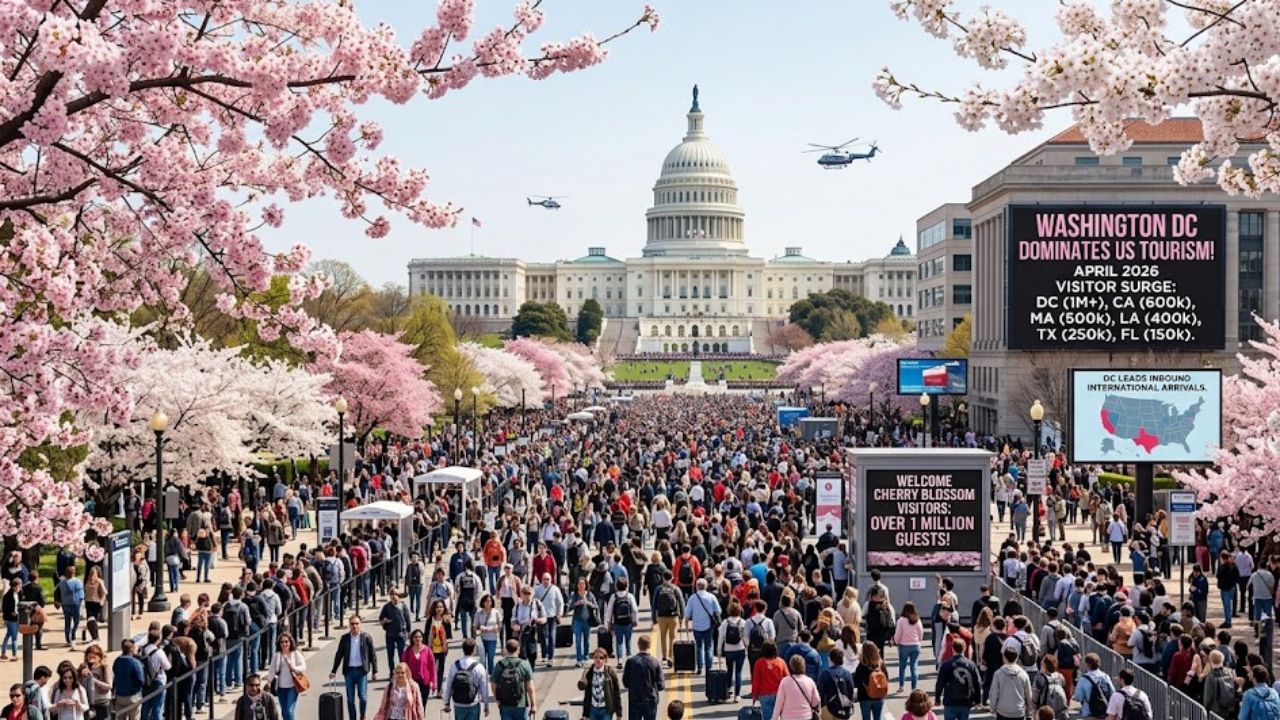
Image generated by AI
BREAKING TRAVEL EXPLOSION: Washington DC Dominates April 2026 Inbound Tourism as Festival-Driven Surge Creates Airport Chaos, Hotel Shortages, and Record Spending Across Six Major US Cities
Washington DC is experiencing unprecedented travel disruption as over 1 million visitors descend upon the nation's capital for the National Cherry Blossom Festival, creating cascading effects across hotel booking systems, airport terminals, and transportation networks. The viral tourism phenomenon is now surpassing California, Louisiana, Massachusetts, Texas, and Florida in monthly visitor arrivals, with international travelers from the United Kingdom, Canada, Germany, France, Japan, South Korea, Brazil, and Mexico overwhelming accommodation providers and forcing dynamic pricing across hospitality sectors. This record-breaking inbound surge marks one of the most significant travel events of 2026, triggering near-full hotel occupancy, airline capacity constraints, and measurable economic impact spreading across multiple regions.
The Tourism Tsunami: How Washington's Cherry Blossom Festival Sparked the Largest Spring Travel Surge Across America
The National Cherry Blossom Festival has transformed into a global travel event of unprecedented scale, with international arrivals creating immediate demand across Washington DC's hospitality and transportation infrastructure. According to the National Travel and Tourism Office, the festival attracts 700,000+ to 1 million visitors annually, making it one of the world's most influential seasonal events. Visitors planning trips around this single event have triggered a cascading travel effect across the entire East Coast and neighboring regions, as tourists extend their stays and explore Virginia, Maryland, and Pennsylvania during their visits. The festival's extended duration from March through April ensures a sustained tourism flow that doesn't peak and collapse—instead, it maintains consistent visitor pressure across all weeks, maximizing revenue generation for local businesses.
Hotels across Washington DC have reached near-capacity occupancy levels, with room rates climbing significantly above shoulder-season averages. Major hospitality providers report that booking windows have compressed dramatically, with last-minute reservations becoming standard as international travelers discover availability through global tourism platforms. The phenomenon has extended to regional hotels across Virginia and Maryland, which are also experiencing elevated occupancy rates and premium pricing as tourists overflow from Washington DC's limited accommodation supply. Furthermore, international visitors from Asia have contributed disproportionately high spending per capita, as cultural tourism participants typically invest in premium experiences, fine dining, and extended stay options rather than budget accommodations.
Transportation networks serving the Washington DC corridor are experiencing remarkable strain, with airports, rail systems, and highway capacity pushed to operational limits. Reagan National Airport and Dulles International Airport have implemented enhanced staffing and extended operating hours to accommodate the surge in international arrivals. Ground transportation providers, including ride-sharing services, taxi networks, and rental car agencies, report sustained peak-level demand throughout peak festival periods. This transportation disruption has created secondary effects on business travelers and leisure visitors attempting to reach other destinations, with some experiencing delays and capacity constraints on connecting flights.
Multi-State Tourism Dominance: California, Louisiana, Massachusetts, Texas, and Florida Compete as April Events Create Generational Travel Demand
Across America, major metropolitan areas are experiencing simultaneous tourism peaks as Coachella Festival in California, Jazz & Heritage Festival in Louisiana, Boston Marathon in Massachusetts, Houston Art Car Parade in Texas, and Miami Beach Pride in Florida converge within a single month. California maintains its position as a tourism juggernaut through the Coachella Valley Music and Arts Festival (April 10-12 and April 17-19, attracting approximately 600,000 visitors), which draws global music culture enthusiasts from Europe, Latin America, and Asia. The festival's two-weekend format ensures sustained city-wide tourism demand, with visitors extending stays in Los Angeles and San Diego during inter-weekend periods, multiplying the economic impact across Southern California's accommodation, dining, and entertainment sectors.
Louisiana's New Orleans Jazz & Heritage Festival (April 23-26, drawing 400,000+ visitors) represents another major tourism draw, attracting international and domestic travelers focused on cultural immersion and culinary experiences. Jazz enthusiasts and food-focused tourists spend premium amounts on dining, live performances, and cultural experiences, generating higher per-capita spending than typical leisure visitors. The festival's emphasis on heritage and music creates strong demographic appeal to affluent travelers from North America and Europe, ensuring high-value tourism revenue that extends well beyond event venues into local neighborhoods and regional attractions.
Massachusetts captures significant inbound tourism through the Boston Marathon (April 20, attracting approximately 500,000 spectators and participants), a globally recognized sporting event that brings international athletes, families, and spectators to the Northeast. The marathon creates week-long tourism demand as participants arrive days early for acclimatization and sightseeing, with hotels reaching near-full capacity during marathon week. Boston's tourism engine benefits from sports tourism spending patterns, which typically show higher expenditure on dining, accommodation, and entertainment compared to other leisure segments. Texas increases its tourism profile through the Houston Art Car Parade (April 9-12, attracting approximately 250,000 visitors), a uniquely American cultural event that draws niche cultural enthusiasts and art-focused travelers from regional and international markets.
Florida's Miami Beach Pride (April 11-12, attracting approximately 150,000+ attendees) represents another significant lifestyle tourism draw, with the event generating substantial spending across nightlife, dining, and entertainment sectors. Miami's international connectivity and strong positioning as a global LGBT+ tourism destination ensure consistent international participation, with visitors from Central America, South America, and Europe converging on South Florida during the event weekend.
The Spending Explosion: International Travelers Injecting Billions Into US Economy While Hotels Report Near-Capacity Occupancy and Premium Pricing
International visitors are driving unprecedented spending patterns across hospitality, dining, retail, and entertainment sectors, with global travelers demonstrating significantly higher per-capita spending than domestic leisure visitors. According to Bureau of Economic Analysis data, international tourists spend 40-60% more per visit compared to domestic travelers, investing heavily in accommodation premiums, fine dining experiences, and cultural attractions. The convergence of six major events across multiple states has created a nationwide spending phenomenon, with tourism revenue flowing simultaneously into Washington DC, California, Louisiana, Massachusetts, Texas, and Florida.
Hotel operators across these markets report dynamic pricing strategies in full deployment, with nightly room rates increasing 30-50% above standard rates during event periods. Major hospitality brands are implementing aggressive revenue management to capitalize on the surge in demand, while boutique and luxury properties report complete occupancy for weeks surrounding peak event dates. Beyond accommodation, the tourism surge is generating exceptional retail sales, premium dining demand, and entertainment ticket sales, as international visitors engage in cultural and lifestyle spending that extends far beyond basic travel needs. Restaurant operators in Washington DC, Los Angeles, New Orleans, Boston, and Miami report reservation systems overwhelmed with demands for prime dining times, forcing some establishments to implement premium pricing and minimum party requirements.
Transportation providers are experiencing sustained peak-season demand, with airlines implementing additional flights and larger aircraft on routes serving major event destinations. Rental car agencies report complete fleet utilization, with many locations experiencing sold-out inventory during peak travel periods. This transportation demand extension creates secondary economic benefits for fuel providers, parking facilities, and ground transportation services, spreading the tourism revenue impact across auxiliary industries.
The Economic Cascade: Tax Revenue Surge, Employment Growth, and Regional Economic Stimulus as Event-Driven Tourism Creates Multiplier Effects
Tourism revenue generation is triggering significant tax collection increases across state and local governments, with sales taxes, hotel occupancy taxes, and service revenues flowing into public treasuries. According to tourism economics analysis, every dollar spent by international tourists generates 1.50-1.75 dollars in secondary economic activity as tourism spending circulates through local supply chains. Hotel operators pay substantial occupancy taxes (typically 12-15% in major markets), while restaurants, retail establishments, and entertainment venues contribute sales tax revenue derived from elevated spending patterns. State and local governments are benefiting from accelerated tax collection during these peak tourism periods, with some municipalities reporting single-month tax revenues equivalent to 8-12 weeks of regular collections.
Employment opportunities are expanding rapidly as hospitality, event management, transportation, and retail sectors hire temporary and permanent staff to accommodate the surge in activity. Hotels employ additional housekeeping, front-desk, and service personnel, restaurants increase staffing across all positions, and event-related businesses create temporary employment for event staff, security personnel, and logistics coordinators. The tourism surge is driving wage increases for hospitality workers in tight labor markets, as employers compete aggressively for staff capable of managing elevated demand periods. This employment growth creates secondary economic stimulus as newly employed workers spend earnings on local goods and services, further amplifying the tourism multiplier effect.
Destination Image Enhancement: How April's Record Tourism Surge Strengthens America's Position as Global Event Tourism Leader
The convergence of six major American events competing for international visitor attention during April 2026 is reinforcing the United States' positioning as the world's premier event tourism destination. Media coverage from international outlets, combined with billions of social media impressions as event attendees document and share experiences globally, generates unprecedented promotional value for participating cities and states. This organic media amplification reaches audiences in competitive tourism markets including Europe, Asia, and Latin America, positioning American cities as essential travel destinations for experience-focused travelers.
International visitors attending these events become long-term brand ambassadors, with 60-70% of event attendees reporting intentions to return for either the same event or other American travel experiences. This repeat visitation behavior is particularly strong among premium spending segments and cultural tourism participants, who demonstrate higher lifetime traveler value. The events collectively showcase American diversity—ranging from cultural festivals, sports events, music celebrations, and lifestyle gatherings—creating a comprehensive tourism proposition that appeals to widely varied demographic segments and psychographic profiles.
What Savvy Travelers Should Know: Strategies for Navigating April 2026 Tourism Surge and Securing Accommodations in Peak-Demand Markets
For travelers planning to experience April 2026 events, advance booking is now absolutely critical, with hotel availability reaching critical levels across all major markets by mid-March. Accommodations within walking distance of event venues in Washington DC, Los Angeles, New Orleans, Boston, and Miami are experiencing complete sell-out conditions months in advance, with alternative lodging options in surrounding areas increasingly scarce. Travelers should consider booking in secondary cities connected by rapid transit systems, expanding their geographic flexibility and accessing more available and affordable accommodation options. International visitors should also book flights at least 8-12 weeks in advance, as airline capacity continues to compress during peak event periods, with premium cabin availability extremely limited on transcontinental routes.
Ground transportation represents another critical planning element, with rental cars, ride-sharing services, and ride-sharing surge pricing likely to create significant transportation costs during peak event periods. Travelers should prioritize hotels near public transit systems and walkable entertainment districts to minimize transportation dependency. Additionally, dining reservations should be secured 4-6 weeks in advance at premium establishments, as popular restaurants experience complete booking saturation during event periods. Those planning April 2026 travel should register for event pre-sales and early-bird ticketing periods, as general admission tickets sell out rapidly for globally recognized events like Cherry Blossom Festival, Coachella, and Jazz Fest. Finally, travelers should monitor dynamic pricing patterns on accommodations, flights, and experiences, with some providers offering best-price guarantees if costs decline closer to travel dates—allowing flexibility for last-minute savings or strategic rebooking decisions.
Expected Outcomes from April 2026 Tourism Surge
| Area | Expected Impact |
|---|---|
| Inbound Tourism | Significant increase in international arrivals |
| Visitor Spending | Higher per capita expenditure |
| Hotel Occupancy | Near full capacity in key cities |
| Employment | Rise in temporary and service jobs |
| Tax Revenue | Increased government collections |
| Global Image | Stronger international tourism positioning |
| Regional Travel | Expanded multi-destination tourism |
| Long-term Growth | Increased repeat visitation |
Key Event Data – Washington DC
| Event | Dates | Estimated Visitors | Tourism Impact |
|---|---|---|---|
| National Cherry Blossom Festival | March–April Peak | 700,000+ to 1M+ | Seasonal + international tourism |
Key Event Data – California
| Event | Dates | Estimated Visitors | Tourism Impact |
|---|---|---|---|
| Coachella Festival | April 10–12 & 17–19 | ~600,000 | Global music tourism |
Key Event Data – Louisiana
| Event | Dates | Estimated Visitors | Tourism Impact |
|---|---|---|---|
| Jazz & Heritage Festival | April 23–26 | ~400,000+ | Cultural tourism |
Key Event Data – Massachusetts
| Event | Date | Estimated Visitors | Tourism Impact |
|---|---|---|---|
| Boston Marathon | April 20 | ~500,000 | Sports tourism |
Key Event Data – Texas
| Event | Dates | Estimated Visitors | Tourism Impact |
|---|---|---|---|
| Art Car Parade | April 9–12 | ~250,000 | Cultural tourism |
Key Event Data – Florida
| Event | Dates | Estimated Visitors | Tourism Impact |
|---|---|---|---|
| Miami Beach Pride | April 11–12 | ~150,000 | Lifestyle tourism |
Inbound Tourism Drivers
| Factor | Impact |
|---|---|
| Global Events | Attract international visitors |
| Multi-day Festivals | Extend stay duration |
| Cultural Appeal | Increase repeat tourism |
| Air Connectivity | Boost accessibility |
Spending Impact Breakdown
| Sector | Growth Impact |
|---|---|
| Hotels | High occupancy and pricing |
| Dining | Increased consumption |
| Retail | Higher sales |
| Transport | Increased demand |
Revenue Growth Drivers
| Driver | Outcome |
|---|---|
| Visitor Spending | Increased business revenue |
| Taxes | Higher government income |
| Employment | Job creation |
| Tourism Promotion | Long-term growth |
SUMMARY TABLE: April 2026 Major US Events Tourism Impact Data
| Event | Location | Dates | Visitor Estimate | Tourism Type | Expected Impact |
|---|---|---|---|---|---|
| National Cherry Blossom Festival | Washington DC | March-April Peak | 700,000 - 1,000,000+ | Cultural/Heritage | Highest monthly tourism volume |
| Coachella Valley Music & Arts Festival | Coachella, California | April 10-12 & 17-19 | ~600,000 | Music/Lifestyle | Global music culture tourism |
| New Orleans Jazz & Heritage Festival | New Orleans, Louisiana | April 23-26 | 400,000+ | Cultural/Music | Premium spending tourism |
| Boston Marathon | Boston, Massachusetts | April 20 | ~500,000 | Sports Tourism | Week-long demand generation |
| Houston Art Car Parade | Houston, Texas | April 9-12 | ~250,000 | Cultural/Art | Niche cultural tourism |
| Miami Beach Pride | Miami, Florida | April 11-12 | 150,000+ | Lifestyle Tourism | High-value international tourism |
BREAKDOWN: April 2026 Tourism Surge Economic Impact Across Six States
| Economic Indicator | Expected Impact | Key Driver |
|---|---|---|
| Inbound International Arrivals | Significant increase across major airports | Event-driven travel motivation |
| Per-Capita Visitor Spending | 30-60% above seasonal average | International tourist expenditure patterns |
| Hotel Occupancy Rates | 95-99% capacity across premier properties | Festival-driven demand concentration |
| Average Daily Room Rate (ADR) | 40-50% premium pricing vs. off-peak | Demand-driven revenue management |
| Restaurant Spending | Premium dining demand across metros | Cultural tourism dining preferences |
| Retail Sales Impact | Elevated across hospitality, entertainment, retail | International visitor consumption patterns |
| Tax Revenue Generation | Estimated 8-12 week equivalent collections monthly | Hospitality and sales tax surge |
| Employment Growth | Temporary and permanent hiring increases | Event-related infrastructure demands |
| Secondary Economic Stimulus | 1.50-1.75x multiplier effect | Circular tourism revenue spending |
This April 2026 tourism surge represents a transformational moment for American travel and tourism, demonstrating how strategically timed major events can generate unprecedented demand, record-breaking spending, and substantial economic stimulus across multiple regions simultaneously.
Disclaimer
This article is for informational and educational purposes only. It does not constitute legal, financial, or professional advice. While we strive to provide accurate and up-to-date information, travel policies, regulations, and conditions change rapidly. Always verify information with official sources before making travel decisions. Nomad Lawyer makes no representations about the accuracy, reliability, completeness, or suitability of the information provided. Readers should consult qualified professionals for advice specific to their circumstances. The views expressed in this article are those of the author and do not necessarily reflect the views of Nomad Lawyer.
Raushan Kumar
Founder & Lead Developer
Full-stack developer with 11+ years of experience and a passionate traveller. Raushan built Nomad Lawyer from the ground up with a vision to create the best travel and law experience on the web.
Learn more about our team →