Supreme Court Voting Rights Dispute Ignites Washington DC Civic Tourism Ahead of 2026 Midterm Elections

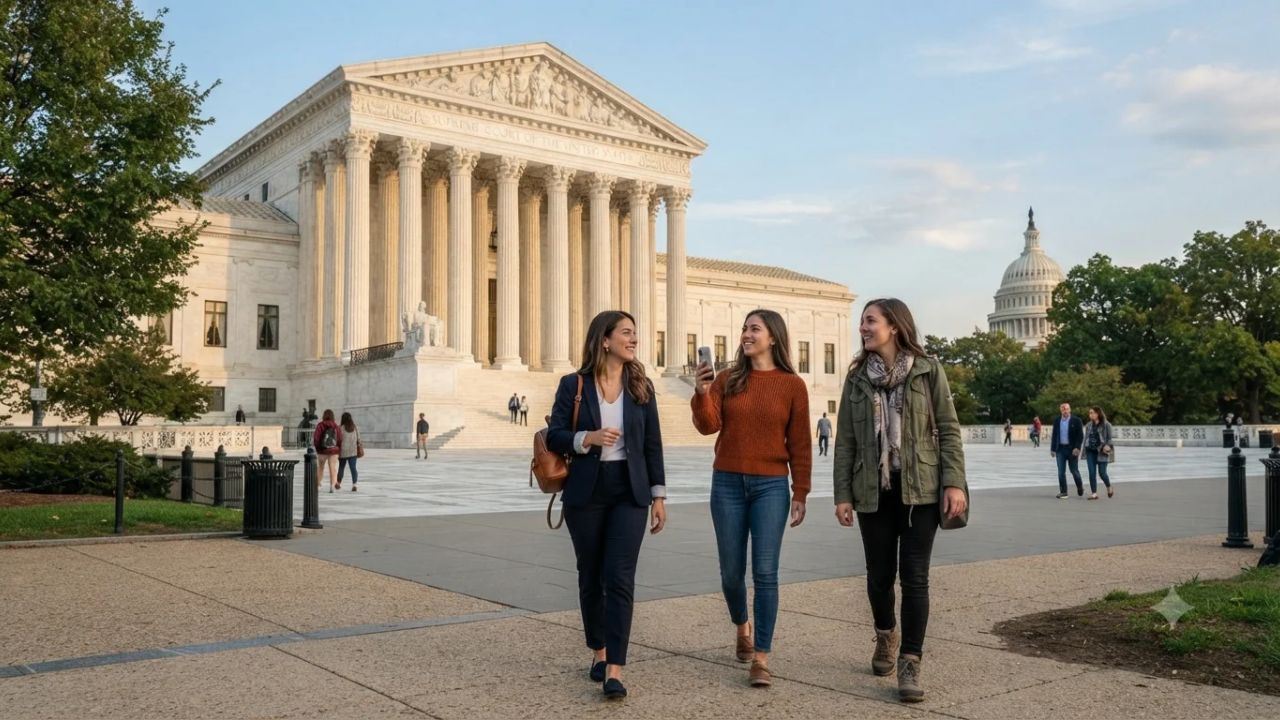
Image generated by AI
An emergency ruling by the Supreme Court blocking proposed federal restrictions on mail-in ballots ahead of the 2026 midterm elections has thrust One First Street into the center of national discourse, accelerating a surge in civic tourism across Capitol Hill. The constitutional confrontation—intensified after former President Donald Trump publicly reprimanded the bench, including justices appointed during his first administration—underscores how high-stakes judicial conflicts drive domestic and overseas visitors directly to the architectural seats of American governance. Supported by destination data tracked by Destination DC, educational and heritage travelers are increasingly building itineraries around the operational friction points of federal power.
The influx of visitors seeking deeper civic context reflects an expanding sector of American travel: political tourism. Rather than consuming policy disputes exclusively through digital feeds, travelers are journeying to the District of Columbia to examine the constitutional foundations that govern the federal apparatus. Across a compact two-square-mile district anchored by Capitol Hill and the National Mall, visitors can observe the three branches of the United States government negotiating the limits of statutory authority in real time.
The Mechanics of Political Tourism: From Emergency Dockets to Capitol Hill Corridors
The dispute that catalyzed recent visitor interest centered on emergency applications concerning mail-in ballot verification procedures and postmark deadlines leading into the 2026 congressional midterms. The high court's intervention, which preserved existing balloting protocols against administrative attempts to restrict postal ballot processing, reaffirmed the judiciary's role as an independent arbiter of statutory authority. For global tourists and civic educators, the immediate political fallout highlighted the physical proximity of American institutions.
Within the marble confines of the Supreme Court of the United States, public access remains an integral tradition of American jurisprudence. Visitors queue along the plaza to attend oral argument sessions, examine judicial exhibitions, and view the towering figures of the courtroom frieze. The court's neoclassical facade, completed in 1935 under the motto "Equal Justice Under Law," stands directly opposite the legislative complex, providing a dramatic tangible lesson in constitutional checks and balances.
This physical concentration allows travelers to bridge legal theory with historical reality. A short walk across East Capitol Street leads directly to the Architect of the Capitol (U.S. Capitol Visitor Center), where guided delegations explore Statuary Hall, the Rotunda, and the legislative chambers of the House of Representatives and the Senate. When national debates over voting rights, executive orders, or congressional oversight capture global attention, these public spaces transform into educational forums where travelers observe the inner mechanics of representative democracy.
| Federal Institution | Primary Constitutional Function | Signature Public Assets | Operational Visitor Access |
|---|---|---|---|
| U.S. Supreme Court | Judicial Branch / Constitutional Review | Courtroom seating, Great Hall, John Marshall statue | Open weekdays, oral argument queues, public exhibits |
| U.S. Capitol | Legislative Branch / Bicameral Congress | Crypt, Rotunda, National Statuary Hall collection | Guided tours via advance booking, gallery passes |
| Library of Congress | Research Arm / National Knowledge Repository | Great Hall architecture, Gutenberg Bible, reading rooms | Free timed-entry passes, rotating literary exhibits |
| National Archives | Historical Records / Custody of National Charters | Declaration of Independence, U.S. Constitution, Bill of Rights | Free admission, timed reservations recommended |
| Smithsonian Institution | Cultural Heritage / Scientific Research | Air & Space, American History, African American History | 100% free admission, advance passes for select sites |
Democratic Heritage and Free-Access Museum Economics
The operational strength of Washington's visitor economy relies on a public-access model without parallel in global tourism. While cultural institutions across Western Europe and Asia command significant admission fees, the core civic landmarks of the United States capital remain free to the public.
This accessibility is anchored by the National Archives and Records Administration on Constitution Avenue. Inside the dim, temperature-controlled Rotunda for the Charters of Freedom, travelers view the original parchment manuscripts of the Declaration of Independence, the United States Constitution, and the Bill of Rights. Standing before these foundational charters, visitors gain unvarnished insight into the legal texts that continue to animate contemporary Supreme Court deliberations and midterm election controversies.
Flanking the National Mall, the Smithsonian Institution network enriches this civic journey. Venues such as the National Museum of American History present artifact-driven narratives documenting civil rights legislation, voting rights movements, and presidential history. The National Air and Space Museum showcases global aviation breakthroughs, while the National Museum of African American History and Culture explores the ongoing struggle for democratic enfranchisement. The absence of admission charges across these premier facilities eliminates financial barriers for family groups, student delegations, and international budget travelers, making Washington a premier destination for immersive civic learning.
Expert Analysis: High-Visibility Jurisprudence and the Security-Access Equilibrium
From a destination management and urban security standpoint, high-profile constitutional rulings present complex operational challenges for municipal authorities and federal police forces. The confluence of contentious election litigation, high-ranking government officials, and international visitor flows demands a delicate balance between public accessibility and institutional protection.
For travelers booking this route, the direct consequence is navigating a layered environment of physical security checkpoints, timed-entry ticketing protocols, and intermittent perimeter closures. While public access to the Supreme Court, Capitol, and Library of Congress remains legally protected, walk-up flexibility has been largely replaced by mandatory digital pre-registration. Travelers attempting to visit Capitol Hill without advance planning frequently face long standby queues or find admission restricted during sensitive congressional hearings or emergency judicial sessions.
The pricing pressure this creates means while museum admissions remain free of charge, the auxiliary costs of a Washington trip—specifically hospitality lodging and private ground transport—command steep premiums during politically charged seasons. Midterm election cycles generate significant corporate, political, and media delegations that absorb hotel room inventory across Downtown, Penn Quarter, and Capitol Hill. To maintain travel value, visitors are increasingly staying in transit-connected districts like Arlington, Alexandria, or Silver Spring, leveraging the Metrorail system to access the National Mall without paying elevated core-city lodging rates. As civic curiosity continues to outpace traditional leisure travel, Washington demonstrates that active democracy remains one of the world's most compelling travel narratives.
Key Takeaways
- Civic Tourism Acceleration: An emergency Supreme Court ruling on mail-in voting curbs ahead of the 2026 midterms has intensified public interest in Washington's judicial and legislative institutions.
- Walkable Institutional Access: Capitol Hill concentrates the Supreme Court, U.S. Capitol, and Library of Congress within an accessible pedestrian district, enabling travelers to study the separation of powers in person.
- Unrivaled Free Access: Foundational attractions—including the National Archives and the world-class museums of the Smithsonian Institution—remain entirely free of admission fees.
- Operational Planning Imperative: Heightened security protocols and heavy visitor volumes make advance timed-entry reservations essential for touring the Capitol, Archives, and select Smithsonian museums.
- Seasonal Travel Dynamics: The intersection of midterm political cycles, autumn foliage, and educational travel increases demand for regional lodging, encouraging visitors to utilize public transit from neighboring suburbs.
FAQ: Washington DC Political Tourism and Supreme Court Visits 2026
Can visitors attend oral arguments at the U.S. Supreme Court?
Yes. The public can attend oral arguments on a first-come, first-served basis when the court is in session. Visitors must line up early on the front plaza for limited gallery seating.
Are tickets required to tour the U.S. Capitol building?
Tours are free, but advance reservations through the U.S. Capitol Visitor Center website are strongly recommended to avoid long lines or missed entry during high-demand periods.
What original documents can travelers see at the National Archives?
Visitors can view the original Declaration of Independence, the Constitution of the United States, and the Bill of Rights in the Rotunda for the Charters of Freedom.
Are all Smithsonian museums in Washington DC free to enter?
Yes. All Smithsonian museums on the National Mall and across the district offer free admission, though select popular locations require free advance timed-entry passes to manage visitor flow.
Where constitutional law meets historic stone, Washington reminds every traveler that the story of democracy is an enduring, living journey.
Related Travel Guides
This article is for informational purposes. Flight routes, passenger regulations, visa rules, and transit advisories are subject to change by airlines and aviation authorities. Readers are advised to verify schedules and travel documentation with relevant carriers and border agencies before departure.
Related Stories

European Mass Protests Disrupt Travel Across France, Italy, Belgium, and Turkey in 2026

Storm Bruna 2026: Iberia Faces 200mm Rainfall and 6m Swells Triggering Mass Travel Chaos