Vietnam Unveils Bold Green Island Vision for Con Dao: Mangrove Restoration, Coral Nurseries, and Carrying Capacity in 2050 Master Plan

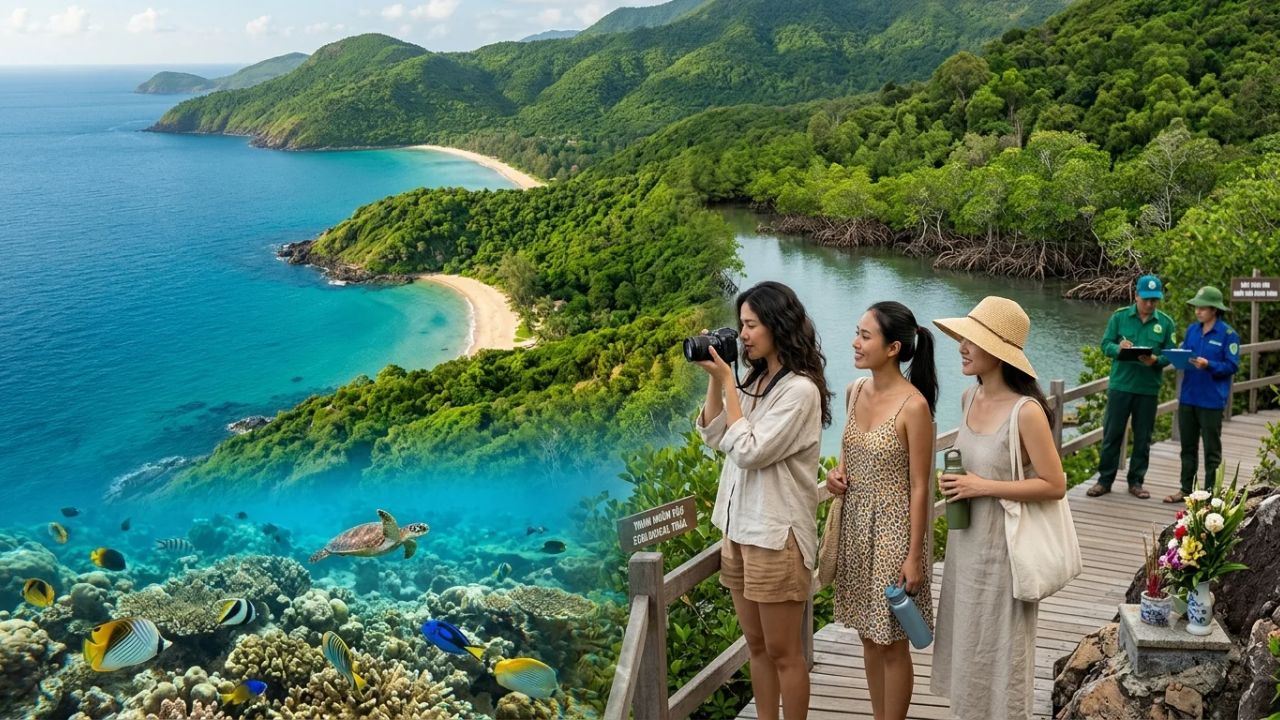
CON DAO, Vietnam — In a transformative policy shift that redefines the relationship between memorial heritage, marine conservation, and island tourism, Vietnamese authorities have unveiled a comprehensive ecological master plan for the Con Dao archipelago.
Approved on 30 October 2026 by the Ho Chi Minh City People's Council as an integral component of the municipal 2025–2050 development framework, the long-term blueprint formally designates Con Dao as one of five strategic satellite centres within the southern metropolitan economic zone.
Rather than pursuing conventional mass-resort expansion or high-density hospitality infrastructure, the newly ratified planning direction mandates an environmental carrying capacity model designed to preserve the sixteen-island archipelago as a green, smart, and low-emission ecological haven.
The initiative marks an unprecedented national effort to harmonize historical remembrance with intensive habitat restoration.
Historically recognized as a remote penal colony and sacred memorial ground where tens of thousands of Vietnamese independence fighters perished, Con Dao has experienced escalating visitor pressure over the past decade, recording annual arrivals between 500,000 and 600,000 travelers.
To prevent tourism from exceeding the physical limits of the island's fragile water tables, power grids, and reef systems, local administrators, national park rangers, and conservationists are executing an interlocking portfolio of environmental initiatives: the permanent eradication of disposable plastics and votive paper burning at historic cemeteries, the cultivation of a 10,000-cutting coral nursery, nearly ten hectares of mangrove reforestation, deep-sea ghost net removals, and strictly regulated sea turtle nesting ecotourism.
CON DAO GREEN ISLAND STRATEGIC MATRIX 2025-2050
| Entity / Route | Metrics | Operational Status |
|---|---|---|
| Development Pillar | Primary Focus Area | Operational Mechanism |
| Metropolitan Role | Satellite Centre of Ho Chi Minh City | Low-emission eco-tourism cluster |
| Carrying Capacity | Finite Water, Energy & Waste Baselines | Strict development quotas |
| Spiritual Heritage | Hang Duong & Hang Keo Memorial Sites | "Green Offering Basket" Mandate |
| Marine Restoration | Ong Dung & Dat Tham Reef Flats | 10,000-fragment coral nursery |
| Coastal Buffers | Hon Ba Island & Duong Beach (Bay Canh) | 10 hectares mangrove afforest. |
| Wildlife Protection | Bay Canh & Hon Cau Turtle Beaches | 50-person overnight visitor cap |
| Clean Utilities | Island-Wide Microgrid & Water Systems | Solar, desalination, zero plastic |
The 2025–2050 Master Plan: Con Dao as Ho Chi Minh City's Green Satellite Anchor
The incorporation of Con Dao into Ho Chi Minh City's regional master planning framework represents a decisive structural evolution in the administrative governance of southern Vietnam.
Ratified by the municipal People's Council on 30 October 2026, the comprehensive planning framework establishes a development roadmap through 2050, accompanied by a strategic spatial vision projected over the coming century.
Under this master strategy, Con Dao is integrated into a multi-tiered economic network alongside four other satellite urban clusters, assigned a specific operational mandate centered on ecological conservation, cultural preservation, high-value scientific research, and sustainable marine recreation.
Urban planners in Ho Chi Minh City have recognized that island environments cannot absorb mainland development densities without triggering irreversible environmental degradation.
Unlike the sprawling delta terrain of southern Vietnam, the Con Dao archipelago possesses an aggregate land area of approximately 76 square kilometers, with Con Son Island accounting for the overwhelming majority of usable topography.
The master plan establishes explicit legal boundaries separating developable urban zones from the strictly protected terrestrial and marine jurisdictions of Con Dao National Park.
Importantly, approval by the municipal People's Council represents the primary legislative validation of the planning concept.
The blueprint must subsequently secure formal executive ratification from the Chairman of the municipal People's Committee before statutory zoning regulations, capital project disbursements, and infrastructural milestones take statutory effect.
This governance sequence signals to domestic and international hospitality investors that future commercial capital allocations on the island must directly comply with rigorous low-carbon architectural standards, water recycling mandates, and strict biodiversity protection agreements.
                                  HO CHI MINH CITY MASTER PLANNING PYRAMID

   +---------------------------------------------------------------------------------+
   | LEGISLATIVE RATIFICATION: Municipal People's Council Approval (30 Oct 2026)      |
   +---------------------------------------------------------------------------------+
                                           |
                                           v
   +---------------------------------------------------------------------------------+
   | STRATEGIC DESIGNATION: Con Dao as 1 of 5 Metropolitan Satellite Centres         |
   +---------------------------------------------------------------------------------+
                                           |
                                           v
   +---------------------------------------------------------------------------------+
   | ZONING ENFORCEMENT: Absolute Protection of Con Dao National Park Land & Waters  |
   +---------------------------------------------------------------------------------+
                                           |
                                           v
   +---------------------------------------------------------------------------------+
   | OPERATIONAL REGULATION: Carrying Capacity Caps, Clean Energy, Zero Plastic      |
   +---------------------------------------------------------------------------------+
Reconciling High Demand with Island Fragility: The 600,000 Visitor Threshold
The urgency behind Con Dao's green transformation stems from the unprecedented surge in domestic and international travel demand over the past five years.
Historically accessible only by infrequent maritime supply vessels or specialized military aircraft, the expansion of commercial turboprop aviation and modern high-speed passenger catamarans from Vung Tau, Can Tho, and Tran De has connected the archipelago directly with mainland population centers.
According to municipal data and historical planning records, Con Dao welcomed 523,515 tourist arrivals in 2022.
In recent operating cycles, baseline annual visitor traffic has consistently hovered between 500,000 and 600,000 travelers.
While this influx has generated substantial commercial revenue for local boutique resorts, family homestays, maritime charter operators, and transport providers, it has placed unprecedented strain on the island's essential utility baselines.
The archipelago's physical isolation creates three critical infrastructure bottlenecks:
First, freshwater resources are severely constrained. Con Dao depends entirely on seasonal rainwater collection reservoirs and fragile underground aquifers that fluctuate dramatically between the monsoon and dry seasons. Unchecked hotel room construction risks depleting subterranean water lenses and causing saltwater intrusion into coastal freshwater tables.
Second, the island's electrical supply has traditionally relied on imported diesel fuel generation, which generates localized carbon emissions, carries high transportation expenses, and poses hazardous maritime fuel spill risks during stormy sea transits.
Third, solid waste management presents a severe ecological hazard. Landfill capacity on Con Son Island is nearly exhausted, with waste treatment plants struggling to process hundreds of tons of packaging, food scraps, and plastic discarded by temporary visitors.
For local leadership, transitioning from untamed volume expansion to a managed carrying-capacity model is not merely an environmental ideal; it is a fundamental prerequisite for long-term economic survival.
CON DAO ISLAND ECOSYSTEM CARRYING CAPACITY PRESSURES
| Entity / Route | Metrics | Operational Status |
|---|---|---|
| Resource Dimension | Baseline Vulnerability | Mitigation Framework |
| Freshwater Supply | Finite seasonal reservoirs & aquifers | Mandatory rainwater harvesting |
| Electrical Grid | High-cost diesel generator dependence | Rooftop solar & microgrid storage |
| Solid Waste Output | Landfill exhaustion on Con Son Island | Single-use plastic prohibition |
| Maritime Ecology | Anchor damage and discarded fishnets | Mooring buoys & cleanup dives |
| Coral Habitats | Thermal bleaching & tourist contact | Coral nurseries & dive zoning |
| Turtle Nesting Dunes | Artificial lighting & crowd disturbance | 50-person visitor quota at night |
Decarbonizing Spiritual Tourism: The Green Offering Basket Revolution
Among Con Dao's most culturally significant and ecologically innovative initiatives is the transformation of ritual practices at historical memorial sites.
For decades, the primary motivation for domestic Vietnamese travelers visiting Con Dao has been spiritual pilgrimage.
Sites such as Hang Duong Cemetery—the final resting place of national heroine Vo Thi Sau and thousands of patriotic martyrs—alongside Hang Keo Cemetery and the French colonial prison complexes, attract immense nightly crowds paying homage to independence heroes.
Traditionally, this ritual remembrance involved the burning of extensive votive paper items (vàng mã), synthetic fabric clothing, miniature paper mansions, and imitation currency, packaged in single-use plastic trays decorated with polystyrene foam and cellophane wrapping.
Prior to environmental interventions, cemetery maintenance teams reported that more than 1,500 elaborate sets of votive paper offerings were burned each night at Hang Duong Cemetery alone.
This practice generated heavy plumes of toxic chemical smoke, coated memorial monuments in thick particulate ash, created severe respiratory discomfort for nearby residential quarters, and left behind mountains of smoldering, non-biodegradable debris.
Recognizing the urgent need to preserve the solemn reverence of memorial practices while eliminating environmental harm, authorities launched the landmark Green Offering Basket (Giỏ Lễ Xanh) program.
Rather than outlawing ceremonial tributes, the initiative introduces strict material standards that substitute petrochemical packaging with natural, compostable elements.
                       CEREMONIAL OFFERING MATERIAL TRANSITION MODEL

  TRADITIONAL MEMORIAL OFFERING (PHASED OUT)       GREEN OFFERING BASKET (MANDATORY STANDARD)
  [Polystyrene Trays & Cellophane Wraps]    ===>   [Woven Bamboo, Reed or Water Hyacinth Baskets]
  [Synthetic Chemical Incense Sticks]       ===>   [Natural Herbal & Sandalwood Incense]
  [Plastic Water Bottles & Cups]            ===>   [Compostable Paper or Bamboo Reusable Vessels]
  [Massive Votive Paper (Vàng Mã) Burning]  ===>   [Fresh Lotus, White Flowers on Banana Stems]
  [Dimensional Sprawl > 1 Meter]            ===>   [Strict Max Dimensions: 50cm x 50cm x 50cm]
The Green Offering Basket framework progressed through deliberate, multi-phase implementation to ensure community acceptance and commercial compliance among local vendors:
In early 2024, awareness campaigns familiarized visitors and market traders with biodegradable alternatives.
By mid-2024, authorities introduced designated Green Offering Basket Days on Saturdays.
The initiative proved immensely successful: between 6 July and 14 September 2024, official tourism audit data recorded 27,663 visits to Hang Duong Cemetery during the Saturday campaign windows.
Out of 10,642 ceremonial offerings brought into the memorial complex, 10,470 complied fully with green material guidelines—achieving an extraordinary 98.38 percent compliance rate.
Building upon this community support, the People's Committee instituted round-the-clock, year-round enforcement across all historical memorial properties starting 1 January 2025.
Under active regulations, ceremonial baskets brought into cemeteries must not exceed 50 centimeters in height, length, or width.
Baskets must be woven from natural bamboo, rattan, water hyacinth, or recycled wood; fresh flowers must be arranged on natural young banana stems; and votive paper burning is strictly prohibited.
This decisive reform has dramatically cleared the night skies over Con Son, restored quiet dignity to sacred burial sites, and spawned a thriving local cottage industry of craft artisans weaving sustainable memorial baskets.
Coastal Buffer Engineering: Two Decades of Mangrove Regeneration
While municipal planners redesign urban policies, the forestry division of Con Dao National Park has conducted sustained, landscape-scale ecological restoration across the archipelago's terrestrial boundaries.
Central to this effort is the systematic rehabilitation of mangrove forest ecosystems, which serve as vital ecological buffers connecting coastal land masses with shallow marine waters.
Mangrove forests in Con Dao fulfill indispensable biological functions: their dense, prop-root networks trap terrestrial sediment runoff from deforested hillsides, preventing silty topsoil from suffocating offshore coral reefs.
Simultaneously, the submerged root architecture provides sheltered nurseries and breeding sanctuaries for hundreds of species of juvenile reef fish, crabs, and mollusks, while shielding shoreline villages from powerful typhoon storm surges.
CON DAO NATIONAL PARK MANGROVE REFORESTATION RECORD
| Entity / Facility | Delays | Cancellations | Details |
|---|---|---|---|
| Restoration Zone | Initiation Date | Cumulative Area Planted | Dominant Species |
| Hon Ba Island | 2008 - 2009 Phase I | Est. 5.2 Hectares | Rhizophora apiculata |
| Duong Beach (Bay Canh) | 2014 - Ongoing Phase II | Est. 4.6 Hectares | Avicennia alba / Brugu |
| Total Documented Area | Nearly 2 Decades | Nearly 10 Hectares | Native Mangrove Clades |
According to conservation data compiled in late 2026, Con Dao National Park has achieved nearly ten hectares of documented, cumulative mangrove reforestation across two primary geographic sectors: Hon Ba Island and Duong Beach on Bay Canh Island.
The initiative commenced between 2008 and 2009 on Hon Ba, where park biologists pioneered specialized seedling propagation techniques designed to withstand intense tidal scouring and saline fluctuations.
Restoration efforts subsequently expanded to Duong Beach on Bay Canh Island, establishing resilient mangrove corridors that now shelter pristine marine coves.
Park scientists emphasize that seedling transplantation represents merely the initial step in ecological engineering; long-term survival demands continuous canopy monitoring, invasive weed eradication, and hydro-sedimentary flow adjustments to ensure that young saplings mature into self-sustaining coastal forest ecosystems.
Marine Bio-Restoration: The 10,000-Cutting Coral Nursery
Submerged beneath the turquoise waters surrounding the archipelago lies one of Vietnam's most biologically diverse marine ecosystems, encompassing over 350 species of hard and soft corals.
However, escalating sea surface temperatures associated with global climate anomalies, combined with historical mechanical anchor damage from commercial fishing vessels, have inflicted severe localized bleaching and reef fragmentation.
In response, Con Dao National Park has mobilized an aggressive marine restoration campaign centered on the propagation of a 10,000-cutting coral nursery.
Operating under controlled scientific conditions in sheltered bays, park marine biologists collect naturally broken coral fragments—termed corals of opportunity—that would otherwise perish upon sandy sea bottoms.
These fragments are secured to submerged nursery tables and artificial propagation matrices, where they receive optimal sunlight, water flow, and periodic manual cleaning to remove suffocating algae.
                                  CORAL REEF RESTORATION CYCLE

   +---------------------------------------------------------------------------------+
   | FRAGMENT RESCUE: Collecting broken "corals of opportunity" from reef flats      |
   +---------------------------------------------------------------------------------+
                                           |
                                           v
   +---------------------------------------------------------------------------------+
   | NURSERY PROPAGATION: 10,000 fragments mounted on underwater nursery tables      |
   +---------------------------------------------------------------------------------+
                                           |
                                           v
   +---------------------------------------------------------------------------------+
   | HEALTH MONITORING: Algae removal, growth tracking & bleaching resistance tests   |
   +---------------------------------------------------------------------------------+
                                           |
                                           v
   +---------------------------------------------------------------------------------+
   | TRANSPLANTATION: Micro-pinning mature colonies to Ong Dung & Dat Tham reefs    |
   +---------------------------------------------------------------------------------+
Once coral cuttings achieve sufficient growth velocity and structural calcification over several months of nursery nurturing, park dive teams transplant the hardened specimens directly onto degraded reef flats at Ong Dung Beach and Dat Tham Beach.
Using non-toxic underwater epoxy resins and mechanical anchoring pins, divers secure the young colonies onto exposed granite boulders and dead coral limestone substrates.
This restorative intervention is accompanied by strict zoning enforcement.
Snorkeling and scuba diving tours operated across restored reef sectors are subject to mandatory ecological briefings: tourists are forbidden from wearing dive fins in shallow flats to prevent accidental breakage, while dive boat operators are required to tie off at permanent mooring buoys, making anchor drops an expellable offense within national park boundaries.
Deep-Sea Cleanups: Eradicating Ghost Nets and Submerged Plastics
A pristine beach surface frequently conceals deep-water ecological trauma.
Tidal currents flowing through the East Sea routinely deposit discarded commercial fishing gear, industrial ropes, and marine plastic debris across the archipelago's submerged contours.
These discarded materials, widely known as ghost nets, wrap tightly around coral heads, trapping sea turtles, rays, and pelagic fish in perpetual underwater mortality cycles while smothering fragile mangrove root systems.
To eliminate this threat, Con Dao National Park organizes regular deep-water marine waste collection expeditions.
A prominent operational update published in August 2024 detailed extensive submerged clean-up operations concentrated around the sensitive marine zones of Bay Canh, Hon Cau, and Hon Ba.
Unlike beach trash collection, deep-sea net extraction requires specialized technical diving skills.
Park divers equipped with surgical shears and pneumatic lifting bags must painstakingly slice through tangled nylon monofilament cords without tearing living coral branches or injuring embedded sea life.
Extracted netting and submerged debris are bundled into weighted cargo nets, surfaced via inflatable lift bags, and transferred aboard patrol cutters for transport to mainland recycling facilities.
These ongoing sweeps confirm that sustainable ecotourism depends on invisible underwater stewardship as much as visible surface cleanliness.
SUBMERGED MARINE HABITAT RECOVERY OPERATIONS
| Entity / Route | Metrics | Operational Status |
|---|---|---|
| Focus Island / Reef | Primary Submerged Threat | Technical Clearance Method |
| Bay Canh Marine Zone | Heavy commercial trawler ghost nets | Diver pneumatic lift bag recovery |
| Hon Cau Reef Slopes | Monofilament lines & plastic packaging | Hand shears & non-impact cutting |
| Hon Ba Channels | Entangled rope matrices in mangroves | Low-tide root extraction sweeps |
Sea Turtle Sanctuaries: Balancing Ecotourism with Strict Biological Protocols
The Con Dao archipelago stands as the most critical nesting stronghold for endangered marine turtles in Vietnam, particularly the Green sea turtle (Chelonia mydas).
Decades of systematic conservation work by national park rangers have rescued the local turtle population from regional extinction, establishing an internationally recognized model of chelonian protection.
During the peak nesting cycle between May and October, female turtles crawl ashore onto fourteen designated nesting beaches, primarily on Bay Canh, Hon Cau, Hon Tre Lon, and Hon Tai islands.
Park rangers patrol sandy dunes throughout the night to locate freshly deposited clutches.
In sectors where high tidal surges, sand erosion, or predatory crabs threaten egg survival, rangers carefully relocate whole clutches to sheltered incubation corrals, tracking temperature, nest depth, and expected hatching dates.
CON DAO SEA TURTLE CONSERVATION AUDIT: DEC 2025 - MAR 2026 (OFFICIAL DATA)
| Conservation Metric Indicator | Recorded Biological Total |
|---|---|
| Total Sea Turtle Hatchlings Safely Released | > 5,600 hatchlings guided to the sea |
| Rescued & Relocated High-Risk Nests | 64 nests successfully transferred to corrals |
| Total Eggs Protected in Relocated Nests | 5,687 viable eggs incubated |
| Total Nests Naturally Hatched in Period | 108 nests successfully emerged |
Official conservation metrics released in May 2026 demonstrate the continuing vitality of the program: during an interim winter monitoring window running from December 2025 to March 2026, park rangers oversaw the safe release of more than 5,600 vigorous turtle hatchlings into the sea.
During that four-month timeframe alone, 64 endangered nests containing 5,687 eggs were rescued from vulnerable beach zones, while 108 protected nests hatched successfully.
To satisfy growing traveler interest in witnessing this wildlife phenomenon without compromising biological success, Con Dao National Park enforces strict ecotourism protocols:
First, visitor access to prime nesting beaches like Bay Canh is capped at a strict maximum of 50 overnight participants per authorized location.
Second, visitors are divided into small, ranger-accompanied squads of no more than ten individuals.
Third, all artificial lighting—including white smartphone flashlights, camera strobes, and headlamps—is forbidden; rangers utilize only dim red-filtered torches, which do not disrupt nocturnal nesting orientation.
Fourth, public interactions during baby turtle releases are conducted under scientific supervision: hatchlings are released across natural beach gradients at dawn, ensuring they orient correctly toward the sea and exercise vital crawl-stroke muscles essential for pelagic survival.
                       RESPONSIBLE TURTLE ECOTOURISM PROTOCOL

  [Prospective Ecotourist]
             |
             +---> Advance National Park Permit & Ranger Booking Required
             |
             +---> Maximum 50 Overnight Guests on Bay Canh Island
             |
             +---> Subdivision into Supervised Squads (<= 10 Persons)
             |
             +---> Strict Zero-White-Light Rule (Red-Filtered Torches Only)
             |
             +---> Mandatory 5-Meter Buffer Distance from Nesting Females
             |
             +---> Supervised Dawn Hatchling Release Across Natural Tidal Sand
Green Infrastructure and the Utility Transition: Towards a Low-Emission Island
The ambitious vision outlined in Ho Chi Minh City's 2025–2050 master plan recognizes that sustainable ecotourism cannot endure on an island powered by fossil fuels and constrained by primitive utilities.
Achieving true carrying capacity balance demands transforming Con Dao's physical utility architecture into a low-emission, self-sufficient smart grid.
Key municipal engineering priorities currently progressing through technical evaluation include:
First, energy diversification. Con Dao is planning the deployment of utility-scale rooftop solar arrays, distributed battery energy storage systems (BESS), and prospective small-scale coastal wind turbines to steadily displace diesel generator usage. Establishing an integrated renewable microgrid will reduce operating costs, eliminate maritime fuel transport risks, and lower carbon emissions per visitor night.
Second, advanced water circularity. To insulate the island against extended dry season droughts, planners are designing modern seawater reverse-osmosis (SWRO) desalination facilities powered by renewable energy, combined with decentralized graywater treatment and recycling systems that mandate treated water reuse for municipal landscaping and resort irrigation.
Third, the total prohibition of single-use plastics. Building upon the success of the Green Offering Basket program, municipal authorities are preparing comprehensive directives that will prohibit single-use plastic water bottles, disposable straws, and plastic takeaway packaging across all national park trails, maritime ferry passenger terminals, and hotel facilities.
Visitors will be encouraged to carry reusable stainless steel bottles, supported by a network of public filtered drinking water refill stations deployed across Con Son town.
CON DAO SUSTAINABLE UTILITY INFRASTRUCTURE PIPELINE
| Entity / Route | Metrics | Operational Status |
|---|---|---|
| Infrastructure Sector | Current Operating State | 2050 Master Plan Target |
| Electrical Power | High-emission diesel generators | Solar, wind & battery microgrid |
| Water Security | Seasonal rainwater reservoirs | Renewable-powered SWRO desal |
| Wastewater Management | Septic tanks & limited treatment plants | 100% tertiary recycling for parks |
| Solid Waste Systems | Overburdened open landfill storage | Zero single-use plastic mandate |
| Urban Transport | Gasoline motorbikes and tourist vans | Electric buggies & e-shuttles |
The Responsible Traveler's Field Guide: Logistics, Etiquette, and Conservation Access
For conscientious domestic and international travelers planning an expedition to Con Dao, navigating the destination requires deliberate preparation and strict adherence to local environmental regulations.
The archipelago offers extraordinary historical gravitas and pristine marine wilderness, provided visitors approach the island with ecological discipline.
CON DAO TRAVELER ACCESS AND TRANSPORT MATRIX
| Entity / Facility | Delays | Cancellations | Details |
|---|---|---|---|
| Transport Mode | Departure Origin Point | Journey Duration | Operational Notes |
| Commercial Flight | Ho Chi Minh City (SGN) | Approx. 45 - 50 Minutes | ATR-72 / Small Jet |
| Commercial Flight | Can Tho (VCA) | Approx. 40 Minutes | Regional feeder routes |
| Express Fast Ferry | Vung Tau (Cau Da Port) | Approx. 3.5 - 4 Hours | High-speed catamaran |
| Express Fast Ferry | Tran De (Soc Trang) | Approx. 2 - 2.5 Hours | Shortest sea crossing |
Step 1: Secure Transportation and Park Authorizations in Advance
Aviation capacity into Con Dao Airport (VCS) on Con Son Island is strictly constrained by runway dimensions, which accommodate regional turboprop aircraft and select regional jets.
Flight tickets from Ho Chi Minh City or Can Tho sell out weeks in advance during high season.
Alternatively, high-speed passenger catamarans operate daily from Vung Tau and Tran De, offering scenic sea crossings that must nevertheless be monitored for seasonal swell conditions.
If you intend to visit uninhabited outer islands like Bay Canh or Hon Cau, coordinate directly with the Con Dao National Park headquarters on Vo Thi Sau Street to secure formal environmental entry permits and book accredited park rangers.
Step 2: Strictly Observe Memorial Protocol and the Green Offering Basket Rules
When visiting Hang Duong Cemetery, Hang Keo Cemetery, or the historic French penitentiaries, dress conservatively in attire that covers shoulders and knees.
Memorial visits frequently occur late at night, between 9:00 PM and midnight, when thousands gather to pay silent respect.
If purchasing ceremonial tributes from local market vendors, confirm that your offering complies fully with Green Offering Basket regulations: insist on natural bamboo or reed baskets, ensure dimensions remain within the 50cm threshold, refuse all plastic wrap or polystyrene foam, and do not attempt to burn votive paper anywhere on cemetery grounds.
Step 3: Practice Responsible Marine and Diving Etiquette
When engaging in snorkeling, scuba diving, or island hopping across Con Dao's pristine bays, choose licensed dive operators affiliated with national park conservation programs.
Apply reef-safe sunscreen devoid of oxybenzone and octinoxate, which bleach and poison coral polyps.
Never stand on shallow reef flats, avoid wearing oversized swim fins in shallow tidal pools, and under no circumstances touch, collect, or purchase coral fragments, giant clam shells, or sea turtle products.
Strategic Horizons: Con Dao as an Ecotourism Model for the Asia-Pacific
The visionary policies advancing across Con Dao demonstrate that the preservation of sacred spiritual heritage and the restoration of fragile marine habitats can coalesce into a unified, economically viable development strategy.
By refusing to sacrifice its ecological soul to unchecked tourist expansion, Con Dao is establishing a compelling precedent for island destinations throughout Southeast Asia.
The approval of Ho Chi Minh City's 2025–2050 master plan signals that sustainable tourism must be defined by environmental carrying capacity, strict material standards, and active biological regeneration.
As the 10,000-cutting coral nursery matures, mangrove roots strengthen coastal shores, and zero-plastic policies take firm root across sacred memorial grounds, Con Dao stands as proof that a destination can honor its historic past while safeguarding its ecological future for generations to come.
Related Travel Guides
- The Mall Group Injects 600 Million Baht into Bangkok Festive Tourism: Mr. Men Campaign Targets 20% Surge
- Mogadishu Tourism Bets on TikTok to Convert Social Scrolls into Travel Bookings: Diaspora Demand and Logistics
- Surabaya Autumn Tourism 2026 Surges as Gen Z Travelers Drive Booking Boom Across East Java
- Germany and France Lead Ten-Nation European Coalition Expanding Sustainable Rail Travel
- Netherlands and European Nations Shift Tourism from Volume to Value: Landmark JRC Economic Data
This article is for informational purposes. Flight routes, passenger regulations, visa rules, and transit advisories are subject to change by airlines and aviation authorities. Readers are advised to verify schedules and travel documentation with relevant carriers and border agencies before departure.
Related Stories

Thailand Cultural Tourism Boom Accelerates as Grab Unveils TASTE Digital Framework and 15 Billion Baht Economic Impact
Gyeonggi Province Elevates South Korean Family Tourism: Six Autumn Nature and Heritage Day Trips Beyond Seoul Revealed