
Vietnam Airlines Boeing 787-9 Returns to Munich Airport After Severe Tailstrike on Hanoi Flight
A Vietnam Airlines Boeing 787-9 flight from Munich to Hanoi was forced to make an emergency overweight landing after a tailstrike during takeoff caused structural damage and tire failure.

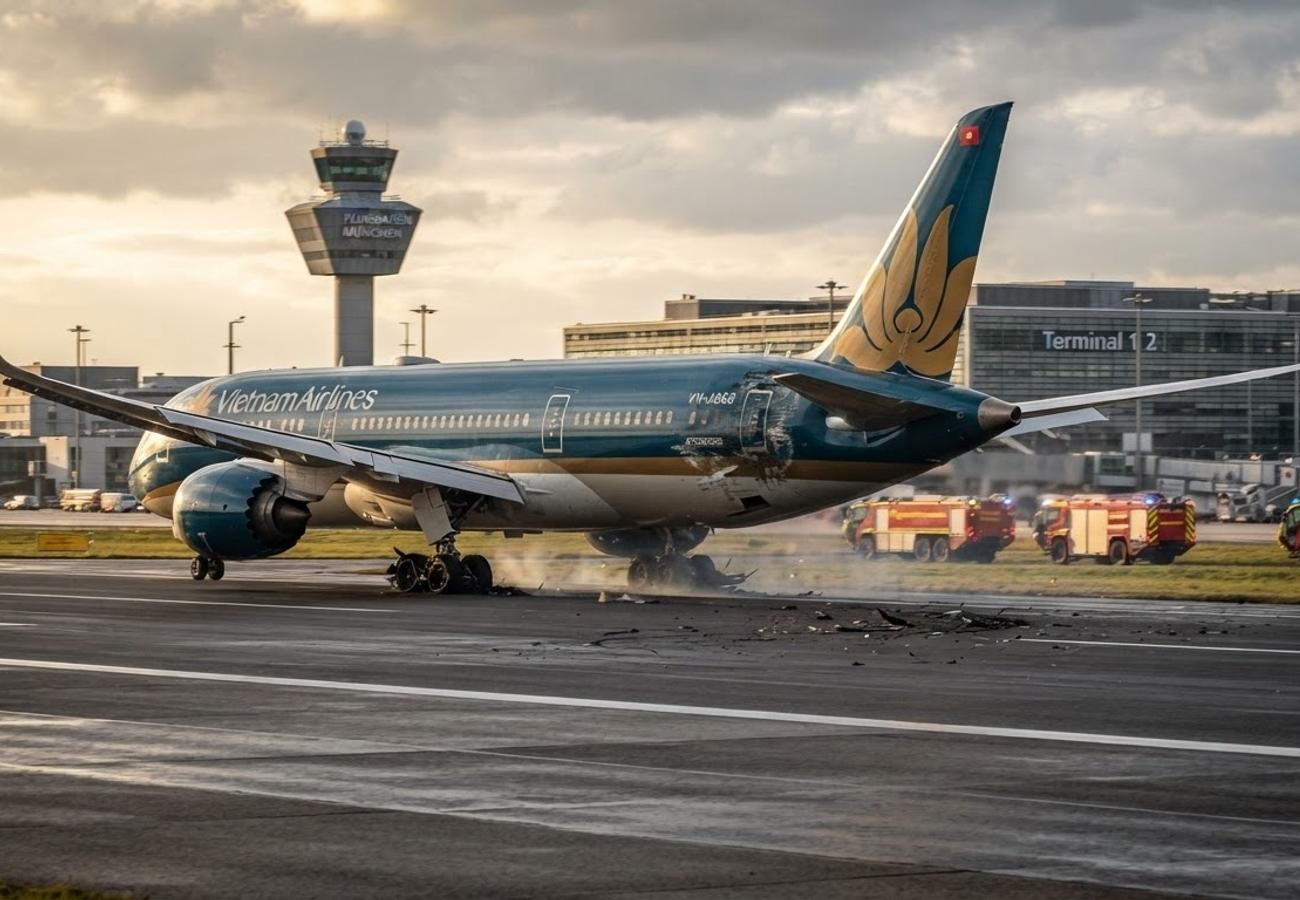
Image generated by AI
A Vietnam Airlines Boeing 787-9 experienced a severe tailstrike during takeoff from Munich, forcing an emergency overweight landing that left multiple tires shredded.
On August 15, 2026, flight VN34, bound for Hanoi, was forced to abort its journey shortly after departure. The incident highlights the high-stress physics of long-haul departures and the rigorous safety protocols required when structural integrity is compromised.
Late Rotation Leads to Runway Contact
The incident began during the takeoff roll at Munich Airport’s northern runway. According to flight tracking data and eyewitness accounts, the Boeing 787-9 accelerated for an unusually long distance before rotating.
Visual evidence shared on social media indicates the aircraft lifted off very close to the end of the runway, with visible sparks and dust trailing the aft fuselage. This late rotation resulted in a tailstrike, where the rear of the aircraft makes direct contact with the runway surface.
Because tailstrikes can cause critical damage to the pressure bulkhead and rear structural frames, the flight crew opted for a conservative safety response. Rather than continuing the long-haul trek to Hanoi, the pilots entered a holding pattern near Munich.
Emergency Overweight Landing and Tire Failure
To ensure a safe return, the crew performed extended loops around the airport. This maneuver is a standard fuel burn-off procedure designed to reduce the aircraft's total mass before landing.
Despite these efforts, the aircraft remained significantly above its normal landing weight. When the Boeing 787-9 finally touched down, the extreme weight combined with heavy braking led to catastrophic tire failure.
Observers reported that multiple tires on one landing gear bogie were completely shredded, leaving significant rubber debris across the runway. Airport fire and rescue services were on high alert, with trucks positioned along the runway to respond to any potential fire resulting from the friction and heat of the overweight landing.
Operational Impact and Route Significance
The aircraft was able to vacate the runway under its own power, but the incident caused temporary disruptions to Munich Airport operations. Debris clearance and the management of the disabled aircraft led to delays and diversions for other flights using the northern runway complex.
The Munich–Hanoi route is a strategic link for Vietnam Airlines, serving as a primary gateway for both business and leisure travelers between southern Germany and Vietnam. With the involved Boeing 787-9 now grounded for extensive structural inspections, the airline may face short-term scheduling adjustments.
Flight Incident Summary: VN34
| Detail | Specification |
|---|---|
| Flight Number | VN34 |
| Route | Munich (MUC) $\rightarrow$ Hanoi (HAN) |
| Date of Incident | August 15, 2026 |
| Aircraft Model | Boeing 787-9 |
| Primary Event | Tailstrike during late rotation |
| Landing Status | Emergency Overweight Landing |
| Damage Reported | Aft fuselage contact; shredded main-gear tires |
| Casualties | None |
The Mechanics of Tailstrikes in Long-Haul Aviation
A tailstrike typically occurs during two phases of flight: an over-rotated takeoff or an over-flared landing. For intercontinental flights like VN34, aircraft often take off at or near maximum takeoff weight (MTOW), which reduces the margin for error during rotation.
While the Boeing 787-9 is equipped with protective skid plates to mitigate minor contact, a severe strike necessitates a "return to field" protocol. The resulting overweight landing puts immense pressure on the landing gear, explaining why the tires on flight VN34 failed during the rollout.
Safety Investigation and Next Steps
National accident agencies in Europe, alongside Boeing and Vietnam Airlines, are expected to launch a formal inquiry. Investigators will likely analyze:
- Flight Data Recorder (FDR) and Cockpit Voice Recorder (CVR): To determine the exact rotation speed and crew communication.
- Performance Calculations: To check if the takeoff weight and balance were correctly calculated for the runway length.
- Environmental Factors: Assessing if wind or weather contributed to the late rotation.
For the passengers of flight VN34, the event resulted in significant travel delays. While the airline has not released specific rebooking data, standard procedure involves transferring passengers to alternative hubs or subsequent flights on the Munich–Hanoi corridor.
The incident serves as a stark reminder of the layered safety systems in modern aviation, where a potentially catastrophic structural failure was mitigated by disciplined crew response and emergency airport coordination.
Key Takeaways
- Incident: Vietnam Airlines flight VN34 suffered a tailstrike during a late rotation takeoff from Munich on August 15, 2026.
- Outcome: The Boeing 787-9 performed an emergency overweight landing, resulting in shredded tires but no injuries.
- Cause: Late rotation caused the aft fuselage to contact the runway; subsequent landing weight exceeded standard limits.
- Impact: Temporary runway disruptions at Munich Airport and the grounding of one Boeing 787-9 for structural repairs.
FAQ
What is a tailstrike? A tailstrike occurs when the rear fuselage of an aircraft contacts the runway surface, usually due to rotating too steeply during takeoff or flaring too high during landing.
Why did the tires shred during landing? The aircraft was landing "overweight," meaning it had not burned enough fuel to reach its standard maximum landing weight. This increased mass created extreme stress on the tires during braking.
Were there any injuries? No injuries were reported among the passengers or crew.
Related Travel Guides
Disclaimer
This article is for informational and educational purposes only. It does not constitute legal, financial, or professional advice. While we strive to provide accurate and up-to-date information, travel policies, regulations, and conditions change rapidly. Always verify information with official sources before making travel decisions. Nomad Lawyer makes no representations about the accuracy, reliability, completeness, or suitability of the information provided. Readers should consult qualified professionals for advice specific to their circumstances. The views expressed in this article are those of the author and do not necessarily reflect the views of Nomad Lawyer.
Kunal K Choudhary
Co-Founder & Contributor
A passionate traveller and tech enthusiast. Kunal contributes to the vision and growth of Nomad Lawyer, bringing fresh perspectives and driving the community forward.
Learn more about our team →