
Vietnam Airlines Boeing 787-9 Suffers Tail Strike and Landing Gear Failure at Munich Airport in 2026
A Vietnam Airlines Boeing 787-9 flight from Munich to Hanoi returned for an emergency landing following a suspected tail strike and severe landing gear damage.

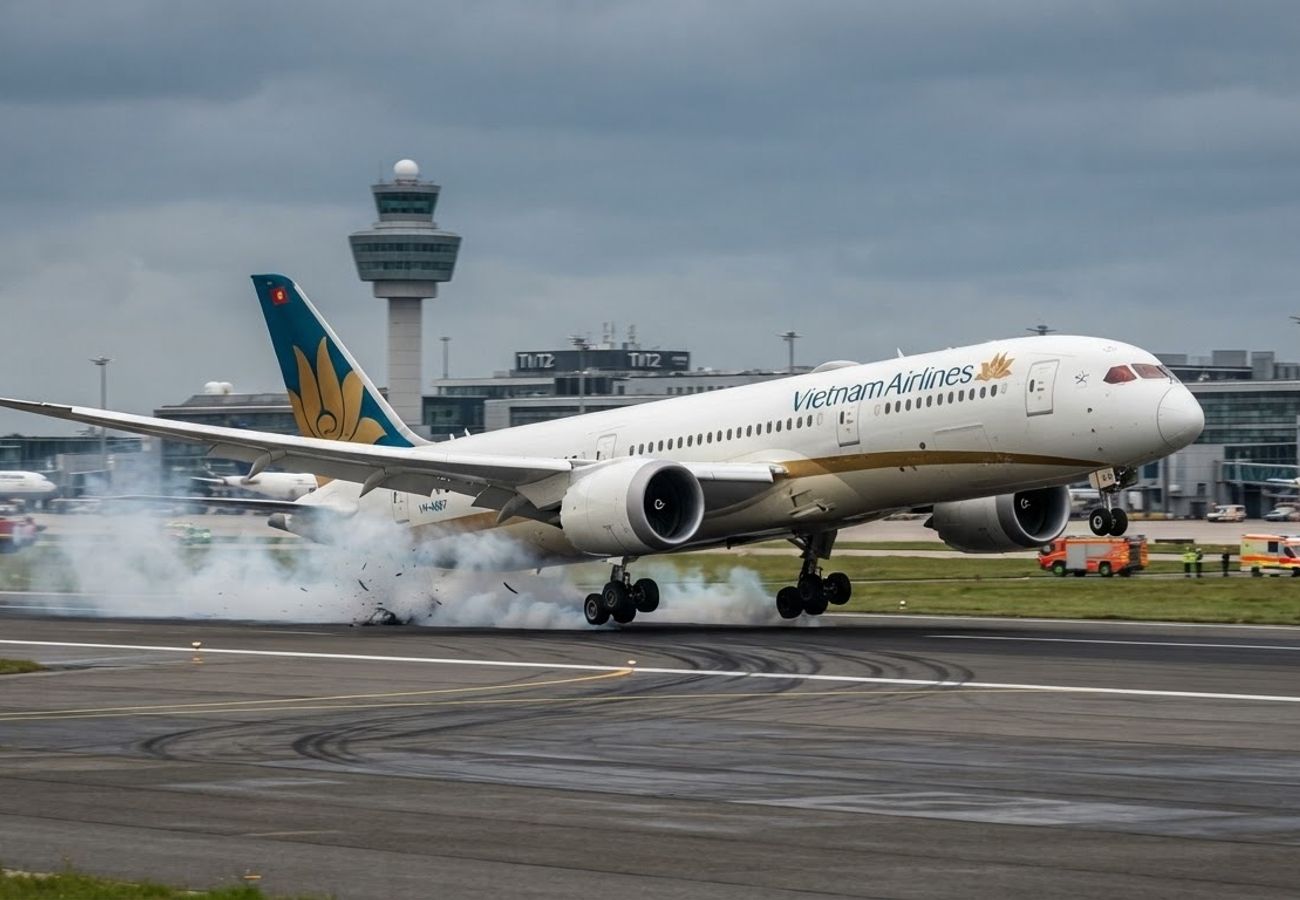
Image generated by AI
A Vietnam Airlines Boeing 787-9 destined for Hanoi was forced to make an emergency return to Munich Airport on August 15, 2026, after a suspected tail strike during takeoff. The incident resulted in visible structural damage to the fuselage and the destruction of multiple tires upon landing, though no injuries were reported among the passengers or crew.
The event, involving flight VN34 (registration VN-A867), triggered a series of emergency protocols including fuel dumping and the temporary closure of a primary runway at one of Europe's busiest aviation hubs. The aircraft utilized nearly the entire length of the 4,000-meter Runway 26L before successfully becoming airborne, a sequence that has since drawn intense scrutiny from aviation analysts.
Late Liftoff and Suspected Tail Strike on Runway 26L
Flight tracking data and eyewitness footage indicate that the Dreamliner experienced an unusually long takeoff roll. Observers noted that the aircraft remained on the ground for a significant portion of Runway 26L, eventually lifting off with a climb gradient that appeared abnormally low for a widebody aircraft of its class.
Amateur video captured during the departure shows a distinct plume of smoke or dust emanating from the rear of the aircraft just as it rotated. This visual evidence is highly consistent with a tail strike, a dangerous occurrence where the aft section of the fuselage makes physical contact with the runway surface during the rotation phase of takeoff.
Industry observers suggest the aircraft may have crossed the runway end lights at the moment of liftoff or immediately thereafter. While official confirmation from aviation authorities is pending, the proximity to the runway threshold suggests a critical margin of error during the departure sequence.
Emergency Fuel Dumping and Visual Inspection Flight
Following the precarious departure, VN34 did not proceed toward its planned cruise altitude for the journey to Hanoi. Instead, the aircraft leveled off at a low altitude over the Munich metropolitan area. Flight data reveals that the crew entered a holding pattern for approximately one to two hours.
This holding maneuver is a standard safety procedure used to burn off or dump excess fuel. Reducing the aircraft's weight is essential for an emergency landing to prevent structural stress and minimize the risk of fire upon touchdown.
Reports from the aviation community indicate that the pilots performed at least one low-altitude pass over the airport. This maneuver is typically utilized to allow ground controllers and engineers to visually inspect the aircraft for external damage, specifically focusing on the tail assembly and control surfaces, before the crew commits to a landing.
Landing Gear Failure and Runway 26R Disruption
The aircraft eventually repositioned to land on the northern runway, 26R. The touchdown was marked by significant distress; witness videos show substantial smoke and debris erupting from the left main landing gear area. The force of the landing caused severe stress to the wheels and tires, leading to a partial failure of the gear assembly.
Upon coming to a halt at the runway exit, photographs revealed that multiple tires on the left main gear had been shredded. The aircraft exhibited a pronounced list to the left side due to the collapsed or damaged tires. Fragments of rubber and metallic debris were scattered across the landing path, creating a significant risk of foreign object debris (FOD) for other operating aircraft.
The emergency landing necessitated the temporary closure of one of Munich's parallel runways for an extensive cleanup and safety inspection. This closure caused a ripple effect of delays and diversions for other flights during the peak summer travel window. Passengers from VN34 were evacuated via buses from a remote stand rather than being directed to a terminal gate, a common practice for aircraft with suspected structural or mechanical failures.
Structural Damage and Maintenance Challenges
High-resolution imagery shared by aviation experts shows extensive abrasion and scarring along the lower rear fuselage of VN-A867. The damage extends to the horizontal and vertical stabilizers, indicating a high-energy impact during the initial takeoff rotation.
Maintenance professionals suggest that while Boeing has a history of repairing tail strike damage on the 787-9, the complexity of this specific case is heightened by the combined damage to the fuselage and the landing gear. The aircraft remains grounded in Munich, awaiting a comprehensive evaluation by insurance assessors and technical engineering teams.
The decision to repair or decommission the airframe will depend on the depth of the structural compromise and the cost of restoration relative to the aircraft's remaining operational lifespan.
Safety Analysis and Investigation Focus
While a formal cause has not been released, safety analysts are examining several potential factors:
- Performance Calculations: Investigators are reviewing whether there was an error in weight and balance data or takeoff performance calculations.
- Configuration Errors: The role of flap settings and thrust levels during the takeoff roll is under review.
- Cockpit Coordination: Analysts are looking into the cross-checks performed by the flight crew when the aircraft failed to lift off as expected.
German aviation investigators are expected to analyze the Flight Data Recorder (FDR) and Cockpit Voice Recorder (CVR) to reconstruct the exact sequence of events. Preliminary findings are typically released within a few weeks, though a final report on human and technical factors may take several months.
For the passenger, this incident highlights the critical role of redundant safety systems. Despite a suspected structural failure and a violent landing with shredded tires, the layered design of the Boeing 787 and the crew's adherence to emergency fuel-dumping protocols ensured that all souls on board disembarked safely.
The incident serves as a stark reminder of the precision required in long-haul aviation performance.
Related Travel Guides
Disclaimer
This article is for informational and educational purposes only. It does not constitute legal, financial, or professional advice. While we strive to provide accurate and up-to-date information, travel policies, regulations, and conditions change rapidly. Always verify information with official sources before making travel decisions. Nomad Lawyer makes no representations about the accuracy, reliability, completeness, or suitability of the information provided. Readers should consult qualified professionals for advice specific to their circumstances. The views expressed in this article are those of the author and do not necessarily reflect the views of Nomad Lawyer.
Preeti Gunjan
Contributor & Community Manager
A passionate traveller and community builder. Preeti helps grow the Nomad Lawyer community, fostering engagement and bringing the reader experience to life.
Learn more about our team →