
Valencia and Alicante Lift Flood Curfews as Storm Adam Toll Reaches Four: 22 Roads Severed and Rail Delays
The Generalitat Valenciana lifted stay-at-home curfews across Valencia and Alicante after Storm Adam dumped up to 720 l/m² of rain, though 22 highways remain closed.

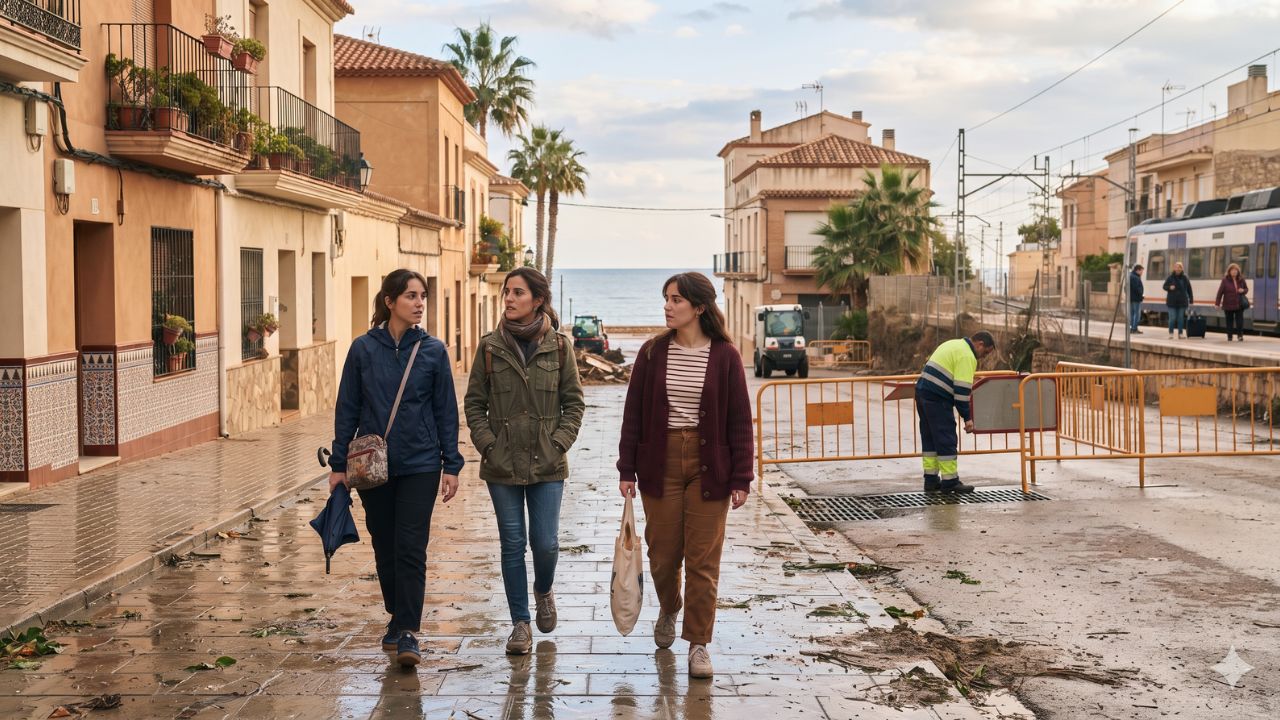
Image generated by AI
With catastrophic rainfall accumulations reaching 720 litres per square metre in Forna and over 600 litres per square metre around Pego, regional emergency authorities have lifted mandatory stay-at-home curfews across 145 municipalities in Valencia and Alicante, even as four storm fatalities and 22 highway closures continue to paralyze Eastern Spain. Although the Generalitat Valenciana 112 Emergency Coordination agency formally rescinded the final confinement orders on Monday evening, October 19, 2026, transportation networks across the La Safor and Marina Alta coastal regions face prolonged operational gridlock. The aftermath of Storm Adam has washed out arterial road bridges, overwhelmed drainage infrastructure, and forced the Military Emergency Unit (UME) into extensive localized rescue missions across trapped communities.
Meteorological Extremes and the Mechanics of the Confinement Rollback
The catastrophic downpours that inundated the Valencian Community were concentrated within coastal and sub-coastal valleys where Mediterranean atmospheric moisture collided with cold air masses. The resulting deluge triggered severe riverine flash floods, most notably when the Girona River breached its banks around Els Poblets, inundating thoroughfares and turning residential avenues into impassable channels. The crisis forced authorities to order shelter-in-place curfews across more than 100 communities during peak storm intensity before narrowing restrictions down to a final group of eight municipalities released on Monday evening.
Those final eight municipalities freed from municipal confinement span two provinces:
- Valencia Province: Bellreguard, Daimús, Miramar, Oliva, and Piles.
- Alicante Province: Xàbia (Jávea), Pego, and Els Poblets.
While the physical containment orders have ended, civil protection authorities emphasize that the legal right to exit homes does not equate to unimpeded transportation mobility. Coastal towns including Gandia, Dénia, Oliva, and Xàbia report extensive mud deposits, submerged underpasses, and destabilized road embankments.
The storm’s lethal toll expanded across eastern and northeastern Spain, claiming four verified lives. Fatalities were registered in Oliva, Cabrera de Mar, and near Sagunto, where maritime search-and-rescue teams recovered the body of a woman who was swept out to sea during severe gale-force surf on Sunday evening. The geographic spread of these incidents demonstrates that peripheral storm hazards persisted well beyond the municipal curfew boundaries.
Infrastructure Damage Assessment: Severed Roads, Transit Lines, and Regional Alerts
The physical recovery phase highlights deep structural vulnerabilities across Spanish intercity and regional transit networks. As state meteorological agency Agencia Estatal de Meteorología (AEMET) downgraded alerts across the central Mediterranean coastline, secondary storm bands shifted risks into neighboring autonomous communities.
The table below synthesizes the municipal impact, meteorological records, transportation interruptions, and current operational status across the storm-impacted regions of Spain as of October 20, 2026.
| Administrative Region | Rainfall Accumulations & Fatalities | Primary Municipalities Affected | Active Infrastructure Disruptions | Official Operational Status |
|---|---|---|---|---|
| Valencia Province | 720 l/m² (Forna); fatalities in Oliva & Sagunto | Bellreguard, Daimús, Miramar, Oliva, Piles, Gandia | 22 roads closed; Renfe Cercanías C1 & C2 disrupted | Confinements lifted; non-essential travel discouraged |
| Alicante Province | >600 l/m² (Pego area); Girona River overflow | Xàbia, Pego, Els Poblets, Dénia | Secondary road washouts; structural bridge damage | Confinements lifted; UME demobilization underway |
| Catalonia | Intense localized cloudbursts; death in Cabrera de Mar | Coastal Barcelona & Maresme districts | Localized street flooding; commuter rail slowdowns | AEMET Orange Warning active; heavy rains continuing |
| Andalusia | Intense precipitation along southern mountain ranges | Eastern and interior Andalusian sectors | River swelling; localized rural route blockades | AEMET Orange Alert maintained across key sectors |
| Balearic Islands | Moderate to heavy storm surges | Mallorca, Menorca, Ibiza | Maritime ferry delays; port access realignments | Weather warnings downgraded across most islands |
On the rail network, national operator Renfe Cercanías and infrastructure manager Adif reported severe trackbed washouts and signaling system failures along the vital Cercanías C1 and C2 lines. These routes connect central Valencia with major regional population and tourist hubs including Gandia and Xàtiva. Commuters and international travelers relying on rail transfers to reach coastal resorts face indefinite service cancellations, bustitutions on select legs, and significant transit delays.
Expert Analysis: Institutional Liability, Accommodation Access, and Passenger Rights
For travelers booking this route, the direct consequence of Storm Adam’s aftermath is the acute disconnect between legal confinement status and physical property accessibility. In popular vacation hubs like Dénia, Oliva, and Xàbia, numerous international visitors and vacation rental occupants discovered that while their municipalities were legally declared open, private access roads, underground parking facilities, and beachfront campsites remained submerged beneath stagnant water and thick river sediment.
The pricing pressure this creates means holidaymakers face unexpected re-accommodation costs while disputing cancellation penalties. Under Spanish consumer regulations and European Union travel directives, hoteliers and short-term rental hosts are legally required to refund non-refundable bookings only when a government authority issues an active force majeure decree or formal travel ban. Once the Generalitat Valenciana lifted the official confinement orders, standard contractual terms reactivated. Consequently, travelers attempting to cancel stays at properties that are physically intact—but accessible only via severed municipal roads—must navigate complex insurance disputes regarding whether access failure constitutes host non-performance.
In parallel, corporate car rental agencies operating out of Valencia Airport (VLC) and Alicante–Elche Miguel Hernández Airport (ALC) are restricting vehicle insurance coverage. Operating a rental vehicle onto officially closed secondary routes or through standing floodwaters voids standard collision damage waivers (CDW), exposing travelers to full financial liability for hydrostatic engine locks and chassis damage.
Transportation analysts point out that ground saturation along the Marina Alta corridor ensures that rockfall and landslide hazards will persist for days after rainfall ceases. Travelers must bypass GPS navigation algorithms that frequently direct drivers toward flooded secondary shortcuts, relying instead on official updates from regional traffic centers before commencing transfers.
Key Takeaways
- 145 Municipal Curfews Lifted: The Generalitat Valenciana fully removed stay-at-home orders across the final eight municipalities in Valencia and Alicante on October 19.
- Extreme Precipitation Records: Forna recorded an extraordinary 720 litres per square metre, while Pego registered over 600 litres per square metre, causing the Girona River to overflow.
- Four Fatalities Confirmed: Storm Adam claimed four lives across Spain, including deaths in Oliva, Sagunto, and Cabrera de Mar.
- 22 Valencia Roads Inaccessible: Over twenty regional thoroughfares remained closed due to structural bridge damage, mudslides, and standing floodwaters.
- Renfe Rail Interrupted: Cercanías commuter rail lines C1 and C2 between Valencia, Gandia, and Xàtiva suffered major schedule suspensions due to track damage.
FAQ: Valencia and Alicante Flood Disruptions 2026
Are tourists permitted to travel to Valencia and Alicante now?
Yes, all mandatory stay-at-home curfews have been officially lifted. However, regional emergency services strongly discourage non-essential travel through heavily damaged coastal and rural sectors.
Are Renfe Cercanías trains operating normally to Gandia?
No. Cercanías lines C1 and C2 continue to experience cancellations and severe delays between Valencia, Gandia, and Xàtiva due to flooded tracks and signaling damage.
Can rental car insurance be voided by driving through flooded areas?
Yes. Driving a rental vehicle onto officially closed roads or into standing water constitutes negligence and automatically invalidates standard collision damage waivers and roadside assistance coverage.
What weather alerts remain active in Spain?
While Valencian warnings have been downgraded, AEMET maintains Orange Warnings for severe rainfall across parts of Catalonia and Andalusia.
Travelers navigating eastern Spain must verify physical property access with accommodation hosts and confirm highway openings prior to departure.
Related Travel Guides
Disclaimer
This article is for informational and educational purposes only. It does not constitute legal, financial, or professional advice. While we strive to provide accurate and up-to-date information, travel policies, regulations, and conditions change rapidly. Always verify information with official sources before making travel decisions. Nomad Lawyer makes no representations about the accuracy, reliability, completeness, or suitability of the information provided. Readers should consult qualified professionals for advice specific to their circumstances. The views expressed in this article are those of the author and do not necessarily reflect the views of Nomad Lawyer.
Raushan Kumar
Founder & Lead Developer
Full-stack developer with 11+ years of experience and a passionate traveller. Raushan built Nomad Lawyer from the ground up with a vision to create the best travel and law experience on the web.
Learn more about our team →