
Schiphol and Frankfurt Confront 5-Hour Border Queues as EU Entry/Exit System Strains Schengen Hubs
Passport queues reaching five hours across Amsterdam Schiphol, Frankfurt, and Milan Linate highlight operational strain following the rollout of the EU Entry/Exit System.

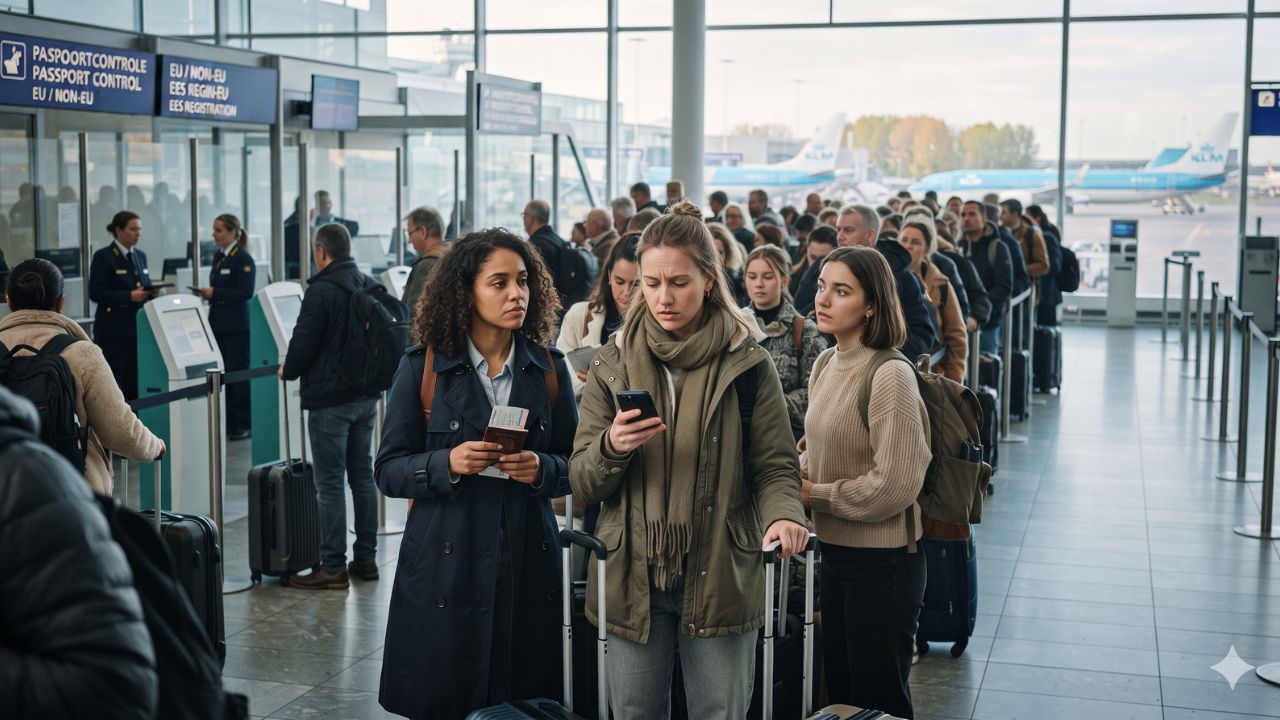
Image generated by AI
With passport-control wait times routinely exceeding two hours and peak bottlenecks reaching an unprecedented five hours at major external Schengen checkpoints, Europe’s primary aviation hubs are confronting acute operational gridlock under the European Union’s new Entry/Exit System (EES). Formal joint warnings issued on October 12, 2026, by Airports Council International Europe (ACI EUROPE) alongside Airlines for Europe (A4E) confirm that mandatory biometric data capture—encompassing digital facial scans and four-finger fingerprint enrollments for non-EU travelers—has overwhelmed border-police staffing and physical terminal space across Germany, the Netherlands, France, Italy, Spain, and Portugal. The resulting congestion has triggered mass misconnects, extended flight departure holds, and widespread baggage sorting delays.
The Biometric Transition Bottleneck: How EES Restructures External Border Control
The systemic cause of these passport-processing delays stems from the fundamental overhaul of Schengen Area frontier management. Fully operational since April 10, 2026, the European Union's automated Entry/Exit System formally replaced physical ink passport stamping with centralized digital travel dossiers under regulations managed by the European Commission Migration and Home Affairs directorate. Applying to short-stay visa-exempt and visa-holding third-country nationals—including millions of regular travelers from the United Kingdom, the United States, Canada, Australia, and India—the architecture requires initial biometric registration at the physical port of entry.
While automated biometric e-gates were engineered to expedite passenger screening, the initial physical enrollment process requires substantial officer intervention. First-time arrivals must submit high-resolution facial scans, verify live four-finger biometrics against centralized databases, and answer algorithmic immigration queries regarding itinerary duration and lodging reservations. When intercontinental wide-body arrivals converge within compact morning flight banks, per-passenger processing durations increase from traditional 45-second manual passport checks to three to four minutes per traveler, rapidly exceeding the holding capacity of international arrival halls.
The operational hazard escalated on October 18, 2026, at Amsterdam Airport Schiphol (AMS), when an IT infrastructure malfunction severed automated border-control servers. Dutch Marechaussee border personnel were forced to revert to manual document checks, compounding queue times that had already reached peak summer measurements of 120 minutes on August 14. Because Schiphol functions as a primary transfer gateway for SkyTeam carrier KLM, passport backlogs paralyzed the B-to-C and D-pier transfer corridors, stranding transit passengers attempting to clear border controls between Schengen and non-Schengen departures.
A similar operational breakdown materialized at Milan Linate (LIN) on April 12, 2026, when severe passport-control queues resulted in 122 boarded passengers missing a single Manchester-bound easyJet flight. Terminal congestion has also disrupted Nice Côte d’Azur (NCE), while airport operator Fraport issued passenger alerts on September 29, 2026, warning that autumn school holiday departures at Frankfurt Airport (FRA) would see passport wait times reaching 120 minutes during concentrated international outbound waves.
Airport Congestion Matrix: Documented Delays Across Schengen Hubs
The impact of EES biometric processing varies significantly depending on airport terminal geometry, border-police staffing rosters, and carrier flight bank scheduling.
The table below outlines documented border-control wait times, official warnings, and passenger impacts across primary European aviation gateways as of late October 2026.
| Aviation Gateway | Sovereign Nation | Reported Peak Wait Time | Evidentiary Basis & Regulatory Warning | Primary Impact on Passenger Journey |
|---|---|---|---|---|
| Frankfurt Airport (FRA) | Germany | Peak of 120 minutes | Fraport passenger warning (Sep 29); Qsensor summer data | Severe delay on non-Schengen transfers and holiday banks |
| Amsterdam Schiphol (AMS) | Netherlands | Peak of 120 minutes; 5h extremes | Official Schiphol notices (Aug 14, Oct 18); server outage | Multi-pier transfer gridlock; missed onward KLM connections |
| Munich Airport (MUC) | Germany | Peak of 60 minutes (vs. 31m prior) | Qsensor data published August 2026 | Tight 45-minute intercontinental transfers compromised |
| Milan Linate (LIN) | Italy | Hours-long queues; unverified cap | Documented incident on April 12, 2026 | 122 easyJet passengers failed to board Manchester flight |
| Nice Côte d’Azur (NCE) | France | Unverified multi-hour queues | Terminal photographic evidence, early October 2026 | Severe physical congestion blocking duty-free circulation |
| Lisbon Airport (LIS) | Portugal | Extensive morning departure queues | A4E airline operational reports (July–October 2026) | Long-haul transatlantic and UK departure gate delays |
| Spanish Holiday Hubs | Spain (ALC, AGP, PMI, TFS) | 60 to 90-minute holiday spikes | Which? consumer report (July 2026); UK traveler audits | British leisure return flights holding for boarding clearance |
| Paris Gateways (CDG, BVA) | France | Intermittent 90+ minute delays | Border police staffing audits (Autumn 2026) | Terminal 2E transfer bottlenecks during morning arrival banks |
Consumer investigations conducted in July 2026 by British consumer organization Which? highlighted pervasive traveler complaints regarding departure queues at Berlin Brandenburg, Kraków, Lisbon, Málaga, Milan Bergamo, Palma de Mallorca, and Tenerife South. Rather than isolated incidents, the data demonstrates structural processing friction across high-density leisure and hub networks alike.
Expert Analysis: Connection Minimums, Passenger Rights, and Carrier Liability
For travelers booking this route, the direct consequence of biometric border bottlenecks is the collapse of traditional Minimum Connection Times (MCT). Major European network carriers have historically marketed intercontinental itineraries with transfer windows as narrow as 45 to 60 minutes through Frankfurt, Munich, and Amsterdam. In the EES operating environment, an itinerary that requires an arriving passenger from New York, London, or New Delhi to clear external Schengen passport control before catching an intra-European connecting flight to Rome or Barcelona cannot be safely executed within a one-hour window.
The pricing pressure this creates means corporate travel departments and independent fliers must deliberately select wider transfer windows of two-and-a-half to three hours, reducing itinerary efficiency and inflating airfare costs. When passport queues cause travelers to miss connecting flights, complex legal disputes arise under European Regulation EC 261/2004. Under established EU aviation jurisprudence, airlines regularly reject statutory compensation claims for missed connections resulting from border-control queues, citing immigration delays as an extraordinary circumstance outside carrier control. While airlines remain legally obligated under duty-of-care provisions to provide rebooking, meals, and overnight hotel accommodations, passengers bear the unrecoverable cost of lost hotel deposits and missed business engagements at their final destinations.
From an airline operational perspective, border delays trigger cascading network penalties. When dozens of transit passengers are trapped in immigration queues, station managers face a costly operational dilemma: hold the departure gate and forfeit precious airport takeoff slots, or depart on schedule, strand connecting passengers, and absorb the subsequent logistical expense of offloading checked baggage under strict aviation security directives.
Industry bodies ACI EUROPE and A4E are urgently lobbying national interior ministries to deploy emergency contingency protocols. These measures include granting border-police commanders discretionary authority to temporarily suspend fingerprint verification during peak queue surges, installing auxiliary mobile biometric kiosks, and establishing separate dedicated lanes for families and mobility-impaired passengers to restore schedule predictability across European airspace.
Key Takeaways
- Five-Hour Queue Extremes: Joint airline and airport warnings confirm that peak passport-control waiting times have reached up to five hours at stressed European gateways.
- 120-Minute Delays at Major Hubs: Frankfurt and Amsterdam Schiphol documented two-hour queue peaks under biometric EES processing and technical server disruptions.
- 122 Passengers Stranded in Milan: Severe passport-control queues at Milan Linate prevented over a hundred passengers from boarding an easyJet departure to Manchester.
- Biometric Registration Impact: First-time biometric registration under the EU Entry/Exit System increases individual check-in processing times from 45 seconds to several minutes per traveler.
- Schengen Transfers Compromised: Minimum connection times of 45 to 60 minutes are no longer viable for itineraries transitioning between non-Schengen and Schengen flights.
FAQ: European Airport EES Border Delays 2026
Who is subject to the new EU Entry/Exit System checks?
All non-EU passport holders traveling for short stays (up to 90 days in any 180-day period) without EU residency permits must register biometrics, including citizens from the UK, US, Canada, Australia, and India.
How much transfer time should I allow when connecting in Europe?
Travelers connecting between non-Schengen and Schengen flights through hubs like Frankfurt, Amsterdam, or Munich should book itineraries with a minimum transfer cushion of two-and-a-half to three hours.
Does travel insurance cover missed flights caused by long passport queues?
Standard travel insurance policies frequently exclude immigration and border-control delays. Check whether your policy includes specific miss-connection riders covering government agency delays.
Are EU citizens affected by the Entry/Exit System queues?
EU, EEA, and Swiss citizens are exempt from EES biometric registration and utilize separate automated e-gates, though terminal crowd congestion can occasionally spill across shared passport halls.
International travelers transiting European airports must verify terminal connection requirements and monitor official airport queue guidance prior to departure.
Related Travel Guides
The 10 Fastest Connecting Airports in Europe, According To Reddit
Disclaimer
This article is for informational and educational purposes only. It does not constitute legal, financial, or professional advice. While we strive to provide accurate and up-to-date information, travel policies, regulations, and conditions change rapidly. Always verify information with official sources before making travel decisions. Nomad Lawyer makes no representations about the accuracy, reliability, completeness, or suitability of the information provided. Readers should consult qualified professionals for advice specific to their circumstances. The views expressed in this article are those of the author and do not necessarily reflect the views of Nomad Lawyer.
Kunal K Choudhary
Co-Founder & Contributor
A passionate traveller and tech enthusiast. Kunal contributes to the vision and growth of Nomad Lawyer, bringing fresh perspectives and driving the community forward.
Learn more about our team →