
Uzbekistan Turns to AI and Builds New Tourist Town as Khiva Manages Tenfold Surge in Foreign Visitors
Uzbekistan Turns to AI and Builds New Tourist Town as Khiva Manages Tenfold Surge in Foreign Visitors

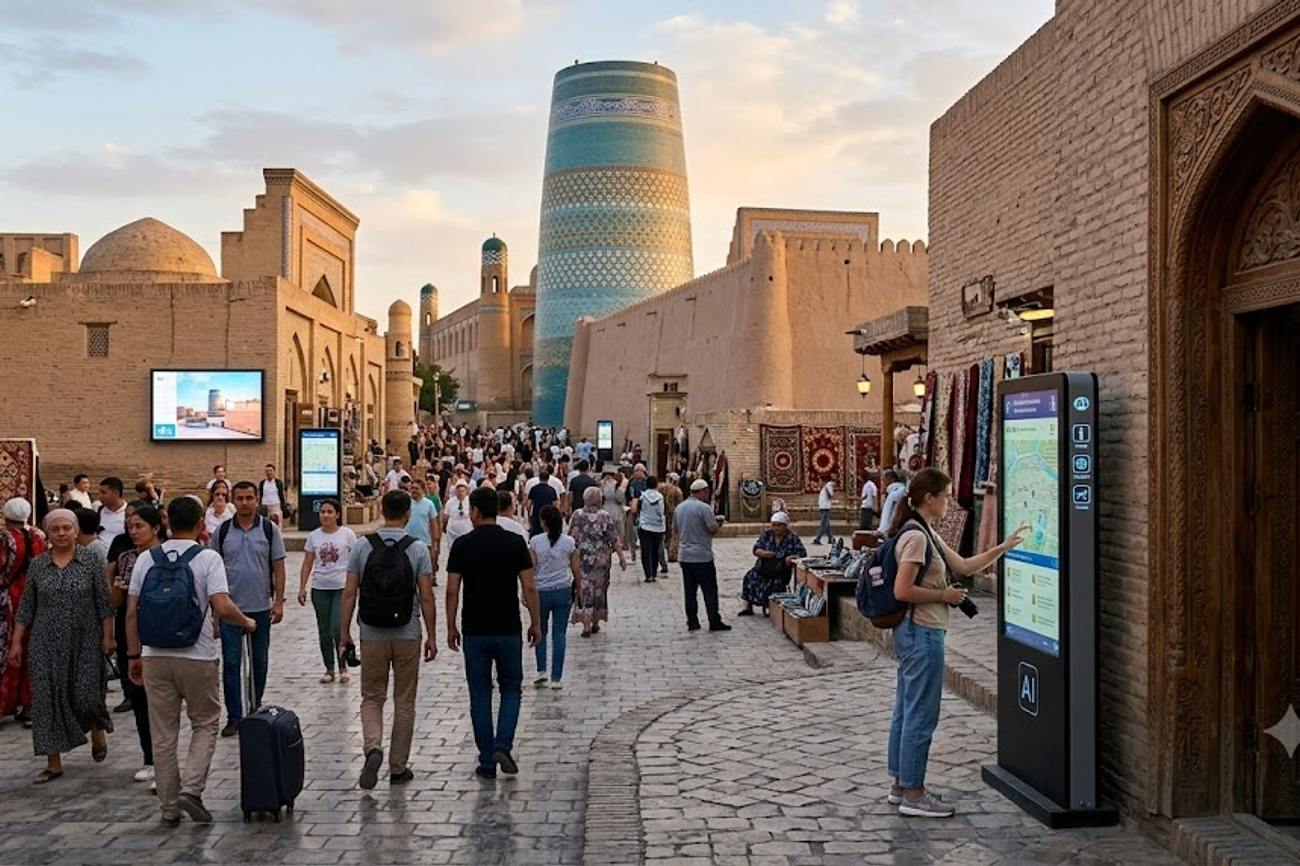
Image generated by AI
[Khiva, August 2026] — Uzbekistan is deploying artificial intelligence and constructing a 12.3-hectare "tourist town" to combat severe overtourism in the historic city of Khiva. The initiative follows a massive surge in arrivals to the Khorezm region, where foreign visitor numbers have increased tenfold between 2021 and 2026.
The strategy, unveiled by the Presidential Administration of Uzbekistan, aims to divert foot traffic away from the densely packed Ichan-Kala State Museum-Reserve. By integrating AI-driven flow analysis and expanding physical infrastructure, the government intends to protect the architectural integrity of the Silk Road site while continuing to scale its tourism economy.
The AI Integration Strategy
The push toward "smart tourism" is the result of a strategic partnership between the Tourism Committee of the Republic of Uzbekistan and the Korea Tourism Organization. The project was born from the KOPIST sustainable-tourism cooperation programme, where Uzbekistan’s proposal for AI-managed tourist flows won first place in a June competition among 10 nations.
The implementation concept focuses on the Ichan-Kala historic center, utilizing a network of sensors to track visitor movement in real time. This data will feed into an AI engine designed to identify bottlenecks and suggest alternative routes to bypass the city's most congested central streets. To guide tourists without damaging the ancient monuments, the government is installing "smart" navigation signs.
Beyond logistics, the AI project includes a professional development component, providing specialized training for local artisans and museum-reserve staff to better integrate with the new digital management system. The overarching goal is to extend the average length of visitor stays and ensure that economic gains are distributed across a wider array of local businesses rather than being concentrated in a few high-traffic zones.
Regional Impact and Infrastructure Scale
The pressure on Khiva is a microcosm of a national tourism explosion. Data from the National Statistics Committee shows that 6,565,410 foreign tourists visited Uzbekistan between January and June 2026, representing a 24.9% increase over the same period in 2025. By August 2026, total foreign arrivals reached 9.1 million, a year-on-year increase of 21.1%.
This growth has fueled a massive expansion in the Khorezm region's hospitality sector. Over the last nine years, 280 new hotels and guesthouses have been constructed, resulting in a quadrupling of total accommodation capacity.
The impact of this growth is detailed across several key metrics:
| Indicator | Current Figure (2026) | Growth/Scale |
|---|---|---|
| Total Foreign Tourists (Jan-Aug) | 9.1 Million | +21.1% Year-on-Year |
| Tourism-Service Exports (Jan-Aug) | US$4.6 Billion | +53.5% Increase |
| Khorezm Visitor Growth | N/A | 10x increase (2021-2026) |
| New Khorezm Accommodations | 280 units | Quadrupled capacity |
| New Tourist Town Area | 12.3 Hectares | New development |
The surge is driven by a diversifying international market. Arrivals from China have grown 2.3 times, Malaysia 2 times, and Japan 1.5 times compared to previous levels, while US visitor numbers have risen 1.4 times.
What This Means for Travelers
For the individual traveler, these changes shift the Khiva experience from a concentrated "museum-city" visit to a more distributed regional tour.
Immediate impacts include:
- Reduced Crowding: Visitors can expect fewer bottlenecks in Ichan-Kala as AI-driven navigation redirects crowds to underutilized streets and sites.
- New Accommodation Options: The 12.3-hectare tourist town will provide a modern alternative to traditional guesthouses, featuring new hotels, restaurants, and retail hubs outside the historic core.
- Faster Transit: The journey from the airport to the city has been slashed. A new 11-kilometer rail link now connects Urgench International Airport to the railway station, reducing travel time from 80 minutes to approximately 40 minutes.
- Modern Amenities: Travelers will find updated transit options, including new trolleybuses and a six-car CR200J electric train capable of carrying 400 passengers per trip.
The "Tourist Town" and Future Expansion
The 12.3-hectare international tourist town is the physical anchor of this management strategy. Reviewed by President Shavkat Mirziyoyev on August 17, the development is designed to act as a "pressure valve" for the historic center.
The site will feature:
- A dedicated museum and pedestrian-only zones.
- Integrated green spaces, fountains, and internal canals.
- Sustainable infrastructure, including solar-panel canopies for all parking areas.
- A diverse mix of service businesses and retail outlets.
The government expects the town to create thousands of new jobs, though specific employment figures have not yet been released. By creating a secondary hub of activity, Uzbekistan hopes to move away from the "short-stay" model that has previously hindered the region's economic potential.
This infrastructure push is supported by broader aviation growth. Uzbekistan’s airports handled 8.15 million passengers in the first half of 2026, a 16% increase. Urgench, the primary gateway to Khiva, saw a specific passenger growth rate of 24%, necessitating the rapid deployment of the new rail and trolleybus networks to prevent airport-to-city gridlock.
FAQ: Khiva Tourism Management 2026
Will the AI system track individual tourists? The system uses sensors to monitor general "flows" and movement patterns to manage congestion. The primary goal is real-time traffic management and the protection of cultural heritage sites, not individual surveillance.
How does the new tourist town affect the historic Ichan-Kala? The town is designed to divert the "load" of visitors. By providing hotels, shopping, and dining in a modern 12.3-hectare zone, the government reduces the physical wear and tear on the ancient monuments of the walled city.
Is the travel time from Urgench Airport to Khiva still the same? No. The new 11-kilometer railway connection and CR200J electric trains have reduced the transit time from 80 minutes down to approximately 40 minutes.
Are there new flight options available for this region? While specific new routes weren't listed, Urgench International Airport has seen a 24% increase in passenger traffic, indicating significantly higher capacity and frequency of flights into the Khorezm region.
Uzbekistan is betting that high-tech diversion and massive infrastructure expansion can save its ancient cities from their own popularity.
#Khiva2026 #IchanKala #UzbekistanTourism #UrgenchAirport #SmartTourismAI #KOPIST
Related Travel Guides
- US Urban Tourism Rebounds as Las Vegas, Nashville, and Philadelphia Drive Search Surges Across Multi-Billion-Dollar Markets
- Beyond the Canal: How Panama's Shift to Eco-Adventure and Cultural Tourism Is Redefining Central American Travel
- Las Vegas Rebounds With 2.7% Visitor Growth and 77.2% Hotel Occupancy Despite Escalating Resort Fees and Travel Costs
Disclaimer
This article is for informational and educational purposes only. It does not constitute legal, financial, or professional advice. While we strive to provide accurate and up-to-date information, travel policies, regulations, and conditions change rapidly. Always verify information with official sources before making travel decisions. Nomad Lawyer makes no representations about the accuracy, reliability, completeness, or suitability of the information provided. Readers should consult qualified professionals for advice specific to their circumstances. The views expressed in this article are those of the author and do not necessarily reflect the views of Nomad Lawyer.
Raushan Kumar
Founder & Lead Developer
Full-stack developer with 11+ years of experience and a passionate traveller. Raushan built Nomad Lawyer from the ground up with a vision to create the best travel and law experience on the web.
Learn more about our team →