US National Parks in Autumn: Ghost Tours and Bat Flights Transform Evening Tourism in New Mexico, Colorado, and Beyond

Evening heritage and wildlife activities across US national park gateways bridge daytime wilderness exploration with nighttime tourism economies
[ESTES PARK, Oct 29, 2026] — A growing seasonal tourism movement across the United States is pairing daytime national park exploration with after-dark heritage experiences, from Brazilian free-tailed bat flights at New Mexico's Carlsbad Caverns to paranormal walking tours at Colorado's historic Stanley Hotel, expanding the economic footprint of autumn travel across gateway communities.
[!NOTE] Seasonal Travel Snapshot: Combining daytime wilderness visits with organized evening tours allows autumn travelers to maximize regional itineraries across five key states: New Mexico, Colorado, Arkansas, Maine, and West Virginia. Park visitors can coordinate daytime hikes with separate private bookings, timed vehicle entries, and regional airport transfers across Rocky Mountain, Carlsbad Caverns, Hot Springs, Acadia, and New River Gorge.
US NATIONAL PARKS AUTUMN DAY-TO-NIGHT ITINERARY MATRIX
| Column 1 |
|---|
| [ MORNING / AFTERNOON: FEDERAL PUBLIC LANDS ] |
| - High-Altitude Hiking (Rocky Mountain National Park) |
| - Subterranean Limestone Route (Carlsbad Caverns Big Room) |
| - Historic Forest Bathhouse Trails (Hot Springs National Park) |
| - Coastal Granite & Foliage Vistas (Acadia National Park) |
| - Gorge Rim Exploration (New River Gorge National Park & Preserve) |
| v |
| [ EVENING / AFTER-DARK: GATEWAY COMMUNITY EXPERIENCES ] |
| - Natural Spectacle: Sunset Bat Flight Amphitheatre (Carlsbad, NM) |
| - Literary & Paranormal Lore: The Stanley Hotel Tours (Estes Park, CO) |
| - Thermal Relaxation & Ghost Walks: Downtown Central Avenue (Hot Springs, AR) |
| - Indigenous Cultural Storytelling: Wabanaki Blue-Lantern Walks (Bar Harbor, ME) |
| - Industrial Heritage Folklore: Abandoned Lake Shawnee Park (Mercer County, WV) |
National Parks in Autumn: Extending Outdoor Discovery into the Evening Hours
Autumn travel throughout the United States has traditionally centered on daytime pursuits: driving foliage byways, hiking subalpine trails, and viewing seasonal wildlife migrations. However, national park gateway communities are reshaping autumn itineraries by introducing structured after-dark programming. Rather than retreating to hotels at sunset, visitors are connecting daylight national park excursions with guided nighttime storytelling, thermal wellness, and natural wildlife spectacles.
This shift provides practical benefits for travelers seeking multi-layered vacations. By coordinating daytime park access with evening town experiences, travelers can experience the natural ecology of protected federal lands alongside the folklore and hospitality of local communities. Across destinations like Estes Park in Colorado, Bar Harbor in Maine, and Hot Springs in Arkansas, the surrounding towns serve as cultural extensions of the park landscapes.
Travelers must navigate distinct operating structures when planning these integrated itineraries. National parks operate under the jurisdiction of the National Park Service (NPS) with federal entry passes, seasonal weather restrictions, and timed entry reservations. In contrast, evening walking tours, historic hotel programs, and private heritage sites function under independent commercial operators with separate ticketing windows, cash policies, and age restrictions.
OPERATIONAL DUALITY: FEDERAL LANDS VS. GATEWAY TOURS
| Column 1 |
|---|
| FEDERAL PUBLIC LANDS (NPS) GATEWAY EXPERIENCES (PRIVATE / MUNICIPAL) |
| ---------------------------------- ----------------------------------------- |
| - Federal Entrance Passes (America Beautiful)- Independent Commercial Ticket Desks |
| - Timed Vehicle Entry Systems (Recreation.gov)- Strict Age Thresholds (Ages 8+, 10+, 14+, 18+) |
| - Ranger-Led Interpretive Programs - Fixed Capacity Limits (15 to 20 Participants) |
| - Wildlife & Conservation Preservation Rules - Scheduled Evening Departures (e.g., 8:00 PM) |
| - Daylight Dependency & Weather Closures - Historic Folklore, Legends & Architectural Access |
| Destination | State | Associated National Park | Primary Daytime Activity | Primary Evening Experience |
|---|---|---|---|---|
| Carlsbad Area | New Mexico | Carlsbad Caverns National Park | Big Room and Natural Entrance cave hikes | Free outdoor Bat Flight Program at sunset |
| Estes Park | Colorado | Rocky Mountain National Park | Trail Ridge Road scenic drive and elk rut viewing | Stanley Hotel historic ghost and Shining tours |
| Hot Springs | Arkansas | Hot Springs National Park | 26 miles of forested ridge and spring trails | Downtown haunted history walk and bathhouse soaking |
| Bar Harbor | Maine | Acadia National Park | Cadillac Mountain summit and Jordan Pond walks | Indigenous Wabanaki ghost walk and Gilded Age mansion tour |
| Rock, Mercer County | West Virginia | New River Gorge National Park and Preserve | Endless Wall Trail and bridge canyon overlooks | Lake Shawnee abandoned park visits and Dark Carnival |
New Mexico Bat Flights: Natural Wildlife Encounters at Carlsbad Caverns
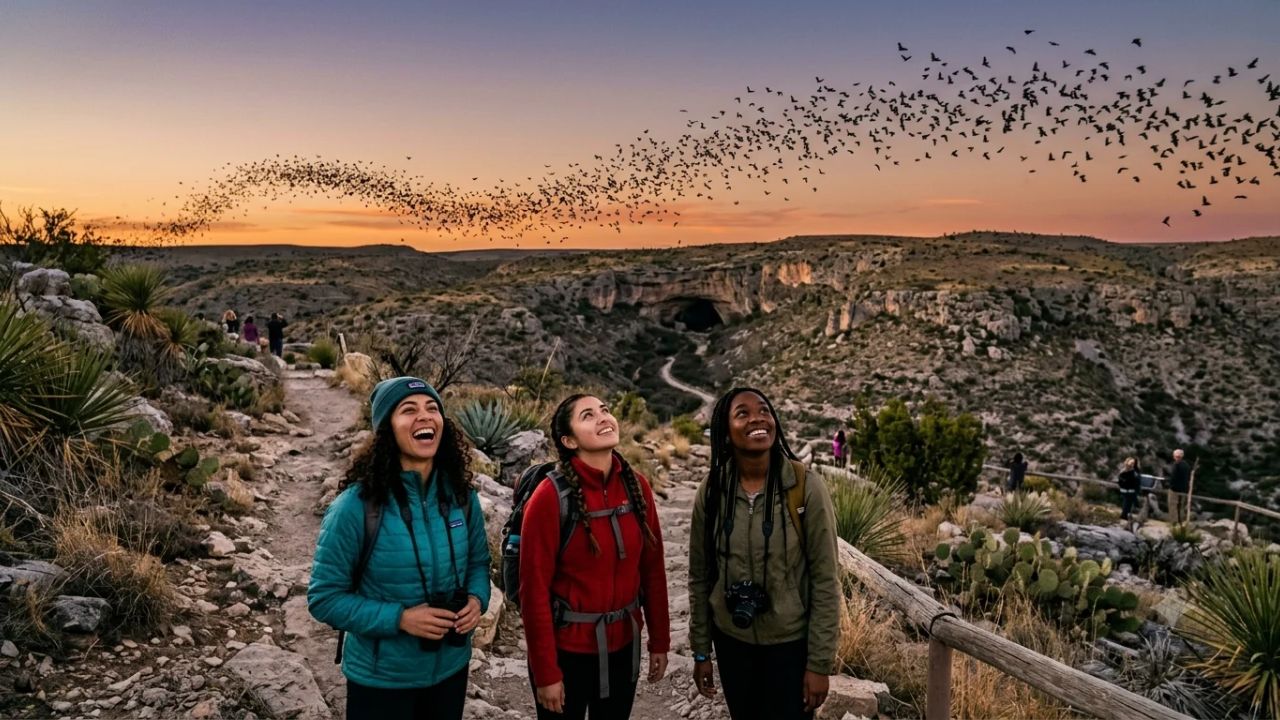
In southeastern New Mexico, the Chihuahuan Desert provides a natural wildlife display that bridges the underground geology of Carlsbad Caverns National Park with twilight ecological activity. Every evening from late spring through autumn, hundreds of thousands of Brazilian free-tailed bats (also known as Mexican free-tailed bats) exit the cavern's natural mouth to forage for flying insects across the Black River and Pecos River valleys.
The National Park Service hosts the Bat Flight Program at the park's outdoor amphitheatre, situated directly above the cavern’s gaping Natural Entrance. Before the flight begins, uniformed park rangers deliver an educational presentation explaining the migratory patterns, echolocation capabilities, and agricultural pest-control benefits provided by the bat colony.
CARLSBAD CAVERNS BAT FLIGHT ECOLOGICAL WORKFLOW
| Column 1 |
|---|
| [ Day: Roosting Inside Bat Cave ] -> Hundreds of thousands of Brazilian free-tailed bats sleep |
| in ceiling darkness off the main cavern passage. |
| [ Sunset: Ranger Interpretive Talk] -> Visitors assemble at outdoor stone amphitheatre. |
| Strict prohibition of cameras, phones & audio gear. |
| [ Dusk: Spiral Outflow Emergence ] -> Swarms spiral counter-clockwise out of the Natural Entrance |
| climbing into desert air currents for nocturnal feeding. |
| [ Dawn: Return Dive Inflow ] -> High-speed dive-bombing entry back into the cavern mouth |
| at speeds reaching up to 60 miles per hour. |
The Bat Flight Program runs continuously from April through October, with flight times shifting progressively earlier or later in tandem with regional sunset tables. Peak emergence numbers occur during August and September, when newborn bat pups join adult females in flight, swelling the colony's evening exodus into dense, swirling funnels.
Attending the evening Bat Flight Program is free and does not require advance reservations; seating in the amphitheatre is allocated on a first-come, first-served basis. However, travelers planning to descend into the underground cave system to tour the famous Big Room or walk the steep paved path down the Natural Entrance must book a separate timed entry ticket online through Recreation.gov.
| Planning Point | Official Guidance & Operational Conditions | Practical Traveler Considerations |
|---|---|---|
| Programme Season | April through October; nightly schedule shifts with sunset | Check daily start times posted at the visitor centre |
| Peak Flight Period | August through September | Colony numbers reach peak density with maturing pups |
| Seating & Access | Outdoor stone amphitheatre at the Natural Entrance | Arrive early to secure seating; first-come, first-served |
| Electronic Device Rule | Total prohibition on cameras, cell phones, and recording gear | Electronic noise and screen backlights disorient bats |
| Weather Contingency | Immediate cancellation if lightning or heavy rain threatens | Desert evening storms can cancel flights without notice |
| Cavern Exploration | Big Room and Natural Entrance routes require advance timed entry | Wear supportive walking shoes with non-slip rubber traction |
Strict operational rules safeguard the resident bat colony. The National Park Service strictly prohibits all electronic devices—including cell phones, cameras, tablets, video recorders, and flashlights—within the amphitheatre seating perimeter during the program. The subtle electromagnetic signals, camera autofocus beams, and ambient screen glows disturb the bats' echolocation navigation and alter their flight trajectories. Visitors are instructed to remain quiet and observe the natural spectacle without artificial lighting.
Colorado Stanley Hotel Tours: Historic Architecture and Ghost Lore in Estes Park
Positioned at 7,522 feet above sea level in the Rocky Mountain valley of Estes Park, The Stanley Hotel has anchored northern Colorado tourism since opening its doors in 1909. Built by inventor and steam-car pioneer Freelan Oscar Stanley, the grand neo-Georgian hotel served as the primary creative catalyst for Stephen King’s 1977 horror novel, The Shining, after King stayed overnight in room 217 during an autumn blizzard.
Today, the Stanley Hotel operates as a heritage destination and paranormal tourism hub, offering scheduled guided tours that explore the property’s architectural history, folklore, and reported supernatural events. The hotel’s primary evening program is the 60-minute Stanley Ghost Tour, which guides visitors through historic rooms, stone cellars, and exterior verandas while professional guides recount verified early 20th-century history alongside local ghost stories.
THE STANLEY HOTEL TOUR PROGRAM COMPARISON
| Column 1 |
|---|
| [ 60-MIN REGULAR GHOST TOUR ] |
| - Focus: Property history, F.O. Stanley legacy, reported hauntings & folklore. |
| - Scope: Selected historic public areas, carriage rooms, veranda; guest rooms excluded. |
| - Logistics: Age 8+, maximum 20 participants, fully wheelchair accessible. |
| [ 60-MIN THE SHINING TOUR ] |
| - Focus: Stephen King's 1974 visit to Room 217, writing the novel, Kubrick film vs. miniseries. |
| - Scope: Pop-culture history, literary connections, hedge maze and film memorabilia. |
| - Logistics: Suited for literary enthusiasts and film history buffs. |
| [ 3-HOUR OVERLOOK PROJECT ] |
| - Focus: Active paranormal investigation utilizing audio meters and temperature sensors. |
| - Scope: Extended late-night access to dark, unlit historic spaces across the property. |
| - Logistics: Requires dedicated stamina; participants must adhere to strict group guidelines. |
To preserve hotel operations and guest privacy, the ghost tours exclude active guest rooms and residential guest corridors. Instead, tours move through public reception halls, historic banquet spaces, and underground utility service tunnels where staff and visitors have reported anomalies over the past century.
| Hotel Experience | Published Duration | Core Focus & Tour Route | Age & Group Restrictions |
|---|---|---|---|
| Regular Ghost Tour | 60 minutes | Architectural history, F.O. Stanley biography, reported hauntings | Ages 8 and over; max 20 participants; wheelchair accessible |
| The Shining Tour | 60 minutes | Novel origins, pop-culture impact, and cinematic adaptations | Open to literature and film history enthusiasts |
| Overlook Project | Three hours | In-depth late-night paranormal investigation across darkened spaces | Strict capacity limits; requires advance reservation |
Daytime visitors to Estes Park can explore Rocky Mountain National Park, located five miles west of the hotel. Autumn brings the annual elk rutting season to Moraine Park and Horseshoe Park, where hundreds of bull elk bugle and display antlers. However, travelers must account for variable mountain weather. High-altitude passes such as Trail Ridge Road—which tops out at 12,183 feet—frequently experience black ice, sudden snowfall, and seasonal closures beginning in mid-October. Packing cold-weather layers, checking Colorado Department of Transportation (CDOT) road reports, and scheduling mountain drives during daylight hours ensures a smooth transition to evening hotel tours.
Arkansas Hot Springs: Combining Bathhouse Relaxation with Haunted Downtown History
Hot Springs National Park presents a distinctive layout within the federal park system. Rather than encompassing an isolated wilderness reserve, the park directly borders the historic downtown commercial district of Hot Springs, Arkansas. Known as "The American Spa," the area was designated by the federal government in 1832 to preserve natural thermal springs emerging from the base of Hot Springs Mountain at an average temperature of 143 degrees Fahrenheit (62 degrees Celsius).
HOT SPRINGS NATIONAL PARK DUAL ITINERARY FLOW
| Column 1 |
|---|
| [ DAYLIGHT FOREST HIKE ] |
| Hot Springs National Park: 26 miles of forested trails across Hot Springs & North Mountains. |
| - Panoramic views from Hot Springs Mountain Tower |
| - Gulpha Gorge Trail connecting rocky creeks to thermal tufa cascades |
| v |
| [ LATE AFTERNOON THERMAL SOAK ] |
| Bathhouse Row: Restored Gilded Age architecture utilizing protected mineral waters. |
| - The Buckstaff Bathhouse: Traditional European-style private mineral tubs (Ages 10+) |
| - The Quapaw Baths & Spa: Modern communal thermal mineral pools and steam caverns (Ages 14+) |
| v |
| [ EVENING DOWNTOWN GHOST WALK ] |
| Historic Central Avenue: 60-minute guided haunted history walk departing at 8:00 PM. |
| - Departs from 430 Central Avenue; cash ticket purchases begin 30 minutes prior |
| - Uncovers 19th-century boomtown fires, medical spa lore, and 1930s gangster associations |
The park features 26 miles of marked hiking trails winding through oak, hickory, and shortleaf pine forests. Visitors can complete scenic daytime circuits like the Peak Trail or the Sunset Trail, observing fall foliage across the Ouachita Mountains.
Because natural outdoor thermal springs inside the park are too hot for direct human contact and protected from wading to preserve fragile microbiological tufa formations, thermal bathing takes place exclusively inside restored facilities along historic Bathhouse Row. Two operating commercial bathhouses provide thermal mineral hydrotherapy: the Buckstaff Bathhouse, which has operated continuously since 1912 offering traditional individual mineral tubs and whirlpool treatments, and the Quapaw Baths & Spa, which features four modern communal thermal pools under a stained-glass dome.
As darkness settles along Central Avenue, visitors can transition to the guided Hot Springs Haunted History Walk. This 60-minute outdoor walking tour guides participants past Victorian architecture, former mobster hideouts tied to figures like Al Capone and Lucky Luciano, and historic hotels while narrating regional urban legends and unsolved mysteries.
| Activity or Ticket Type | Published Detail & Location | Access Rule & Operational Consideration |
|---|---|---|
| Adult Haunted History Ticket | US$20 per participant | Departs from 430 Central Avenue; in-person purchase |
| Child Haunted History Ticket | US$10 for children under 10 | Family-friendly walking tour format |
| Ticket Box Office Policy | Cash payment required; desk opens 30 minutes before 8:00 PM | Credit cards not accepted at ticket door; arrive with cash |
| Buckstaff Bathhouse Soaking | Historic mineral bathhouse on Bathhouse Row | Minimum admission age: 10 years and over |
| Quapaw Baths Thermal Pools | Modern thermal mineral soaking pools | Minimum admission age: 14 years and over |
| National Park Hiking | 26 miles of marked trails | Complete forest hiking before dusk; trails are unlit |
Planning requires careful coordination between cash ticket sales for the ghost walk, operating hours at Bathhouse Row, and trail daylight windows to avoid scheduling conflicts during a regional visit.
Maine Bar Harbor Ghost Tours: Indigenous Storytelling and Gilded Age Architecture at Acadia
Perched on the eastern shore of Mount Desert Island, Bar Harbor serves as the coastal gateway to Acadia National Park. While millions of summer visitors flock to Acadia for ocean kayaking and granite cliff climbs, autumn brings crisp air, brilliant deciduous foliage, and a quieter atmosphere suited for walking tours.
Bar Harbor Ghost Tours offers an evening program that distinguishes itself from standard theatrical ghost walks. As an Indigenous-owned tour enterprise, the company incorporates Wabanaki oral traditions, tribal spiritual history, and Native folklore alongside verified colonial, maritime, and Gilded Age historical accounts.
BAR HARBOR HISTORIC & INDIGENOUS WALKING TOURS
| Column 1 |
|---|
| [ ORIGINAL BLUE-LANTERN GHOST WALK ] |
| - Operator: Indigenous-owned enterprise presenting Wabanaki cultural perspectives. |
| - Duration: Approximately 90 minutes covering 1 mile of outdoor paved terrain. |
| - Meeting Point: 26 Mount Desert Street in downtown Bar Harbor. |
| - Content: Maritime sea disasters, tribal spiritual traditions, colonial settlement lore. |
| [ HISTORIC HAUNTED MANSION TOUR ] |
| - Location: 127 West Street in Bar Harbor's historic district. |
| - Duration: Approximately 60 minutes exploring a restored Gilded Age estate. |
| - Capacity: Strictly capped at 15 participants to maintain personal guide interaction. |
| - Accessibility: Multi-story building with stairs; NO modern passenger elevator/lift. |
The operator’s flagship experience is the 90-minute Original Ghost Walk. Departing from 26 Mount Desert Street, participants follow guides carrying blue lanterns through historic streets, covering roughly one mile on foot while learning about coastal shipwrecks, rum-running lore, and Wabanaki legends.
For an indoor architectural experience, the operator also conducts the Haunted Mansion Tour at 127 West Street. This 60-minute tour explores a preserved Gilded Age cottage, examining the extravagant lifestyles of early 20th-century summer industrialists, tragic fires that reshaped the island, and reported supernatural events. Because the mansion preserves original architectural woodwork and narrow staircases, it does not have modern elevators, making it unsuitable for visitors with mobility impairments. Group sizes are strictly limited to 15 participants, requiring advance booking during October.
| Experience & Location | Duration & Group Size | Route Characteristics & Accessibility |
|---|---|---|
| Original Blue-Lantern Ghost Walk (26 Mount Desert Street) |
About 90 minutes; Standard tour group |
Approximately one mile of outdoor walking on town sidewalks |
| Haunted Mansion Tour (127 West Street) |
About 60 minutes; Strict limit of 15 guests |
Multi-story Gilded Age building; interior stairs, no elevator |
| Cadillac Summit Road (Acadia National Park) |
Daytime vehicle drive; Timed entry reservation |
2026 vehicle reservations ran 20 May–25 October; verify seasonal closure dates |
| Jordan Pond Path (Acadia National Park) |
3.3-mile loop trail; Scenic daylight hike |
Flat gravel and wooden boardwalks; ideal for autumn foliage |
Daytime exploration in Acadia National Park pairs naturally with evening tours. Travelers can hike the 3.3-mile flat loop around Jordan Pond or drive up the Cadillac Summit Road to stand atop the highest peak on the eastern seaboard. Travelers should note that vehicle access to Cadillac Summit Road requires a timed reservation booked via Recreation.gov between late May and late October (in 2026, reservations concluded on October 25). Once the reservation window closes, vehicle access depends on clear autumn weather and winter gate status.
West Virginia Lake Shawnee: Industrial Folklore Near New River Gorge
In the Appalachian coalfields of southern West Virginia, Lake Shawnee Abandoned Amusement Park in Rock, Mercer County, offers an offbeat evening excursion for travelers exploring New River Gorge National Park and Preserve. Originally established in the 1920s as a recreational swimming and fairground retreat for local coal mining families, the amusement park closed in 1966 following multiple tragic accidents on its rides.
Decades of abandonment have left rusted Ferris wheel frames, swings hanging from weathered metal spokes, and overgrown ticket booths surrounded by Appalachian forest. The property’s history is further shaped by its location on an ancient Native American burial mound, giving rise to regional folklore and ghost accounts.
LAKE SHAWNEE & NEW RIVER GORGE AUTUMN CIRCUIT
| Column 1 |
|---|
| [ DAYLIGHT ADVENTURE: NEW RIVER GORGE NATIONAL PARK ] |
| - Endless Wall Trail: 2.4-mile rim hike with panoramic sandstone cliff views. |
| - Diamond Point: 2.0-mile out-and-back trail overlooking New River rapids and bridge. |
| - Seasonal Activities: Whitewater rafting, rock climbing, and autumn hardwood foliage. |
| v |
| [ AFTER-DARK EXCURSION: LAKE SHAWNEE AMUSEMENT PARK ] |
| - Location: Rock, Mercer County (Approx. 60-75 minute drive south from Fayetteville). |
| - Daytime Guided Visits: Private appointments arranged directly with site operators. |
| - Dark Carnival: Seasonal October event running Friday and Saturday nights. |
| - Overnight Group Stays: Self-sufficient overnight access (bring sleeping gear, food & lights). |
Today, Lake Shawnee operates under private historic management, welcoming photographers, paranormal investigators, and history enthusiasts by appointment. During October, the property hosts its annual Dark Carnival on Friday and Saturday evenings, transforming the rusted fairgrounds into an open-air seasonal event.
Travelers can also arrange daytime guided walks or reserve private overnight group stays. The site maintains strict operational rules: the primary booking holder must be at least 18 years of age, and parents must closely supervise children around the weathered machinery. For overnight visits, groups are left alone on the property and must be self-sufficient, bringing their own food, drinking water, warm bedding, and flashlights.
| Experience | Operating Format | Booking & Safety Planning Detail |
|---|---|---|
| Lake Shawnee Daytime Visit | Guided historical walk | By private appointment only; advance direct booking required |
| Lake Shawnee Overnight Stay | Private group property access | Groups stay self-sufficient; bring sleeping bags, food, and lights |
| Dark Carnival Event | Public evening October festival | Operates Friday and Saturday evenings throughout October |
| Endless Wall Trail (NPS) | 2.4 miles one way (rim path) | Moderate hike through hemlock forest; sandstone overlook drops |
| Diamond Point Overlook (NPS) | 2.0 miles out-and-back | Highest concentration of panoramic gorge and river views |
Lake Shawnee pairs well with outdoor exploration in New River Gorge National Park and Preserve, located roughly 60 to 75 minutes north by car. Travelers can spend daylight hours hiking the Endless Wall Trail—a 2.4-mile path along sandstone cliff edges—or walking the two-mile out-and-back route to Diamond Point for sweeping views of the river canyon 1,000 feet below.
Airport Access and Ground Logistics: Structuring Multi-Modal Gateway Travel
Executing a vacation that pairs national parks with evening tours requires coordinated flight itineraries, car rental arrangements, and road transfers. Most national parks are situated hours away from major international hub airports, meaning ground transit schedules dictate the viability of evening tours.
AIRPORT GATEWAY & GROUND TRANSFER DISTANCE OVERVIEW
| Column 1 |
|---|
| [ CARLSBAD CAVERNS ] |
| - El Paso International (ELP): ~140 miles (2.5 hours driving via US-62/180 across desert). |
| - Roswell Air Center (ROW): ~75 miles (1.25 hours driving via US-285 south). |
| [ ROCKY MOUNTAIN / ESTES PARK ] |
| - Denver International (DEN): ~75 miles (1.5 hours driving via I-25 & US-36 west). |
| [ HOT SPRINGS ] |
| - Hot Springs Memorial Field (HOT): Local regional access (~3 miles downtown). |
| - Little Rock Clinton National (LIT): ~55 miles (1 hour driving via I-30 west & US-70). |
| [ ACADIA / BAR HARBOR ] |
| - Hancock County-Bar Harbor Airport (BHB): ~12 miles (20 minutes driving via ME-3). |
| - Bangor International Airport (BGR): ~50 miles (1.25 hours driving via US-1A east). |
| [ NEW RIVER GORGE / LAKE SHAWNEE ] |
| - Charleston Yeager Airport (CRW): ~70 miles (1.25 hours driving via I-64/I-77). |
| - Beckley Raleigh County Memorial (BKW): ~30 miles (45 minutes driving via US-19). |
The National Park Service identifies recommended aviation gateways for each park destination. Selecting the right airport depends on balancing commercial flight frequencies against onward driving times.
| National Park Destination | Primary Commercial Aviation Gateways (NPS) | Ground Transfer Distance & Driving Duration | Optimal Route Logistics & Buffer Strategy |
|---|---|---|---|
| Carlsbad Caverns | El Paso International (ELP) or Roswell Air Center (ROW) | ELP: ~140 miles (2.5 hours) ROW: ~75 miles (1.25 hours) |
Fly into ELP for broad airline options; allow daylight drive across Guadalupe Mountains |
| Rocky Mountain | Denver International Airport (DEN) | ~75 miles (1.5 hours via US-36) | Rent an AWD vehicle at DEN; monitor I-25 traffic and mountain frost |
| Hot Springs | Little Rock National (LIT) or Hot Springs Memorial (HOT) | LIT: ~55 miles (1 hour) HOT: ~3 miles (10 minutes) |
LIT provides direct mainline flights; drive US-70 direct to historic Bathhouse Row |
| Acadia | Bangor International (BGR) or Hancock County (BHB) | BGR: ~50 miles (1.25 hours) BHB: ~12 miles (20 minutes) |
BHB offers Cape Air commuter hops; BGR provides major national network carriers |
| New River Gorge | Charleston Yeager (CRW) or Beckley Memorial (BKW) | CRW: ~70 miles (1.25 hours) BKW: ~30 miles (45 minutes) |
CRW connects to major Midwest hubs; drive scenic southern toll corridors |
Travelers must build realistic time buffers into their arrival days. Landing at a regional airport at 4:00 PM, collecting checked bags, completing rental car paperwork, and driving two hours over unfamiliar mountain or desert highways will rarely allow sufficient time to reach an 8:00 PM ghost tour or sunset bat flight.
A sound logistical rule is dedicating the initial arrival day exclusively to transit and hotel check-in. This buffers travelers against flight delays, allows proper rest, and ensures subsequent days flow seamlessly between daytime park activities and evening entertainment.
Economic Impacts and Regional Tourism Benefits for Gateway Communities
Pairing daytime wilderness access with evening cultural programming provides measurable economic advantages for gateway towns. In conventional national park tourism models, day-trippers often enter parks in the morning, complete a hike while eating packed provisions, and depart by late afternoon, contributing little revenue to the local economy beyond service station fuel purchases.
Organized evening tours change this spending pattern by incentivizing visitors to remain in gateway communities after sunset.
GATEWAY ECONOMIC MULTIPLIER MECHANISM
| Column 1 |
|---|
| DAY-TRIP VISITATION MODEL: |
| Drive into park -> Hike trails -> Eat packed lunch -> Depart at 4 PM |
| * Net Community Spend: Minimal (Fuel, parking, incidental retail) |
| INTEGRATED DAY-AND-NIGHT TOURISM MODEL: |
| Morning Park Hike -> Gateway Retail & Cafes -> Late Afternoon Thermal Bath/Rest |
| -> Dinner at Downtown Bistro -> Evening Walking Tour / Bat Program -> Gateway Overnight Lodging |
| * Net Community Spend: High (Lodging taxes, restaurant meals, tour operator payroll) |
When travelers commit to an 8:00 PM walking tour or an evening bat flight, they naturally dine at local restaurants, patronize independent coffee shops, and book overnight accommodations within the immediate gateway corridor. This extends average lengths of stay, supports local hospitality jobs, and generates municipal lodging taxes that fund local infrastructure.
| Visitor Itinerary Choice | Local Service Provider Involved | Direct Economic & Itinerary Benefit |
|---|---|---|
| Evening Storytelling & Walks | Independent guides and historic tour operators | Generates local service employment beyond federal park payrolls |
| Overnight Gateway Lodging | Boutique hotels, heritage lodges, and B&Bs | Expands municipal bed-tax revenue and lengthens stay durations |
| Thermal Soaking & Wellness | Historic bathhouses and spa therapy facilities | Preserves historic public utilities and Gilded Age architecture |
| Regional Dining & Breweries | Local gateway restaurants, diners, and bistros | Keeps visitor dining expenditures circulating in local rural economies |
| Off-Peak Autumn Booking | Transportation services, outfitters, and gear rentals | Stabilizes tourism revenues past the peak July–August summer surge |
For international travelers, clear admission guidelines, established safety protocols, and transparent booking information make unfamiliar regional destinations accessible and straightforward to plan. Combining daytime natural landscapes with evening heritage storytelling offers a deeper, more varied perspective on American travel.
Why This Matters: Operational Takeaways and Traveler Recommendations
From a travel planning and risk-management perspective, linking daytime national park adventures with independent nighttime tours requires shifting away from spontaneous travel habits toward coordinated advance booking.
For the traveler, this means treating a regional holiday as two separate operational layers:
THE STRATEGIC AUTUMN TRAVEL CHECKLIST
| Column 1 |
|---|
| [ ADVANCE PREPARATION (30 TO 60 DAYS OUT) ] |
| - Confirm timed vehicle permits on Recreation.gov (e.g., Cadillac Summit Road, Carlsbad Caverns). |
| - Book limited-capacity evening tours (Stanley Hotel capped at 20; Bar Harbor Mansion at 15). |
| - Reserve rental vehicles equipped for autumn mountain conditions (AWD/snow tires in Colorado). |
| [ DAY-OF-TRAVEL EXECUTION ] |
| - Carry physical cash for independent box offices (e.g., Hot Springs Haunted Tour desk). |
| - Check afternoon sunset tables to schedule arrival at unreserved events (Carlsbad Amphitheatre). |
| - Pack layered thermal clothing; temperatures drop rapidly after sunset in deserts and mountains. |
| - Respect wildlife conservation rules (power off all phones and cameras during bat emergences). |
- Separate Booking Streams: Never assume a national park pass grants entry into historic hotels, bathhouses, or private ghost walks. Secure both federal reservations and commercial tour tickets well in advance.
- Mobility and Environmental Awareness: Match chosen tours to your physical mobility. Historic properties like Bar Harbor's Gilded Age mansion feature staircases without elevators, while cavern routes involve steep paved grades.
- Respecting Conservation and Folklore: Treat historical ghost tours as cultural storytelling and community folklore rather than verified academic history. When participating in wildlife events like the Carlsbad Bat Flight, strictly follow ranger directives regarding electronic silences to protect migratory wildlife.
- Daylight Margin Management: Complete hiking trails well before twilight. Autumn mountain trails lose light quickly, and higher elevations can ice over rapidly once the sun dips below canyon walls.
By structuring itineraries with adequate transit buffers, advance reservations, and warm autumn layers, travelers can experience the full spectrum of America’s federal parklands and regional heritage.
Frequently Asked Questions (PAA)
Are electronic devices permitted during the Carlsbad Caverns Bat Flight Program?
No, the National Park Service strictly prohibits all electronic devices—including cell phones, cameras, tablets, flashlights, and audio recorders—at the outdoor amphitheatre during the Bat Flight Program. Electronic screens and camera signals disturb the Brazilian free-tailed bats' echolocation and alter their flight patterns as they emerge from the cavern mouth.
Do I need advance reservations for the Stanley Hotel ghost tours in Estes Park?
Yes, advance reservations are strongly recommended. The regular Stanley Ghost Tour limits groups to a maximum of 20 participants, while specialized programs like The Shining Tour and the three-hour Overlook Project fill up weeks in advance during the peak autumn season. Note that ghost tours do not enter active guest rooms to protect hotel guest privacy.
What are the age restrictions for thermal bathhouses in Hot Springs National Park?
Traditional thermal mineral bathing at the Buckstaff Bathhouse is restricted to visitors aged 10 and over. At the Quapaw Baths & Spa, communal thermal pools and spa services require guests to be at least 14 years old. Families traveling with younger children should plan alternative daytime outdoor activities along the park's forested trails.
When do vehicle reservations end for Cadillac Summit Road in Acadia National Park?
For the 2026 autumn season, vehicle reservations for Cadillac Summit Road ran through October 25. After the timed reservation period ends, access depends on prevailing weather and road conditions managed by the National Park Service. Always verify current park road status before driving to the summit during late autumn.
Can visitors explore Lake Shawnee Abandoned Amusement Park without an appointment?
No, Lake Shawnee is located on private property in Rock, Mercer County, West Virginia, and requires an advance appointment for both daytime photography visits and overnight group stays. The person booking an event or visit must be at least 18 years old. The park also hosts its public Dark Carnival on Friday and Saturday evenings during October.
Related Travel Guides
This article is for informational purposes. Flight routes, passenger regulations, visa rules, and transit advisories are subject to change by airlines and aviation authorities. Readers are advised to verify schedules and travel documentation with relevant carriers and border agencies before departure.
Related Stories
Europe’s Underrated Autumn Foliage Destinations: Ambroz Valley, Gauja National Park, and Hidden Fall Escapes
Grand Canyon Enforces $100 Foreign Visitor Surcharge as US National Parks Adopt Two-Tier Pricing