
US Airlines Shake-Up: Flight Attendants Push for Pay Raise
United, Delta, American and Southwest face a potential shake-up as flight attendants demand a pay rise, sit pay and better layover hotel standards.

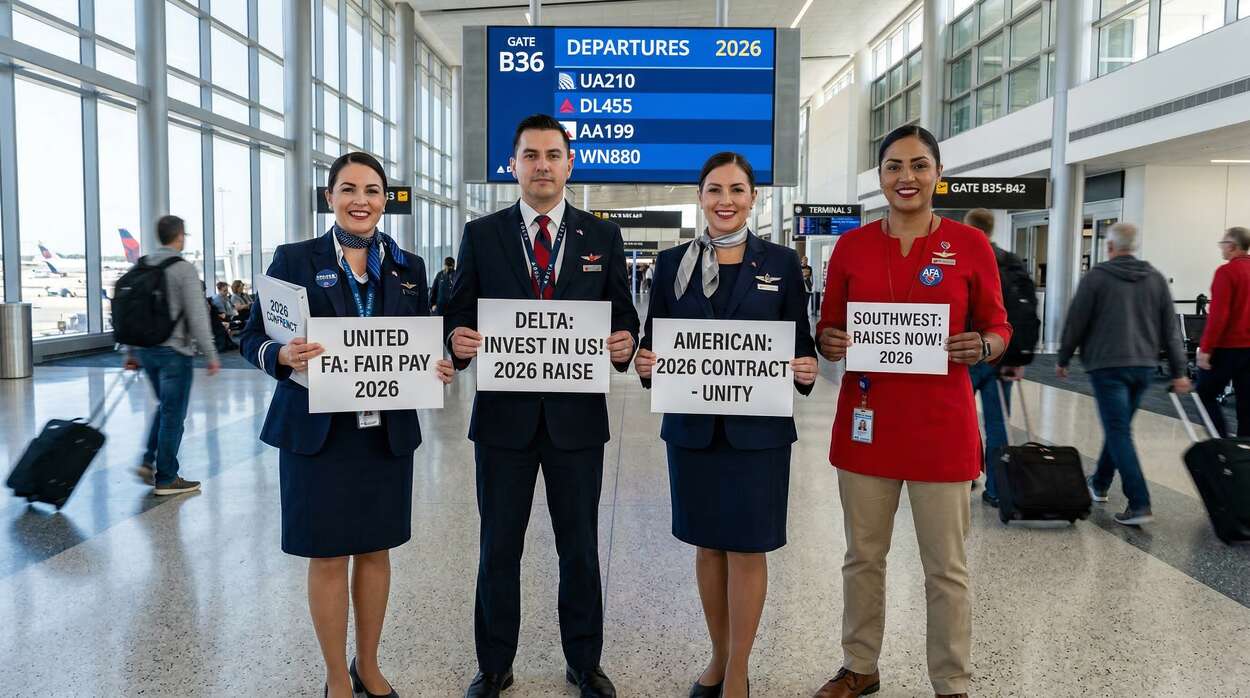
Image generated with AI
Quick Summary
- United, Delta, American, and Southwest are in active labor negotiations with the Association of Flight Attendants-CWA (AFA-CWA)
- Flight attendants are pushing for a pay raise after five years of stagnant wages, plus the introduction of sit pay for time spent waiting between flights
- Negotiations also target layover hotel standards, demanding stronger quality and safety protections
- A successful contract could mean better service, fewer disruptions, and improved reliability for travelers nationwide
Four of the United States' largest airlines — United Airlines, Delta Air Lines, American Airlines, and Southwest Airlines — are facing a potential industry shake-up as the Association of Flight Attendants-CWA (AFA-CWA) pushes for new labor contracts after five years without a pay increase for cabin crews. The negotiations, which go well beyond wages, could reshape how airlines compensate and support their flight attendants — with direct consequences for passengers, tourism hubs, and the hospitality industry.
5 Years Without a Pay Raise: What Flight Attendants Are Demanding
United Airlines' labor talks with its flight attendants sit at the center of current aviation news. The AFA-CWA is pursuing a substantial pay raise to bring compensation in line with the intensifying demands of modern cabin crew work — demands that have surged in the post-pandemic operating environment.
While United Airlines already markets itself as an industry pay leader, the union's central new demand is the introduction of sit pay — direct compensation for the time flight attendants spend waiting between flights. Historically, this waiting time has gone entirely unpaid. Introducing sit pay would represent a fundamental shift in how airlines account for the full scope of their crew's working day.
Beyond wages, the negotiations are tackling layover hotel standards. Flight attendants spend a significant portion of their careers in transit accommodation, and the union is seeking enforceable protections around the quality and safety of hotels used for overnight crew stays. These new standards would compel airlines to coordinate more closely with hotel partners — a change that will ripple directly into the hospitality industry.
How Labor Negotiations Could Reshape Air Travel
The outcome of these negotiations carries implications far beyond the payroll of cabin crews. A successfully ratified contract — particularly one introducing sit pay and legally binding hotel standards — would alter the core economics of how airlines staff and schedule their operations.
Better-compensated, more rested flight attendants are directly linked to a better passenger experience. Crews who are fairly paid for their full working time and accommodated in quality layover hotels arrive at flights less fatigued and more prepared to deliver attentive, efficient service.
For passengers on key routes — including United's nonstop services from Chicago O'Hare to London, Paris, and Frankfurt — this could translate into fewer cancellations, improved on-time performance, and a measurably more consistent cabin service standard. Domestic routes to leisure destinations like Orlando, New York City, and Las Vegas could similarly benefit from a more stable, motivated workforce.
Airlines that resolve their labor negotiations smoothly also tend to experience fewer operational disruptions tied to crew shortages or work-to-rule actions — a direct benefit for travelers who depend on schedule reliability.
Impact on U.S. and Global Tourism
The downstream effects of these labor negotiations extend well beyond aircraft cabins. U.S. gateway cities — including New York, Chicago, Los Angeles, and San Francisco — stand to benefit from improved flight operations if these contracts bring greater schedule stability and elevated service quality.
Internationally, major European destinations that receive significant U.S. traveler in-flows — Paris, Barcelona, and Rome among them — could see increased visitor numbers if improved flight reliability raises consumer confidence in booking long-haul travel. When travelers trust that their flight will depart on time and arrive with the service they paid for, booking hesitancy decreases.
Stabilised labor relations also tend to have a moderating effect on ticket prices over time. With fewer disruption-driven operational costs and reduced crew turnover, airlines can price routes more competitively — an important factor for destinations that depend heavily on international tourism volumes.
What This Means for the Hospitality Industry
The hospitality sector is paying close attention to the outcome of these labor talks, and for good reason. Airlines hold direct contracts with hotels near airports and in hub cities to accommodate flight crews during layovers. New, more stringent layover hotel standards — if the union's demands are met — would push airlines to upgrade these arrangements, increasing demand for higher-quality accommodation from major chains.
Hotels near key U.S. airport hubs — including properties around San Francisco International (SFO), Los Angeles International (LAX), and Chicago O'Hare (ORD) — could see increased airline-contracted bookings as carriers seek to meet elevated crew accommodation standards. This creates new revenue opportunities for hotel operators targeting the airline crew segment.
Simultaneously, tourism-driven hotels in major city centers would benefit from the spill-over effect of improved air connectivity. Globally connected hubs like Paris, Madrid, Rome, and New York City all rely on the air traffic generated by carriers like United, Delta, American, and Southwest. More reliable operations mean more tourists completing their booked trips — translating into higher hotel occupancy, more restaurant covers, and greater footfall for local retail and tour operators.
What This Means for Travelers
The practical impact on passengers will depend on how quickly — and successfully — these negotiations conclude. Here is what travelers should know right now:
- Better service on board: Airlines that compensate crews fairly and support them with quality layover accommodation consistently outperform on cabin service metrics
- Fewer flight disruptions: Resolved labor relations reduce the risk of crew shortages, work slowdowns, or scheduling instability that can trigger cancellations and delays
- Competitive ticket pricing: Operational stability tends to support more predictable airline pricing, benefiting both leisure and business travelers
- Improved domestic connectivity: Routes to popular U.S. destinations including Orlando, Hawaii, and Las Vegas may see schedule reliability improvements as crew satisfaction rises
Travel Tips for Tourists
As these negotiations unfold, here is how travelers can best protect their plans:
- Stay informed: Monitor your airline's app and email notifications for any schedule changes tied to labor developments
- Book with flexibility: Check your airline's cancellation and change policies before booking — many carriers now offer low-cost or free date changes
- Book early: Securing flights and hotel accommodation in advance locks in current pricing and availability, which can shift quickly if labor actions occur
- Use flexible travel dates: Avoiding peak travel windows reduces exposure to any operational disruptions that may temporarily affect scheduling
- Compare fares across carriers: Tools like Google Flights and Skyscanner allow you to identify the most reliable options across United, Delta, American, and Southwest simultaneously
Frequently Asked Questions
Why are US flight attendants demanding a pay raise now? Flight attendants across United, Delta, American, and Southwest have gone five years without a pay increase, despite significantly heightened operating demands in the post-pandemic aviation environment. The AFA-CWA is now pushing for wage increases, plus the introduction of sit pay for time spent waiting between flights — time that has historically gone uncompensated.
What is sit pay and why does it matter for travelers? Sit pay is compensation for the time flight attendants spend on standby or waiting between flights. Currently unpaid, this time can extend for hours. Introducing sit pay ensures crews are compensated for their full working day, which reduces financial stress and fatigue — both of which directly affect the quality of in-flight service passengers receive.
How could these labor negotiations affect my flight? If negotiations conclude successfully, passengers should see improvements in on-time performance, service consistency, and fewer disruptions related to crew availability. If negotiations stall or break down, there is a risk of service disruptions or operational slowdowns on affected routes.
Which airlines are involved in these negotiations? The primary carriers in active labor negotiations are United Airlines, Delta Air Lines, American Airlines, and Southwest Airlines. The Association of Flight Attendants-CWA (AFA-CWA) is the primary union body representing cabin crew in these talks.
Related Travel Guides
US Flight Chaos: 693 Cancellations and 4,247 Delays Hit Delta, Southwest and United on March 15
South Korea Airlines Face 27% Complaint Surge — Tourists Warned
Minnesota Storm Grounds Delta & United at MSP — International Tourists Warned
Disclaimer
This article is for informational and educational purposes only. It does not constitute legal, financial, or professional advice. While we strive to provide accurate and up-to-date information, travel policies, regulations, and conditions change rapidly. Always verify information with official sources before making travel decisions. Nomad Lawyer makes no representations about the accuracy, reliability, completeness, or suitability of the information provided. Readers should consult qualified professionals for advice specific to their circumstances. The views expressed in this article are those of the author and do not necessarily reflect the views of Nomad Lawyer.
Kunal K Choudhary
Co-Founder & Contributor
A passionate traveller and tech enthusiast. Kunal contributes to the vision and growth of Nomad Lawyer, bringing fresh perspectives and driving the community forward.
Learn more about our team →