
Universal Studios Hollywood's Fast & Furious Hollywood Drift Coaster Sparks Resident Noise Complaints 3 Days After 2026 Opening
Universal Studios Hollywood's new Fast & Furious: Hollywood Drift coaster triggered Toluca Lake resident complaints over screaming noise just three days after public rehearsals began on July 27, 2026.

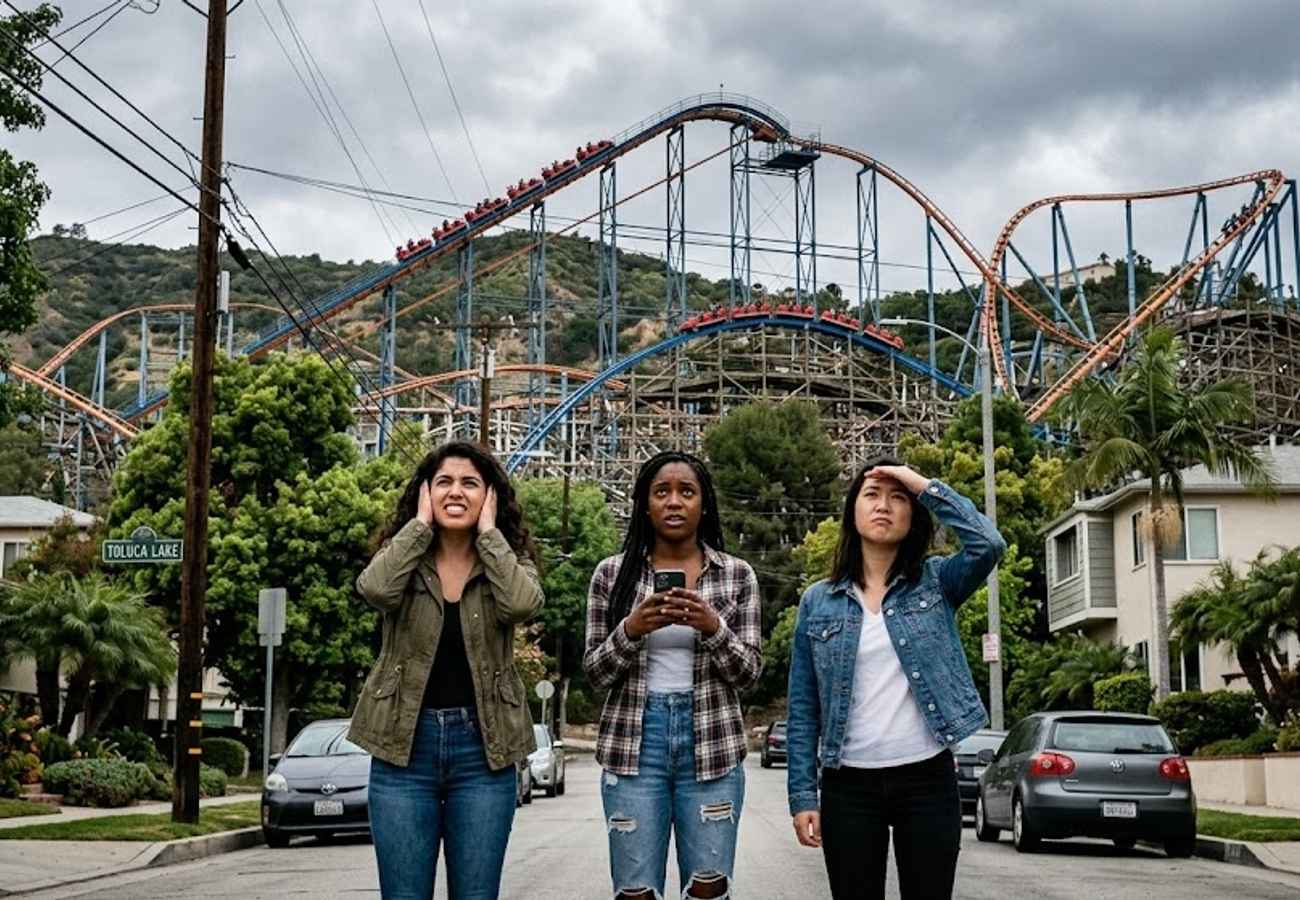
Image generated by AI
Universal Studios Hollywood's newest outdoor roller coaster, Fast & Furious: Hollywood Drift, triggered immediate neighborhood backlash just three days after public technical rehearsals began on July 27, 2026, with Toluca Lake residents reporting intrusive screaming noise penetrating double-paned windows.
The Core Development
Universal Studios Hollywood quietly launched public technical rehearsals for Fast & Furious: Hollywood Drift on Monday, July 27, 2026. Within 72 hours, residents of the neighboring Toluca Lake area began contacting local media outlets with noise complaints that centered not on the coaster's mechanical operation but on the sound of riders screaming.
The outdoor track runs along the hillside above Toluca Lake, placing portions of the ride in close proximity to established residential streets. The speed and scale of the attraction — hitting 72 mph across 4,100 feet of track — produces involuntary vocal reactions from passengers that carry into the neighborhood below.
Toluca Lake resident Colby Jensen described the noise to KTLA as "constant" and "very intrusive," adding that it "sounds like bloody murder over there." Jensen compared the repeated screams to a horror movie soundtrack. Another resident, John Heim, told ABC7 that noise levels vary daily but confirmed hearing screaming at night even with doors closed.
Key Facts Breakdown
- Public technical rehearsals began: July 27, 2026
- Official opening: Summer 2026, exact date not announced
- Maximum speed: 72 mph
- Track length: 4,100 feet
- Ride vehicles: 360-degree rotating cars
- Location: Universal Studios Hollywood Upper Lot
- Noise mitigation features: Sound-reducing track, sound shields, monitoring equipment
- Coaster announced: May 2024
- Extended vehicle testing began: October 2025
- LA Times first reported complaints: July 24, 2026
- Community update expected: August 7, 2026
- County Supervisor involved: Kathryn Barger
Complaints Began Before Public Access
The Los Angeles Times first reported on the noise issue on July 24, 2026 — three days before the public technical rehearsals even started. At that point, the park had been running the attraction with groups of test riders, likely park employees. Residents noted that earlier empty-car testing had been surprisingly quiet, but the sound profile changed dramatically once passengers were added.
Reports indicated screams were frequent enough to be heard through double-paned windows. The transition to public technical rehearsals amplified the issue significantly, as regular park guests replaced controlled test groups.
Noise Reduction Was Built Into the Design
These complaints carry weight because noise mitigation was embedded in the coaster's design from the earliest planning stages. Universal first announced Fast & Furious: Hollywood Drift in May 2024 as its first-ever high-speed outdoor roller coaster. That initial announcement specifically referenced "sound reduction technology" for the aerial track.
This was a critical design consideration given the park's location. Unlike sprawling resort theme parks surrounded by their own properties, Universal Studios Hollywood shares its hillside with an active film studio and sits adjacent to long-established Los Angeles neighborhoods. Hollywood Drift is also substantially larger and faster than the park's existing outdoor coaster, Flight of the Hippogriff.
By October 2025, when extended vehicle testing began, the park was again emphasizing the 4,100-foot track's sound-reduction technology. Yet even the quietest track cannot absorb the acoustic output of passengers reacting to a 72-mph drop.
Fast & Furious: Hollywood Drift Specifications
| Feature | Detail |
|---|---|
| Public technical rehearsals | Began July 27, 2026 |
| Official opening | Summer 2026, exact date not announced |
| Maximum speed | 72 mph |
| Track length | 4,100 feet |
| Ride vehicles | 360-degree rotating cars |
| Location | Universal Studios Hollywood Upper Lot |
| Noise mitigation | Sound-reducing track, sound shields, monitoring equipment |
Universal's Response and Mitigation Steps
Universal Studios is not dismissing the complaints. According to correspondence sent to the Toluca Lake HOA, the park is sharing coaster testing schedules with locals and has established a community hotline for neighbors to report noise-level feedback.
"We have refined our testing schedule to evaluate the coaster's performance under a variety of real-world operating conditions and how sound is being experienced in the surrounding communities," Universal stated. "The testing process will help inform what future adjustments may be needed."
The company told the HOA it expects to provide an update by August 7, 2026.
Announced mitigation steps include:
- Installing sound shields around the noisiest ride segments
- Using pea gravel to absorb and reduce mechanical noise
- Adjusting car orientation so riders face away from residential areas during screaming portions
- Placing microphones throughout the surrounding neighborhood to track sound levels
The microphone deployment may prove decisive. Data collected could determine whether the attraction violates local noise ordinances or remains within legal limits — a distinction that matters for any future regulatory action.
County Government Involvement
The office of Los Angeles County Supervisor Kathryn Barger is actively engaged. A spokesperson told the Los Angeles Times that county staff have been facilitating conversations between Universal Studios and residents, describing the company as "very willing partners."
"They are very interested in finding common ground to address the community concerns, while also meeting their bigger objectives of bringing a new attraction to keep their theme park thriving," said Helen Chavez Garcia, Barger's communications director. "They've been good partners at the table and this is going to be a continued work in progress."
As of now, no finding indicates the attraction violates applicable noise standards. That distinction is important — residents can find repetitive sounds disruptive even when they fall within legal limits, and the technical rehearsal period gives the park a window to adjust operations before the formal public debut.
Public Reaction Splits Along Predictable Lines
Online response to the complaints has fractured. A significant contingent argues that Toluca Lake residents should have anticipated noise when purchasing property near a major theme park.
One YouTube commenter wrote sarcastically: "Then I woke up one day to discover there was an amusement park near my home! Was that there before?" Another compared the situation to buying a house near an airport and complaining about aircraft.
Others pushed back, noting that park expansion has altered the historical noise baseline. One commenter observed: "It is not fair in the sense that before building the rollercoaster it probably was ivy covered hillside actually blocking sound. Universal and Disney are both trying to expand and that evolves building to the ends of their borders and even trying to block and take over city streets."
Local residents have expressed surprise at the online hostility toward their complaints.
Why This Matters
For theme park operators and residential developers alike, this case underscores a persistent tension in urban-adjacent entertainment expansion. Universal built sound-reducing track technology, installed shields, and deployed monitoring equipment — yet none of those measures accounted for the human element. Rider screams at 72 mph travel differently than mechanical noise, and no track design can silence a passenger's involuntary vocal response to a high-speed drop.
From a logistical perspective, this means parks in dense urban environments may need to treat passenger noise as a separate acoustic category from ride noise, requiring distinct mitigation strategies. The microphone data Universal is collecting could set a precedent for how municipalities measure and regulate human-generated amusement noise versus mechanical noise.
For travelers planning visits to Universal Studios Hollywood, the situation is unlikely to affect ride access during the official summer 2026 opening, but operational adjustments — including potential ride orientation changes or modified testing schedules — could influence the guest experience. Anyone visiting during the technical rehearsal period should expect intermittent closures as the park refines operations.
Our analysis of the route map and park layout suggests the hillside placement of Hollywood Drift was unavoidable given Universal's limited footprint, but the decision to orient a 72 mph coaster toward a residential valley created an acoustic funnel that no amount of track-level sound reduction could fully address.
Industry Outlook
The August 7 update to the Toluca Lake HOA will be the next critical milestone. If Universal announces effective mitigation — particularly the car-orientation adjustments — other parks facing similar residential proximity issues will likely study the approach. If complaints persist despite the announced measures, the case could draw regulatory attention that reshapes how Los Angeles County evaluates theme park expansion proposals going forward.
Theme park operators across Southern California are watching. Disney, which faces its own neighborhood tensions in Anaheim, will be paying close attention to how Universal navigates the intersection of ride innovation and community relations.
The quietest coaster in the world still can't silence the person riding it.
Related Travel Guides
Disclaimer
This article is for informational and educational purposes only. It does not constitute legal, financial, or professional advice. While we strive to provide accurate and up-to-date information, travel policies, regulations, and conditions change rapidly. Always verify information with official sources before making travel decisions. Nomad Lawyer makes no representations about the accuracy, reliability, completeness, or suitability of the information provided. Readers should consult qualified professionals for advice specific to their circumstances. The views expressed in this article are those of the author and do not necessarily reflect the views of Nomad Lawyer.
Raushan Kumar
Founder & Lead Developer
Full-stack developer with 11+ years of experience and a passionate traveller. Raushan built Nomad Lawyer from the ground up with a vision to create the best travel and law experience on the web.
Learn more about our team →