
Breaking Airline News: Severe Mid-Air Emergency Forces United Airlines Flight UA1945 Into Terrifying Houston Return, Igniting Massive Travel Chaos
Breaking airline news: Amidst a terrifying era of sudden operational failures, United Airlines Flight UA1945 executes a highly tense return-to-origin emergency landing in Houston, entirely aborting its Los Angeles route.

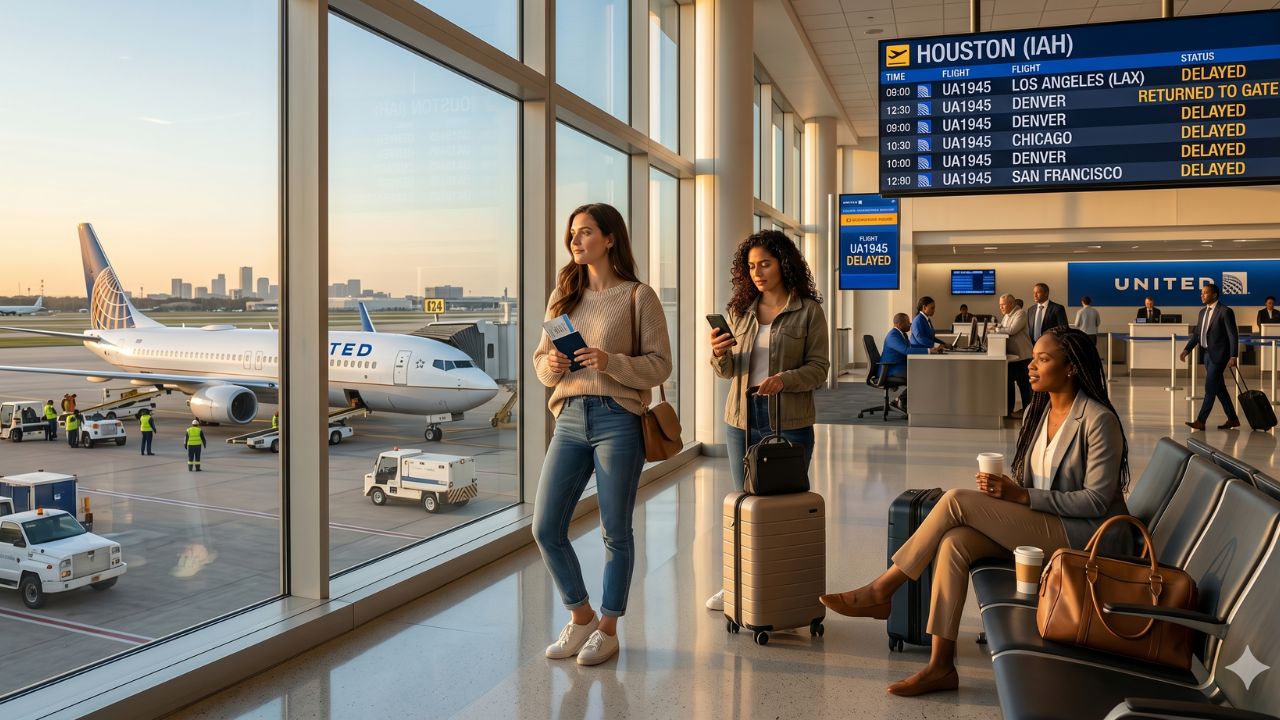
Image representing the intense mid-air emergency and massive flight disruptions aggressively crippling operations following the sudden return of United Airlines Flight UA1945 to Houston.
Breaking Airline News: Severe Mid-Air Emergency Forces United Airlines Flight UA1945 Into Terrifying Houston Return, Igniting Massive Travel Chaos
As sudden mechanical failures and paralyzing airport disruptions continue to violently threaten the stability of the United States domestic network, United Airlines Flight UA1945 was forced into a highly critical, terrifying mid-air return. On 7 June 2026, a massive operational anomaly triggered an immediate, high-stakes emergency landing back at its departure point of Houston George Bush Intercontinental Airport, violently severing the scheduled transcontinental route to Los Angeles and plunging furious passengers into an inescapable web of severe travel chaos.
In a harrowing display of modern aviation fragility, a seemingly routine domestic service rapidly devolved into a high-stress survival scenario. Operating along the heavily congested Southern corridor, United Airlines Flight UA1945—also officially identified under the operational callsign UAL1945—departed from Houston, perfectly destined for Southern California. However, while navigating the highly critical cruise phase, the flight crew suddenly altered course. Facing a potential breach of operational safety, the captain rapidly abandoned the aircraft's intended trajectory, instantly terminating the approach into Los Angeles International Airport. This sudden, highly aggressive return-to-origin diversion completely disrupted regional operations, stranding exhausted passengers back exactly where they started and triggering massive shockwaves across the United Airlines domestic network.
Expanded Overview: The Massive Scale of the Contagion
The terrifying mid-air crisis involving United Flight UA1945 brutally exposes the severe, interconnected nature of North American air travel. Transcontinental network continuity relies entirely on robust equipment and reliable long-haul execution. When a critical fleet asset suffers a sudden operational anomaly, the terrifying ripple effects instantly devastate connecting flights across the entire corridor. This specific operation utilized a massive Boeing 737-900 aircraft, explicitly tasked with connecting two major United Airlines mega-hubs. When this massive airframe violently altered course and executed a precautionary landing back in Texas, it not only stranded passengers but also forced sudden logistical shifts at the Houston terminal. The inability of airlines to smoothly process unexpected, high-capacity returns meant that this singular failure rapidly morphed into cascading travel chaos, trapping passengers in an environment completely devoid of immediate rebooking options.
Section-Wise Breakdown: The Operational Collapse
The Delayed Houston Departure
The incident began when the Boeing 737-900 officially pushed back from George Bush Intercontinental Airport, departing from Terminal C, Gate C11. However, the flight was already suffering from localized travel chaos. Originally scheduled to depart at 2:54 PM local time, the aircraft did not officially take off until approximately 3:18 PM. Despite the initial delay, the service initially appeared to proceed normally, demonstrating no outward signs of the impending crisis as the aircraft proceeded westbound towards California.
The High-Stakes Mid-Air Crisis
Airlines rarely completely abandon a flight when any issue arises that could jeopardize safety, regulatory compliance, or operational reliability. As the flight progressed, flight tracking information violently revealed a sudden, unannounced alteration in the aircraft's trajectory. After spending a highly significant portion of the planned operation airborne, the flight crew aggressively executed emergency protocols, violently banking the aircraft around. Rather than proceeding directly to Los Angeles to meet its 4:27 PM local time arrival target, flight status systems quickly identified Houston as the aircraft’s official, emergency diversion point, throwing massive airport logistics into immediate disarray.
The Terrifying Return-to-Origin Grounding
The aircraft successfully touched down back at George Bush Intercontinental Airport, completely abandoning its Californian trajectory after remaining airborne for an incredibly tense three hours and thirty-three minutes. While United Airlines has not publicly disclosed the specific factor that prompted the violent reversal, the decision to ground the aircraft back in Houston was executed in strict accordance with rigid aviation safety procedures. Return-to-origin diversions are extremely complex and highly frustrating, utilized only when flight crews determine that continuing the journey or diverting to a secondary alternate airport is absolutely not the safest or most practical operational choice.
Flight Details & Aviation Defense Matrix
To fully comprehend the massive logistical and strategic fallout of this emergency landing, corporate travel managers must review the exact disruption metrics currently paralyzing the regional network. The following matrix provides a granular breakdown of the specific flight parameters involved in the crisis.
| Operational Metric | Flight Data Specification |
|---|---|
| Airline Operator | United Airlines |
| Flight Number | UA1945 (UAL1945) |
| Aircraft Fleet Type | Boeing 737-900 |
| Registration Tail Number | N69888 |
| Origin Airport | George Bush Intercontinental Airport (Houston) |
| Departure Gate | Terminal C, Gate C11 |
| Intended Destination | Los Angeles International Airport |
| Scheduled Departure | 2:54 PM Local Time |
| Actual Departure | 3:18 PM Local Time |
| Scheduled Arrival (LAX) | 4:27 PM Local Time |
| Airborne Duration | Approx. 3 Hours 33 Minutes |
Passenger Impact: Surviving the Aerial Nightmare
For the passengers physically trapped aboard United Flight UA1945, the human cost of this mid-air emergency was absolutely terrifying and deeply infuriating. The brutal reality of enduring a sudden diversion inflicts massive psychological stress, but a return-to-origin is uniquely devastating. After enduring three hours and thirty-three minutes inside the cabin, travelers expecting to step off in Los Angeles were violently stranded right back where their journey began in Houston. Once the aircraft landed, passengers were subjected to the excruciating reality of severe travel chaos. Travelers were forced to remain in logistical limbo, desperately waiting for United Airlines personnel to coordinate alternative aircraft, rebooking options, or updated travel solutions, effectively ruining critical business meetings and highly sensitive personal plans on the West Coast.
Industry Analysis: The Fragility of the Domestic Corridor
From a strategic aviation perspective, the travel turmoil currently decimating the domestic network highlights the terrifying vulnerability of the highly congested flight corridors. Commercial aircraft may divert for a massive variety of reasons, including severe weather developments, crippling air traffic restrictions, operational requirements, medical situations, or mandatory technical safety evaluations. When an aircraft executes a return-to-origin emergency landing, it guarantees immediate access to specialized, hub-specific maintenance personnel and airline operations centers. However, it actively drains resources from scheduled operations and causes widespread flight cancellations and airport disruptions. This incident proves that even routine flights connecting massive mega-hubs can violently collapse without warning.
Conclusion: A Strategic Retreat to Ensure Aviation Survival
As the situation remains highly volatile, the successful emergency landing of United Airlines Flight UA1945 represents a massive triumph of pilot discipline against sudden operational failure. However, the subsequent travel chaos proves that domestic flight schedules remain terrifyingly fragile. Corporate travel buyers must proactively implement aggressive risk-mitigation strategies, utilizing real-time data feeds to instantly rebook stranded clients. Passengers attempting to navigate this highly unstable era of airport disruptions must maintain extreme flexibility, prioritizing personal safety over schedule adherence, and demand immediate alternative routing when legacy carriers collapse under the pressure of severe in-flight emergencies.
Key Takeaways
- Massive Emergency Declared: United Airlines Flight UA1945 executed a highly critical mid-air return-to-origin diversion following an unexpected operational incident on 7 June 2026.
- The Aircraft Involved: The crippled aircraft was a Boeing 737-900 operating under the registration tail number N69888.
- The Severed Flight Path: The aircraft departed Houston at 3:18 PM but violently abandoned its scheduled 4:27 PM arrival at Los Angeles International Airport.
- The Houston Reversal: After remaining airborne for roughly three hours and thirty-three minutes, the flight crew aggressively altered course, executing a successful precautionary emergency landing back in Houston.
- Severe Travel Chaos: Passengers were suddenly stranded back at their departure point, forcing United Airlines to violently scramble replacement aircraft and massive logistical rebooking efforts.
- Traveler Advisory: Passengers must aggressively monitor real-time updates and prepare for massive cascading delays when flying transcontinental domestic routes.
Related Travel Guides
Disclaimer
This article is for informational and educational purposes only. It does not constitute legal, financial, or professional advice. While we strive to provide accurate and up-to-date information, travel policies, regulations, and conditions change rapidly. Always verify information with official sources before making travel decisions. Nomad Lawyer makes no representations about the accuracy, reliability, completeness, or suitability of the information provided. Readers should consult qualified professionals for advice specific to their circumstances. The views expressed in this article are those of the author and do not necessarily reflect the views of Nomad Lawyer.
Kunal K Choudhary
Co-Founder & Contributor
A passionate traveller and tech enthusiast. Kunal contributes to the vision and growth of Nomad Lawyer, bringing fresh perspectives and driving the community forward.
Learn more about our team →