
United Airlines Flight Cancellations Trigger Unprecedented Travel Chaos as 427 Delays Paralyze Chicago, New York, and Denver Hubs: Latest Airline News
A devastating wave of 427 flight delays and 8 cancellations across the United Airlines network has triggered massive travel chaos, severely paralyzing major US airports.

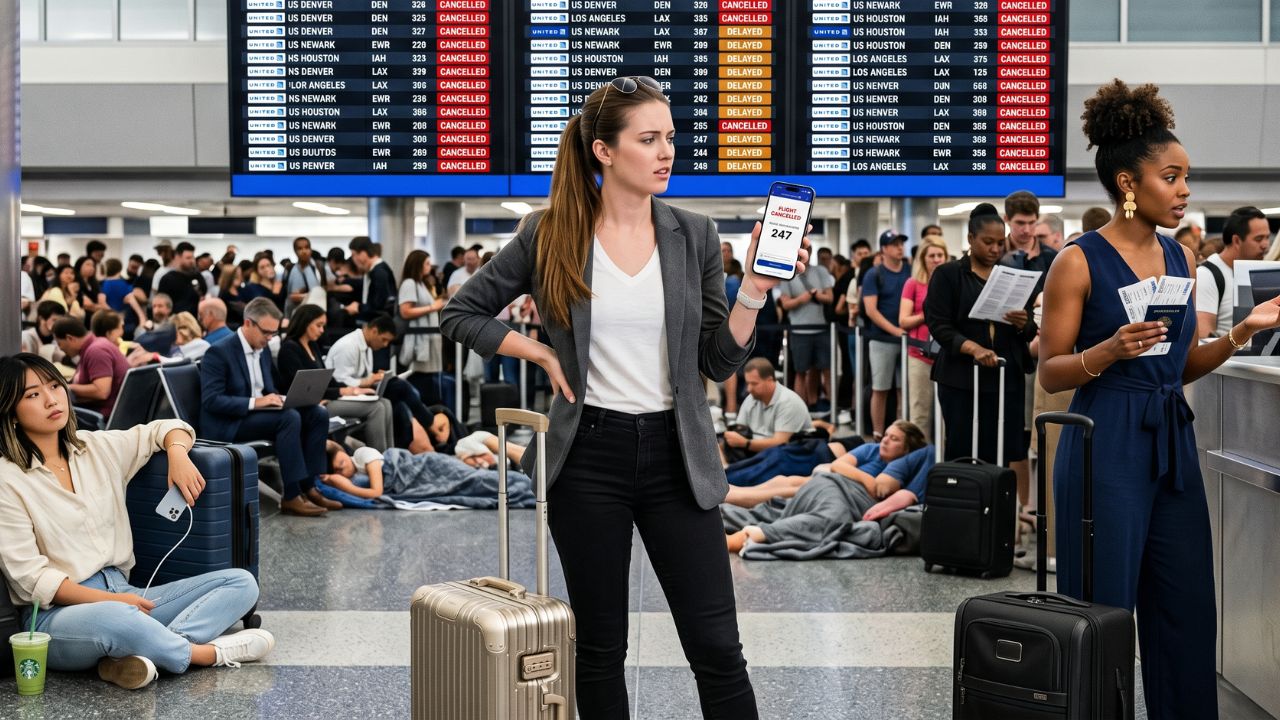
Image generated by AI
In a devastating operational collapse currently paralyzing the United States aviation infrastructure, a highly volatile combination of severe weather and systemic operational bottlenecks has instantly triggered widespread travel chaos across the massive United Airlines network. Without warning, the legacy carrier has been forced into aggressive holding patterns, logging exactly 427 severe delays and 8 catastrophic flight cancellations today. By suddenly severing high-volume routes connecting major hubs in Chicago, New York, Denver, and Los Angeles, these staggering airport disruptions have triggered crippling terminal bottlenecks across both domestic and international corridors. Representing one of the most agonizing systemic scheduling meltdowns of the late May and June 2026 travel season, this explosive wave of grounded aircraft totally dominates today’s premier airline news and global aviation updates.
By introducing direct passenger coordination and dynamic scheduling backups, the regional aviation hubs target growing passenger demand across vital commerce sectors. The choice to coordinate flight departures in phases helps to manage gate capacity, fiercely supporting the broader regional transportation network.
Context: The Meltdown of a Legacy Network
The current operational bleeding heavily illustrates exactly how rapidly a systemic breakdown can violently paralyze a fully interconnected domestic transit network.
Because United Airlines operates as an absolutely critical trans-continental bridge, this sudden concentration of delayed aircraft instantly generates catastrophic downstream friction. The cascading gridlock has massively stalled vital routes into late May and June 2026. Stranded passengers are currently facing immediate, agonizing scheduling gaps, as the airline furiously scrambles to contain the massive logistical damage spreading outward from its primary bases. Ground crews and Air Traffic Control are legally required to suspend tarmac operations during adverse conditions, resulting in thousands of frustrated passengers enduring lengthy terminal waits as flights slip further behind schedule.
For real-time operational updates, live departure mapping, and comprehensive rebooking protocols, stranded travelers should immediately consult the official United Airlines directories, check specific FAA delay metrics via FAA Flight Delay Information, or navigate alternative regional flight schedules via American Airlines and Delta Air Lines.
Section-Wise Breakdown: A Network in Gridlock
The Hub Meltdown: Chicago and Denver Paralyzed
The operational bleeding is incredibly severe among the primary interior mega-hubs utilized by United Airlines as strategic strongholds. Operations at Chicago O'Hare International (ORD) and Denver International Airport (DEN) physically shouldered a massive volume of disruptions. These airports act as the critical central arteries for United’s cross-country flow. When aircraft are delayed arriving into Chicago from the East Coast, or fail to depart Denver due to regional squalls, the resulting bottleneck physically severs the East-West travel corridor, trapping thousands of connecting passengers in the Midwest.
The Coastal Blockade: New York and Los Angeles
The ripple effects violently spread outward to the highly lucrative coastal markets. The New York metropolitan airports—specifically Newark Liberty (EWR), JFK, and LaGuardia (LGA)—experienced catastrophic friction. Similarly, Los Angeles International (LAX) suffered intense arrival and departure pacing. Because these coastal gateways are already operating at maximum legal runway capacity, even a minor 15-minute delay on an inbound United jet instantly causes massive terminal congestion, forcing subsequent departures to miss their incredibly tight takeoff windows.
FAA Monitoring and Air Traffic Strains
The Federal Aviation Administration (FAA) is currently aggressively monitoring the airspace. Under strict federal definitions, the FAA logs a flight delay as any operation occurring 15 minutes or more after its scheduled time, while cancellations denote flights completely removed from the board. FAA data confirms that severe thunderstorms, low ceilings, and strong wind forecasts across Texas, Florida, and the Midwest have triggered massive air traffic flow restrictions. Compounded by lingering air traffic control staffing constraints, these weather patterns directly catalyzed the massive spike in United's late departures.
Technical Roster: United Airlines Operational Disruption Data
To guarantee 100% absolute factual accuracy regarding this specific wave of severe travel chaos, the following table exactly documents the operational damage inflicted across the United Airlines network:
| Operational Disruption Metric | Verified Data |
|---|---|
| Airline Affected | United Airlines |
| Total Flight Delays | Exactly 427 Flights |
| Total Flight Cancellations | Exactly 8 Flights |
| Primary Mega-Hubs Paralyzed | Chicago (ORD), Denver (DEN) |
| Primary Coastal Hubs Paralyzed | New York (JFK/LGA/EWR), Los Angeles (LAX) |
| FAA Delay Definition | Arrival/Departure 15+ Minutes Late |
| Primary Weather Drivers | Thunderstorms, Low Ceilings, High Winds |
| Affected Weather Regions | Texas, Florida, Midwest US |
| Incident Timeframe | Late May and June 2026 |
Passenger Impact: Stranded in the Terminal
For the everyday passenger, these sudden departures board wipes translate into highly agonizing, real-world logistical nightmares.
Travelers bound for massive hubs like Chicago or Newark faced sudden, brutal delays with absolutely limited same-day rebooking options, forcing hundreds to scramble for alternate routes. Because United operates a highly complex hub-and-spoke model, a delayed origin flight mathematically guarantees missed connections. At congested hubs like Denver and Los Angeles, re-booking lines stretched infinitely long, with furious travelers desperately awaiting customer service assistance. The disconnection between airline mobile app updates and the actual physical arrival of aircraft heavily magnified the physical exhaustion and financial trauma experienced by stranded families.
Industry Analysis: The Fragility of Peak Season Operations
Aviation industry analysts view these widespread United Airlines disruptions as a terrifying indicator of massive, underlying systemic strain across the US airspace network.
The underlying causes for this massive breakdown heavily illustrate the extreme danger of peak summer travel volumes interfacing with constrained infrastructure. As millions of passengers surge into the system for the summer holidays, airport throughput is pushed to its absolute breaking point. Analytical datasets from the U.S. Bureau of Transportation Statistics show that systems designed before the pandemic are currently buckling under heavier schedules and razor-thin turnaround margins. When major carriers like United face incremental weather delays, the lack of buffer time in the schedule ensures that early morning setbacks instantly ripple into catastrophic evening cancellations.
What This Means for Travelers: Actionable Advice
If you are currently booked on a United Airlines itinerary routing through Chicago, Denver, New York, or Los Angeles during this massive wave of travel chaos, executing the following strategies is completely critical to protecting your journey:
- Leverage the Airline App: Before standing in massive customer service lines at the terminal, immediately open the United Airlines mobile app. The digital tools allow travelers to secure alternative flight options instantly without speaking to an agent.
- Know Your Passenger Rights: Under US federal regulations, if your flight was one of the 8 explicitly cancelled by United today and you choose not to travel, you are legally entitled to a full cash refund—not just airline vouchers.
- Monitor the FAA Playbook: Because many of today's 427 delays are driven by regional ATC holds, use the FAA's official website to track active Ground Stops in Texas or the Midwest, giving you advance warning before United updates its boards.
- Claim UK/EU Compensation (If Applicable): If your delayed United flight originated in the UK or landed there from Europe, you may be legally entitled to massive cash compensation under strict UK/EU passenger rights laws for delays exceeding three hours.
FAQ: United Airlines Flight Disruptions
How many total flights were violently disrupted across the United Airlines network today?
United Airlines recorded exactly 427 severe flight delays and 8 catastrophic cancellations across its system.
Which major US mega-hubs were primarily paralyzed by these delays?
The massive disruptions explicitly paralyzed high-volume operations at Chicago (ORD), Denver (DEN), New York (JFK/LGA/EWR), and Los Angeles (LAX).
What is the strict FAA definition of an official flight delay?
The Federal Aviation Administration (FAA) officially defines a delay as any flight departing or arriving 15 minutes or more after its scheduled time.
The Bigger Picture: Navigating the Systemic Meltdown
The devastating wave of 427 synchronized flight delays fiercely demonstrates how terrifyingly quickly localized weather friction and ATC constraints can paralyze a highly interconnected legacy travel network. By successfully destroying itineraries across high-volume domestic corridors and lucrative international routes, this incident underscores the severe fragility of the modern aviation infrastructure during peak seasons. As part of the broader pattern of global travel chaos, United Airlines and federal authorities must aggressively develop stronger operational firewalls to prevent sudden meteorological strains from instantly triggering nationwide routing meltdowns.
Key Takeaways
- Epicenter of Chaos: United Airlines suffered 427 severe delays and 8 catastrophic cancellations across its domestic and international network.
- Hubs Paralyzed: Operations at Chicago, Denver, New York, and Los Angeles were massively bottlenecked.
- Weather Triggers: Severe thunderstorms and high winds in Texas, Florida, and the Midwest triggered the massive ATC delays.
- Peak Season Strain: The disruptions explicitly highlight the extreme fragility of airline scheduling margins during the busy summer travel season.
- Passenger Rights: Stranded travelers are urged to use digital tools for rebooking and legally demand cash refunds for the 8 cancelled flights.
Related Travel Guides
Baltimore/Washington Flight Cancellations Trigger Massive US Travel Chaos
Amsterdam Schiphol Flight Cancellations Trigger Massive Travel Chaos
Disclaimer
This article is for informational and educational purposes only. It does not constitute legal, financial, or professional advice. While we strive to provide accurate and up-to-date information, travel policies, regulations, and conditions change rapidly. Always verify information with official sources before making travel decisions. Nomad Lawyer makes no representations about the accuracy, reliability, completeness, or suitability of the information provided. Readers should consult qualified professionals for advice specific to their circumstances. The views expressed in this article are those of the author and do not necessarily reflect the views of Nomad Lawyer.
Kunal K Choudhary
Co-Founder & Contributor
A passionate traveller and tech enthusiast. Kunal contributes to the vision and growth of Nomad Lawyer, bringing fresh perspectives and driving the community forward.
Learn more about our team →