
TSA Confiscates Legal Keurig Coffee Maker in 2026: Analyzing the Gap Between Guidelines and Officer Discretion
A North Carolina traveler's legal Keurig coffee maker was seized by TSA due to explosive alarms, highlighting the critical risk of officer discretion over official guidelines.

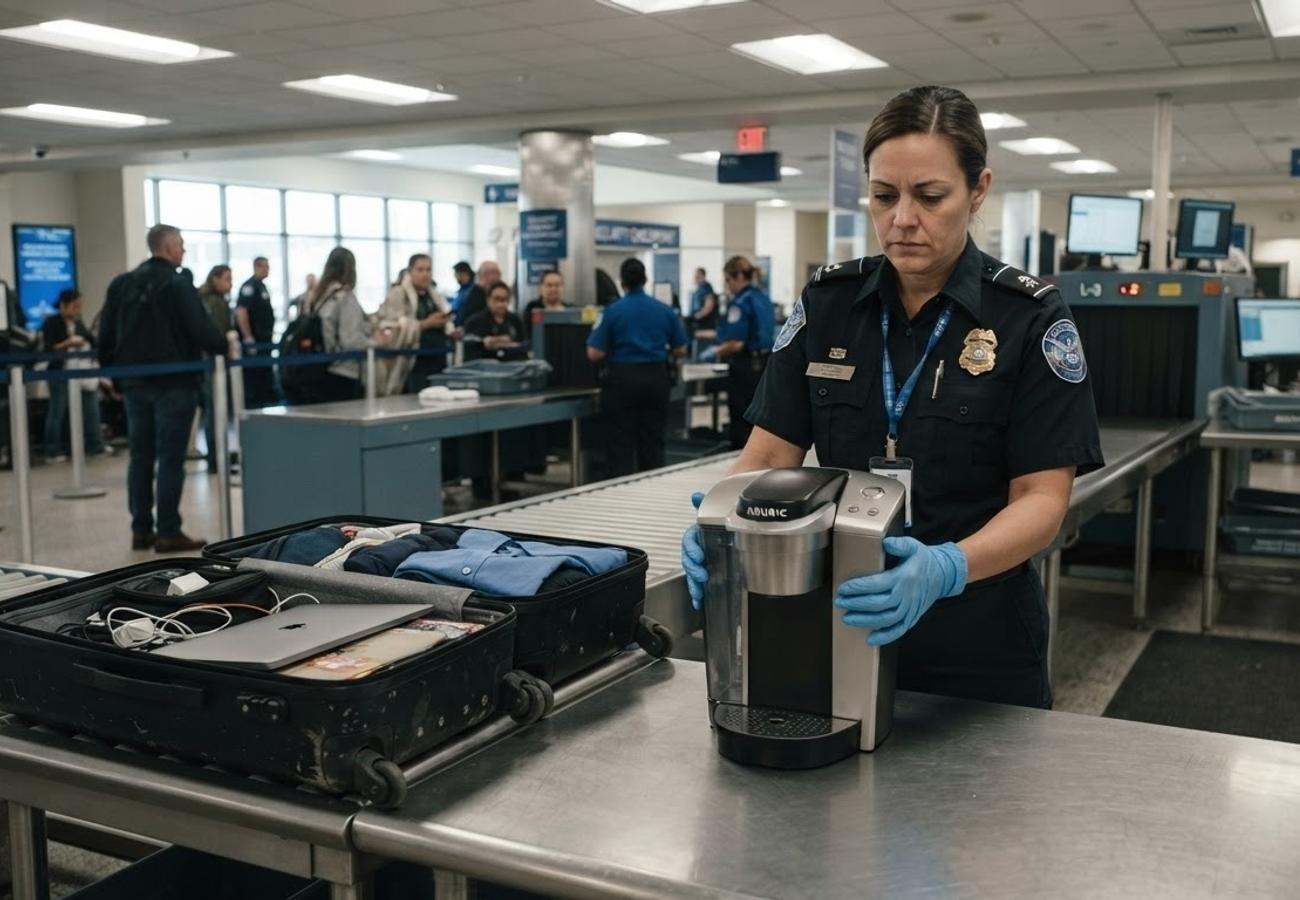
Image generated by AI
While the Transportation Security Administration (TSA) maintains a public list of nearly 500 permitted items, a recent seizure of a legal household appliance proves that official guidelines are secondary to the immediate judgment of on-site security personnel. This discrepancy creates a volatile environment for travelers who rely on static "permitted" lists to pack their checked luggage, as the gap between written policy and operational enforcement continues to widen.
The Discretion Gap in Numbers: The Keurig Case
The recent incident involving Paul Gosselin, a traveler from the Charlotte, North Carolina area, serves as a primary case study in the unpredictability of airport security. Gosselin and his wife were traveling to Las Vegas with a 48-ounce Keurig coffee maker packed in their checked baggage. Despite the item being explicitly permitted under Transportation Security Administration (TSA) guidelines, the appliance was removed from the luggage without the passenger's immediate knowledge.
The agency's justification for the seizure was based on technical triggers rather than policy violations. According to a statement issued to Action 9 (WSOC), the coffee maker triggered "multiple explosives compound alarms." This specific data point is critical: the item was not confiscated because coffee makers are banned, but because the internal components of this specific 48-ounce unit mirrored the signature of explosive compounds during screening.
This highlights a systemic risk for the modern traveler. Even when an item is listed as "Yes" for checked bags, the presence of complex electronics or specific materials can trigger automated alarms that override the general permission list. In this instance, the removal was conducted in the presence of an airline representative, and a notification note was left in the bag, though the item was not returned to the traveler.
Comparative Context: Policy vs. Operational Reality
To understand the scale of this issue, one must compare the "What Can I Bring?" database against the operational authority granted to TSA officers. The agency's official stance is that coffee and espresso makers are allowed in both carry-on and checked luggage, provided cords are wrapped and electronics are packed carefully. However, the fine print of the agency's own policy states that the final decision rests entirely with the TSA officer at the checkpoint.
This creates a hierarchy of authority where the digital guideline is a suggestion, but the officer's discretion is law. The following table compares the official guidelines for common household appliances against the operational risks that could lead to confiscation.
| Appliance | Official Checked Bag Status | Potential Trigger for Confiscation | Carry-on Requirement |
|---|---|---|---|
| Keurig/Coffee Maker | Permitted | Explosive compound alarms / Dense electronics | Allowed (Wrap cords) |
| Blender | Permitted | Unsheathed blades / Sharp edges | Blades must be removed |
| Microwave | Permitted | High-density metal shielding | Check with Airline |
| Sewing Machine | Permitted | Complex motor/internal wiring | Check dimensions |
| Waffle Iron | Permitted | Heating element density | Check dimensions |
| Electric Fan | Permitted | Motor size/wiring | Check dimensions |
When analyzing this data against historical travel patterns, it is evident that as screening technology becomes more sensitive, the likelihood of "false positives" for explosive compounds increases. Travelers who have successfully flown internationally—as Gosselin did with his coffee maker to Greece and Aruba—may find that domestic US security protocols in 2026 are more stringent or utilize different alarm thresholds.
What This Means for Travelers
The data from this incident suggests that relying on the TSA's searchable list is insufficient for high-value or essential electronics. If you are planning a trip in late 2026, the following actionable strategies are recommended to mitigate the risk of loss:
- Prioritize Carry-On for High-Value Electronics: The TSA explicitly recommends packing expensive or fragile electronics in carry-on bags. While this does not eliminate the risk of seizure, it ensures you are present during the screening process and can provide immediate clarification or contest a seizure in real-time.
- Document Your Items: For appliances like the 48-ounce Keurig, take photos of the item and its model number before packing. In the event of a seizure, having a documented record makes it easier to file a claim or seek reimbursement from the manufacturer.
- Avoid "Dense" Packing: Explosive compound alarms are often triggered by the density of materials or the way items are layered. Avoid packing electronics tightly against other dense objects, which can create "dark spots" on an X-ray that trigger alarms.
- Prepare for Total Loss: As seen in the Gosselin case, the process of submitting a government claim for a mid-range household appliance is often viewed as prohibitively tedious. Travelers should treat checked electronics as "at-risk" assets.
For those concerned about the broader regulatory environment, monitoring updates from the International Air Transport Association (IATA) can provide insight into how global security standards are shifting, which often precedes changes in domestic TSA behavior.
Forward Projection: The Rise of Automated Seizures
The trajectory of airport security is moving toward increased automation and AI-driven threat detection. As the TSA integrates more advanced scanning technology, we can expect a rise in "compound alarms" triggered by everyday household items. This suggests a future where the "permitted" list becomes less relevant than the "material signature" of the item.
We are likely to see a shift where certain brands or models of electronics are flagged across multiple airports due to their internal construction. If a specific model of coffee maker triggers an alarm in Charlotte, it is highly probable that the same model will trigger alarms in other major hubs. This creates a "blacklist by proxy," where an item is legally permitted but operationally impossible to transport.
Furthermore, the industry may see a rise in manufacturer-led insurance or replacement programs. In this case, Keurig provided a new coffee maker after the incident gained media attention. This indicates that brands are recognizing the volatility of modern security screenings and may use "security replacement" as a customer loyalty tool.
FAQ: TSA Appliance Confiscations 2026
Can the TSA legally take an item that is on the "permitted" list? Yes. While the "What Can I Bring?" list provides general guidance, TSA policy explicitly states that the final decision rests with the individual officer. Security alarms (such as explosive compound triggers) override general permission lists.
Should I put my coffee maker in my checked bag or carry-on? The TSA recommends carry-on for expensive electronics. This allows you to communicate with officers if an alarm is triggered, rather than discovering the item is missing upon arrival at your destination.
What should I do if the TSA confiscates a legal item? Request a written explanation for the seizure and a case number. While government claims are slow, having a formal record is essential if you intend to seek a replacement from the manufacturer or file an insurance claim.
Will these rules change for international flights? Security protocols vary by country. While an item may pass in Aruba or Greece, US-based TSA screenings often utilize different technology and alarm thresholds, making domestic travel more unpredictable for certain electronics.
When the rules say "Yes" but the alarm says "No," the officer always has the final word.
Related Travel Guides
Disclaimer
This article is for informational and educational purposes only. It does not constitute legal, financial, or professional advice. While we strive to provide accurate and up-to-date information, travel policies, regulations, and conditions change rapidly. Always verify information with official sources before making travel decisions. Nomad Lawyer makes no representations about the accuracy, reliability, completeness, or suitability of the information provided. Readers should consult qualified professionals for advice specific to their circumstances. The views expressed in this article are those of the author and do not necessarily reflect the views of Nomad Lawyer.
Raushan Kumar
Founder & Lead Developer
Full-stack developer with 11+ years of experience and a passionate traveller. Raushan built Nomad Lawyer from the ground up with a vision to create the best travel and law experience on the web.
Learn more about our team →