
Qantas' Ultra-Long-Range A350-1000ULR: Engineering Marvel Enables Nearly 22-Hour Nonstop Flights
Breaking airline news and aviation industry updates for 2026.

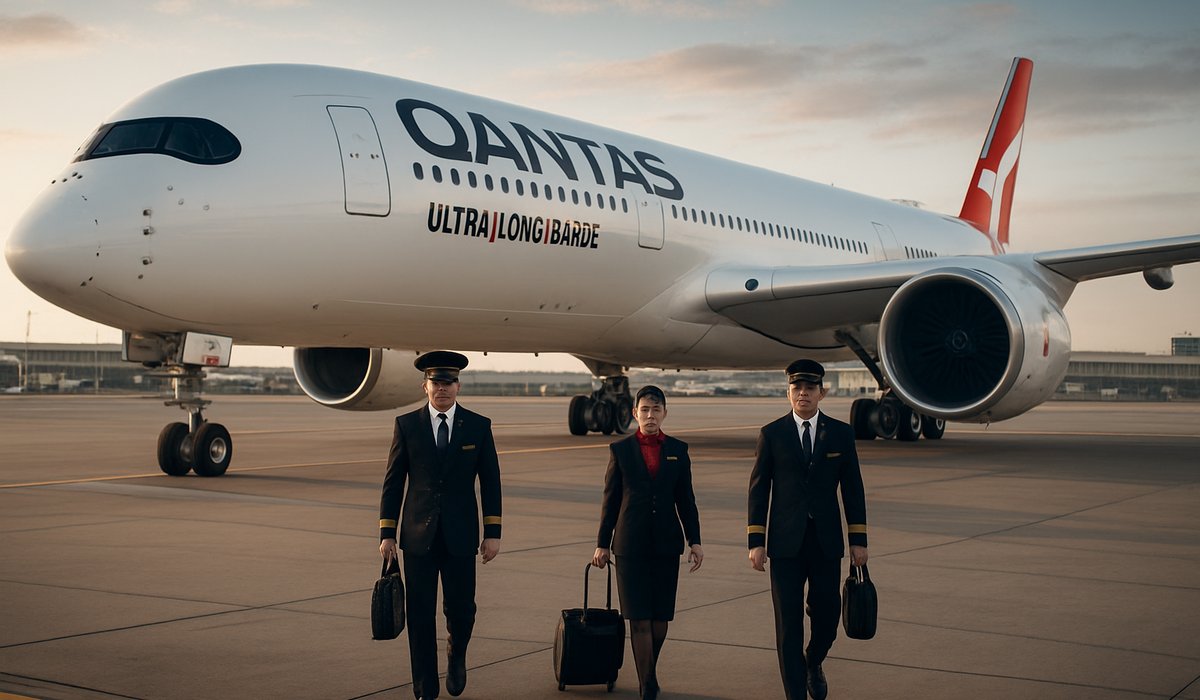
Image generated by AI
Qantas' Ultra-Long-Range A350-1000ULR: Engineering Marvel Enables Nearly 22-Hour Nonstop Flights
The aviation industry's longest-range commercial aircraft enters service this year, redefining intercontinental travel with groundbreaking fuel tank technology
Revolutionary Aircraft Reshapes Global Aviation Landscape
Airbus has delivered a game-changing piece of aviation engineering: the A350-1000ULR (Ultra Long Range), a aircraft designed to fundamentally alter how airlines operate intercontinental routes. The aircraft's defining feature—an additional 20,000-liter fuel capacity integrated into its fuselage—enables commercial flights spanning nearly 10,000 nautical miles (18,500 kilometers) without refueling, transforming aviation connectivity on a global scale.
The first production A350-1000ULR recently rolled off Airbus's manufacturing facility in Toulouse, France, marking a watershed moment for long-haul aviation. Within months, this twin-engine powerhouse will enter revenue service with Qantas Airways, fundamentally changing how passengers travel between distant continents.
How Engineering Innovation Enables Ultra-Distance Flight
The aircraft's extended fuel capacity represents a sophisticated engineering solution to an industry-wide challenge: eliminating intermediate stops on the world's most grueling routes. The supplementary 20,000-liter tank, seamlessly integrated into the aircraft's design, provides sufficient fuel reserves to maintain commercial operations across distances previously requiring stopover points.
This technical advancement addresses a persistent pain point in global aviation. Airlines operating legacy long-haul fleets have historically relied on fuel stops in hub cities, adding 8-12 hours to journey times while increasing operational complexity and costs. The A350-1000ULR eliminates this necessity entirely on premium intercontinental corridors.
Qantas Launches Service on World's Longest Routes
Australia's flagship carrier, Qantas Airways, will deploy the A350-1000ULR on two of Earth's most challenging aviation routes—flights that demand extraordinary fuel endurance and operational precision. These services, launching within the year, will accommodate direct connections previously impossible with conventional aircraft, dramatically improving passenger experience and reducing total travel time.
The aircraft's engineering represents years of collaborative development between Airbus engineers and airline operators seeking solutions for ultra-distance travel. Its arrival signals a shift toward point-to-point connectivity over traditional hub-and-spoke models.
Implications for the Aviation Industry
The A350-1000ULR's introduction arrives amid industry transformation. Airlines worldwide increasingly demand aircraft capable of operating uneconomical routes profitably, reducing passenger fatigue, and improving schedule reliability. This aircraft directly addresses these priorities.
The implications extend beyond passenger convenience. Extended-range capabilities reduce aircraft utilization pressure on hub airports, potentially alleviating congestion at major aviation chokepoints while opening secondary city markets previously dependent on connecting flights.
Frequently Asked Questions
What makes the A350-1000ULR different from standard A350 aircraft? The ULR variant includes an additional 20,000-liter fuel tank integrated into its structure, enabling flights up to 18,500 kilometers without refueling—approximately 3,000 kilometers farther than conventional A350 models.
Which routes will use Qantas' A350-1000ULR aircraft? Qantas has specified two of the world's longest routes, though specific city pairs remain to be officially announced. These routes previously required intermediate stops.
How long will flights actually take on ultra-long-range routes? Flight times will extend to approximately 22 hours depending on prevailing winds, weather patterns, and specific routing, representing 8-12 hour time savings compared to conventional multi-stop itineraries.
What is the commercial significance of ultra-long-range aircraft? Airlines can eliminate costly intermediate stops, improve fuel efficiency through reduced taxi and takeoff cycles, and offer superior passenger convenience—creating competitive advantages on premium routes.
When will the A350-1000ULR begin passenger operations? Qantas plans service launch within approximately one year following the aircraft's recent delivery, pending regulatory approvals and crew training completion.
Related Travel Guides
Flight Delay Compensation Guide 2026
Understanding Airline Route Changes
Airport Security Process Updated (2026)
External Resources
Disclaimer
This article is for informational and educational purposes only. It does not constitute legal, financial, or professional advice. While we strive to provide accurate and up-to-date information, travel policies, regulations, and conditions change rapidly. Always verify information with official sources before making travel decisions. Nomad Lawyer makes no representations about the accuracy, reliability, completeness, or suitability of the information provided. Readers should consult qualified professionals for advice specific to their circumstances. The views expressed in this article are those of the author and do not necessarily reflect the views of Nomad Lawyer.
Raushan Kumar
Founder & Lead Developer
Full-stack developer with 11+ years of experience and a passionate traveller. Raushan built Nomad Lawyer from the ground up with a vision to create the best travel and law experience on the web.
Learn more about our team →