
Boeing 787-10 vs Airbus A350-900: Five Critical Landing Gear Engineering Differences Reshaping Widebody Aircraft Design
Breaking airline news and aviation industry updates for 2026.

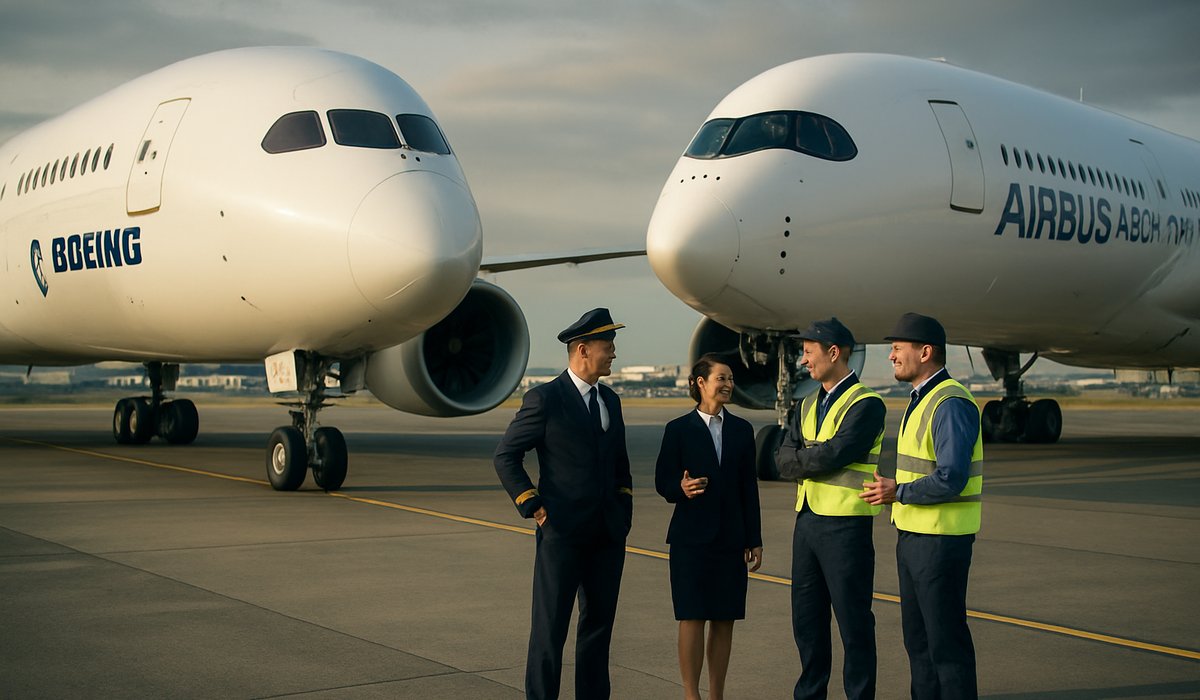
Image generated by AI
Boeing 787-10 vs Airbus A350-900: Five Critical Landing Gear Engineering Differences Reshaping Widebody Aircraft Design
As airlines expand their long-haul fleets with next-generation composite aircraft, engineers reveal fundamental design divergences between industry heavyweights
Market Dominance Masks Deeper Engineering Divide
The Boeing 787 Dreamliner's early market entry established it as the dominant widebody aircraft in the modern composite jetliner era, commanding significant order books from global carriers. However, a detailed technical examination reveals that the 787-10 variant and its closest competitor, the Airbus A350-900, embody starkly different engineering philosophies—nowhere more apparent than in their landing gear systems.
While both aircraft represent state-of-the-art long-haul design and share considerable technological overlap, their undercarriage configurations expose the divergent strategic approaches aerospace manufacturers have adopted to solve identical operational challenges.
Engineering Philosophy Drives Design Decisions
The landing gear systems of these aircraft illustrate how Boeing and Airbus prioritize different operational requirements. The 787-10, optimized for rapid deployment across diverse airport infrastructure, incorporates specific geometric and mechanical solutions that differ fundamentally from the A350-900's approach, which emphasizes efficiency on premium long-range routes.
These five key differences—spanning structural geometry, material selection, load distribution mechanisms, maintenance accessibility, and operational specifications—demonstrate how even closely comparable aircraft can achieve their objectives through contrasting technical pathways.
Implications for Fleet Operations
For airlines managing mixed-fleet operations, these engineering variations carry substantial implications. Maintenance protocols, component compatibility, spare parts inventory, and ground handling procedures all diverge based on landing gear architecture. Carriers operating both aircraft types must train technicians to specifications tailored to each platform, increasing operational complexity and training costs.
The 787-10's approach prioritizes flexibility across global airport networks with varying runway conditions and ground support capabilities. Conversely, the A350-900's configuration reflects Airbus's confidence in modern airport infrastructure standardization, allowing for optimization around premium long-haul operations on well-equipped airways.
Industry Ripple Effects
These technical distinctions cascade through the aviation supply chain. Landing gear manufacturers must develop specialized components for each platform, affecting production efficiency and parts availability. Component lead times, warranty structures, and retrofit capabilities all hinge on whether operators deploy 787-10 or A350-900 aircraft.
As airlines continue evaluating wide-body procurement strategies amid fluctuating fuel costs and post-pandemic demand recovery, understanding these engineering fundamentals becomes crucial to total cost-of-ownership calculations extending across 20+ year aircraft lifecycles.
FAQ: Landing Gear Engineering in Modern Widebody Aircraft
Q: Why do the Boeing 787-10 and Airbus A350-900 require different landing gear designs? A: Both manufacturers prioritize different operational scenarios. Boeing emphasized airport infrastructure versatility, while Airbus optimized for premium long-haul efficiency on modern facilities.
Q: How do landing gear differences affect maintenance costs for airlines? A: Distinct specifications require separate training, specialized tools, and component inventories, increasing overall maintenance overhead for mixed-fleet operators.
Q: Which aircraft's landing gear design is more cost-effective for global carriers? A: Cost-effectiveness depends on route networks. The 787-10 suits diverse airport operations; the A350-900 optimizes for established long-haul corridors.
Q: Do landing gear differences impact passenger experience or comfort? A: Indirectly—design choices affect fuel efficiency, maintenance scheduling, and operational reliability, which influence ticket pricing and flight reliability.
Q: Are these landing gear systems interchangeable between aircraft types? A: No. Each system is proprietary and optimized for its respective aircraft's weight distribution, aerodynamic profile, and operational parameters.
Related Travel Guides
External Resources
Disclaimer
This article is for informational and educational purposes only. It does not constitute legal, financial, or professional advice. While we strive to provide accurate and up-to-date information, travel policies, regulations, and conditions change rapidly. Always verify information with official sources before making travel decisions. Nomad Lawyer makes no representations about the accuracy, reliability, completeness, or suitability of the information provided. Readers should consult qualified professionals for advice specific to their circumstances. The views expressed in this article are those of the author and do not necessarily reflect the views of Nomad Lawyer.
Kunal K Choudhary
Co-Founder & Contributor
A passionate traveller and tech enthusiast. Kunal contributes to the vision and growth of Nomad Lawyer, bringing fresh perspectives and driving the community forward.
Learn more about our team →