
Tenerife Prepares for Rare 2026 Solar Eclipse and Perseid Meteor Shower Double Event at Teide National Park: Everything You Need to Know
Tenerife hosts a rare celestial double event on August 12, 2026, featuring a 70% solar eclipse and peak Perseid meteors at Teide National Park.

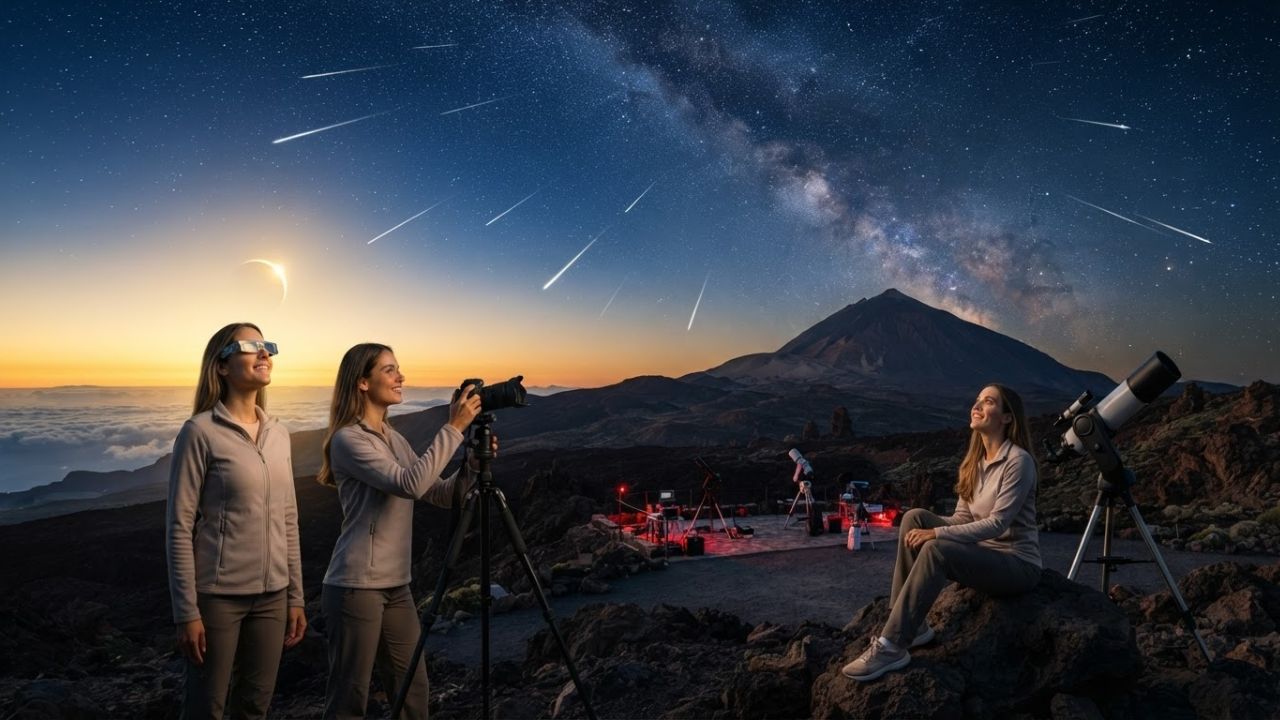
Image generated by AI
On August 12, 2026, the island of Tenerife in Spain's Canary Islands will host an extraordinary double astronomical event, bringing together a 70% partial solar eclipse and the peak of the annual Perseid meteor shower in a single evening. Centered around the UNESCO World Heritage site of Teide National Park, the phenomenon is expected to attract thousands of international travelers, astronomers, and photographers. With viewing conditions optimized by protected dark skies and high-altitude volcanic peaks above the cloud line, visitors must secure certified solar viewing gear and arrange high-altitude park permits in advance.
Quick Summary
- Rare Celestial Double Header: On August 12, 2026, Tenerife experiences a 70% partial solar eclipse during the afternoon followed by peak Perseid meteors at night.
- Optimal Dark Sky Location: Teide National Park, home to Mount Teide (3,715 meters above sea level), offers pristine high-altitude viewing above the clouds.
- Ideal Moon Phase: The event coincides with the new moon phase, providing dark skies for observing dozens of shooting stars per hour.
- Protected Sky Environment: Regulated under regional Sky Law protections, Tenerife ranks alongside Chile's Atacama Desert and Hawaii's Mauna Kea for global stargazing.
- Hospitality & Science Travel: Local properties including Spring Hotel Vulcano, Spring Hotel Bitácora, and Spring Hotel Arona Gran are building specialized packages ahead of October’s Starmus VIII Festival.
Context and Background: Tenerife’s Shift Toward Astronomy Tourism
While Tenerife has long been recognized for its volcanic beaches and coastal resorts, the Canary Islands are increasingly establishing themselves as a premier global hub for scientific and astronomy tourism. The archipelago benefits from strict regional legislation known as the Sky Law, which limits light pollution, restricts flight corridors over observatories, and preserves night sky clarity.
The alignment of a major daytime solar eclipse with the peak night of the Perseid meteor shower creates a rare opportunity for destination marketers. Tourism authorities are leveraging this event to encourage visitors to explore inland volcanic reserves, supporting sustainable eco-tourism beyond traditional beach vacations.
Event Details: The August 12, 2026 Astronomical Sequence
On the afternoon of August 12, 2026, the Moon will pass in front of the Sun, obscuring approximately 70 percent of the solar disk as seen from Tenerife. This partial solar eclipse will noticeably dim daylight across the island, creating a dramatic prelude to the night sky events.
As night falls, the annual Perseid meteor shower will reach its peak intensity. Produced as Earth passes through the orbital dust trail of comet 109P/Swift-Tuttle, the Perseids deliver dozens of fast-moving meteors per hour under clear conditions. Crucially, the 2026 shower coincides with the new moon phase, ensuring zero moonlight interference and creating optimal conditions for spotting faint shooting stars.
Table: Tenerife August 12, 2026 Celestial Event Matrix
| Event Parameter | Astronomical Details | Viewing Impact in Tenerife |
|---|---|---|
| Date of Event | August 12, 2026 | Afternoon partial solar eclipse + night Perseid meteor peak |
| Solar Eclipse Coverage | ~70% solar surface coverage | Noticeable daylight dimming; requires ISO-certified eclipse glasses |
| Meteor Origin | Comet 109P/Swift-Tuttle debris | Dozens of meteors per hour during peak night hours |
| Lunar Phase Influence | New Moon Phase | Zero moonlight interference, ensuring pitch-black dark skies |
| Primary Viewing Hub | Teide National Park (3,715m) | High-altitude observation above cloud layers and light pollution |
| Legal Protections | Canary Islands Sky Law | Regulates light pollution to preserve high atmospheric clarity |
Risks, Travel Disruptions, and Stargazing Logistics
Witnessing a double celestial event at high altitude requires careful preparation to avoid logistical bottlenecks:
- Mount Teide Access Congestion: Heavy vehicle traffic along mountain access roads entering Teide National Park will create delays during peak afternoon and evening hours.
- Extreme High-Altitude Temperature Drops: At 3,715 meters, temperatures near Mount Teide drop significantly after sunset, posing hypothermia risks for unprepared visitors.
- Solar Viewing Eye Safety: Observing the 70% partial solar eclipse without certified ISO 12312-2 solar glasses can cause permanent ocular damage.
- Coastal to Mountain Accommodation Demands: High hotel booking volumes across Tenerife necessitate early reservations, particularly in resort areas connecting coastal stays with night tours.
What Authorities and Astronomers Are Saying
Astronomers at the Canary Islands Astrophysics Institute emphasize that Teide National Park offers one of Europe's most atmospheric locations for viewing the 2026 double event. Positioned above the thermal inversion layer, the park provides ultra-dry, stable air that minimizes optical distortion.
Hospitality leaders across Tenerife—including management at Spring Hotel Vulcano, Spring Hotel Bitácora, and Spring Hotel Arona Gran—highlight that guests are increasingly seeking experiential travel that combines daytime beach relaxation with evening guided astronomy tours using professional telescopes.
Practical Advice for Stargazing Travelers in Tenerife
Visitors traveling to Tenerife for the August 12 celestial spectacle should implement these essential guidelines:
- Obtain Certified Solar Filters: Secure ISO 12312-2 compliant eclipse glasses prior to arrival for safe observation during the 70% afternoon solar coverage.
- Dress in Extreme Cold-Weather Layers: Bring heavy thermal jackets, gloves, and beanies, as temperatures at Teide National Park drop near freezing after dusk.
- Pre-Book Mountain Transport & Permits: Reserve guided stargazing excursions or park transit passes well in advance to bypass vehicle entry restrictions.
- Allow Extra Transit Time Up Mount Teide: Depart coastal hotels early in the afternoon to account for heavy traffic along mountain winding roads.
- Use Red-Light Flashlights: Bring red LED flashlights during night meteor watching to preserve night-vision adaptation in dark sky zones.
Broader Context: Global Science Travel and Starmus VIII
Tenerife’s astronomical prominence extends beyond August. The island is set to host Starmus Festival VIII in October 2026, bringing together global astronauts, Nobel Laureates, and international musicians to celebrate space exploration and science.
Alongside Chile’s Atacama Desert and Hawaii’s Mauna Kea, the Canary Islands remain at the forefront of international observational astronomy. The August 12 event highlights how scientific preservation under the Sky Law translates into high-value, sustainable tourism.
What to Expect Next in Tenerife Tourism
Following the August 12 celestial event, local tourism authorities expect continued interest in night-sky excursions leading into the October 2026 Starmus VIII Festival.
Hotels and tour operators will continue expanding stargazing packages, establishing Tenerife as a year-round destination for astronomy enthusiasts and nature travelers.
Conclusion
The convergence of a 70% partial solar eclipse and the peak Perseid meteor shower on August 12, 2026, positions Tenerife as Europe's premier stargazing destination. By offering protected dark skies at Teide National Park, the island provides an unforgettable setting where volcanic landscapes meet the cosmos. Travelers planning to attend must secure certified eclipse glasses, prepare for high-altitude cold, and book mountain excursions early to enjoy this rare night sky spectacle.
Frequently Asked Questions (FAQ)
1. What makes the August 12, 2026 celestial event in Tenerife so rare?
On August 12, 2026, Tenerife will experience a 70% partial solar eclipse in the afternoon followed immediately by the peak of the annual Perseid meteor shower under pitch-black new moon skies at night.
2. Why is Teide National Park one of Europe's best locations for stargazing?
Located at an altitude of up to 3,715 meters, Teide National Park sits above cloud layers, benefits from strict Sky Law light pollution controls, and provides exceptionally clear atmospheric conditions.
3. Do travelers need special glasses to view the solar eclipse in Tenerife?
Yes. Observers must wear certified ISO 12312-2 solar eclipse glasses to safely view the afternoon partial solar eclipse without risking eye damage.
4. What other major astronomy events are taking place in Tenerife in 2026?
Tenerife will host Starmus Festival VIII in October 2026, bringing together astronauts, Nobel Prize winners, and musicians for a global celebration of science and space exploration.
5. Which hotels are offering bases for stargazing excursions in Tenerife?
Major coastal properties—including Spring Hotel Vulcano, Spring Hotel Bitácora, and Spring Hotel Arona Gran—provide convenient bases combining beach holidays with evening mountain astronomy tours.
SEO & Metadata Specifications
- Suggested Meta Title (58 characters): Tenerife 2026 Solar Eclipse & Perseid Stargazing Guide
- Suggested Meta Description (153 characters): Tenerife hosts a rare celestial double event on August 12, 2026, featuring a 70% solar eclipse and peak Perseid meteors at Teide National Park.
- URL Slug:
tenerife-solar-eclipse-perseid-meteor-shower-2026 - Article Tags:
Tenerife Solar Eclipse 2026,Perseid Meteor Shower,Teide National Park,Canary Islands Stargazing,Astronomy Travel Alert - Featured Image Alt Text: Mount Teide under starry night sky in Tenerife showcasing the 2026 solar eclipse and Perseid meteor shower stargazing spectacle.
Related Travel Guides
Disclaimer
This article is for informational and educational purposes only. It does not constitute legal, financial, or professional advice. While we strive to provide accurate and up-to-date information, travel policies, regulations, and conditions change rapidly. Always verify information with official sources before making travel decisions. Nomad Lawyer makes no representations about the accuracy, reliability, completeness, or suitability of the information provided. Readers should consult qualified professionals for advice specific to their circumstances. The views expressed in this article are those of the author and do not necessarily reflect the views of Nomad Lawyer.
Kunal K Choudhary
Co-Founder & Contributor
A passionate traveller and tech enthusiast. Kunal contributes to the vision and growth of Nomad Lawyer, bringing fresh perspectives and driving the community forward.
Learn more about our team →