
Sydney Airport Retains Australia's Top Global Connectivity Ranking in OAG Megahubs 2026

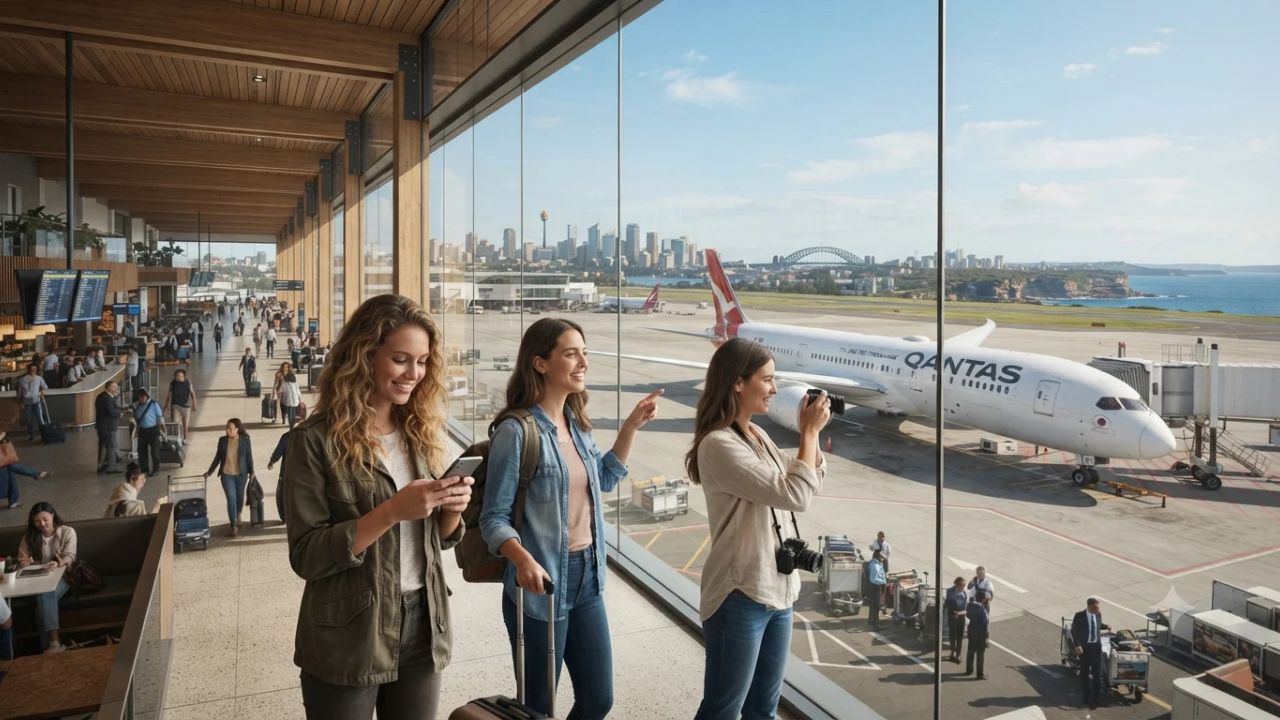
Image generated by AI
Capturing 37.2 percent of Australia's total international passenger movements and generating 11,807 potential flight connections across 101 destinations, Sydney Kingsford Smith Airport (SYD) has maintained its position as the nation's premier international transit hub in the OAG Megahubs 2026 index. Released on 16 September 2026, the global connectivity benchmark placed Sydney at number 35 worldwide with a connectivity index score of 116.9, making it the sole Australian airport to secure a place within the prestigious global top 50.
While Sydney slipped five positions from its 30th-place ranking in 2025 amid aggressive capacity additions across Asian and Middle Eastern super-connectors, its domestic dominance remains unassailable. Anchor tenant Qantas commands approximately 39 percent of all scheduled aircraft movements at the gateway, anchoring a dual-hub network that distributes overseas arrivals into regional coastal markets while channeling trans-Tasman and long-haul passengers into global trunk routes.
Decoding the OAG Megahubs Index: Why Sydney Outpaces Regional Rivals
To understand the operational significance of the OAG Megahubs ranking, aviation planners distinguish between raw passenger volume and effective network connectivity. The index does not measure terminal foot traffic or fleet sizes; instead, it evaluates the mathematical efficiency of an airport's timetable matrix.
The 2026 study evaluated flight schedules operating across the globe between September 2025 and August 2026, focusing on Sunday, 2 August 2026—identified as the single busiest operating day in global commercial aviation. Connectivity algorithms tracked all possible flight connections where at least one leg was international, filtering pairings through each airport's minimum connection time (MCT) and applying a maximum connection window of six hours.
Sydney's network score of 116.9 reflects 11,807 viable connection pathways across 101 total domestic and overseas destinations. By contrast, global top-tier megahubs like Istanbul (ranked first worldwide), London Heathrow (second), Amsterdam Schiphol (third), Kuala Lumpur (fourth and top in Asia), and Chicago O'Hare (fifth) operate within denser geographical corridors. In the Asia-Pacific basin, super-hubs including Seoul Incheon, Tokyo Haneda, Singapore Changi, Bangkok Suvarnabhumi, Shanghai Pudong, Guangzhou Baiyun, and Hong Kong maintain higher connection counts, yet Sydney stands entirely alone as Australasia’s representative in the global top tier.
The Traffic Matrix: June 2026 Passenger Movements and Air Freight Supremacy
The empirical weight of Sydney's international gateway status is corroborated by federal civil aviation data published by the Australian Department of Infrastructure, Transport, Regional Development, Communications and the Arts. In June 2026, Sydney Kingsford Smith processed 1,262,659 international passenger movements, accounting for 37.2 percent of the national total.
This performance established a commanding lead of 349,264 passengers over second-place Melbourne Airport, which recorded 913,395 movements (26.9 percent share). Brisbane Airport followed with 540,431 passengers (15.9 percent share), while Perth Airport handled 423,097 international travelers (12.5 percent share). Beyond passenger numbers, Sydney processed 48.3 percent of Australia's entire international air cargo tonnage in June 2026, cementing its role as the continent's primary supply-chain umbilical.
Across the first half of 2026, Sydney accommodated more than 20.7 million total travelers. International throughput rose 2.1 percent year-on-year to 8.44 million passengers, while domestic passenger traffic edged up 1.0 percent to 12.29 million.
| Australian Airport Gateway | June 2026 International Passenger Volume | National Market Share (%) | OAG Megahubs 2026 Global Rank | Operational Curfew / Terminal Characteristics |
|---|---|---|---|---|
| Sydney Kingsford Smith (SYD) | 1,262,659 | 37.2% | #35 (Top in Australia) | Strict 23:00–06:00 curfew; separate T1 international & T2/T3 domestic terminals |
| Melbourne Tullamarine (MEL) | 913,395 | 26.9% | Unranked in Top 50 | 24/7 curfew-free operations; single-precinct co-located terminal design |
| Brisbane Airport (BNE) | 540,431 | 15.9% | Unranked in Top 50 | 24/7 operations; Australia's largest domestic network (62 destinations) |
| Perth Airport (PER) | 423,097 | 12.5% | Unranked in Top 50 | 24/7 operations; western trans-continental and European non-stop gateway |
While Sydney leads in international network density, domestic competitors exploit structural niches. Brisbane Airport promotes its round-the-clock operations and direct links to 62 domestic and 32 international destinations as Australia’s most geographically connected domestic network. Simultaneously, Melbourne Airport highlights its absence of flight curfews and an integrated single-terminal precinct that minimizes transit friction for transfer passengers.
Network Realignment: Asian Routing Resilience and Forward Expansion
Sydney’s international stability during 2026 was largely sustained by a major reorientation toward East and Southeast Asian hubs, which cushioned Australian travelers against operational disruptions and airspace closures across the Middle East. According to operational disclosures from Sydney Airport, passenger volumes on the Guangzhou route surged 50.5 percent year-on-year during the second quarter of 2026, while passenger traffic via Hong Kong and Kuala Lumpur each climbed by more than 14 percent. Strong performance also continued across Tokyo, Seoul, and Singapore.
This eastward pivot expands further in late 2026. On 14 December 2026, Shenzhen Airlines will launch a four-times-weekly service connecting Shenzhen and Sydney deploying widebody Airbus A330-300 aircraft. The route will introduce approximately 130,000 annual seats, translating to roughly 100,000 anticipated passenger journeys each year. Shenzhen was Sydney's seventh-largest mainland Chinese origin-and-destination market in 2025, recording a 16 percent volume increase to 56,000 travelers.
The arrival of Shenzhen Airlines marks the tenth mainland Chinese carrier operating at the gateway and pushes Sydney’s carrier roll to a historic record of 55 international airlines. Looking ahead to 2027, the airport has finalized plans for EgyptAir to initiate a one-stop Cairo–Singapore–Sydney service, subject to regulatory approvals, which would establish Sydney's first carrier link into North Africa.
Expert Analysis: Curfew Constraints, Terminal Splits, and Trans-Pacific Fare Dynamics
Despite its connectivity accolades, Sydney Kingsford Smith operates under significant physical and regulatory handicaps that complicate passenger itineraries. The gateway remains bound by a federally enforced statutory curfew between 23:00 and 06:00, alongside an 80-movement-per-hour runway cap. This restricts scheduling flexibility, condensing international departures and arrivals into narrow morning and evening banks.
Compounding this schedule compression is the airport's divided ground layout. International flights operate exclusively from Terminal 1 (T1), separated from domestic Terminals 2 and 3 (T2/T3) by active runways. Connecting passengers cannot walk between precincts; they must utilize a free shuttle bus operating every 15 minutes between 5:30 am and 10:30 pm (a 10-minute ride) or pay for a two-minute subterranean rail transfer.
For travelers booking this route, the direct consequence is that transfer itineraries bridging domestic regional cities with long-haul international departures require a mandatory minimum connection buffer of 2.5 to 3 hours, accounting for baggage reclamation, terminal transfers, and separate security clearances. Booking tighter unofficial connections exposes travelers to missed departures if inbound regional flights encounter air traffic control delays.
The pricing pressure this creates means airlines operating out of Sydney command premium yields during peak daytime operational slots. Business travelers and premium long-haul tourists absorb higher ticket costs to secure departures that align with midday banking windows, while cost-conscious travelers increasingly evaluate connecting via Melbourne or Brisbane, where single-terminal precincts and 24-hour schedules eliminate connection penalties. Nevertheless, Sydney's sheer route diversity ensures that it remains the anchor through which the majority of global travelers experience Australia.
Key Takeaways
- Australia's Top Connectivity Hub: Sydney Kingsford Smith Airport ranks 35th globally in the OAG Megahubs 2026 index with a connectivity score of 116.9, standing as the only Australian airport in the global top 50.
- Overwhelming Market Share: Handling 1,262,659 international travelers in June 2026, Sydney captured 37.2 percent of Australia’s international traffic, outpacing Melbourne by nearly 350,000 passengers.
- Critical Asian Transit Corridors: Second-quarter 2026 passenger volumes jumped 50.5 percent on the Guangzhou route and over 14 percent across Hong Kong and Kuala Lumpur, serving as vital alternative conduits for Europe-bound travelers.
- Carrier Expansion: Shenzhen Airlines launches a four-times-weekly Airbus A330-300 service on 14 December 2026, adding 130,000 annual seats and raising Sydney's airline portfolio to a record 55 operators.
- Operational Transit Hurdles: A strict night curfew (23:00–06:00) and geographically disconnected international (T1) and domestic (T2/T3) terminals mandate that travelers maintain substantial connection windows when transferring.
FAQ: Sydney Airport Connectivity and Transit 2026
What is Sydney Airport's global rank in OAG Megahubs 2026?
Sydney Kingsford Smith Airport ranked 35th worldwide with an index score of 116.9, serving 101 destinations with 11,807 possible connections, remaining the only Australian airport in the global top 50.
How do passengers transfer between domestic and international terminals in Sydney?
T1 (international) and T2/T3 (domestic) are separate. Passengers can take a free terminal transfer bus running every 15 minutes (10-minute trip) or use the paid airport rail link (2-minute transit).
When do Shenzhen Airlines flights to Sydney begin?
Shenzhen Airlines launches four weekly flights between Shenzhen and Sydney on 14 December 2026 using Airbus A330-300 aircraft, adding approximately 130,000 seats annually as the airport's tenth Chinese carrier.
Why does Sydney have a night flight curfew?
Federal law enforces a strict noise curfew between 23:00 and 06:00 to protect surrounding residential communities, capping aircraft movements at 80 per hour during operational daytime windows.
[As international networks realign across the Pacific basin, Sydney’s unbeatable route density proves that infrastructure longevity and global connectivity remain the lifeblood of Australian tourism.]
Related Travel Guides
Disclaimer
This article is for informational and educational purposes only. It does not constitute legal, financial, or professional advice. While we strive to provide accurate and up-to-date information, travel policies, regulations, and conditions change rapidly. Always verify information with official sources before making travel decisions. Nomad Lawyer makes no representations about the accuracy, reliability, completeness, or suitability of the information provided. Readers should consult qualified professionals for advice specific to their circumstances. The views expressed in this article are those of the author and do not necessarily reflect the views of Nomad Lawyer.
Kunal K Choudhary
Co-Founder & Contributor
A passionate traveller and tech enthusiast. Kunal contributes to the vision and growth of Nomad Lawyer, bringing fresh perspectives and driving the community forward.
Learn more about our team →